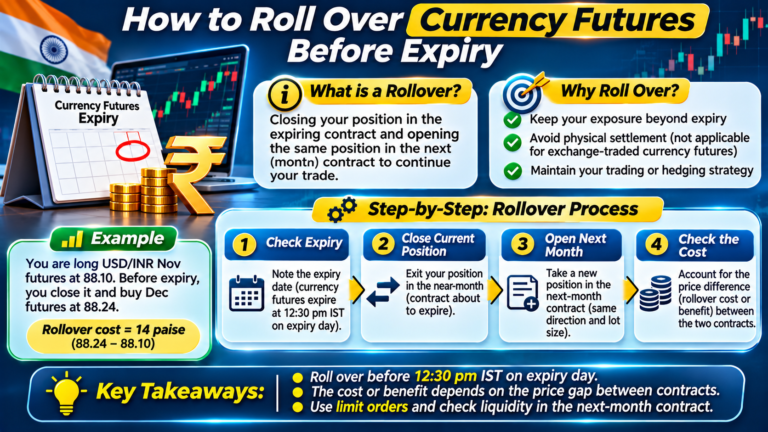

Introduction
GIFT City in Gujarat is India’s international financial centre. Its exchanges trade in US dollars, it hosts global banks and brokers, and it offers products that are not available on NSE or BSE. Naturally, many Indian traders ask: can I trade forex through GIFT City and avoid the restrictions on offshore platforms?
The short answer is that GIFT City forex trading is not a simple loophole for Indian residents. GIFT City does open some new doors, such as foreign currency accounts and access to global stocks, but leveraged forex and derivatives trading by resident individuals remains restricted. This guide explains what is and is not allowed.
We cover:
- What GIFT City and GIFT IFSC are
- How the Liberalized Remittance Scheme (LRS) applies
- Whether GIFT City forex trading is allowed for residents
- What residents can invest in through GIFT City
- Tax, risks and legal alternatives for currency trading
What Is GIFT City?
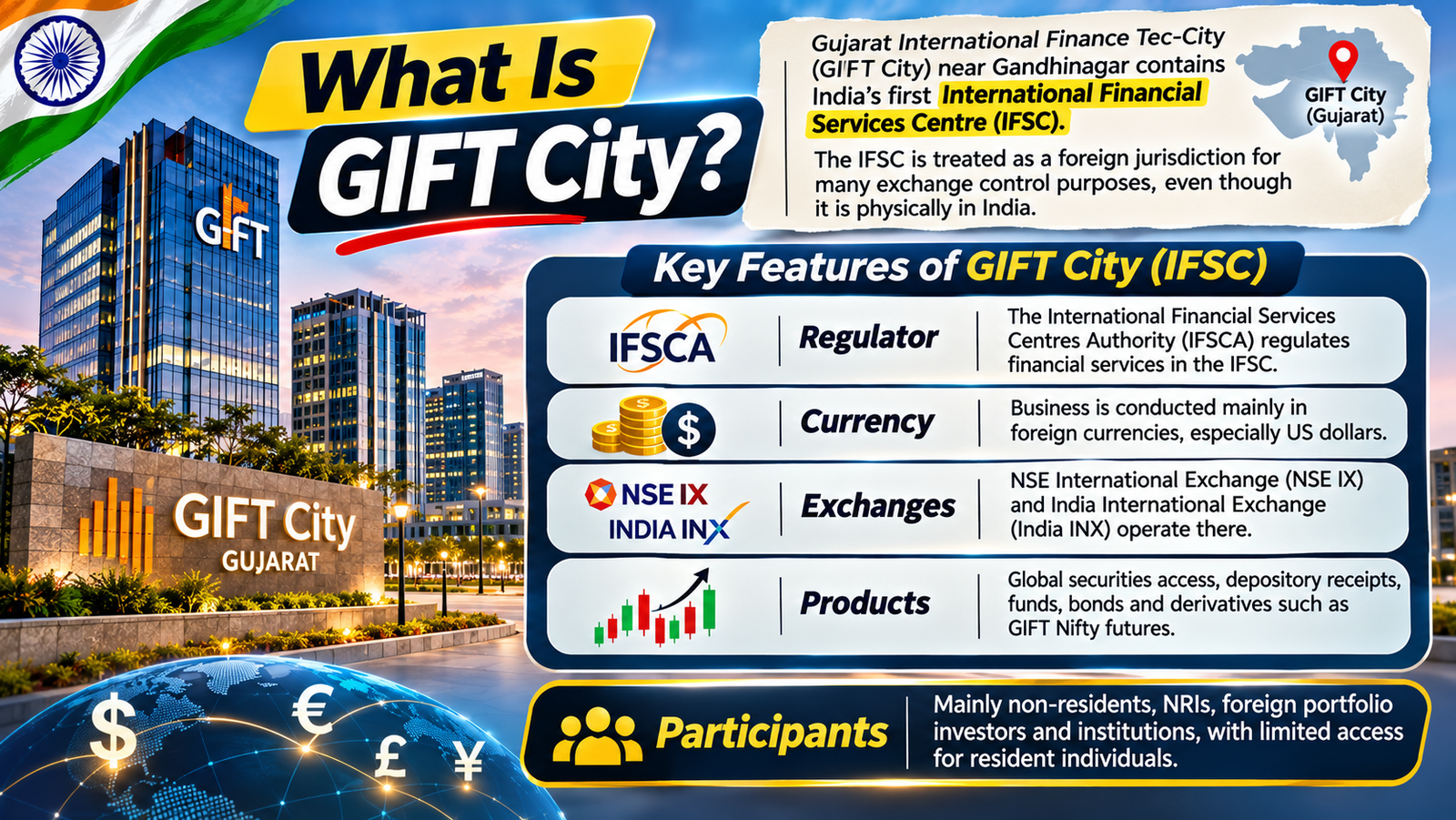
Gujarat International Finance Tec-City (GIFT City) near Gandhinagar contains India’s first International Financial Services Centre (IFSC). The IFSC is treated as a foreign jurisdiction for many exchange control purposes, even though it is physically in India.
Key features:
- Regulator: The International Financial Services Centres Authority (IFSCA) regulates financial services in the IFSC.
- Currency: Business is conducted mainly in foreign currencies, especially US dollars.
- Exchanges: NSE International Exchange (NSE IX) and India International Exchange (India INX) operate there.
- Products: Global securities access, depository receipts, funds, bonds and derivatives such as GIFT Nifty futures.
- Participants: Mainly non-residents, NRIs, foreign portfolio investors and institutions, with limited access for resident individuals.
 How LRS Applies to GIFT City
Resident individuals can send money to the IFSC only under the Liberalized Remittance Scheme, the same scheme used for overseas investments and expenses.
- Annual limit: Up to US$250,000 per person per financial year across all LRS remittances.
- Foreign currency account: Residents can open a foreign currency account (FCA) in the IFSC for permitted purposes.
- Permitted purposes: RBI changes in July 2024 allowed LRS remittances to the IFSC for all purposes that are permissible under LRS generally, replacing a narrower list from 2021.
- No domestic use: IFSC foreign currency accounts cannot be used to settle domestic transactions with other residents.
- Prohibitions still apply: Anything prohibited under LRS remains prohibited when routed through the IFSC.
That last point is the key to understanding GIFT City forex trading for residents.
How the Rules Around GIFT City Forex Trading Have Evolved
Resident access to GIFT City has widened step by step, which is one reason the topic causes confusion.
- February 2021: The RBI first allowed resident individuals to remit money under LRS to IFSCs, but only to invest in securities issued in the IFSC by entities other than those resident in India, and through a foreign currency account that could not hold idle funds for long.
- July 2024: The RBI broadened the permission so that residents could use LRS remittances to the IFSC for all purposes permissible under LRS, bringing the IFSC closer to how other overseas destinations are treated.
- Platform growth: Exchanges in GIFT City have since launched easier ways for Indians to buy global stocks and funds.
Each change made GIFT City more useful for residents, but none of them turned GIFT City forex trading into a permitted leveraged activity. The broader the access becomes, the more important it is to read exactly what the rules allow, because promoters of such schemes sometimes point to these changes as if they removed all restrictions.
Is GIFT City Forex Trading Allowed for Indian Residents?
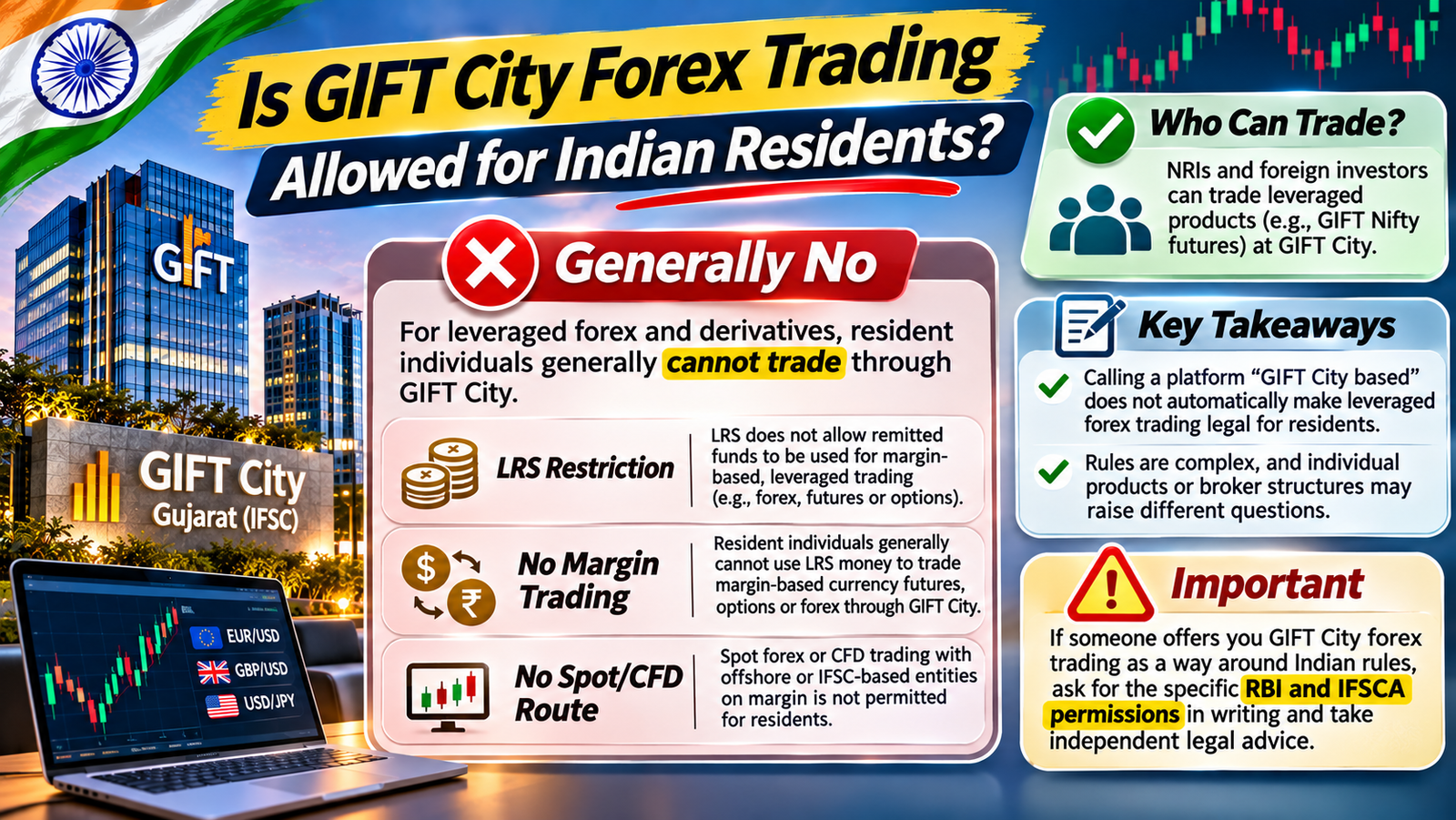
For leveraged forex and derivatives, the answer is generally no. LRS does not permit resident individuals to use remitted funds for margin-based, leveraged trading such as forex, futures or options abroad, and that restriction carries over to the IFSC. Practitioner guides on GIFT Nifty, for example, note that LRS stops residents using remitted money for leveraged derivatives, while NRIs and foreign investors can trade them.
This means:
- Resident individuals generally cannot use LRS money to trade margin-based currency futures, options or forex through GIFT City.
- Spot forex or CFD trading with offshore or IFSC-based entities on margin is not a permitted route for residents.
- Calling a platform “GIFT City based” does not by itself make leveraged forex trading legal for residents.
Some practitioners note that the rules are complex and that individual products or broker structures may raise different questions. If someone offers you GIFT City forex trading as a way around Indian rules, ask for the specific RBI and IFSCA permissions in writing and take independent legal advice.
GIFT City Forex Trading vs Investing: What Residents Can Do
| Activity | Generally allowed for residents under LRS? | Notes |
|---|---|---|
| Open a foreign currency account in the IFSC | Yes | For permitted purposes; cannot settle domestic transactions |
| Invest in US stocks through IFSC platforms | Yes | Through IFSC exchange platforms for global stocks, within LRS limits |
| Invest in IFSC mutual funds and ETFs | Yes | Counts as overseas portfolio investment |
| Buy bonds and other permitted securities | Yes | Subject to LRS rules |
| Trade leveraged forex or CFDs | No | Margin-based trading is not permitted under LRS |
| Trade GIFT Nifty or other futures with LRS funds | Generally no | Leveraged derivatives are restricted for residents |
So GIFT City is mainly useful for residents who want dollar-denominated investments, not for leveraged currency speculation.
Who Can Use GIFT City Derivatives?
Derivatives listed in GIFT City, including dollar-denominated index futures and other contracts, are designed mainly for:
- Non-resident Indians (NRIs)
- Foreign portfolio investors and eligible foreign investors
- Institutional participants such as funds and banks
- Entities set up in the IFSC
Banks in the IFSC are also allowed to participate in certain offshore rupee markets, such as non-deliverable forwards, with non-residents. These are institutional markets, not retail forex products for residents.
GIFT City Forex Trading vs NSE Currency Derivatives
| Feature | GIFT City (IFSC) | NSE and BSE currency derivatives |
|---|---|---|
| Regulator | IFSCA | SEBI and RBI |
| Currency of trading | Mainly US dollars | Indian rupees |
| Funding for residents | Only via LRS | Normal bank account in India |
| Leveraged currency trading for residents | Generally not permitted | Permitted through SEBI-registered brokers |
| Pairs | Varies; aimed at non-residents | USD/INR, EUR/INR, GBP/INR, JPY/INR, EUR/USD, GBP/USD, USD/JPY |
| Best suited for | Dollar investments, NRIs, institutions | Resident currency traders and hedgers |
For a resident who wants to trade currencies legally with leverage, NSE and BSE currency derivatives remain the main route, not GIFT City forex trading.
Worked Example: Two Residents, Two Plans
Priya wants exposure to US technology stocks. She remits $20,000 under LRS to a foreign currency account in GIFT City and buys US shares through an IFSC exchange platform. This fits within LRS rules for investment, though TCS and tax rules apply.
Rahul wants to trade EUR/USD with 1:100 leverage. A social media advertisement promises “legal GIFT City forex trading”. He asks for the platform’s registration and finds it is an offshore broker with no IFSCA licence. Even if it were licensed in the IFSC, LRS would not allow him to remit funds for leveraged forex. Instead, he opens an account with a SEBI-registered broker and trades EUR/USD futures on NSE with exchange-set margins.
This example is illustrative.
Red Flags in GIFT City Forex Trading Offers
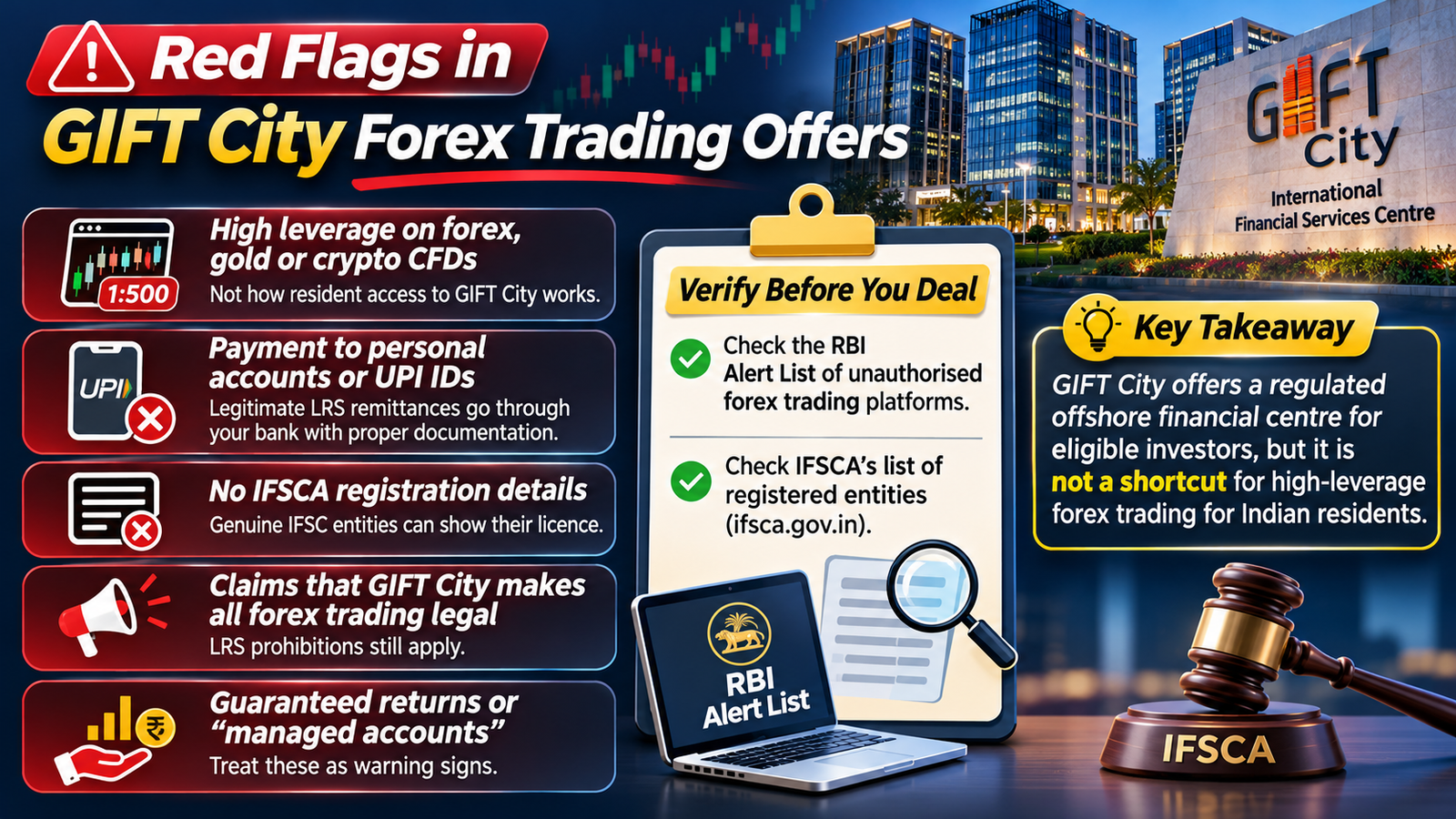
- High leverage on forex, gold or crypto CFDs: This is not how resident access to GIFT City works.
- Payment to personal accounts or UPI IDs: Legitimate LRS remittances go through your bank with proper documentation.
- No IFSCA registration details: Genuine IFSC entities can show their licence.
- Claims that GIFT City makes all forex trading legal: LRS prohibitions still apply.
- Guaranteed returns or “managed accounts”: Treat these as warning signs.
The RBI maintains an Alert List of unauthorised forex trading platforms. Check it, and check IFSCA’s list of registered entities, before dealing with any platform that mentions GIFT City forex trading.
Questions to Ask Before Any GIFT City Forex Trading Offer
If a broker, app or adviser pitches GIFT City forex trading to you, ask these questions before sending any money:
- What is the entity’s IFSCA registration number, and can I verify it on IFSCA’s website?
- Exactly which product will I be trading, and is it leveraged or margin-based?
- Under which RBI provision is a resident individual allowed to remit money for this product?
- Will the remittance go through my bank under LRS with Form A2 and the correct purpose code?
- Who holds my funds, and how are they protected?
- What tax, TCS and reporting obligations will I have in India?
A legitimate provider should answer clearly and in writing. Vague answers, pressure to act quickly or requests to pay outside the banking system are strong signs to walk away from any GIFT City forex trading proposal.
Tax Points for Residents Using GIFT City
- No special tax benefit for residents: Most IFSC tax concessions are aimed at non-residents and IFSC units. Residents are generally taxed in India on gains and income as usual.
- TCS on LRS remittances: Tax collected at source may apply on remittances above the prescribed threshold. Check current rates with your bank.
- Transaction taxes: IFSC exchange transactions are generally exempt from STT and stamp duty.
- Foreign asset disclosure: IFSC accounts and investments may need to be reported in Schedule FA of your ITR. Ask your chartered accountant how to classify them.
Legal Alternatives to GIFT City Forex Trading
If your goal is currency trading rather than dollar investing, the legal options are:
- NSE and BSE currency futures and options on USD/INR, EUR/INR, GBP/INR and JPY/INR.
- Cross-currency futures and options on EUR/USD, GBP/USD and USD/JPY on Indian exchanges.
- Trading through SEBI-registered brokers with exchange-set margins and investor protection.
These products are cash-settled in rupees, regulated by SEBI and the RBI, and accessible with a normal Indian trading account.
GIFT City Forex Trading Checklist
- Am I a resident individual, an NRI or an institution?
- Is the activity I want permitted under LRS?
- Does it involve leverage, margin or derivatives?
- Is the entity registered with IFSCA?
- Is the platform on the RBI Alert List?
- Have I considered TCS, tax and Schedule FA reporting?
- Would NSE or BSE currency derivatives meet my goal more simply?
FAQs
Is GIFT City forex trading legal for Indian residents?
Leveraged forex and derivatives trading by resident individuals through GIFT City is generally not permitted, because LRS does not allow remittances for margin-based trading. Residents can use GIFT City for permitted investments such as foreign stocks and funds.
Can residents open a dollar account in GIFT City?
Yes. Residents can open a foreign currency account in the IFSC under LRS for permitted purposes.
Can I trade GIFT Nifty as a resident?
GIFT Nifty futures are mainly for non-residents and institutions. Using LRS funds for leveraged derivatives is generally restricted for residents.
What is the LRS limit?
US$250,000 per person per financial year across all permitted LRS remittances.
Where can residents trade currencies legally?
On NSE and BSE through SEBI-registered brokers, in INR pairs and the permitted cross-currency pairs.
Conclusion
GIFT City is an important step in opening India to global finance, and it gives residents new ways to hold dollars and invest in foreign securities. But GIFT City forex trading is not a loophole for leveraged currency speculation. LRS prohibitions apply inside the IFSC just as they do abroad, and leveraged forex and derivatives trading remain restricted for resident individuals.
If you want to trade currencies, use NSE and BSE currency derivatives through a SEBI-registered broker. If you want dollar investments, GIFT City may be useful within LRS limits. Either way, verify registrations, avoid platforms that promise high leverage and take professional advice before remitting money.