
Key points rbnz rate decision
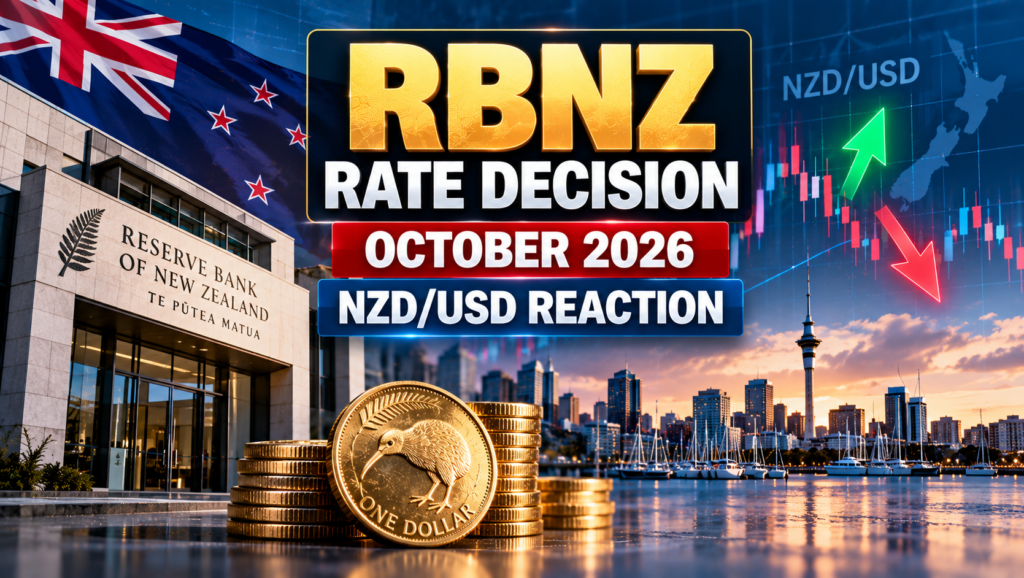
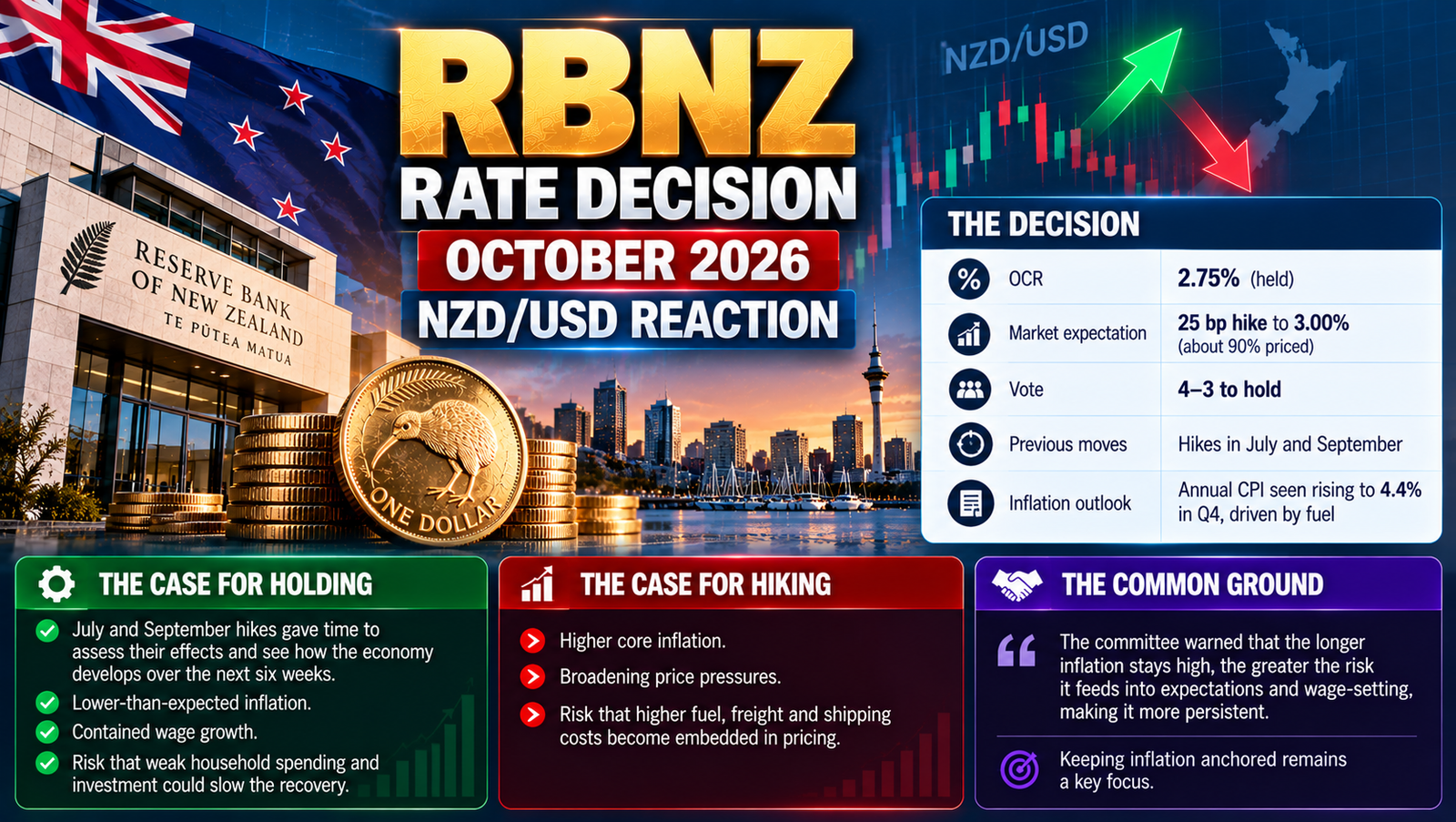
- The RBNZ held the Official Cash Rate (OCR) at 2.75% in a narrow 4–3 vote. Markets had expected a hike to 3.00%.
- Markets had priced about a 90% chance of a hike, and all five major New Zealand banks had forecast one.
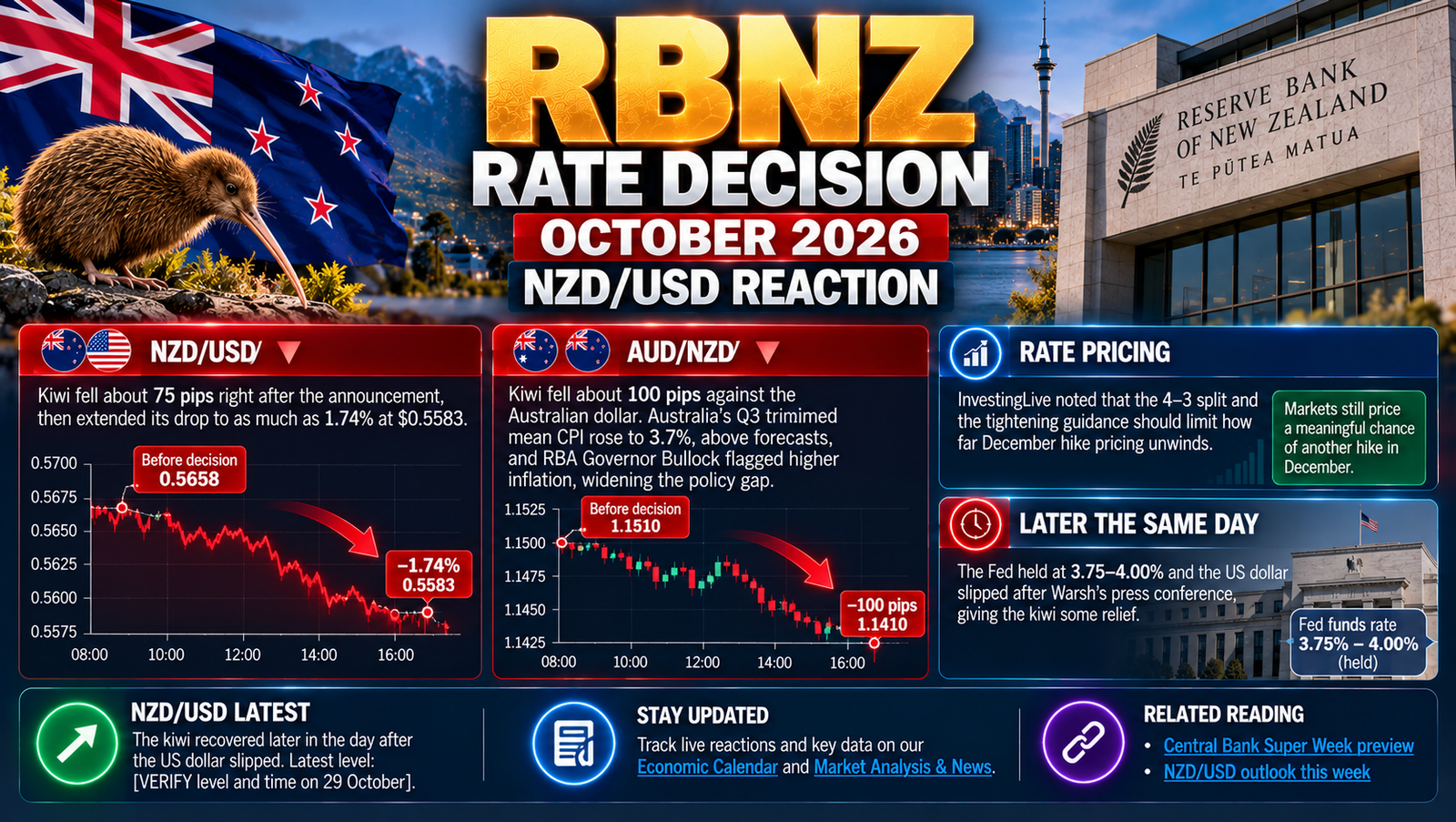
- NZD/USD fell as much as 1.74% to $0.5583, and the kiwi dropped against every major currency.
- All seven members agreed tighter policy is likely, so the focus shifts to the 9 December meeting.
What happened
| Item | Detail |
|---|---|
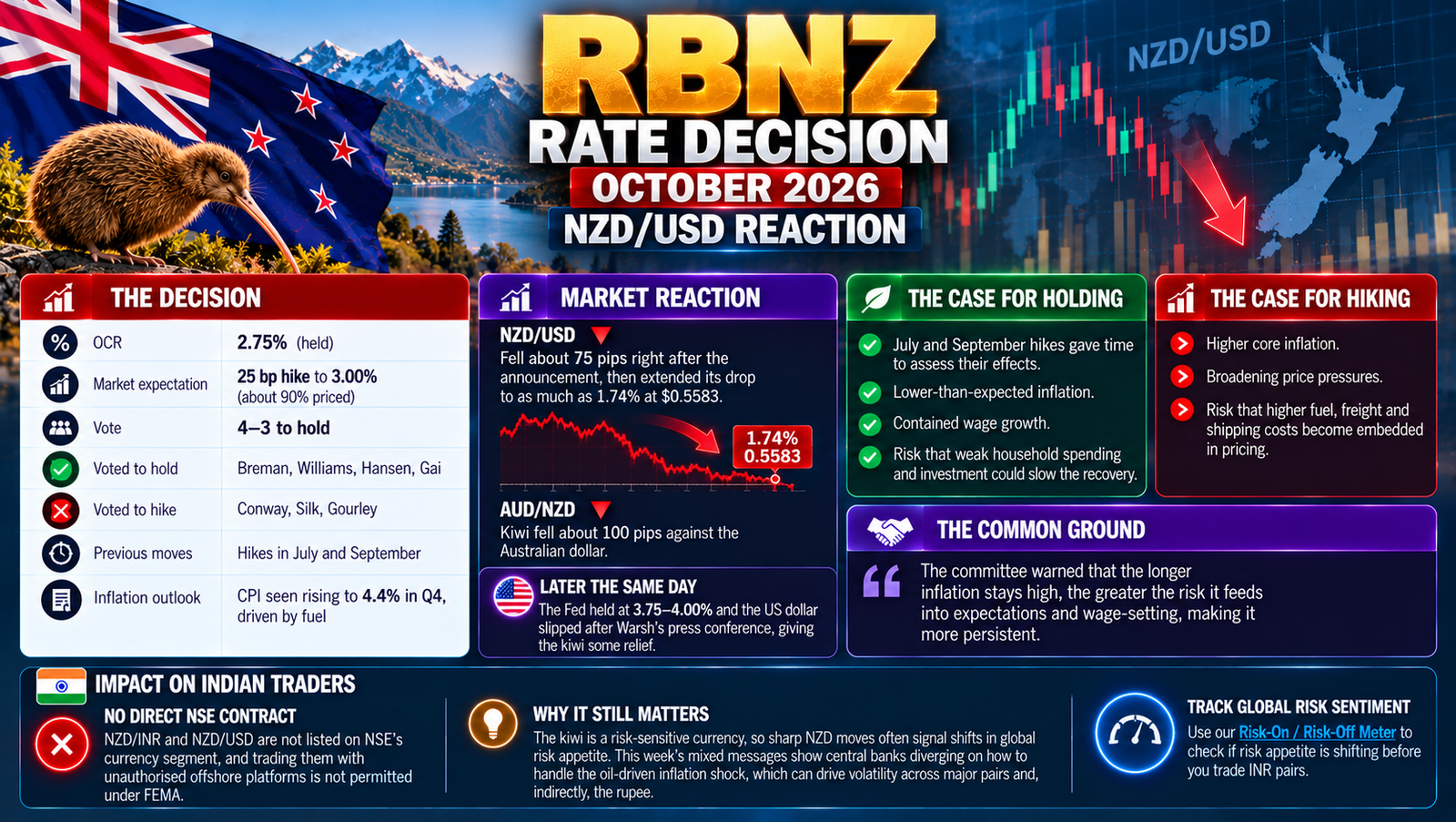
| Decision | OCR held at 2.75% |
| Market expectation | 25 bp hike to 3.00% (about 90% priced) |
| Vote | 4–3 to hold |
| Voted to hold | Governor Anna Breman, Rebecca Williams, Carl Hansen, Prasanna Gai |
| Voted to hike | Chief economist Paul Conway, Assistant Governor Karen Silk, Hayley Gourley |
| Previous moves | Hikes in July and September |
| Inflation outlook | Annual CPI seen rising to 4.4% in Q4, driven by fuel |
The case for holding: The four members who voted to hold said the July and September hikes gave the committee time to assess their effects and see how the economy develops over the next six weeks. They pointed to lower-than-expected inflation, contained wage growth and the risk that weak household spending and investment could slow the recovery.
The case for hiking: The three dissenters put more weight on high core inflation, broadening price pressures and the risk that higher fuel, freight and shipping costs become embedded in pricing.
The common ground: The committee warned that the longer inflation stays high, the greater the risk it feeds into expectations and wage-setting, making it more persistent.
Why it matters
A dovish surprise. With a hike almost fully priced, the hold forced traders to rethink the RBNZ’s path. BabyPips notes this is the RBNZ’s second dovish surprise in a row, so traders may still be overestimating future hikes.
But not the end of the cycle. Standard Chartered called the 4–3 vote less dovish than the headline suggests, since three members wanted to hike and all seven saw further tightening as likely. It now expects 25 bp hikes in December and February, taking the OCR to 3.25%, with a March hike possible if domestic inflation persists.
Inflation near the top of the band. Core inflation is near the top of the RBNZ’s 1–3% target band, and the household saving rate is estimated at 3.7%, far above its 10-year average of about 1%. High saving points to weak consumer demand, one reason the majority chose to wait.
Market reaction
- NZD/USD: The kiwi fell about 75 pips against the US dollar right after the announcement, then extended its drop to as much as 1.74% at $0.5583.
- AUD/NZD: The kiwi fell about 100 pips against the Australian dollar. On the same morning, Australia’s Q3 trimmed mean CPI rose to 3.7%, above forecasts, and RBA Governor Bullock flagged higher inflation. That widened the policy gap between the two.
- Rate pricing: InvestingLive noted that the 4–3 split and the tightening guidance should limit how far December hike pricing unwinds.
- Later the same day: The Fed held at 3.75–4.00% and the US dollar slipped after Warsh’s press conference, giving the kiwi some relief.
NZD/USD outlook and levels
| Level | Price | Why it matters |
|---|---|---|
| Resistance | – | Where the pair traded before the hold |
| Support | $0.5583 | Post-decision low |
| Support | – | Next technical support |
Possible scenarios:
- If New Zealand inflation data and the 17 November Survey of Expectations show persistent price pressure, December hike bets are likely to rebuild, which could help NZD/USD recover.
- If weak demand and contained wages continue, markets may push hikes further out, and the kiwi may stay under pressure, especially against the AUD.
- US factors still matter. A hawkish Fed path and a firmer dollar would weigh on NZD/USD regardless of the RBNZ.
Impact on Indian traders
No direct NSE contract: NZD/INR and NZD/USD are not listed on NSE’s currency segment, and trading them with unauthorised offshore platforms is not permitted under FEMA. NSE lists USD/INR, EUR/INR, GBP/INR and JPY/INR, plus EUR/USD, GBP/USD and USD/JPY.
Why it still matters: The kiwi is a risk-sensitive currency, so sharp NZD moves often signal shifts in global risk appetite. This week’s mixed messages show central banks diverging on how to handle the oil-driven inflation shock: the RBNZ held, while the Bank of Canada hiked, the RBA leans hawkish and the Fed signalled December. That divergence can drive volatility across major pairs and, indirectly, the rupee.
Use our Risk-On / Risk-Off Meter to track whether risk appetite is shifting before you trade INR pairs.
What to watch next
| Date (IST) | Event | Why it matters |
|---|---|---|
| Thu, 29 Oct, 18:00 | US Q3 GDP and September PCE | The US side of NZD/USD |
| Tue, 3 Nov | RBA decision | AUD/NZD; markets may lift hike odds |
| Tue–Wed, 3–4 Nov | US midterm elections | Risk sentiment and the dollar |
| TBA | New Zealand Q3 labour market data | Wage pressure check |
| Tue, 17 Nov | RBNZ Survey of Expectations | Inflation expectations |
| Wed, 9 Dec | RBNZ Monetary Policy Statement, with new forecasts and OCR track | The next decision point |
Track all release times on our Economic Calendar, and find more coverage in Market Analysis & News. Related: Central Bank Super Week preview, BoC decision post
FAQs
What did the RBNZ decide in October 2026?
It held the OCR at 2.75% on 28 October in a 4–3 vote. Markets had expected a hike to 3.00%.
Why did the New Zealand dollar fall?
Markets had priced about a 90% chance of a hike, so the hold was a dovish surprise. The kiwi fell as much as 1.74% to $0.5583 against the US dollar.
Will the RBNZ raise rates in December?
Possibly. All seven members agreed further tightening is likely but depends on the outlook. Some banks, including Standard Chartered, now expect a hike on 9 December.