

Key points on US Consumer Confidence
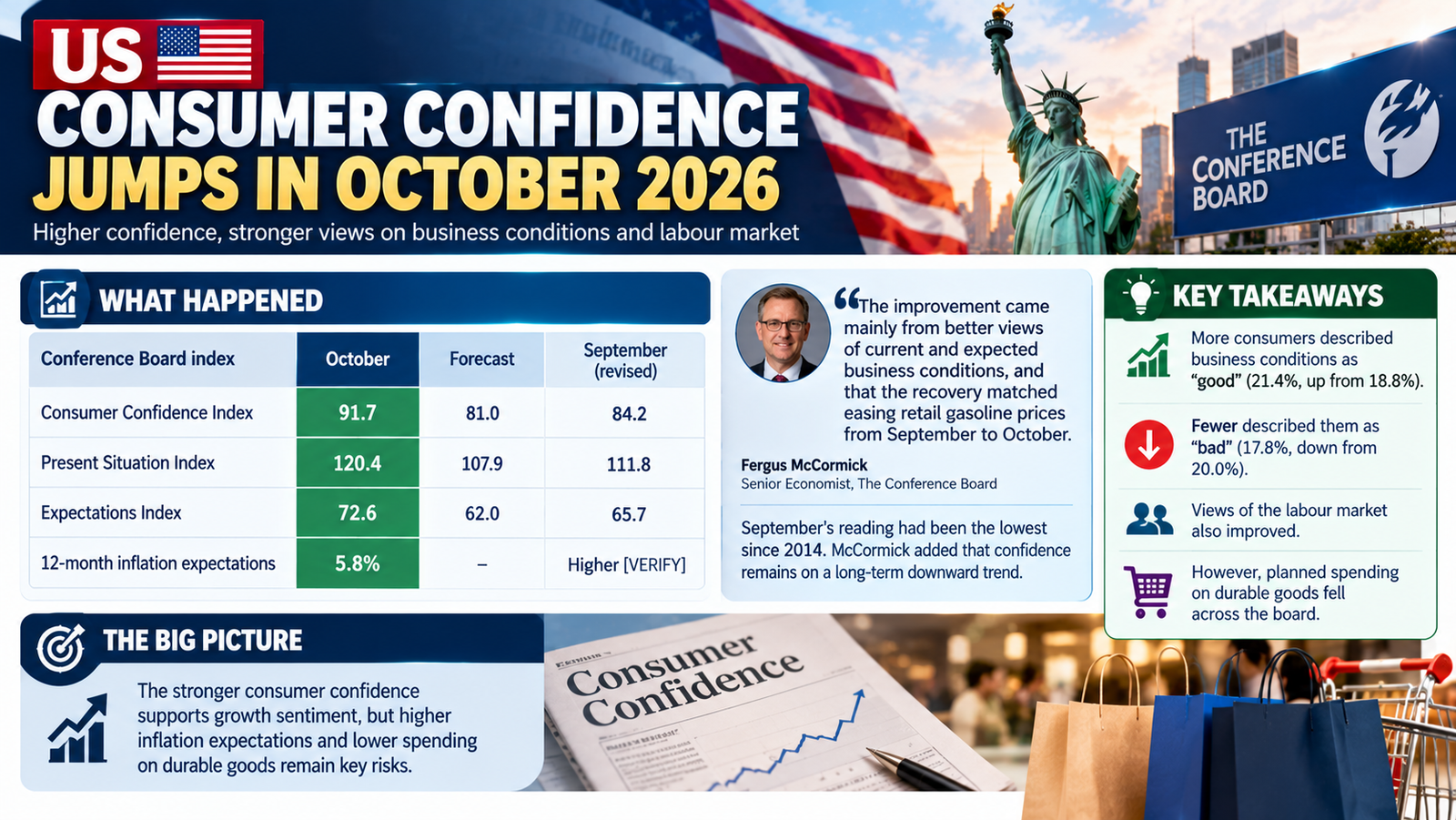
- The Conference Board’s Consumer Confidence Index rose 7.5 points to 91.7 in October, its first rise in four months and back to June levels.
- Economists had expected 81.0, so the result beat forecasts by more than 10 points.
- Consumers’ 12-month inflation expectations eased but stayed high at 5.8%. The Expectations Index remained weak at 72.6.
- A day later, the Fed held rates at 3.75–4.00% in a 10–2 vote, and the dollar slipped. December stays in focus.
What happened
| Conference Board index | October | Forecast | September (revised) |
|---|---|---|---|
| Consumer Confidence Index | 91.7 | 81.0 | 84.2 |
| Present Situation Index | 120.4 | 107.9 | 111.8 |
| Expectations Index | 72.6 | 62.0 | 65.7 |
| 12-month inflation expectations | 5.8% | – | Higher |
The Conference Board’s senior economist Fergus McCormick said the improvement came mainly from better views of current and expected business conditions, and that the recovery matched easing retail gasoline prices from September to October. September’s reading had been the lowest since 2014. McCormick added that confidence remains on a long-term downward trend.
More consumers described business conditions as “good” (21.4%, up from 18.8%), and fewer as “bad” (17.8%, down from 20.0%). Views of the labour market also improved. However, planned spending on durable goods fell across the board.
Why it matters
Consumers drive the US economy. Household spending makes up most of US GDP, so confidence surveys are watched as an early signal of future spending. A big beat suggests households are coping better with high prices than feared.
But the details are mixed. The Expectations Index, which tracks the six-month outlook for income, business and jobs, stayed at 72.6. That is the seventh reading below 80 in 2026, a level often linked to recession risk. Planned spending also softened. So the headline bounce may not translate into stronger spending.
Inflation expectations matter for the Fed. Consumers’ 12-month inflation expectations eased but remained elevated at 5.8%. Fed Chair Kevin Warsh has said it is the Fed’s job to ensure inflation expectations stay anchored. He has called consumers’ price worries, especially over petrol, short-term in nature rather than a general loss of confidence that inflation will come down.
Market reaction
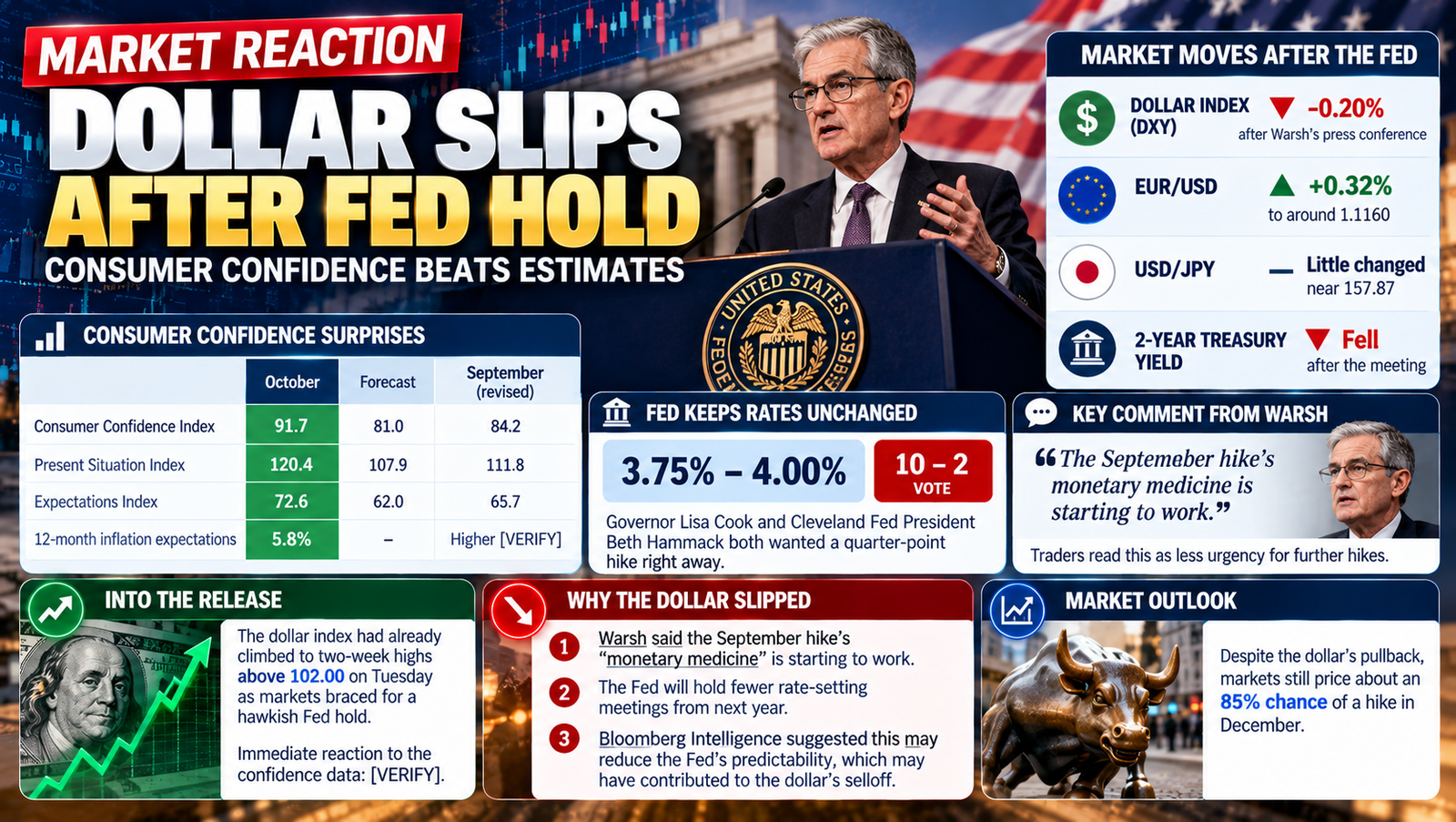
- Into the release: The dollar index had already climbed to two-week highs above 102.00 on Tuesday as markets braced for a hawkish Fed hold.
- After the Fed (28 October): The Fed held at 3.75–4.00% in a 10–2 vote. Governor Lisa Cook and Cleveland Fed President Beth Hammack both wanted a quarter-point hike right away.
- Dollar: The dollar fell after Warsh’s press conference, slipping about 0.2% against a basket of currencies and 0.3% against the euro. EUR/USD rose about 0.32% to around 1.1160, and USD/JPY was little changed near 157.87.
- Yields: The 2-year Treasury yield fell after the meeting. Markets still price about an 85% chance of a hike in December.
Why the dollar slipped: Warsh said the September hike’s “monetary medicine” is starting to work, which traders read as less urgency. He also announced that the Fed will hold fewer rate-setting meetings from next year. Bloomberg Intelligence suggested this may reduce the Fed’s predictability, which may help explain the dollar’s selloff on the announcement.
Impact on Indian traders
USD/INR: A softer dollar after the Fed may give the rupee some relief at Thursday’s open. However, Brent crude near $117 and FPI outflows still weigh on the rupee.
EUR/INR: The euro gained against the dollar after the Fed, but the ECB decides today, 29 October, at 18:45 IST. EUR/INR may move again after Lagarde’s press conference.
Cross pairs on NSE: NSE lists USD/INR, EUR/INR, GBP/INR and JPY/INR, plus EUR/USD, GBP/USD and USD/JPY. Trading forex with unauthorised offshore platforms is not permitted under FEMA.
Consumer confidence feeds into global risk appetite. A healthier US consumer usually supports risk-on moves, while weak expectations do the opposite. Our Risk-On / Risk-Off Meter can help you track the mood.
What to watch next
| Date (IST) | Event | Why it matters |
|---|---|---|
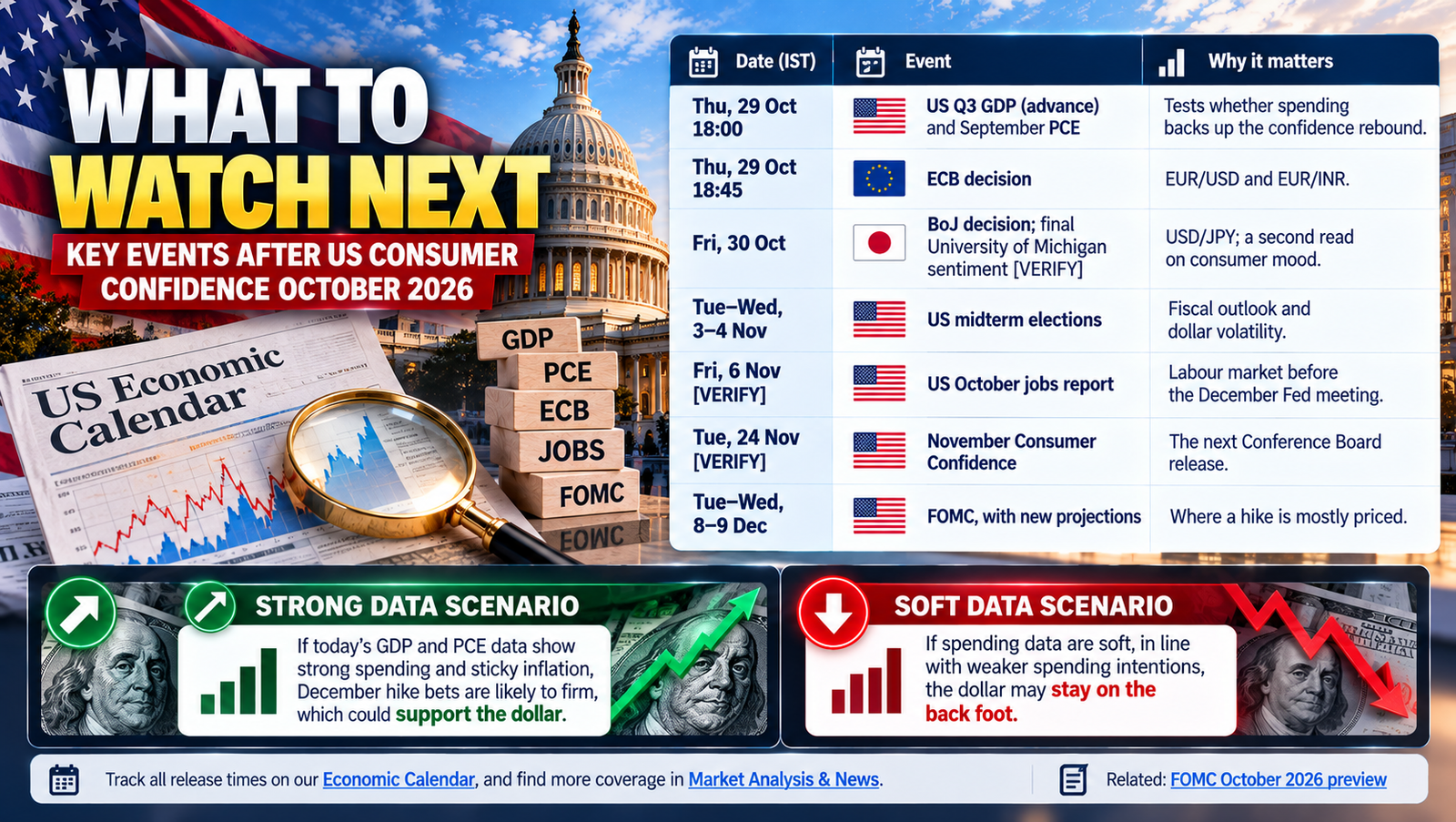
| Thu, 29 Oct, 18:00 | US Q3 GDP (advance) and September PCE | Tests whether spending backs up the confidence rebound |
| Thu, 29 Oct, 18:45 | ECB decision | EUR/USD and EUR/INR |
| Fri, 30 Oct | BoJ decision; final University of Michigan sentiment | USD/JPY; a second read on consumer mood |
| Tue–Wed, 3–4 Nov | US midterm elections | Fiscal outlook and dollar volatility |
| Fri, 6 Nov | US October jobs report | Labour market before the December Fed meeting |
| Tue, 24 Nov | November Consumer Confidence | The next Conference Board release |
| Tue–Wed, 8–9 Dec | FOMC, with new projections | Where a hike is mostly priced |
Possible scenarios:
- If today’s GDP and PCE data show strong spending and sticky inflation, December hike bets are likely to firm, which could support the dollar.
- If spending data are soft, in line with weaker spending intentions, the dollar may stay on the back foot.
Track all release times on our Economic Calendar, and find more coverage in Market Analysis & News. Related: FOMC October 2026 preview
FAQs
What was US consumer confidence in October 2026?
The Conference Board index rose 7.5 points to 91.7, from a revised 84.2 in September. Economists had expected about 81.0.
Why did US consumer confidence rise in October?
Mainly because consumers felt better about current and future business conditions. The Conference Board linked the recovery to easing petrol prices.
How does consumer confidence affect the dollar?
Strong confidence can signal stronger spending and inflation, which may keep the Fed hawkish and support the dollar. Weak confidence tends to do the opposite.