
Key points on India Forex Reserves
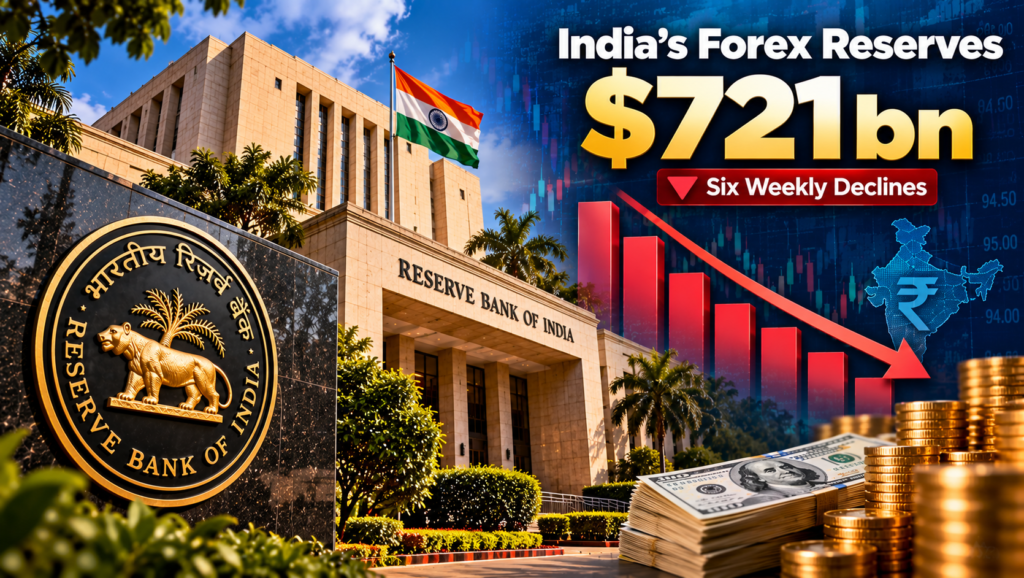
- India’s forex reserves fell by $5.011 billion to $721.016 billion in the week ended 16 October.
- This was the sixth straight weekly decline, following an $8.578 billion drop the week before.
- Reserves are now about $65 billion below the record high of $785.706 billion set in the week of 4 September.
- Next update: Friday, 30 October, for the week ending 23 October.
What happened
The Reserve Bank of India‘s weekly data, released on Friday, 23 October, showed another fall in reserves. The drop came mainly from foreign currency assets, while gold holdings rose.
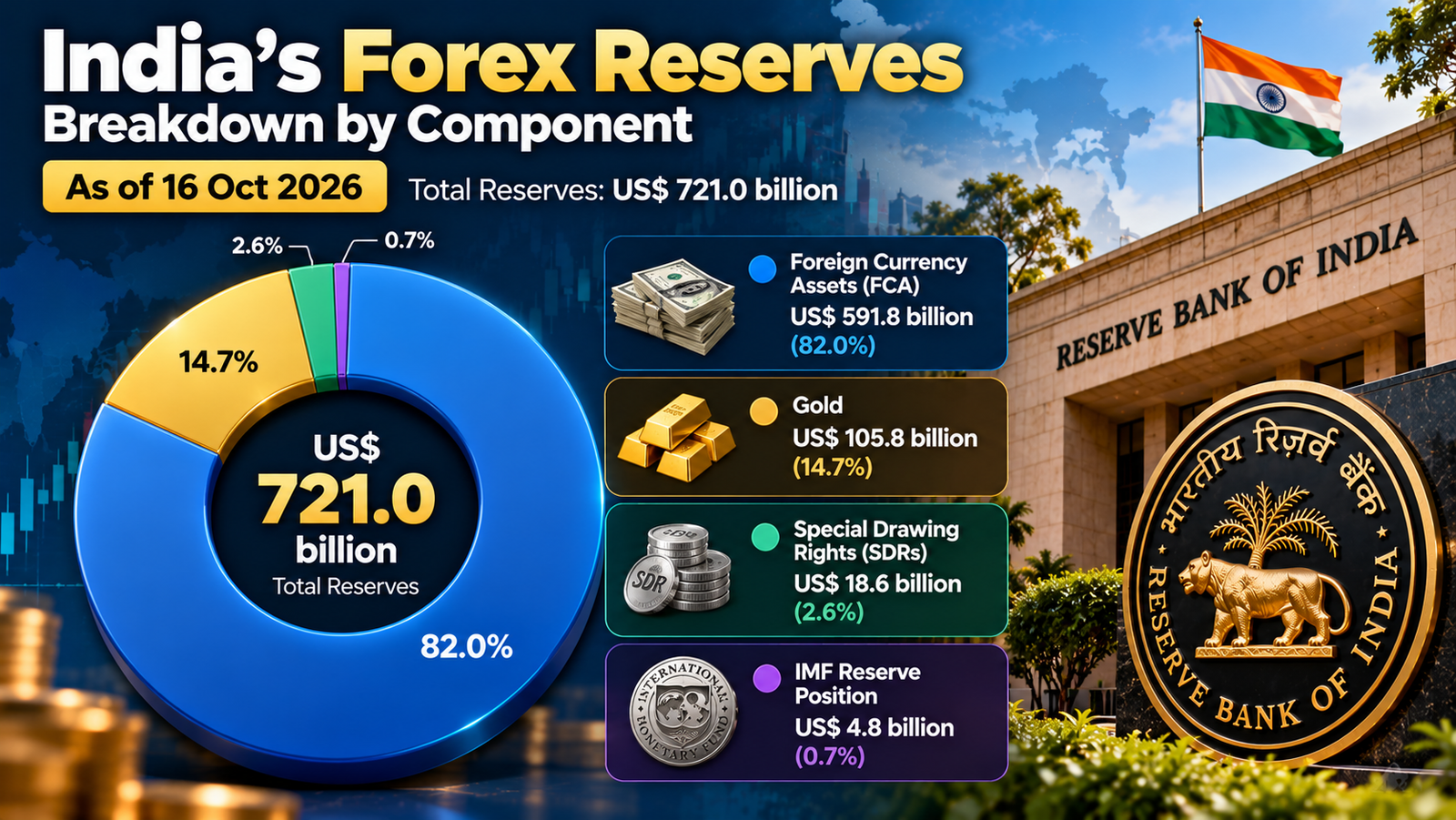
| Component | Week ended 16 Oct | Weekly change |
|---|---|---|
| Total reserves | $721.016 bn | −$5.011 bn |
| Foreign currency assets (FCA) | $591.847 bn | −$5.758 bn |
| Gold | $105.8 bn | +$0.706 bn |
| Special Drawing Rights (SDRs) | $18.578 bn | +$0.030 bn |
| Reserve position with the IMF | $4.791 bn | +$0.011 bn |
| Previous week (ended 9 Oct) | $726.027 bn | −$8.578 bn |
Foreign currency assets, the largest component, are reported in dollar terms. Their value also changes with moves in other currencies the RBI holds, such as the euro, pound and yen.
Why it matters
The fall points to RBI intervention. Weekly changes in reserves reflect two things: valuation changes and RBI dollar sales or purchases. A drop in foreign currency assets of this size, during a period when the rupee was under pressure, is consistent with the RBI selling dollars to support the rupee. The RBI does not confirm intervention amounts in the weekly data. Monthly intervention data is published with a lag.
The rupee was under heavy pressure early in October. The rupee moved close to 97 per dollar, near record lows, before recovering. The RBI also announced its strongest set of measures since the 2013 currency crisis, including a dollar window for state oil companies and curbs on speculation in rupee derivatives. Governor Sanjay Malhotra said the central bank would do whatever was needed to keep currency moves orderly.
The peak was boosted by special inflows. The record $785.7 billion in early September came after a special concessional swap scheme for diaspora deposits, through which banks raised nearly $133 billion. Reserves have been falling since. Even so, at $721 billion they remain high by historical standards, and above the end-March 2026 level by roughly $30 billion.
Market reaction
- USD/INR: The data came out on Friday evening, after Indian currency markets had closed, so the reaction will show on Monday, 26 October. The rupee had closed at 94.82 (provisional) on Thursday, after a strong run earlier in the week.
- Context: On Wednesday, 21 October, the rupee posted its strongest close since 4 September. Jio IPO dollar inflows and the RBI’s measures both helped.
- Other pressures: Brent crude hit a four-year high near $114, and FPIs sold about ₹52,000 crore of Indian equities in October through the 19th. Both add to dollar demand.
Impact on Indian traders
USD/INR: Large reserves give the RBI the firepower to smooth sharp moves in the rupee. That tends to limit extreme spikes in USD/INR. Six weeks of declines show the RBI has been using that buffer. If the pace of decline continues, markets may start to question how long it can keep supporting the rupee at current levels.
EUR/INR, GBP/INR, JPY/INR: The RBI’s actions mainly target USD/INR. The INR crosses also depend on how the euro, pound and yen move against the dollar. Changes in those currencies also affect the dollar value of the RBI’s foreign currency assets.
Cross pairs on NSE: NSE lists USD/INR, EUR/INR, GBP/INR and JPY/INR, plus EUR/USD, GBP/USD and USD/JPY. Trading forex with unauthorised offshore platforms is not permitted under FEMA.
Reserve drawdowns tend to rise in risk-off periods, when foreign money leaves emerging markets. Our Risk-On / Risk-Off Meter can help you track global risk appetite, which often drives rupee pressure.

What to watch next
| Date (IST) | Event | Why it matters |
|---|---|---|
| Mon, 26 Oct | Rupee reaction to the reserves data; Jio IPO allotment | First trading session after the release |
| Wed, 28 Oct | Jio listing; FOMC decision (~23:30) | Equity flows and the US dollar |
| Fri, 30 Oct (evening) | RBI weekly reserves, week ending 23 Oct | Shows whether the drawdown continued during the Jio IPO week |
| TBA | RBI monthly bulletin with intervention data | Confirms how much the RBI sold |
| Fri, 4 Dec, 10:00 | RBI MPC decision | Rates and rupee policy |
Possible scenarios:
- If Jio IPO inflows and a possible US–India trade deal ease pressure on the rupee, the RBI may need to sell fewer dollars, and reserves could stabilise or rise.
- If crude stays above $110 and FPI selling continues, further reserve declines are likely as the RBI defends the rupee.
- Valuation effects can also swing the total. A stronger dollar against the euro and yen lowers the dollar value of foreign currency assets, while higher gold prices raise the gold component.
Track all release times on our Economic Calendar, and find more coverage in Market Analysis & News.
FAQs
What are India’s forex reserves as of 16 October 2026?
$721.016 billion, down $5.011 billion from the previous week, according to RBI data released on 23 October.
Why are India’s forex reserves falling?
Reserves have fallen for six straight weeks. Likely reasons include RBI dollar sales to support the rupee, and valuation changes in non-dollar currencies. They are also falling back from a peak boosted by a special deposit swap scheme.
When does the RBI release forex reserves data?
Every Friday, in its Weekly Statistical Supplement, covering the week ended the previous Friday.