
Introduction
Scalping is the fastest style of trading in the forex market. Scalpers open and close trades within seconds or minutes, aiming to collect many small profits throughout a session. Done well, it can be exciting and rewarding. Done badly, it can drain an account quickly.
For beginners, the key is to start with a simple, rule-based forex scalping strategy and strict risk management. This guide walks you through the basics step by step, covering:
- What scalping is and who it suits
- The best currency pairs, timeframes and trading sessions for scalping
- Two beginner-friendly scalping setups using EMAs and RSI
- Risk management, costs, a sample routine and common mistakes
What Is Scalping in Forex?
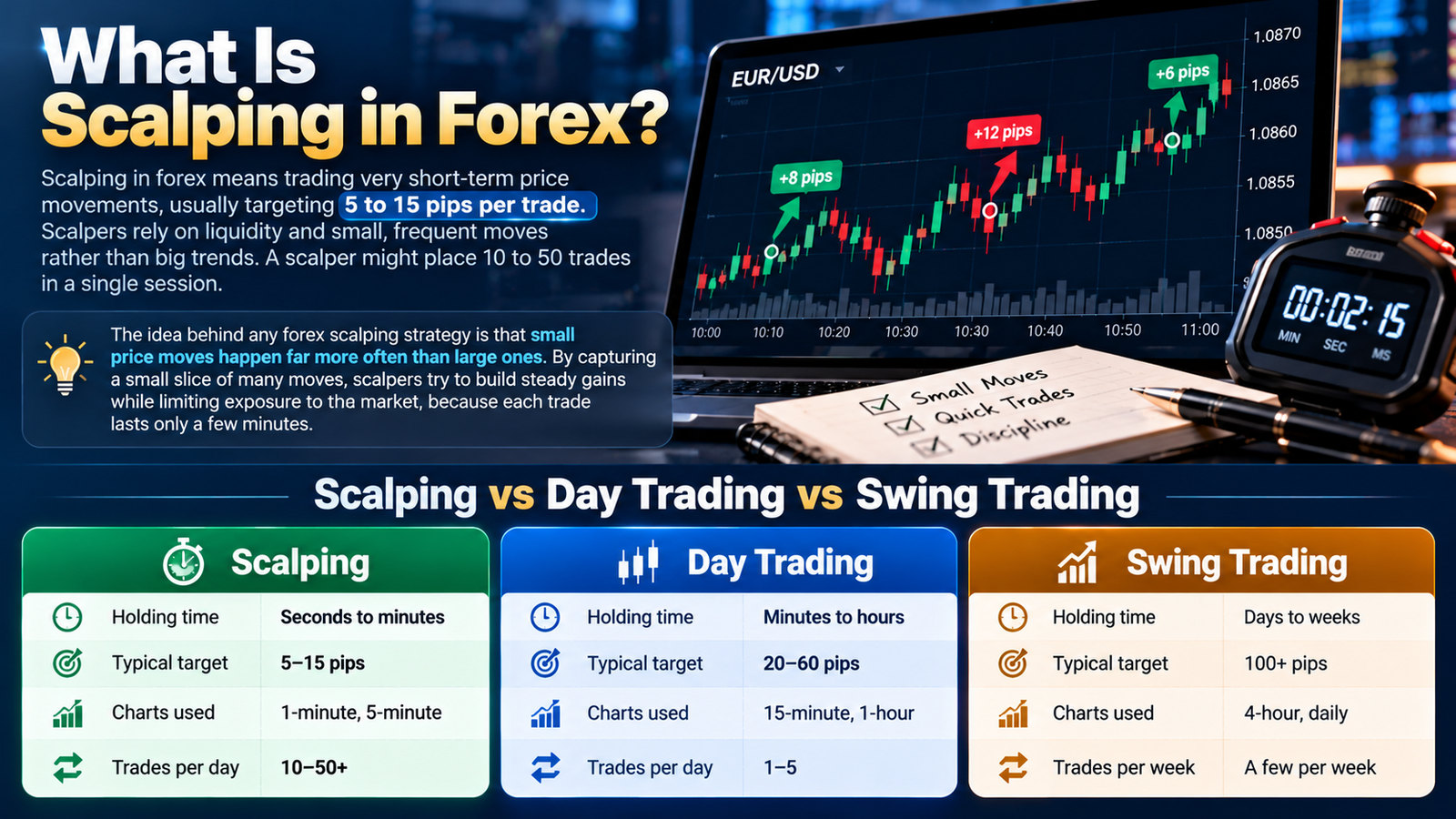
Scalping in forex means trading very short-term price movements, usually targeting 5 to 15 pips per trade. Scalpers rely on liquidity and small, frequent moves rather than big trends. A scalper might place 10 to 50 trades in a single session.
The idea behind any forex scalping strategy is that small price moves happen far more often than large ones. By capturing a small slice of many moves, scalpers try to build steady gains while limiting exposure to the market, because each trade lasts only a few minutes.
Scalping vs day trading vs swing trading
| Style | Holding time | Typical target | Charts used | Trades per day |
|---|---|---|---|---|
| Scalping | Seconds to minutes | 5–15 pips | 1-minute, 5-minute | 10–50+ |
| Day trading | Minutes to hours | 20–60 pips | 15-minute, 1-hour | 1–5 |
| Swing trading | Days to weeks | 100+ pips | 4-hour, daily | A few per week |
 Is Scalping Right for You?
Before choosing a forex scalping strategy, be honest about your personality and schedule. Scalping suits traders who:
- Can focus on the screen for one to three hours at a time
- Make quick decisions without second-guessing
- Follow rules strictly and accept small losses without emotion
- Have access to a low-cost broker and a fast, stable internet connection
It is less suitable if you are easily stressed, tend to “revenge trade” after a loss, or can only check charts occasionally. In that case, swing trading may be a better fit.
Best Currency Pairs for Scalping
Because scalpers target small moves, trading costs matter a lot, and the pair you choose can make or break a forex scalping strategy. The best pairs for scalping have tight spreads and high liquidity:
| Pair | Why it suits scalping |
|---|---|
| EUR/USD | Most traded pair, usually the tightest spreads |
| USD/JPY | High liquidity, smooth intraday moves |
| GBP/USD | More volatile, offering bigger short-term moves |
| AUD/USD | Active during the Asian and early London sessions |
| EUR/GBP | Tight ranges, useful for range-based scalping |
Avoid exotic pairs for scalping. Their wider spreads can wipe out a 5-pip target before the trade even begins.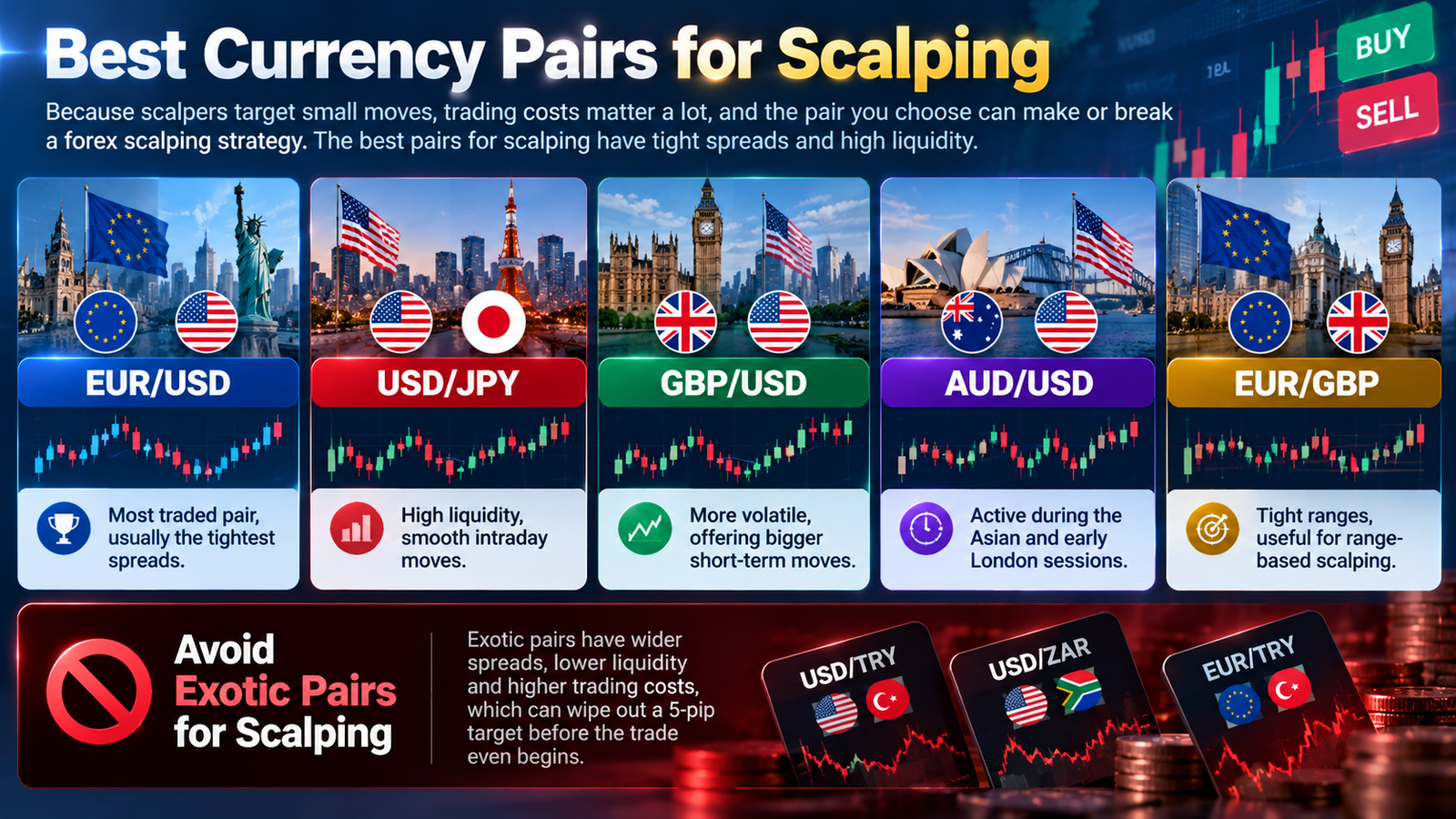
Best Timeframes and Trading Sessions
Timeframes
Most scalpers use the 1-minute and 5-minute charts for entries, with the 15-minute chart to check the short-term trend. Beginners often find the 5-minute chart easier, because it is slower and produces fewer false signals than the 1-minute chart.
Sessions
Liquidity and volatility are highest when major markets overlap. Approximate times in Indian Standard Time (IST):
| Session | Approx. time (IST) | Scalping conditions |
|---|---|---|
| Asian (Tokyo) | 5:30 am – 2:30 pm | Quieter; better for JPY and AUD pairs |
| London open | From about 12:30–1:30 pm | Volume and volatility pick up sharply |
| London–New York overlap | About 5:30–9:30 pm (summer) / 6:30–10:30 pm (winter) | Most liquid window; ideal for scalping |
Session times shift by an hour when UK, European and US clocks change between summer and winter time. A good forex scalping strategy focuses on these active hours and avoids quiet periods, when spreads widen and price barely moves.
Tools You Need for a Forex Scalping Strategy
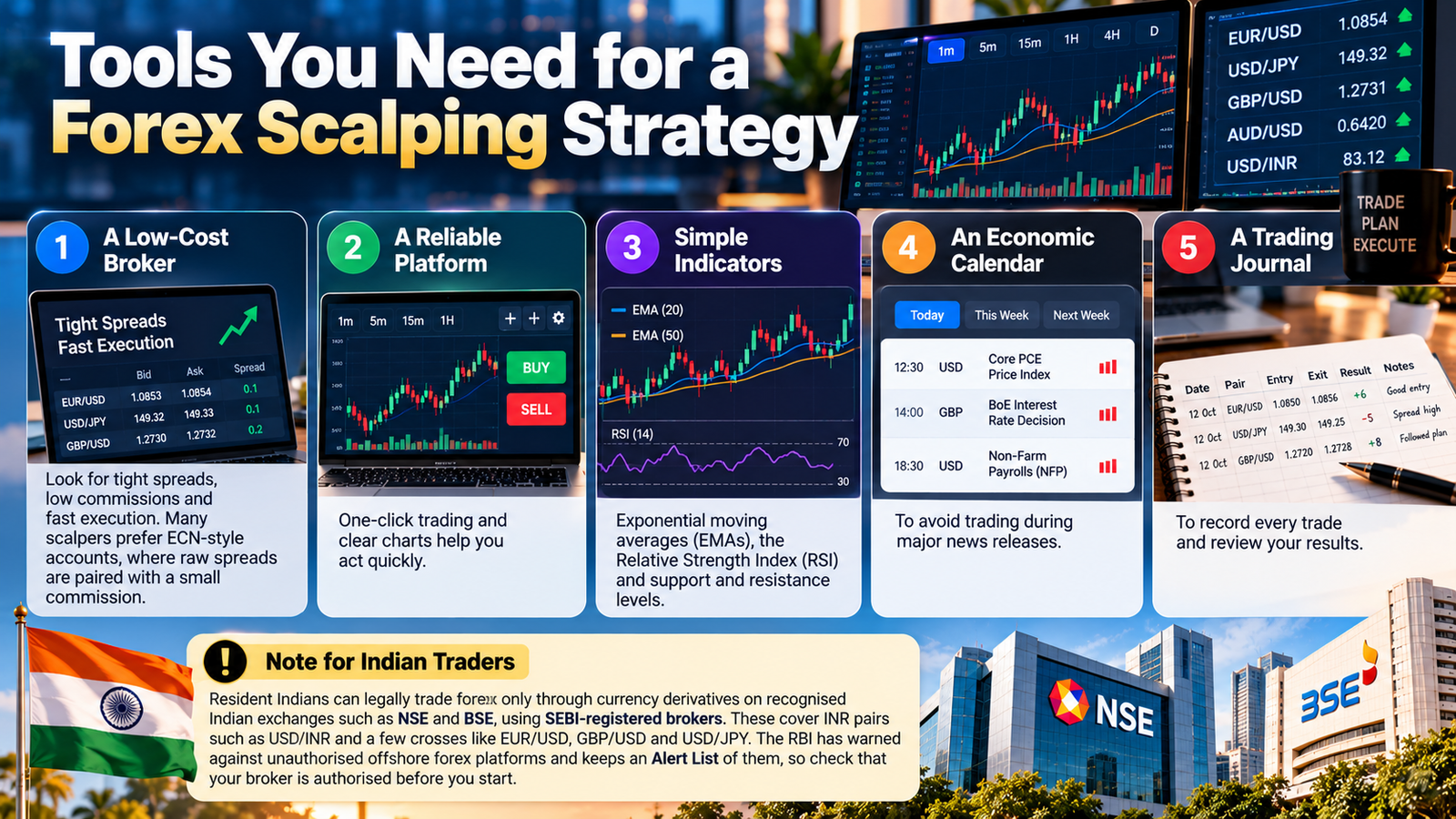
- A low-cost broker: Look for tight spreads, low commissions and fast execution. Many scalpers prefer ECN-style accounts, where raw spreads are paired with a small commission.
- A reliable platform: One-click trading and clear charts help you act quickly.
- Simple indicators: Exponential moving averages (EMAs), the Relative Strength Index (RSI) and support and resistance levels.
- An economic calendar: To avoid trading during major news releases.
- A trading journal: To record every trade and review your results.
Note for Indian traders: Resident Indians can legally trade forex only through currency derivatives on recognised Indian exchanges such as NSE and BSE, using SEBI-registered brokers. These cover INR pairs such as USD/INR and a few crosses like EUR/USD, GBP/USD and USD/JPY. The RBI has warned against unauthorised offshore forex platforms and keeps an Alert List of them, so check that your broker is authorised before you start.
Strategy 1: EMA Crossover Scalping (5-Minute Chart)
This is one of the simplest forex scalping strategy setups for beginners. It uses two exponential moving averages to identify short-term momentum.
Setup
- Chart: 5-minute
- Indicators: 9-period EMA and 21-period EMA
- Filter: 50-period EMA on the 15-minute chart to confirm the short-term trend
Buy rules
- Price is above the 50 EMA on the 15-minute chart.
- On the 5-minute chart, the 9 EMA crosses above the 21 EMA.
- Wait for price to pull back to the 9 or 21 EMA.
- Enter long when a bullish candle closes off the EMA.
- Place the stop loss 5–8 pips below the recent swing low.
- Take profit at 1.5 times your risk, for example 12 pips for an 8-pip stop.
Sell rules
Reverse the rules: price below the 15-minute 50 EMA, the 9 EMA crosses below the 21 EMA, then sell on a pullback to the EMAs with a stop above the recent swing high.
Strategy 2: RSI Pullback Scalping
This forex scalping strategy combines trend direction with the RSI to time entries after short pullbacks.
Setup
- Chart: 1-minute or 5-minute
- Indicators: 50-period EMA and 14-period RSI
Buy rules
- Price is above the 50 EMA, confirming an uptrend.
- Price pulls back and the RSI drops toward 30–40.
- Enter long when the RSI turns back up and a bullish candle forms.
- Place the stop just below the pullback low.
- Exit at a fixed target of about 1.5 times your risk, or when the RSI reaches 70.
For sells, look for price below the 50 EMA, the RSI rising toward 60–70, and a bearish candle as the RSI turns down.
The key to this forex scalping strategy is to trade only in the direction of the trend. Buying every time the RSI is low, regardless of trend, is a common beginner mistake.
Example Trade on EUR/USD
Imagine EUR/USD is trading above its 50 EMA on the 15-minute chart during the London–New York overlap. On the 5-minute chart, the 9 EMA crosses above the 21 EMA. Price pulls back to touch the 21 EMA at 1.1220, then forms a bullish candle.
You buy at 1.1222, place a stop at 1.1214 (8 pips) and set a target at 1.1234 (12 pips). Fifteen minutes later, price reaches 1.1234 and the trade closes in profit. If price had instead dropped to 1.1214, you would take a small, planned loss and move on.
This example is illustrative and uses hypothetical prices.
Forex Scalping Strategy Risk Management
Because scalpers trade often, small mistakes add up quickly. Strong risk management is the foundation of any forex scalping strategy:
- Risk 0.5–1% per trade: Lower than swing trading, because you take many more trades.
- Set a daily loss limit: For example, stop trading for the day after losing 2–3% or after three losing trades in a row.
- Always use a stop loss: Never let a scalp turn into a long-term trade.
- Aim for at least 1:1.5 risk-reward: At this ratio you break even, before costs, with a 40% win rate, which leaves room for spreads and the occasional losing streak.
- Avoid news spikes: Close or avoid trades around major releases such as central bank decisions, jobs data and inflation reports.
- Keep leverage moderate: High leverage turns small price moves into large account swings.
Position sizing example
With a $5,000 account and 1% risk, you can lose $50 per trade. If your stop is 8 pips on EUR/USD, where one pip on a standard lot is about $10, your position size is $50 ÷ (8 × $10) = about 0.6 lots.
Understanding Trading Costs
Costs are the hidden enemy of scalping. Every trade pays the spread, and often a commission too. If you target 8 pips and pay 1.5 pips in costs, nearly 20% of your profit is gone before you start.
- Spread: The difference between the buy and sell price. Tighter is better.
- Commission: Some accounts charge per lot traded in exchange for raw spreads.
- Slippage: When orders fill at a worse price than expected, often during fast markets or news.
Before committing to any forex scalping strategy, calculate your average cost per trade and make sure your targets are large enough to cover it comfortably.
A Simple Scalping Routine
Consistency comes from repeating the same process every day. Here is a simple routine to support your forex scalping strategy:
- Before the session: Check the economic calendar and mark major support and resistance levels on the 15-minute chart.
- Pick one or two pairs: Focus beats variety.
- Trade the active window: Limit yourself to one to two hours during the London open or London–New York overlap.
- Follow your rules: Take only setups that meet every condition.
- Stop at your limits: Quit after hitting your daily profit target or loss limit.
- Review: Log every trade and review your journal at the end of each week.
Common Scalping Mistakes
Even a well-designed forex scalping strategy can fail if these habits creep in:
- Overtrading: Taking low-quality trades out of boredom.
- Revenge trading: Trying to win back losses immediately, usually with bigger size.
- Ignoring costs: Targets that are too small relative to the spread.
- Trading during news: Sudden spikes can trigger stops and cause slippage.
- Moving stop losses: Turning a small loss into a big one.
- Skipping practice: Jumping into a live account without testing on a demo first.
How to Practise Your Forex Scalping Strategy
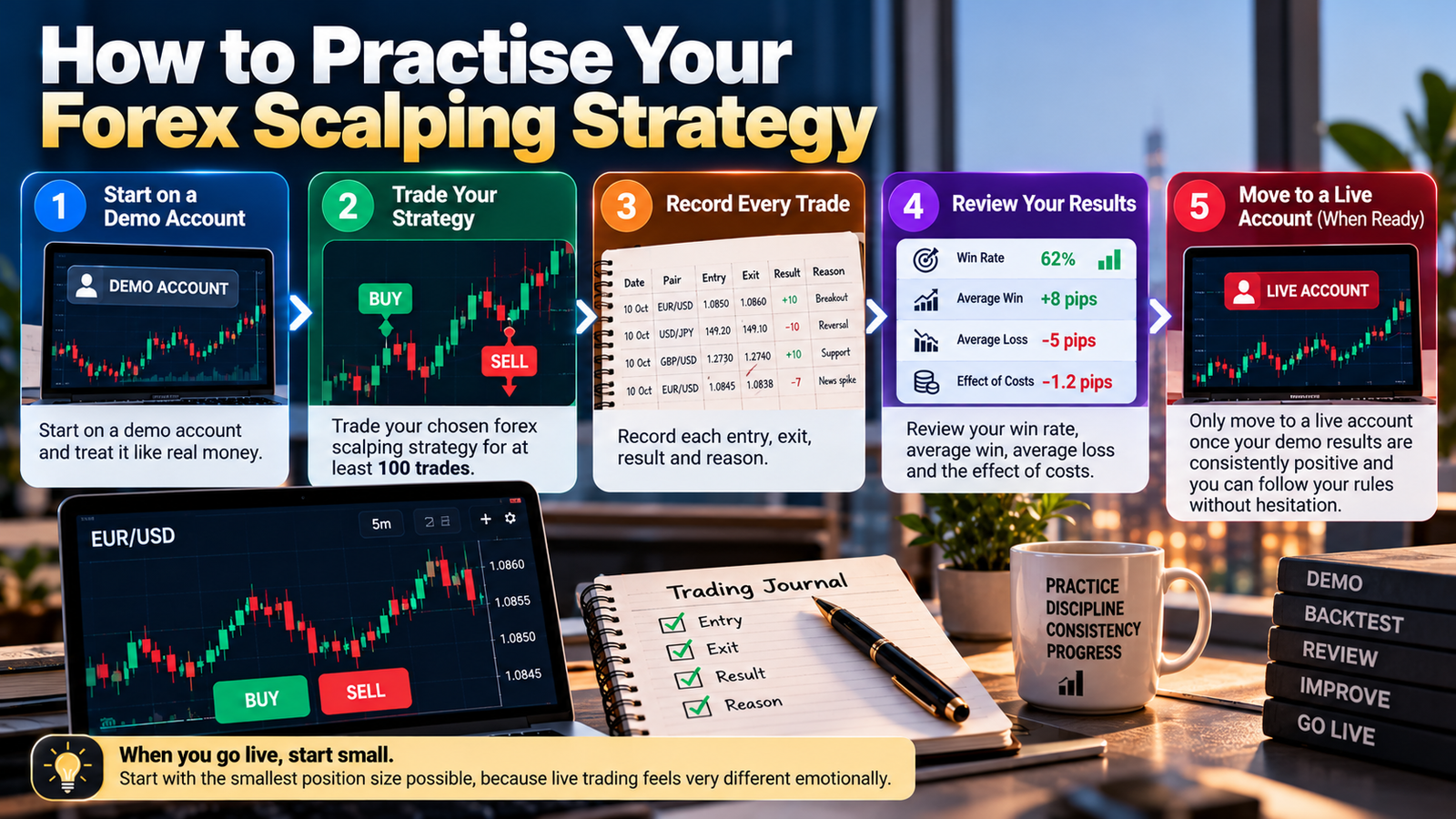
Start on a demo account and treat it like real money. Trade your chosen forex scalping strategy for at least 100 trades, recording each entry, exit, result and reason. Then review your win rate, average win, average loss and the effect of costs.
Only move to a live account once your demo results are consistently positive and you can follow your rules without hesitation. When you do, start with the smallest position size possible, because live trading feels very different emotionally.
FAQs
What is the best forex scalping strategy for beginners?
A simple EMA crossover or RSI pullback strategy on the 5-minute chart, traded in the direction of the trend, is a good starting point.
How many pips do scalpers target?
Usually 5 to 15 pips per trade, depending on the pair and market conditions.
What is the best time to scalp forex?
During the London session and the London–New York overlap, when liquidity is highest and spreads are tightest.
Is scalping profitable?
It can be, but it is demanding. Costs, discipline and risk management decide whether a scalper succeeds over time.
Should I use the 1-minute or 5-minute chart?
Beginners usually do better on the 5-minute chart. The 1-minute chart offers more trades, but it is noisier and harder to follow with a new forex scalping strategy.
Can I scalp with a small account?
Yes, as long as you keep risk per trade small and use a broker with low costs.
Conclusion
A forex scalping strategy can suit traders who enjoy fast decisions and short trades, but it demands focus, discipline and tight cost control. Start with liquid pairs like EUR/USD, trade the busiest sessions, use simple tools such as EMAs and RSI, and protect your account with strict risk rules.
Above all, practise first. Test your forex scalping strategy on a demo account, keep a detailed journal, and build consistency before risking real money. Small, steady improvements matter far more than chasing big wins.
Disclaimer: This article is for education only and is not investment or trading advice. Forex trading involves a high risk of loss, especially with leverage. Trade only through authorised brokers and consult a registered financial adviser before trading.