

Introduction
Oil had a dramatic week. Brent crude rose about 5% to settle at $109.69 a barrel on Friday, 16 October, touching $110 for the first time since May. Tanker attacks in the Strait of Hormuz and strikes on Russian oil facilities drove the rally. By Monday morning, Brent had pulled back to around $107–108 as traders priced in the return of some Russian supply.
For India, which imports most of the crude it uses, every one of those moves matters. The crude oil rupee link is one of the most important relationships in Indian markets: when oil gets more expensive, India needs more dollars, and the rupee comes under pressure.
Yet last week the rupee rallied for six straight sessions, even as oil climbed. In this crude oil rupee weekly recap, we explain that puzzle and cover:
- What moved the crude oil price this week
- How India’s oil import bill is feeding into dollar demand
- Why the rupee rose despite higher oil, and what the RBI did
- The oil price forecast, key levels and what to watch for USD/INR this week
Crude Oil Price This Week: What Happened
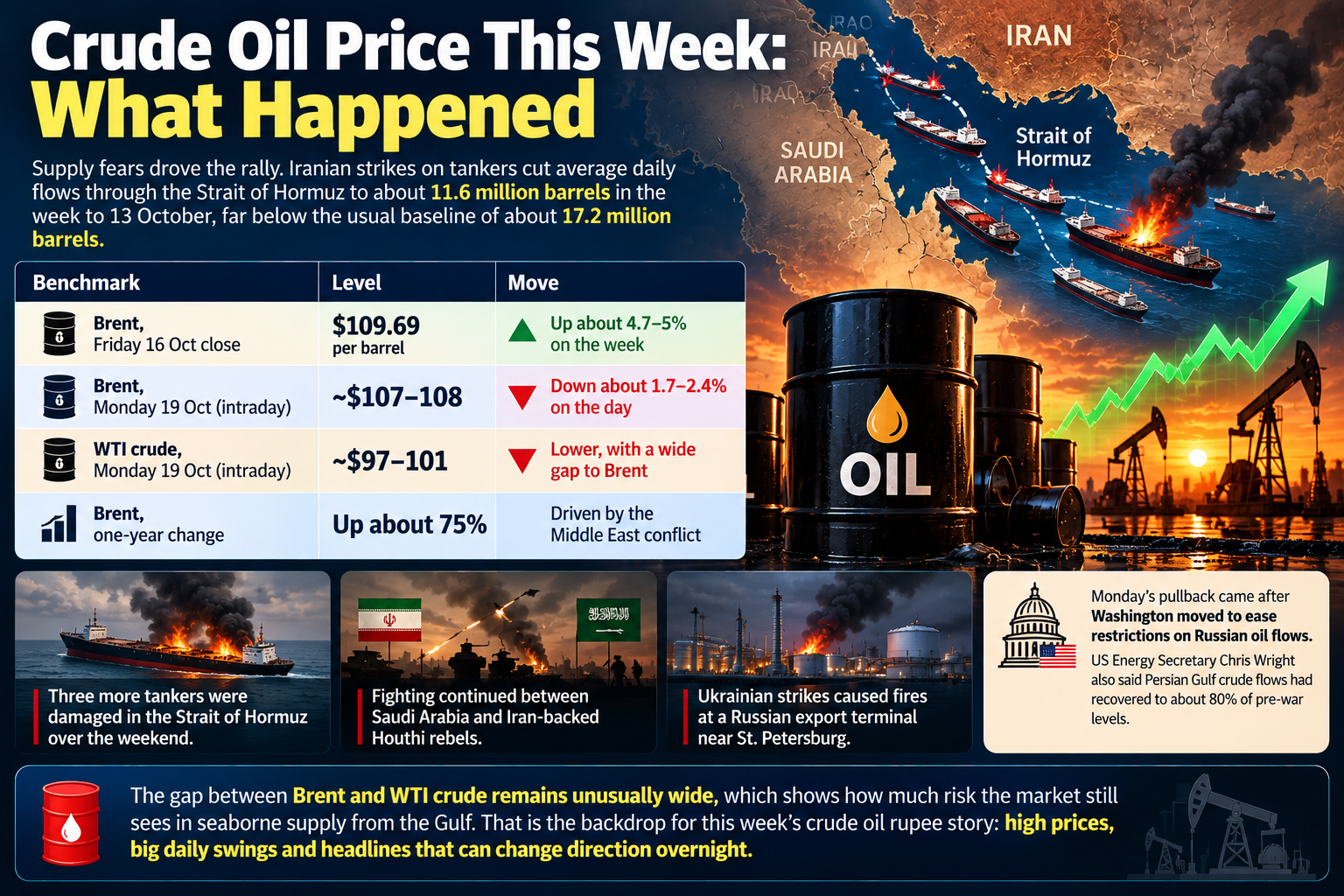
Supply fears drove the rally. Iranian strikes on tankers cut average daily flows through the Strait of Hormuz to about 11.6 million barrels in the week to 13 October, far below the usual baseline of about 17.2 million barrels. Over the weekend, three more tankers were damaged in the strait, fighting continued between Saudi Arabia and Iran-backed Houthi rebels, and Ukrainian strikes caused fires at a Russian export terminal near St. Petersburg.
| Benchmark | Level | Move |
|---|---|---|
| Brent, Friday 16 Oct close | $109.69 per barrel | Up about 4.7–5% on the week |
| Brent, Monday 19 Oct (intraday) | ~$107–108 | Down about 1.7–2.4% on the day |
| WTI crude, Monday 19 Oct (intraday) | ~$97–101 | Lower, with a wide gap to Brent |
| Brent, one-year change | Up about 75% | Driven by the Middle East conflict |
Monday’s pullback came after Washington moved to ease restrictions on Russian oil flows. US Energy Secretary Chris Wright also said Persian Gulf crude flows had recovered to about 80% of pre-war levels. The gap between Brent and WTI crude remains unusually wide, which shows how much risk the market still sees in seaborne supply from the Gulf.
That is the backdrop for this week’s crude oil rupee story: high prices, big daily swings and headlines that can change direction overnight.
Why the Crude Oil Rupee Link Matters
India imports roughly 85% of its crude oil needs, and almost all of it is paid for in dollars. When the Brent crude price today is higher, Indian refiners need more dollars to buy the same number of barrels. That extra dollar demand pushes up USD/INR, which means a weaker rupee.
The effect runs in a loop. A weaker rupee makes oil even more expensive in rupee terms, which widens the trade deficit and raises inflation. That is why economists watch the crude oil rupee relationship so closely, and why a $10 move in Brent can matter as much for the currency as a change in interest rates.
The September data shows the scale of the problem:
- Oil import bill: India’s crude import bill rose 46% year on year to $15.4 billion in September, even though volumes rose only about 7%.
- Indian crude basket: It averaged about $116 a barrel in September, against roughly $70 a year earlier.
- First half of FY27: India spent $90.6 billion on crude imports between April and September, up from $61.9 billion a year earlier, for broadly the same volume.
- Trade deficit: The merchandise trade deficit was $30.2 billion in September. It narrowed from a year earlier only because exports grew faster than imports.
In short, India is paying almost $30 billion more for roughly the same oil. Every one of those dollars has to be bought in the currency market, which is the core of the crude oil rupee pressure this year.
The Rupee This Week: Rallying Against the Oil Tide
Here is the puzzle. Brent rose about 5% last week, yet the rupee gained for six straight sessions. It closed Friday at about 94.89 per dollar, more than 2% stronger than its record closing low of 96.88 on 8 October.
The answer is the RBI. On 10 October, the central bank announced a set of measures to defend the rupee, and one of them targets oil directly. From 12 October, the RBI has been supplying the full daily dollar needs of Indian Oil, BPCL and HPCL from its own reserves. That takes India’s biggest dollar buyers out of the spot market, so higher oil prices no longer hit the rupee as quickly.
The RBI also tightened rules on forex derivatives, making it costlier to bet against the rupee. Speculators unwound their positions, which added to the rally. The dollar index also eased to about 101.45, helping emerging-market currencies.
So the crude oil rupee link has not broken. It has been rerouted. Instead of oil companies buying dollars in the market, the RBI is paying for oil out of India’s reserves.

The Hidden Cost: Falling Forex Reserves
That support has a price. India’s forex reserves fell for a fifth straight week to $726 billion in the week to 9 October, down from $785.7 billion on 4 September. They dropped $8.6 billion in that week alone, mostly due to RBI dollar sales. Since its special measures began on 8 June, the RBI has reportedly deployed about $75–80 billion through spot sales and swaps.
Reserves are still large, but they are not unlimited. If Brent stays above $100 for months, the cost of the oil window will keep growing. That is why the crude oil rupee outlook depends not just on oil prices, but also on how long the RBI is willing to keep paying the bill.
The next reserves update, due on Friday, 23 October, will show how much the oil window cost in its first full week.
India’s Oil Sourcing Is Shifting
Where India buys its oil also affects the bill. Russian crude, once available at steep discounts, now trades at premiums of more than $10 a barrel to Dated Brent. As a result, Indian refiners have cut Russian purchases. Russia’s share of India’s crude imports fell to about 35% in September from as high as 56% in July, and shipments dropped to about 310,000 barrels a day in the four weeks to 4 October, the lowest since March 2022.
Refiners are turning back to Gulf suppliers and to the Americas, partly because shorter voyages save on freight costs. This shift reduces one benefit India enjoyed earlier in the conflict: discounted Russian oil that softened the crude oil rupee impact. Without that discount, more of the global price spike flows straight into India’s import bill.
Crude Oil Rupee Impact on Petrol, Diesel and Inflation
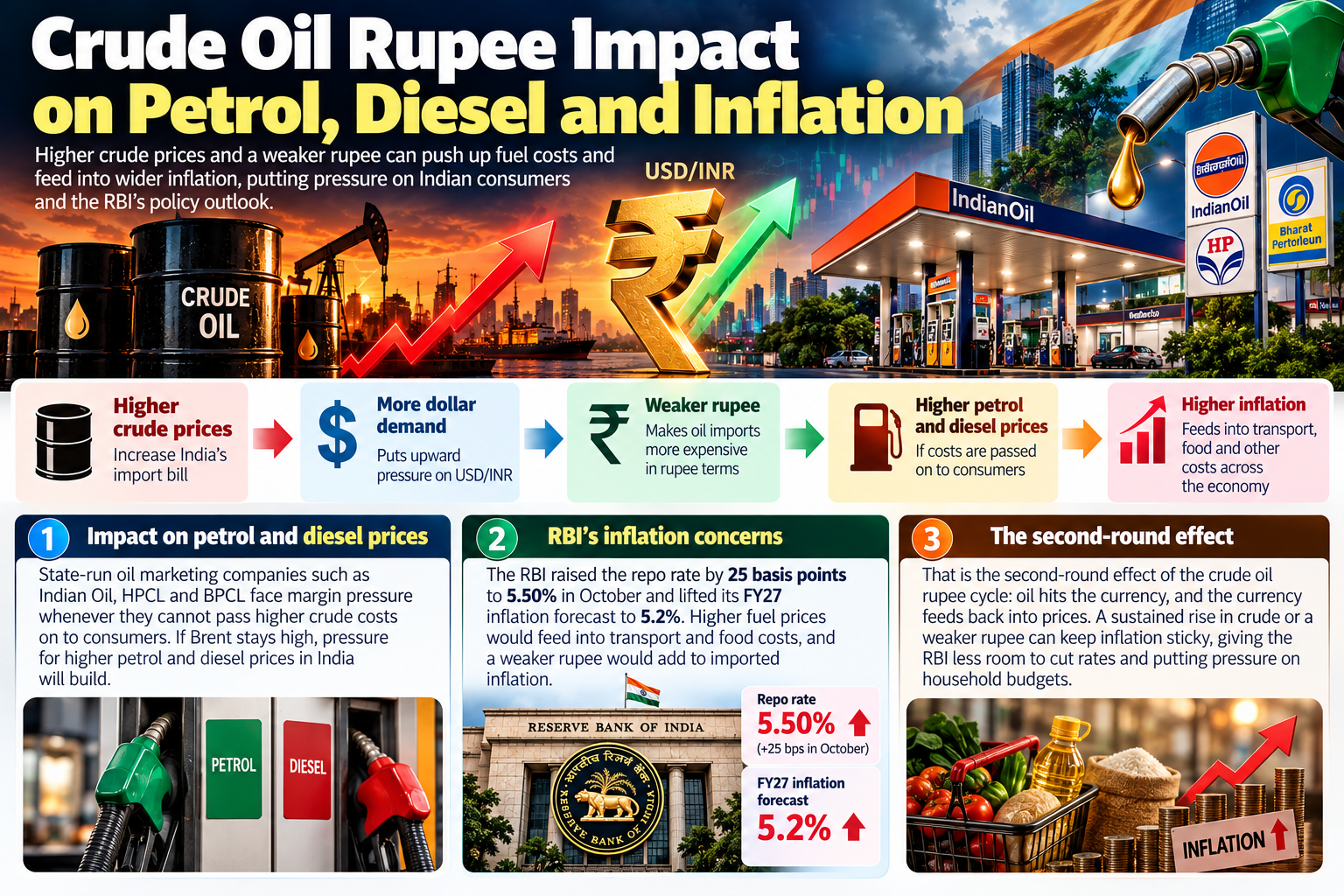
State-run oil marketing companies such as Indian Oil, HPCL and BPCL face margin pressure whenever they cannot pass higher crude costs on to consumers. If Brent stays high, pressure for higher petrol and diesel prices in India will build.
The RBI is already worried about inflation. It raised the repo rate by 25 basis points to 5.50% in October and lifted its FY27 inflation forecast to 5.2%. Higher fuel prices would feed into transport and food costs, and a weaker rupee would add to imported inflation. That is the second-round effect of the crude oil rupee cycle: oil hits the currency, and the currency feeds back into prices.
Oil Price Forecast: Where Could Brent Go?
Forecasts are split, which shows how uncertain the outlook is:
- Goldman Sachs: Raised its December 2026 Brent forecast to $90 from $85, and expects about $80 on average in 2027 as Gulf exports recover and a global surplus builds. It estimates Brent includes a risk premium of nearly $25 a barrel.
- Trading Economics models: Point to about $114 by the end of the quarter, reflecting the ongoing supply disruptions.
- Market technicals: Analysts see resistance at $110 and support at $104, with a wider zone at $100–104. A daily close above $110 would reopen the May highs, while a drop below $100 would signal the risk premium is fading.
For the crude oil rupee picture, the gap between $80 and $114 is huge. At $80, India’s oil bill would shrink sharply and the rupee would have room to recover. At $114, pressure on the rupee and reserves would grow. Tracking where Brent settles each week is therefore the simplest way to follow the crude oil rupee trend, even for readers who never trade currencies.
Crude Oil Rupee Outlook: Three Scenarios This Week
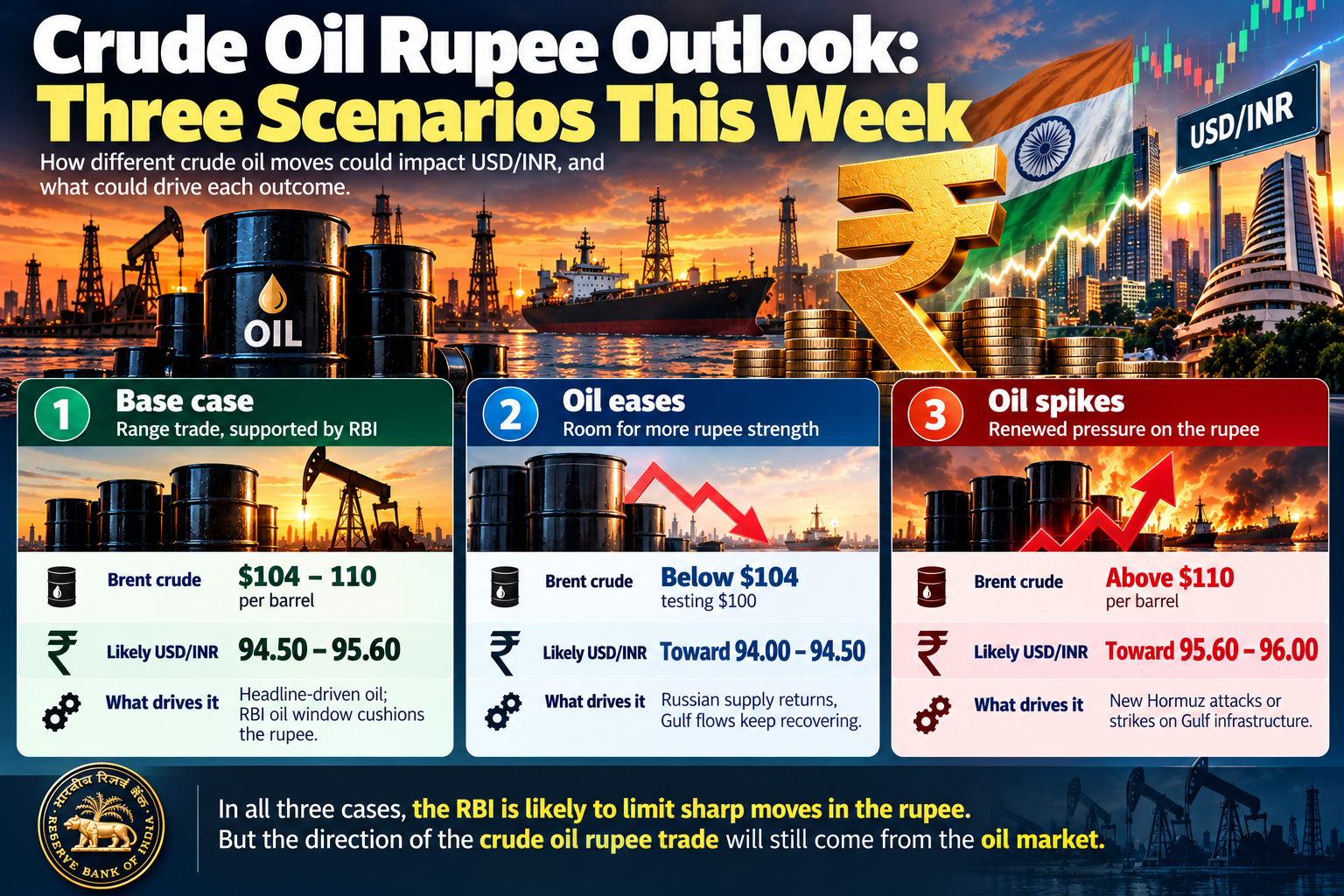
| Scenario | Brent | Likely USD/INR | What drives it |
|---|---|---|---|
| Base case | $104–110 | 94.50–95.60 | Headline-driven oil; RBI oil window cushions the rupee |
| Oil eases | Below $104, testing $100 | Toward 94.00–94.50 | Russian supply returns, Gulf flows keep recovering |
| Oil spikes | Above $110 | Toward 95.60–96.00 | New Hormuz attacks or strikes on Gulf infrastructure |
In all three cases, the RBI is likely to limit sharp moves in the rupee. But the direction of the crude oil rupee trade will still come from the oil market.
Key Events to Watch This Week
These are the events most likely to move the crude oil rupee trade over the next five sessions:
- Strait of Hormuz and Gulf headlines: The biggest daily driver of Brent and the rupee.
- Russian supply: Any easing of restrictions or new attacks on Russian facilities.
- US data: Weekly jobless claims and flash PMIs, which shape both oil demand and the dollar.
- China’s Q3 GDP: A read on demand from the world’s largest crude importer.
- India forex reserves (Friday, 23 October): The first full-week cost of the RBI’s oil window.
- US Fed meeting (27–28 October): A rate hike would firm the dollar and add pressure on the rupee.
What This Means for You
- Importers: Oil-linked costs and the rupee both carry upside risk. Hedging part of near-term payables in stages makes sense while the RBI is supporting the currency.
- Exporters: A spike in oil that pushes USD/INR back toward 96 would be a chance to lock in better rates.
- Investors: Oil marketing companies, airlines and paint makers are sensitive to crude, while upstream producers tend to benefit. Watch the crude oil rupee trend before adding to these sectors.
- Households: Fuel prices may rise if Brent stays above $100, so budget for higher transport costs.
FAQs
How does crude oil affect the rupee?
India pays for most of its oil imports in dollars. Higher oil prices raise dollar demand and widen the trade deficit, which weakens the rupee. That is the basic crude oil rupee link.
Why did the rupee rise when oil prices went up last week?
The RBI started supplying dollars directly to state oil companies from 12 October, keeping their demand out of the market. Tighter rules on currency speculation also helped.
What is the Brent crude price today?
Brent traded around $107–108 a barrel on Monday, 19 October, after settling at $109.69 on Friday. Prices are moving quickly, so check a live source.
Will oil prices fall soon?
Goldman Sachs expects Brent to ease toward $90 by December and $80 in 2027, but renewed attacks on Gulf supply could keep prices high for longer.
Conclusion
This week showed both sides of the crude oil rupee story. Oil jumped toward $110 on Gulf supply fears, and India’s import bill is up by tens of billions of dollars. Yet the rupee rallied, because the RBI stepped in to pay for oil directly from its reserves.
That protection buys time, but it does not change the underlying math. As long as Brent stays above $100, India will keep spending heavily on oil, reserves will keep falling and the rupee will stay exposed. Watch $104 and $110 on Brent, 94 and 96 on USD/INR, and Friday’s reserves data. We will be back next week with a fresh crude oil rupee recap.
Disclaimer: This article is for information only and is not investment or trading advice. Commodity and currency markets are volatile; consult a registered financial adviser before making decisions.