Quick answer
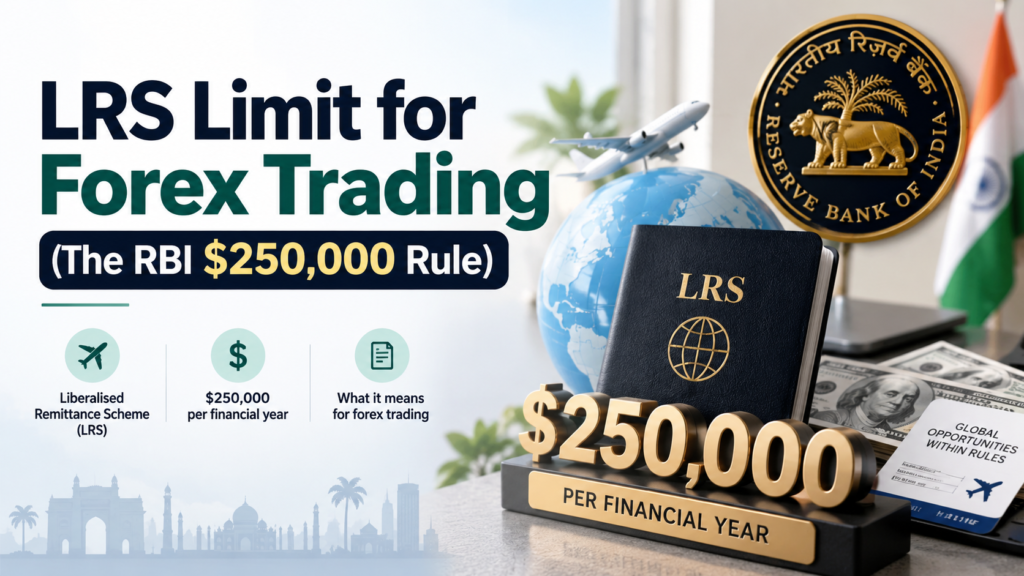
The LRS lets a resident Indian send up to USD 250,000 abroad per financial year for permitted purposes. But the LRS limit for forex trading is effectively zero: forex and margin trading are expressly excluded from the scheme. So you cannot legally use any of your USD 250,000 to fund offshore forex trading.
Introduction
Few rules are as widely cited – and as widely misused – as the RBI’s USD 250,000 LRS limit. Offshore forex brokers love to wave it around, implying you can pour up to $250,000 a year into their platforms ‘under the LRS’. Understanding the real LRS limit for forex trading matters precisely because that pitch is false, and believing it can put you on the wrong side of FEMA.
This guide explains the LRS and its USD 250,000 rule accurately: what the limit is, what it can and can’t fund, why forex is excluded, and the legal way to trade currencies in India instead. Details were verified against current 2026 sources, but rules change, so confirm the latest with the RBI. This is educational information, not legal or tax advice.
What Is the LRS?
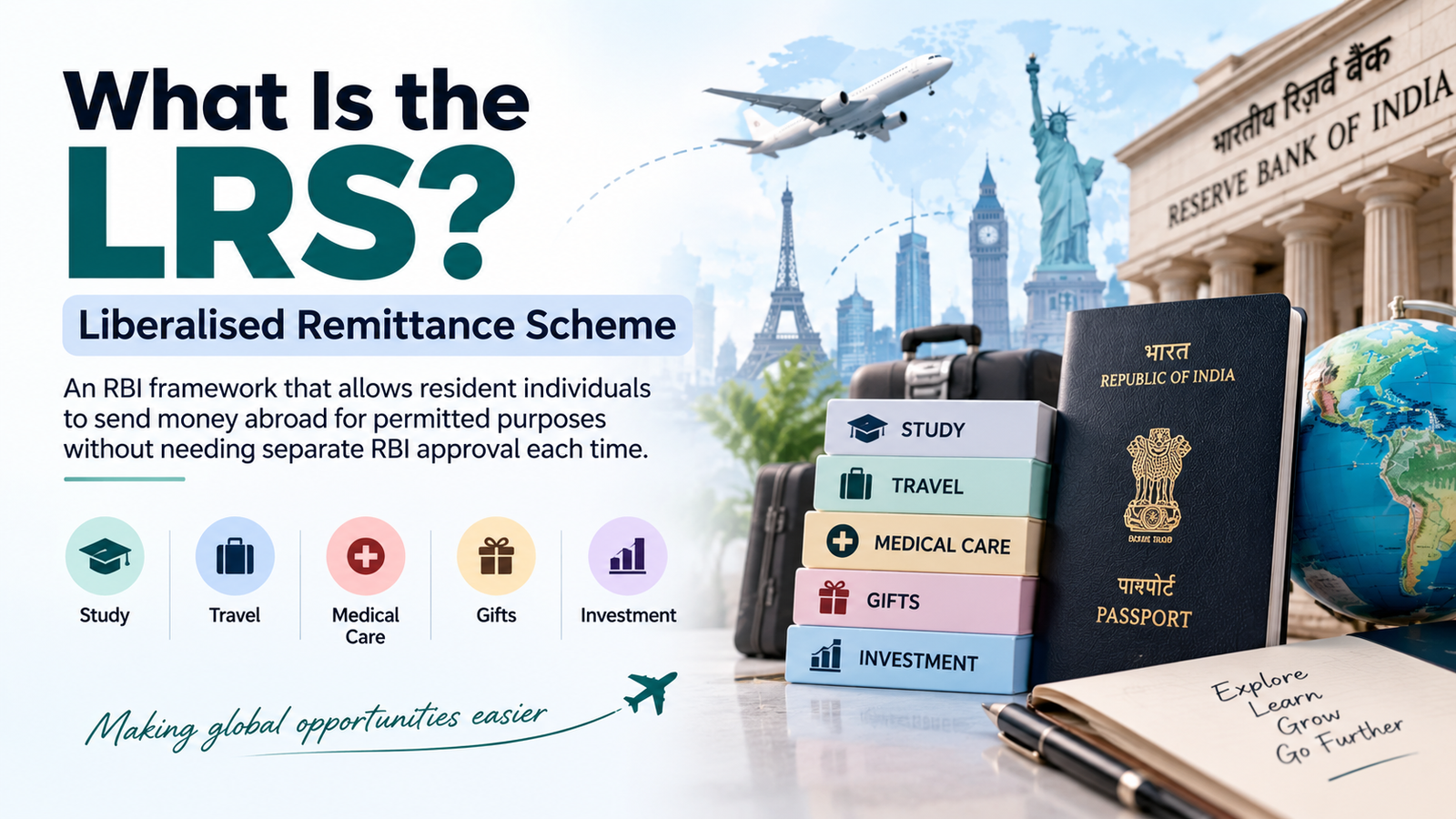
The Liberalised Remittance Scheme (LRS) is an RBI framework that lets resident individuals send money abroad for a range of permitted purposes without needing separate RBI approval each time. Introduced to make legitimate overseas payments easy – study, travel, medical care, gifts, investment – it channels those remittances through authorised dealer banks under a single annual cap. It is one of the most useful permissions a resident has, which is exactly why its boundaries matter.
The USD 250,000 Rule, in Detail
The headline figure is straightforward, but the details define how it works:
| Feature | Detail |
|---|---|
| Limit | USD 250,000 per resident individual, per financial year |
| Period | 1 April to 31 March; resets each year with no carry-forward |
| Basis | Cumulative across all permitted purposes combined |
| Who | Resident individuals only (minors too, with a guardian’s countersignature) |
| Tracking | Monitored PAN-wise across all banks – you can’t multiply it |
| Process | Through an authorised dealer (bank) with Form A2 and documentation |
The limit has stood at USD 250,000 since 2015. It’s generous – but generosity in some directions comes with firm prohibitions in others.
What the LRS Can and Cannot Fund
This is the crux of the whole topic. The LRS permits many things – and specifically bars a few, forex trading among them:
| LRS CAN fund | LRS CANNOT fund |
|---|---|
| Overseas travel and tourism | Margin trading or margin calls to overseas exchanges |
| Education and student expenses abroad | Forex trading on offshore platforms |
| Medical treatment abroad | Lottery, sweepstakes and proscribed magazines |
| Gifts and maintenance of relatives | Remittances to FATF non-cooperative countries |
| Investment in foreign shares, ETFs and property | Purchase of FCCBs in the overseas secondary market |
| Employment and emigration expenses | Any purpose otherwise prohibited under FEMA |
The Big Myth: ‘Trade Forex Under the $250,000 LRS Limit’
Here is the claim, and why it’s wrong. Offshore brokers and their affiliates routinely tell Indian traders they can ‘legally trade forex up to the USD 250,000 LRS limit’. But the LRS rules expressly exclude margin and forex trading from permitted remittances. That means the real LRS limit for forex trading isn’t $250,000 – it’s zero. You cannot lawfully use any part of your LRS allowance to fund forex margin trading abroad, no matter how the broker frames it. The $250,000 rule is real; applying it to offshore forex is a myth designed to get you to deposit.
Why this matters
Even if an offshore broker accepts your money (via cards, UPI through third parties, or crypto), funding it for forex trading is a FEMA contravention regardless of whether the payment succeeds. Legality depends on the purpose and route, not on whether the transfer goes through – and forex trading simply isn’t a permitted LRS purpose.
Why Is Forex Trading Excluded?
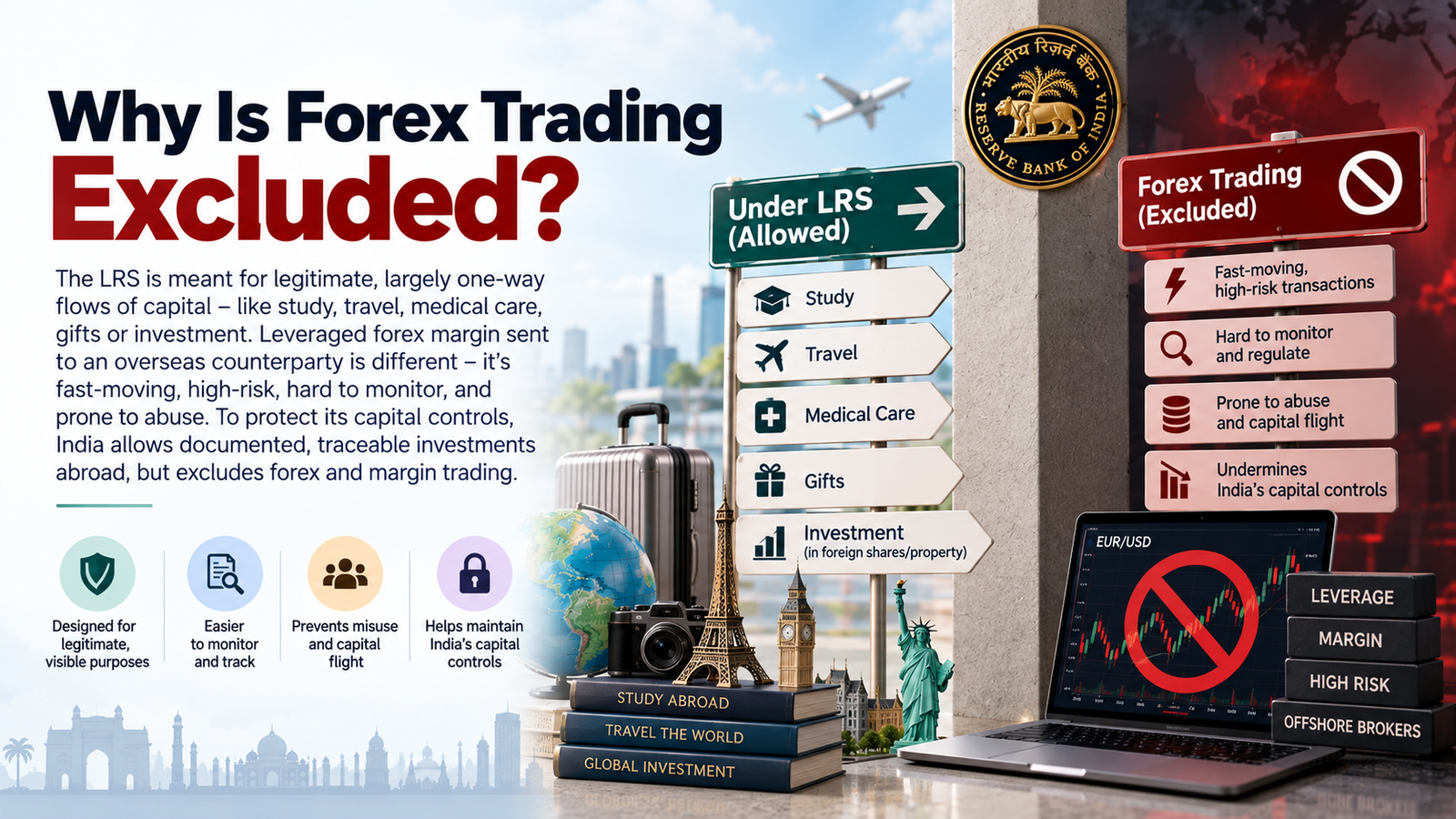
The exclusion isn’t arbitrary – it follows from what the LRS is for. The scheme exists to allow legitimate, largely one-way flows of capital: money that goes abroad to be spent, studied on, or invested in visible assets. Leveraged forex margin sent to an overseas counterparty is the opposite – fast-moving, high-risk, hard to monitor, and prone to abuse and capital flight. India is happy to let residents invest in foreign shares or property under the LRS because those flows are documented and traceable; it blocks forex and margin trading because they undermine the capital controls the scheme is meant to preserve.
A Note on TCS
Separate from the forex exclusion, TCS (tax collected at source) can apply to LRS remittances. The TCS-free threshold was raised to ₹10 lakh per financial year from April 2025, with rates varying by purpose (for example, education and medical typically attract lower rates than other remittances). TCS is a tax mechanism, not permission – it applies to allowed remittances and does not make a prohibited purpose like forex trading permissible. Confirm current TCS rates with a chartered accountant.
The Legal Way to Trade Forex (No LRS Needed)
The good news: the legal route doesn’t touch the LRS at all. Indian residents can trade currencies as exchange-traded derivatives on the NSE, BSE or MSE, through a SEBI-registered broker, in the seven permitted pairs – all in rupees, within India’s system. Because this happens on domestic exchanges and settles in INR, no overseas remittance is involved, so the LRS and its limit simply don’t apply. You get to trade the world’s major pairs (including EUR/USD, GBP/USD and USD/JPY as cross-currency contracts) legally, without sending a rupee abroad. (See our guides to SEBI’s rules and the legal pairs.)
Compliance Checklist
- Don’t fund offshore forex via the LRS – it’s a prohibited purpose, whatever a broker claims.
- Use the LRS only for permitted purposes – travel, education, medical, gifts, overseas investment.
- Track your usage PAN-wise – stay within USD 250,000 across all banks and purposes.
- Trade forex the legal way – exchange-traded currency derivatives via a SEBI-registered broker.
- Get advice on TCS and disclosure – confirm current TCS and Schedule FA requirements with a CA.
Common Misconceptions
- ‘I can trade forex up to $250,000 under the LRS.’ – No; forex/margin trading is a prohibited LRS purpose.
- ‘The LRS covers anything I send abroad.’ – It excludes forex, margin, lottery and a few other purposes.
- ‘If TCS is paid, the remittance is legal.’ – TCS is a tax, not permission; it doesn’t allow a prohibited purpose.
- ‘I can split the limit across banks.’ – It’s tracked PAN-wise across all banks.
- ‘Legal forex trading uses my LRS limit.’ – No; exchange-traded currency derivatives are rupee-settled in India.
Myths vs Facts
| Myth | Fact |
|---|---|
| You can trade forex under the USD 250,000 LRS limit. | Forex and margin trading are excluded; the LRS limit for forex is effectively zero. |
| The LRS can fund any overseas activity. | It has specific permitted purposes and explicit prohibitions. |
| Paying TCS legalises the remittance. | TCS is a tax on permitted remittances, not a permission for prohibited ones. |
| Legal forex trading needs the LRS. | It uses Indian exchanges and rupee settlement, so the LRS doesn’t apply. |
Compliance disclaimer
This article is for educational purposes only and is not legal, tax or investment advice. LRS, TCS and FEMA rules change and are enforced strictly; details here were checked against 2026 sources but may since have changed. Do not treat this as confirmation that any offshore forex funding is permitted. Always verify current rules with the RBI and your bank, and consult a qualified professional before remitting funds or trading
.Expert Analysis
The LRS limit for forex trading is a textbook case of a real rule being weaponised by misinformation. The USD 250,000 figure is genuine and easy to verify, which is exactly what makes the offshore pitch persuasive: brokers pair a true number with a false conclusion, and the true number lends the false conclusion credibility. A resident who checks only ‘is there a $250,000 LRS limit?’ finds a reassuring yes and stops there, never reaching the more important question – ‘is forex trading a permitted purpose under that limit?’ – whose answer is a firm no. Understanding the scheme means holding both facts at once: the limit exists, and forex trading sits outside it.
The deeper point is that the LRS is designed around the visibility of capital, not the size of it. India permits large sums to flow abroad for study, property or shares because those uses are traceable and broadly permanent; it forbids forex and margin trading not because of the amount but because of the nature of the flow – leveraged, rapid and easily hidden. For the individual trader, this reframing is liberating rather than restrictive: the legal path to trading currencies doesn’t require the LRS at all, because it never sends money abroad. Trading exchange-traded currency derivatives in rupees keeps the entire activity inside India’s supervised system, delivering the same access to major pairs without the legal exposure – and without spending a single dollar of an LRS allowance that was never meant for forex in the first place.
Key Takeaways
- The LRS lets a resident remit up to USD 250,000 abroad per financial year for permitted purposes.
- Forex and margin trading are expressly excluded, so the LRS limit for forex is effectively zero.
- The ‘trade forex under the $250,000 LRS limit’ claim is a myth used by offshore brokers.
- Paying TCS doesn’t legalise a prohibited purpose; TCS is a tax on permitted remittances.
- Legal forex trading uses Indian exchanges and rupee settlement – the LRS doesn’t apply at all.
Frequently Asked Questions (FAQ)
Q: What is the LRS limit?
A: USD 250,000 per resident individual, per financial year (1 April to 31 March), cumulative across all permitted purposes and tracked PAN-wise.
Q: Can I use the LRS for forex trading?
A: No. Forex trading and margin trading are expressly excluded from permitted LRS purposes, so you cannot use the limit to fund them.
Q: Is the LRS limit for forex trading really zero?
A: In effect, yes. Because forex/margin trading is a prohibited purpose, none of your USD 250,000 can lawfully fund offshore forex trading.
Q: What is the RBI $250,000 rule?
A: It’s the LRS annual cap: each resident individual can remit up to USD 250,000 abroad per financial year for permitted purposes.
Q: What can I use the LRS for?
A: Travel, education, medical treatment, gifts, maintenance of relatives, and investment in foreign shares, ETFs or property, among other permitted purposes.
Q: Why is forex trading excluded from the LRS?
A: Because leveraged forex margin sent abroad is fast-moving, high-risk and hard to monitor, undermining the capital controls the scheme protects.
Q: Does paying TCS make offshore forex legal?
A: No. TCS is a tax on permitted remittances; it does not make a prohibited purpose such as forex trading permissible.
Q: Can I split the LRS limit across multiple banks?
A: No. The USD 250,000 limit is tracked PAN-wise across all banks, so it cannot be multiplied.
Q: Does legal forex trading use my LRS limit?
A: No. Exchange-traded currency derivatives are traded in rupees on Indian exchanges, so no overseas remittance and no LRS is involved.
Q: Who can use the LRS?
A: Resident individuals, including minors (with a guardian’s countersignature). Companies and firms use other FEMA routes.
Q: When does the LRS limit reset?
A: On 1 April each financial year. Unused headroom cannot be carried forward.
Q: What happens if I use the LRS for forex anyway?
A: It’s a FEMA contravention, which can attract penalties, and offshore platforms offer no recourse if funds are lost.
Q: Is investing in US stocks allowed under the LRS?
A: Yes. Investment in foreign shares and ETFs is a permitted LRS purpose, unlike forex or margin trading.
Q: How do I remit money under the LRS?
A: Through an authorised dealer (bank) using Form A2 and the required documentation, within the annual limit.
Q: What’s the legal way to trade forex in India?
A: Exchange-traded currency derivatives on the NSE, BSE or MSE through a SEBI-registered broker, in the seven permitted pairs.