
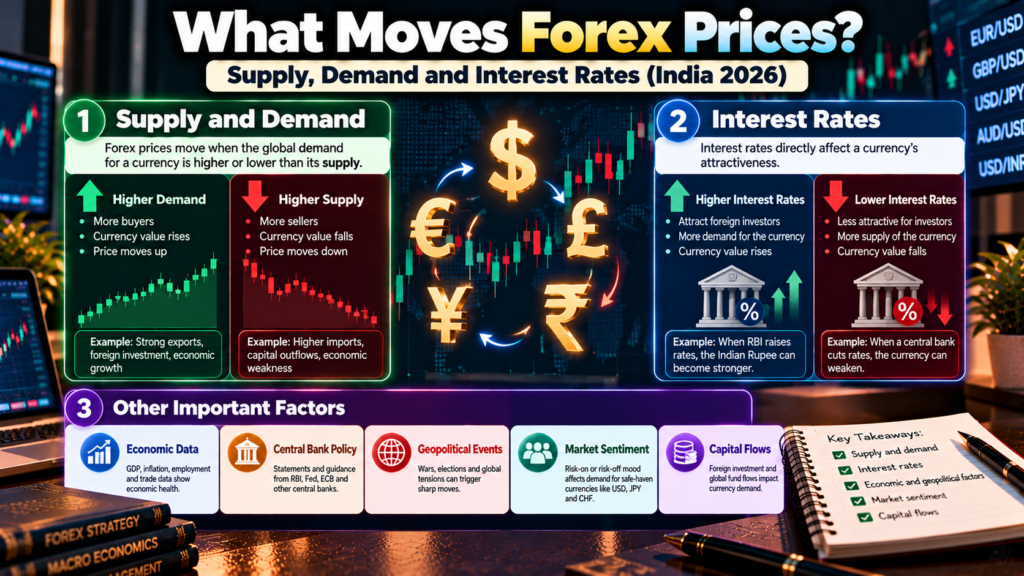
Quick answer: A currency’s price moves with supply and demand for it. Demand comes from exporters, foreign investors and people sending money home; supply comes from importers, investors leaving and anyone who needs foreign currency. Interest rates are the biggest single lever: higher rates attract foreign money and tend to strengthen a currency. Inflation, growth, the trade balance, oil prices, global risk mood and central bank intervention shift those flows. In the short term, news and positioning dominate; over years, inflation and productivity matter more.
In September 2026, the rupee hit a record low near ₹96 per dollar. Almost every driver in this guide was involved:
- the US Federal Reserve raised rates;
- crude oil climbed above $100;
- foreign investors sold Indian shares;
- the RBI sold billions of dollars from its reserves to slow the fall.
This guide explains each driver, then uses the rupee in 2026 as a case study.
Supply and demand: who buys and sells a currency
An exchange rate is just the price at which one currency trades for another. Like any price, it moves when demand and supply change.
Who needs rupees, and who needs dollars
| Creates demand for rupees (rupee tends to rise) | Creates demand for dollars (rupee tends to fall) |
|---|---|
| Exporters converting dollar earnings | Importers paying for oil, gold, electronics |
| Foreign investors buying Indian shares and bonds (FPI inflows) | Foreign investors selling Indian assets (FPI outflows) |
| Foreign companies investing in Indian plants and firms (FDI) | Indians investing or studying abroad, travel spending |
| Remittances from Indians working abroad | Companies repaying foreign loans |
| RBI selling dollars from reserves | RBI buying dollars to add to reserves |
How big are these flows?
- Global FX market: about $9.6 trillion a day in April 2025 (BIS Triennial Survey). The US dollar was on one side of 89.2% of all trades. The rupee’s share was 1.9%, 11th among currencies.
- Remittances into India: $135.4 billion in FY25, per RBI data, making India the world’s largest recipient. That is a steady source of demand for rupees.
- Oil imports: India imported a record 88.7% of its crude oil needs in FY26 (provisional), per a government reply in Parliament. That is a steady source of demand for dollars.
Flows vs price
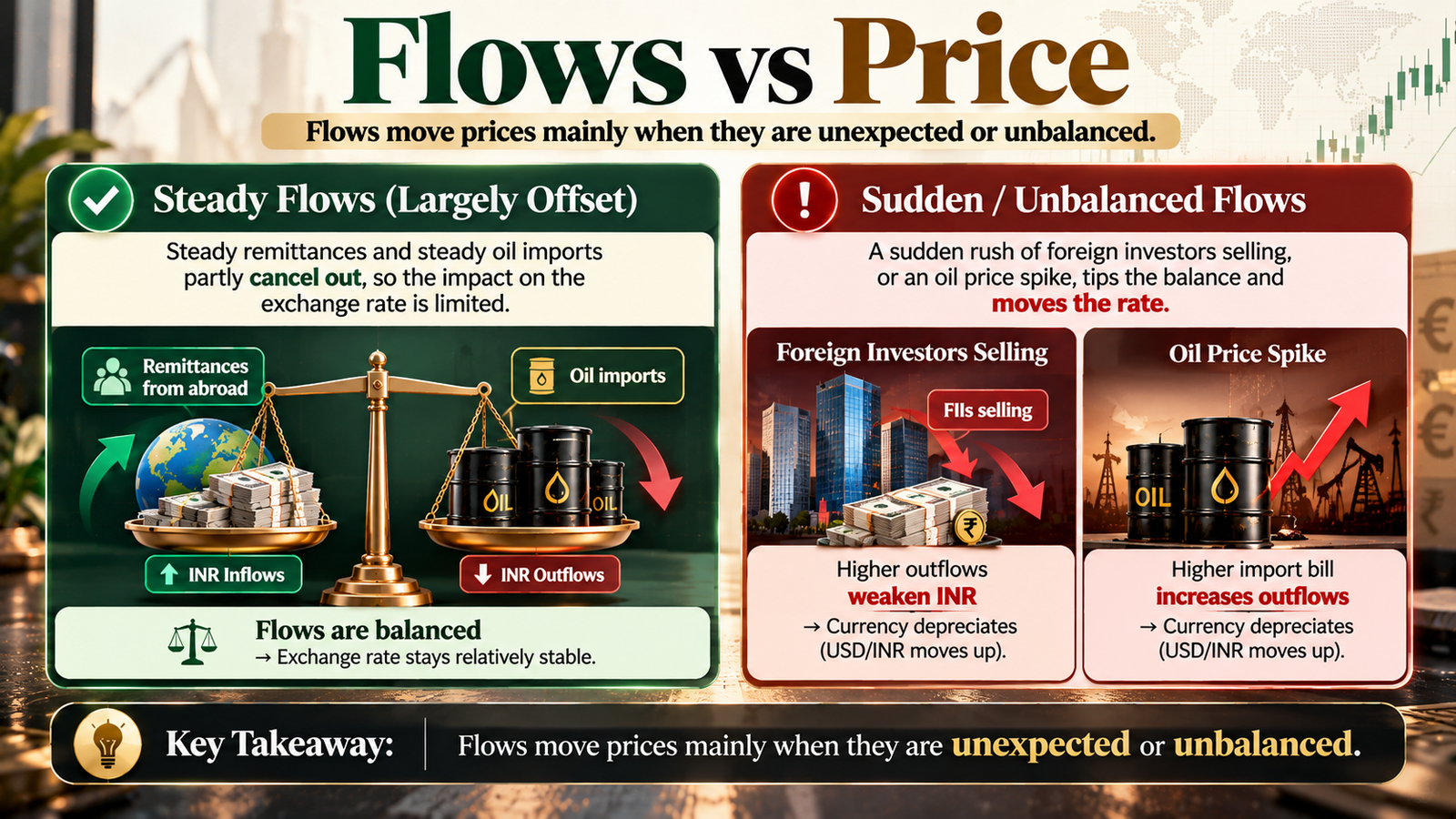
Flows move prices mainly when they are unexpected or unbalanced. Steady remittances and steady oil imports partly cancel out. A sudden rush of foreign investors selling, or an oil price spike, tips the balance and moves the rate.
Interest rates: the biggest lever
Why rates matter: investors move money to where it earns more, adjusted for risk. When a country’s interest rates rise relative to others, its bonds and deposits become more attractive. Foreign money flows in and buys the currency.
The interest rate differential
What matters is the gap between two countries’ rates, and where it is heading.
| Indicator (as of September 2026) | Level |
|---|---|
| RBI repo rate | 5.25% (held on 5 August 2026) |
| US federal funds target | 3.75%–4.00% (raised 25 bp on 16 September 2026, first hike since 2023) |
| Policy-rate gap (repo vs top of Fed range) | About 1.25 percentage points |
| US 10-year Treasury yield | Around 5%, per mid-September market reports |
A narrower gap, and higher US bond yields, make holding rupee assets less attractive relative to dollar assets. That is part of why foreign investors sold Indian shares in September.
Expectations matter more than today’s rate
Markets price in expected changes before they happen. A currency often moves more on a surprise (a hike nobody expected, or a hint about future hikes) than on the decision itself. That’s why traders watch central bank statements and the economic calendar closely.
Carry and the forward premium
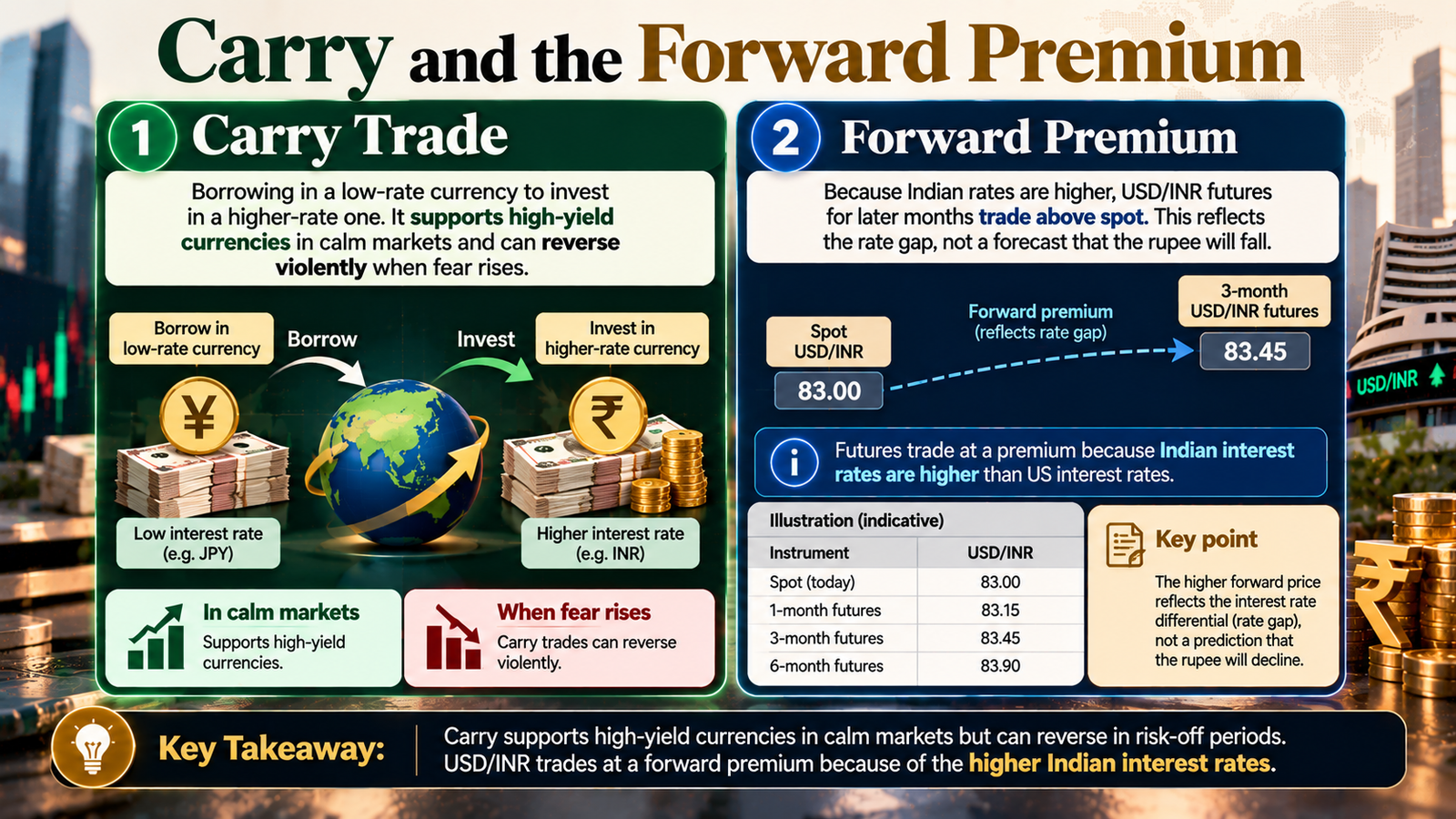
- Carry trade: borrowing in a low-rate currency to invest in a higher-rate one. It supports high-yield currencies in calm markets and can reverse violently when fear rises.
- Forward premium: because Indian rates are higher, USD/INR futures for later months trade above spot. This reflects the rate gap, not a forecast that the rupee will fall.
Other drivers
| Driver | How it usually works | India-specific angle |
|---|---|---|
| Inflation | Higher inflation erodes a currency’s value over time (purchasing power parity), unless rates rise to offset it | CPI rose to 4.82% in August 2026, limiting room for RBI rate cuts |
| Economic growth | Strong growth attracts investment and supports the currency | RBI raised its FY27 GDP growth forecast to 6.7% in August |
| Current account | A deficit means the country needs foreign capital to fund it | Deficit of $4.2 billion (0.5% of GDP) in April–June 2026; merchandise trade gap $86.1 billion |
| Oil prices | India imports most of its crude, so higher oil raises dollar demand | Import dependence at a record 88.7% in FY26; crude above $105 a barrel in late September per market reports |
| Capital flows | Foreign buying of local assets supports the currency; selling weakens it | FPIs pulled ₹20,974 crore from Indian shares on 1–18 September 2026 |
| Risk sentiment | In “risk-off” periods investors flee to the dollar, yen and gold, and emerging-market currencies weaken | Geopolitical tension and higher US yields weighed on the rupee |
| Central bank intervention | Central banks buy or sell foreign currency to smooth moves | RBI sold about $10.9 billion in the week to 18 September; reserves fell $14.9 billion to $765.9 billion, from a record $785.7 billion two weeks earlier |
| Politics and policy | Elections, trade policy, tariffs and sanctions change expected flows | Trade and tariff news can shift export and investment outlooks quickly |
How RBI intervention works
The rupee is market-determined, but the RBI intervenes to curb excessive volatility. When the rupee falls sharply, the RBI sells dollars from reserves, adding dollar supply. When inflows are strong, it buys dollars, building reserves. Intervention can slow a move but rarely reverses a trend driven by fundamentals on its own. Reserves are large but finite.
Case study: the rupee in September 2026
The rupee traded at a record low near ₹95.9–96 per dollar in September 2026, briefly crossing 96 intraday. Here is how each driver contributed.
| Driver | What happened | Pressure on the rupee |
|---|---|---|
| US interest rates | Fed hiked to 3.75%–4.00% on 16 September; US 10-year yield around 5% | Weaker |
| Rate gap | Narrowed to about 1.25 percentage points vs the RBI repo rate | Weaker |
| Oil | Brent above $100, then above $105 per market reports; India imports 88.7% of its crude | Weaker |
| Foreign investor flows | ₹20,974 crore of equity outflows on 1–18 September, after inflows in July and August | Weaker |
| Inflation | India CPI up to 4.82% in August | Weaker (limits rate cuts that could support growth; erodes value) |
| Trade balance | Merchandise trade gap widened to $86.1 billion in April–June | Weaker |
| Growth | RBI forecast raised to 6.7% for FY27 | Supportive |
| Remittances | Record inflows ($135.4 billion in FY25) | Supportive |
| RBI intervention | About $10.9 billion of dollar sales in one week | Slowed the fall |
Reading the table: most drivers pointed the same way, which is why the move was strong. Supportive factors such as growth, remittances and RBI selling reduced the speed of the fall but didn’t reverse it. When drivers conflict, currencies tend to move sideways; when they line up, trends form.
This is a snapshot as of 26 September 2026. Upcoming events include the RBI decision on 7 October and the next Fed decision on 28 October.
Short-term vs long-term drivers
| Time frame | What tends to dominate | Example |
|---|---|---|
| Minutes to hours | Data surprises, central bank statements, order flow, headlines | Rupee jumps after a surprise US jobs number |
| Days to weeks | Capital flows, oil moves, risk sentiment, intervention | FPI outflows over a few weeks |
| Months to years | Rate differentials, inflation gaps, current account, growth, productivity | Long-run rupee trend against the dollar |
What the evidence says
- Fact: In a classic 1983 study, Meese and Rogoff found that standard economic models of exchange rates did not forecast better than a simple “random walk” over horizons of up to a year. Later research has only partly overturned this.
- Fact: A European Central Bank working paper by Neely and Weller reviewed technical trading in forex and found that returns to simple rules seemed to fade over time as markets adapted.
- Analysis: Knowing the drivers helps you understand why a currency moved and which risks to watch. It does not give you a reliable short-term forecast.
- Opinion: For beginners, the most useful skill is not predicting direction but recognising when several drivers line up, and sizing risk small when they conflict.
Expert analysis
Fact: The rupee’s September 2026 fall came as US rates rose, oil climbed, and foreign investors sold Indian shares, while the RBI sold reserves to slow the move.
Analysis: That combination is typical for emerging-market currencies. Higher US yields pull capital toward the dollar; costlier oil increases India’s dollar needs; intervention buys time but costs reserves.
Opinion: A beginner should treat the rupee as a currency with a long-run tendency to weaken slowly (because India’s inflation has historically been higher than US inflation) punctuated by sharp moves when global shocks hit. Treat any “sure” forecast with caution.
Common mistakes
- Watching one driver only. Oil alone or rates alone rarely explains a move.
- Trading the headline, not the surprise. If a rate hike was fully expected, the currency may not move, or may move the “wrong” way.
- Confusing flows with price. Big inflows don’t guarantee a stronger rupee if dollar demand is bigger.
- Reading the forward premium as a forecast. It mostly reflects the interest rate gap.
- Fighting the central bank on short time frames. RBI intervention can reverse intraday moves sharply.
- Using illegal offshore platforms. In India, retail forex trading is allowed only in permitted INR pairs and cross-currency pairs on recognised exchanges such as NSE and BSE. The RBI’s alert list names unauthorised platforms.
Myths vs facts
| Myth | Fact |
|---|---|
| “A weak rupee means India’s economy is failing.” | Currencies weaken for many reasons, including a strong dollar globally. Growth can be solid while the rupee falls. |
| “The RBI fixes the rupee’s value.” | The rupee is market-determined. The RBI intervenes to reduce volatility, not to set a level. |
| “Higher rates always strengthen a currency.” | Only if they are credible and not offset by inflation or risk. Rate hikes made in a crisis can fail to stop a fall. |
| “Remittances make the rupee strong.” | They are a steady support, but they can be outweighed by oil imports and capital outflows. |
| “If I know the news, I can predict the move.” | Markets price expectations in advance. Only the surprise moves prices. |
Key takeaways
- Forex prices move on supply and demand for currencies, driven by trade, investment and speculation.
- Interest rate differentials, and expectations of changes, are among the strongest drivers.
- For India, oil prices, foreign investor flows, remittances and RBI intervention matter most.
- Markets react to surprises versus expectations, not to news itself.
- Drivers explain moves after the fact far better than they predict them in advance.
- Trade only on SEBI-regulated exchanges, and size your risk as if any forecast might be wrong.
FAQs
- What moves forex prices the most? Supply and demand for each currency. Interest rate differentials, capital flows, trade balances, inflation, risk sentiment and central bank action drive that supply and demand.
- Why do interest rates affect currency value? Higher rates offer better returns on deposits and bonds, attracting foreign capital, which increases demand for the currency.
- Why does the rupee fall when the US Federal Reserve raises rates? Higher US rates make dollar assets more attractive. Some investors move money out of India, selling rupees and buying dollars.
- How do oil prices affect the rupee? India imported 88.7% of its crude oil needs in FY26. Higher oil prices mean importers need more dollars, which puts pressure on the rupee.
- What is RBI intervention in the forex market? The RBI buys or sells foreign currency from its reserves to smooth sharp moves in the rupee. It does not target a fixed level.
- Do FPI flows affect the rupee? Yes. When foreign portfolio investors sell Indian shares and take money home, they convert rupees into dollars, weakening the rupee.
- How does inflation affect exchange rates? Over long periods, higher inflation tends to reduce a currency’s purchasing power and value relative to lower-inflation currencies.
- What is a current account deficit and why does it matter? It means a country spends more foreign currency on imports and payments than it earns. It must be funded by capital inflows, making the currency sensitive to investor sentiment.
- Do remittances support the rupee? Yes. India received $135.4 billion in remittances in FY25, a steady source of dollar supply.
- What does “risk-off” mean in forex? It describes periods when investors avoid risk and move into safe havens such as the US dollar, Japanese yen or gold. Emerging-market currencies usually weaken.
- Why do USD/INR futures trade above the spot rate? Because Indian interest rates are higher than US rates. The forward premium reflects that gap and is not a forecast.
- Can economic news predict currency moves? Only partly. Markets react to the difference between actual data and expectations, and research shows short-term forecasting is very hard.
- Which economic data should Indian beginners watch? RBI and Fed rate decisions, India and US inflation, US jobs data, India’s trade balance, crude oil prices and FPI flow data.
- Is the rupee freely floating? It is market-determined, but the RBI manages volatility through intervention, so it is often described as a managed float.
- Can I trade currency pairs legally in India? Yes, but only permitted pairs (such as USD/INR, EUR/INR, GBP/INR, JPY/INR and certain cross-currency pairs) on recognised exchanges through SEBI-registered brokers. Trading on unauthorised offshore apps is not permitted.
- Should beginners trade based on fundamentals? Fundamentals help you understand the big picture and avoid trading into major events blind. Combine them with strict risk management rather than relying on them for exact entries.