
Quick answer
Forex trading is buying one currency while selling another to profit from changes in their exchange rate. For forex trading for beginners in India, the key point is that it’s legal only as exchange-traded currency derivatives on recognised exchanges (NSE, BSE, MSE) through a SEBI-registered broker – not via offshore apps
Introduction
Every time the rupee moves against the dollar, money changes hands in the world’s largest financial market – the foreign exchange, or forex, market. For anyone curious about it, forex trading for beginners in India can look intimidating and, thanks to a flood of misleading offshore ads, confusing about what’s even legal.
This guide clears that up from scratch: what forex trading actually is, how it works, the handful of terms you need, and – crucially for India – how to do it legally and safely. It’s written for complete beginners, and it’s educational information, not investment advice. Regulatory details were checked against current 2026 sources, but always verify the latest with SEBI and the RBI.
What Is Forex Trading?
Forex trading is the act of exchanging one currency for another in the hope of profiting from a change in their relative value. Currencies are always quoted in pairs – like USD/INR or EUR/USD – because to buy one currency you must sell another. If you expect the US dollar to strengthen against the rupee, you ‘buy’ USD/INR; if you expect it to weaken, you ‘sell’.
The global forex market is enormous and open 24 hours a day on weekdays, driven by banks, companies, governments and traders. But how ordinary people can participate differs sharply by country – and India has its own specific, regulated framework, which is the most important thing a beginner here must understand.
How Forex Trading Works
A few simple mechanics underpin every forex trade:
- Currency pairs – the first currency is the ‘base’, the second the ‘quote’. USD/INR of 88 means one dollar costs 88 rupees.
- Going long or short – you buy (go long) if you expect the base currency to rise, or sell (go short) if you expect it to fall.
- Bid and ask – the bid is the price to sell, the ask the price to buy; the small gap between them is the spread.
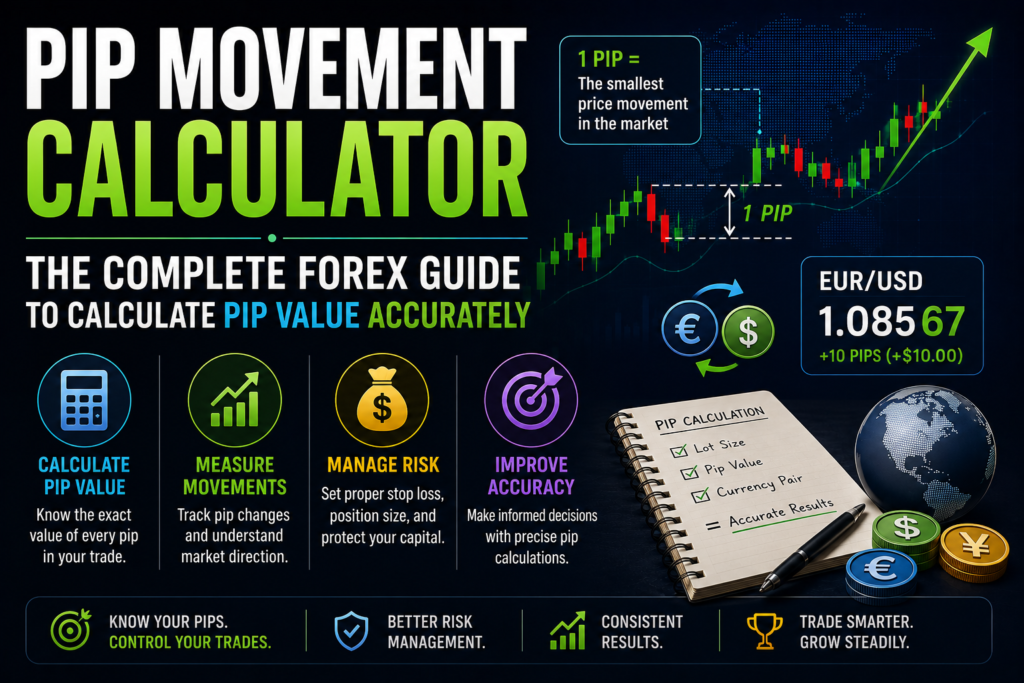
- Pips – the smallest standard price move, usually the fourth decimal place, used to measure gains and losses.
- Lots – the standardised trade size; a standard lot is 100,000 units, with smaller mini and micro lots for beginners.
Key Forex Terms for Beginners
| Term | What it means |
|---|---|
| Pip | The smallest standard price move (usually 0.0001) |
| Lot | Trade size – standard (100,000), mini (10,000), micro (1,000) |
| Pip value | The money one pip is worth for your position size |
| Leverage | Borrowed exposure that magnifies both gains and losses |
| Margin | The deposit needed to open a leveraged position |
| Spread | The gap between the buy and sell price – a trading cost |
How Forex Trading Works in India (the Legal Part)
This is where forex trading for beginners in India differs most from the global picture, and getting it right protects both your money and your legal standing. In India, residents can trade currencies only in a tightly defined way:
- Only on recognised exchanges – the NSE, BSE or Metropolitan Stock Exchange (MSE), not offshore platforms.
- Only through SEBI-registered brokers – like Zerodha, Upstox or Angel One.
- Only as futures and options – exchange-traded currency derivatives, not spot forex or CFDs.
- Only seven pairs – USD/INR, EUR/INR, GBP/INR, JPY/INR, plus EUR/USD, GBP/USD and USD/JPY.
The framework is governed by FEMA and overseen by the RBI and SEBI. Trading through offshore or unregulated apps – however heavily advertised – is not permitted and can breach FEMA. For a beginner, the simplest safe rule is: if it’s not a SEBI-registered broker routing to an Indian exchange, don’t use it.
Why Do People Trade Forex?
- Speculation – to profit from currency price movements (the most common reason for retail traders).
- Hedging – businesses and investors protect themselves against adverse currency moves.
- Accessibility – small lot sizes and leverage make it possible to start with modest capital.
- Liquidity and hours – the market is deep and trades through the day on weekdays.
How to Start Forex Trading in India (Step by Step)
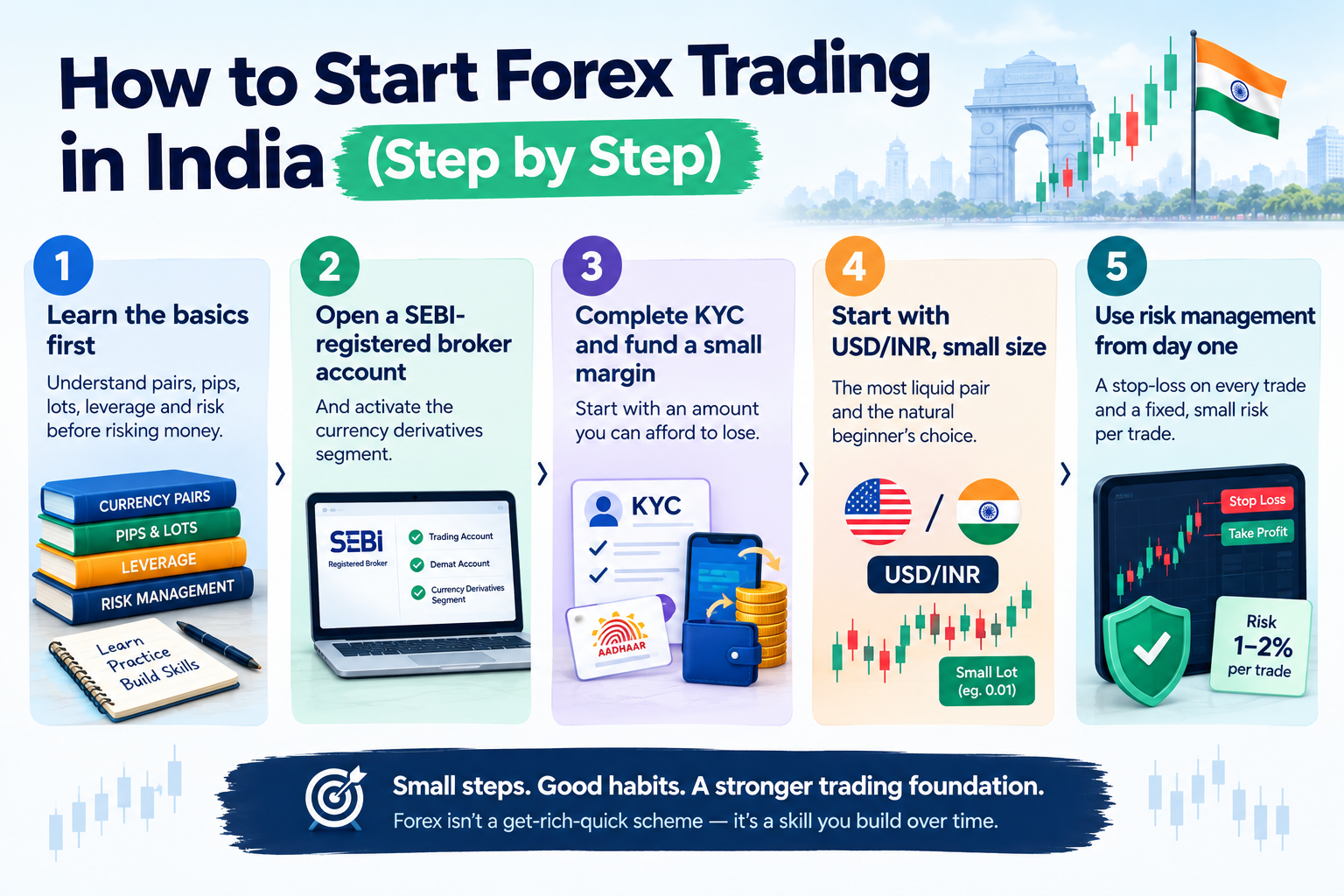
- Learn the basics first – understand pairs, pips, lots, leverage and risk before risking money.
- Open a SEBI-registered broker account – and activate the currency derivatives segment.
- Complete KYC and fund a small margin – start with an amount you can afford to lose.
- Start with USD/INR, small size – the most liquid pair and the natural beginner’s choice.
- Use risk management from day one – a stop-loss on every trade and a fixed, small risk per trade.
Understanding Leverage and Risk
Leverage is the feature that makes forex exciting – and dangerous. It lets you control a large position with a small margin, magnifying gains but equally magnifying losses. A modest adverse move on a highly leveraged position can wipe out your capital. This is why disciplined beginners use leverage sparingly and never risk more than a small, fixed percentage of their account (many use 1-2%) on any single trade. Respect for leverage, more than any strategy, is what keeps new traders in the game.
Is Forex Trading Profitable? An Honest Look
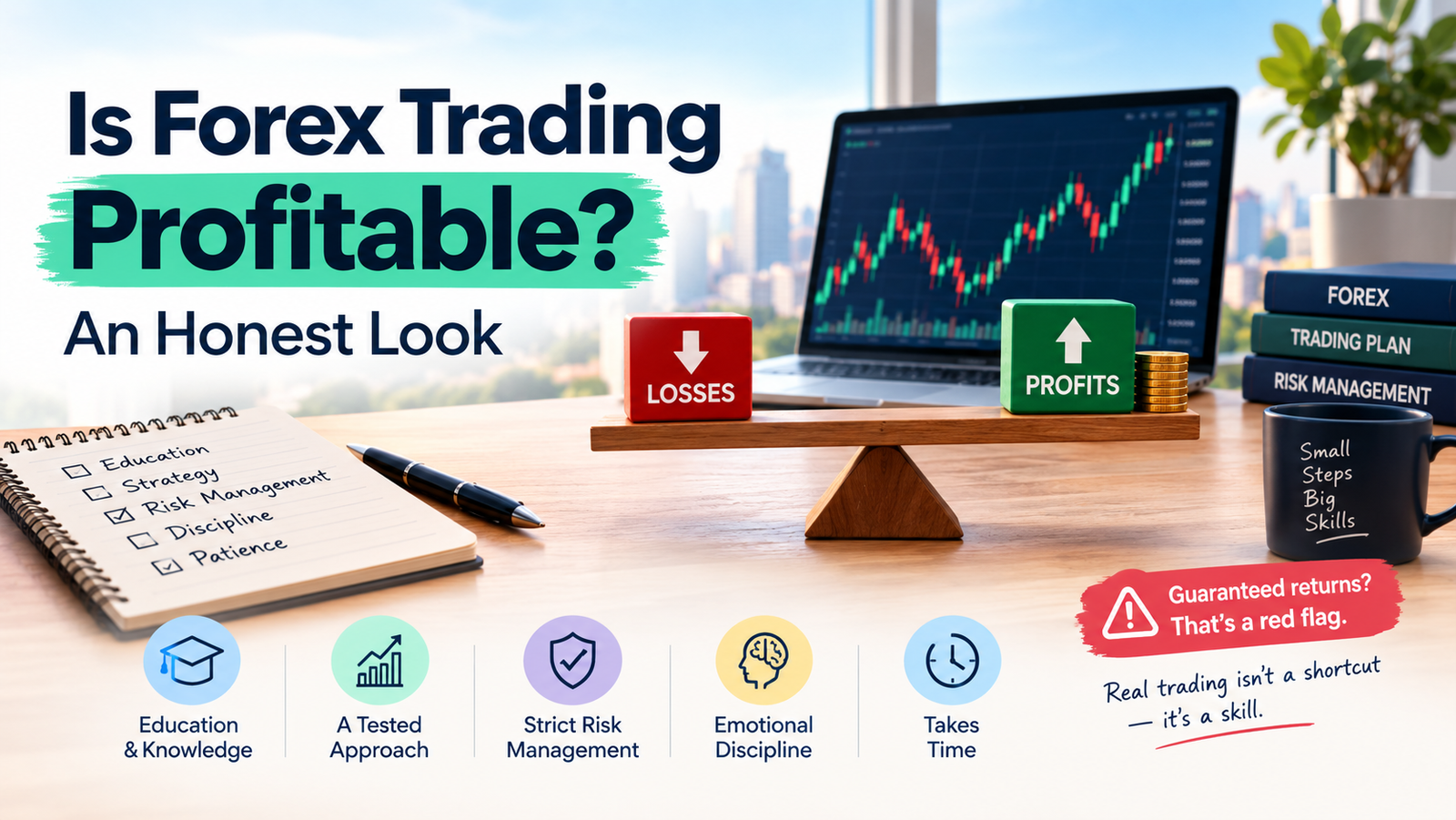
It’s important to be realistic. Regulated brokers around the world routinely disclose that a majority of retail traders lose money, and forex is no exception. Profit is possible, but it requires education, a tested approach, strict risk management and emotional discipline – and it takes time. Treat anyone promising guaranteed or effortless returns as a red flag; that promise is the calling card of scams, not of real trading. Approached patiently, with small size and a focus on not blowing up, forex can be a skill worth building – but it is not a shortcut to quick money.
Common Beginner Mistakes
- Using illegal offshore platforms drawn in by high leverage and big promises.
- Over-leveraging and risking too much per trade.
- Trading without a stop-loss or a plan.
- Chasing losses (revenge trading) after a bad day.
- Expecting fast profits and skipping the learning phase.
Myths vs Facts
| Myth | Fact |
|---|---|
| Forex trading is banned in India. | It’s legal as exchange-traded currency derivatives on NSE/BSE/MSE. |
| You can get rich quickly with forex. | Most retail traders lose money; success takes skill, time and discipline. |
| More leverage means more profit. | Leverage magnifies losses just as much as gains. |
| Any popular app is safe to use. | Only SEBI-registered brokers on recognised exchanges are legal. |
Risk disclaimer
This article is for educational purposes only and is not investment or legal advice. Forex trading carries a high risk of loss, and most retail traders lose money. Only trade through SEBI-registered brokers on recognised exchanges. Regulatory details were checked against 2026 sources but may change; verify with SEBI and the RBI and consult a qualified professional before trading.
Expert Analysis
The single most valuable thing a beginner in India can learn about forex is not a strategy but a boundary: the difference between the regulated market and the offshore one. Globally, ‘forex trading’ usually means spot trading with an online broker; in India that model is largely outside the law, and the legal path runs through exchange-traded currency derivatives instead. Beginners who don’t grasp this early tend to start on a slick offshore app, mistake its high leverage for opportunity, and discover only later that they were both exposed under FEMA and unprotected if the platform failed. Front-loading the legal framework, as this guide does, is therefore not pedantry – it’s the first and most important risk-management decision.
Beyond legality, the honest framing of profitability matters just as much. Forex is marketed as a fast path to wealth precisely because that story sells accounts, yet the data consistently shows most retail traders lose. A beginner who internalises that – and who treats their first year as an apprenticeship in risk control rather than a hunt for profit – has a far better chance than one chasing the dream in the ads. The realistic goal at the start is not to make money but to avoid losing it recklessly while you learn; the traders who survive that phase are the only ones who ever get to find out whether they can profit at all.
Key Takeaways
- Forex trading is buying one currency while selling another to profit from exchange-rate moves.
- Learn the core terms first: pairs, pips, lots, leverage, margin and spread.
- In India, trade only exchange-traded currency derivatives on NSE/BSE/MSE via a SEBI broker.
- Only seven pairs are permitted; offshore platforms are not legal and can breach FEMA.
- Most beginners lose money – use small size, strict risk control, and expect a long learning curve.
Frequently Asked Questions (FAQ)
Q: What is forex trading in simple words?
A: It’s buying one currency while selling another – like USD/INR – to try to profit when their exchange rate changes.
Q: Is forex trading legal in India?
A: Yes, but only as exchange-traded currency derivatives on recognised exchanges (NSE, BSE, MSE) via SEBI-registered brokers. Offshore trading is not permitted.
Q: How do beginners start forex trading in India?
A: Learn the basics, open a SEBI-registered broker account, activate the currency segment, fund a small margin, and start with USD/INR at small size.
Q: How much money do I need to start?
A: Because of small lot sizes and leverage you can start modestly, but only risk money you can afford to lose.
Q: Which currency pairs can I trade in India?
A: Seven: USD/INR, EUR/INR, GBP/INR, JPY/INR, EUR/USD, GBP/USD and USD/JPY, all as exchange-traded derivatives.
Q: What is a pip?
A: The smallest standard price move in a currency pair, usually the fourth decimal place, used to measure gains and losses.
Q: What is leverage in forex?
A: Borrowed exposure that lets you control a large position with a small margin – it magnifies both profits and losses.
Q: Can beginners make money in forex?
A: It’s possible but hard; most retail traders lose money. Success needs education, risk management, discipline and time.
Q: What is the best pair for beginners in India?
A: USD/INR, because it’s the most liquid, most covered, and driven by familiar domestic factors.
Q: Are offshore forex apps safe?
A: No. They’re not authorised for residents, can breach FEMA, and offer no recourse if your funds are lost.
Q: What is the spread?
A: The difference between the buy and sell price of a pair – effectively a cost of trading.
Q: Do I need a demat account for forex?
A: You need a broker account with the currency derivatives segment activated; requirements vary by broker.
Q: Is forex trading gambling?
A: Traded without skill or risk control it can resemble gambling; approached with a tested method and discipline it is a skill-based activity.
Q: How is forex income taxed in India?
A: Income from currency derivatives is generally taxed as business income; consult a chartered accountant.
Q: What’s the first thing a beginner should focus on?
A: Risk management and legality – trade legally, keep risk small, and focus on not losing money while you learn.