
Introduction
Some days, almost everything seems to move together. Stocks rally, commodity prices rise, emerging market currencies strengthen and the Japanese yen weakens. On other days, the reverse happens all at once: stocks fall, gold and government bonds rise, and money rushes into the US dollar, the yen and the Swiss franc.
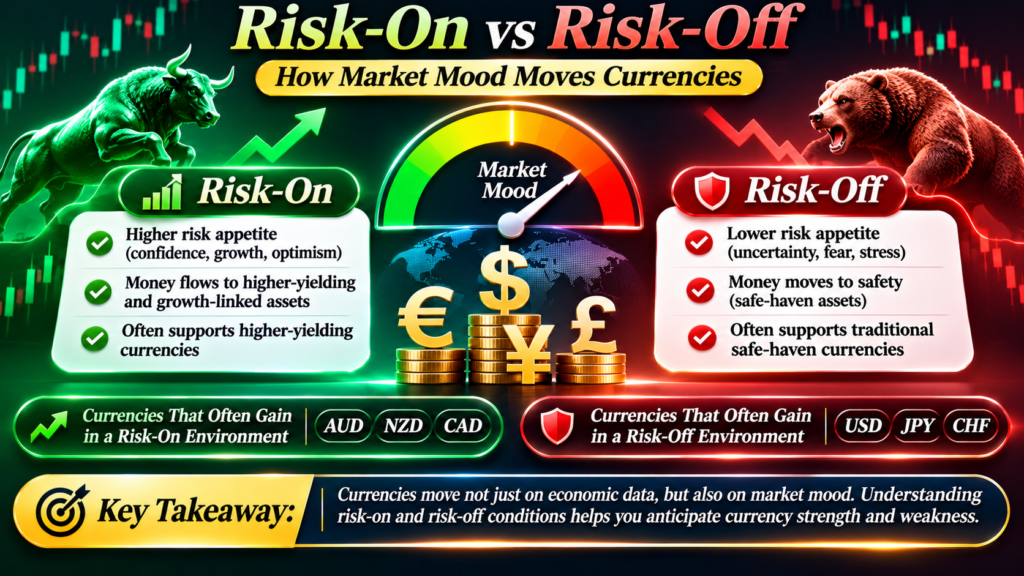
Traders describe these swings in market mood as risk on risk off. When investors feel confident, they move into riskier assets in search of higher returns, which is “risk-on”. When they feel fearful, they sell risky assets and seek safety, which is “risk-off”.
Understanding the risk on risk off cycle helps forex traders explain why currencies move in groups, why some pairs suddenly correlate with stock markets, and why a quiet trade can turn violent when sentiment flips. This guide explains how it works, which currencies benefit in each mood, the indicators to watch, how the Indian rupee reacts and how to use sentiment in your own trading.
What Does Risk On Risk Off Mean?
Risk on risk off (often written RORO) describes how investors’ appetite for risk changes with economic and market conditions.
- Risk-on: investors are optimistic about growth, earnings and stability. They buy equities, high-yield bonds, commodities and emerging market assets, and fund those positions by selling or borrowing low-yielding currencies.
- Risk-off: investors are worried about recession, financial stress, war or policy shocks. They sell risky assets, cut leverage and move into perceived safe havens such as US Treasuries, gold, the dollar, the yen and the Swiss franc.
The idea is simple, but its effect on currencies is powerful. In strong risk on risk off phases, a single driver, investor fear or confidence, can outweigh interest rates, trade data and other fundamentals for days or weeks.

Why Market Mood Moves Currencies
Several mechanisms link sentiment to exchange rates:
- Capital flows: in risk-on periods, money flows into higher-yielding and emerging markets, lifting their currencies. In risk-off periods, it flows back home or into safe assets.
- Carry trades: traders borrow in low-yielding currencies such as the yen to buy higher-yielding ones. When fear rises, these trades are unwound, and the funding currency is bought back sharply.
- Dollar funding: much of global trade and finance is priced in dollars. In stress, demand for dollars to repay debts and meet margin calls can push the dollar higher.
- Repatriation: investors in countries with large overseas assets, such as Japan and Switzerland, may bring money home during crises, supporting their currencies.
- Commodity demand: risk-on usually comes with stronger growth expectations, which supports commodity prices and commodity-linked currencies.
Risk-On and Risk-Off Currencies
| Group | Typical currencies | Risk-on behaviour | Risk-off behaviour |
|---|---|---|---|
| Safe havens | USD, JPY, CHF | Tend to weaken | Tend to strengthen |
| Commodity currencies | AUD, NZD, CAD, NOK | Tend to strengthen | Tend to weaken |
| Emerging market currencies | INR, BRL, MXN, ZAR, KRW | Tend to strengthen | Tend to weaken |
| Middle ground | EUR, GBP | Mixed; often firm against the dollar | Mixed; often weaker against the dollar, yen and franc |
These are tendencies, not rules. The way each currency behaves in a risk on risk off swing depends on interest rates, the source of the shock and positioning at the time.
The US dollar
The dollar is the world’s main reserve and funding currency and is traditionally the biggest beneficiary of risk-off flows. However, its safe-haven status is not automatic. In April 2025, for example, when US tariff announcements triggered a sharp sell-off in global stocks, the dollar weakened alongside US assets while the yen, Swiss franc and gold rallied. When the shock originates in the US, the dollar may not behave like a safe haven.
The Japanese yen
The yen tends to strengthen in risk-off episodes because it is a popular funding currency for carry trades and because Japan has large net overseas assets. A clear example came in early August 2024, when a rapid unwind of yen carry trades helped USD/JPY fall from around 161 in July to around 142 within weeks.
The Swiss franc
The franc benefits from Switzerland’s political stability, strong external position and deep financial system. The Swiss National Bank has sometimes intervened to limit the franc’s strength during risk-off periods.
Commodity and emerging market currencies
The Australian dollar, New Zealand dollar, Canadian dollar and many emerging market currencies usually rise in risk-on phases and fall in risk-off phases, because they depend on global growth, commodity prices and foreign capital.
How to Spot a Risk On Risk Off Shift
No single indicator defines sentiment, but traders watch a group of signals together:
| Indicator | Risk-on signal | Risk-off signal |
|---|---|---|
| VIX (S&P 500 volatility index) | Low or falling | High or rising sharply |
| Global stock indices | Rising | Falling |
| US Treasury yields | Often rising | Often falling as investors buy bonds |
| Credit spreads | Narrowing | Widening |
| Gold | Mixed | Often rising |
| AUD/JPY | Rising | Falling |
| Copper and crude oil | Rising on growth hopes | Falling on growth fears (oil can rise on supply shocks) |
| India VIX and FPI flows | Low volatility, FPI buying | High volatility, FPI selling |
AUD/JPY: the risk barometer
AUD/JPY combines a growth-sensitive, commodity-linked currency with a classic safe haven. When it rises, risk appetite is usually improving; when it falls sharply, investors are usually seeking safety. Many traders keep an AUD/JPY chart open as a quick risk on risk off gauge.
What Triggers Risk-On and Risk-Off Moves?
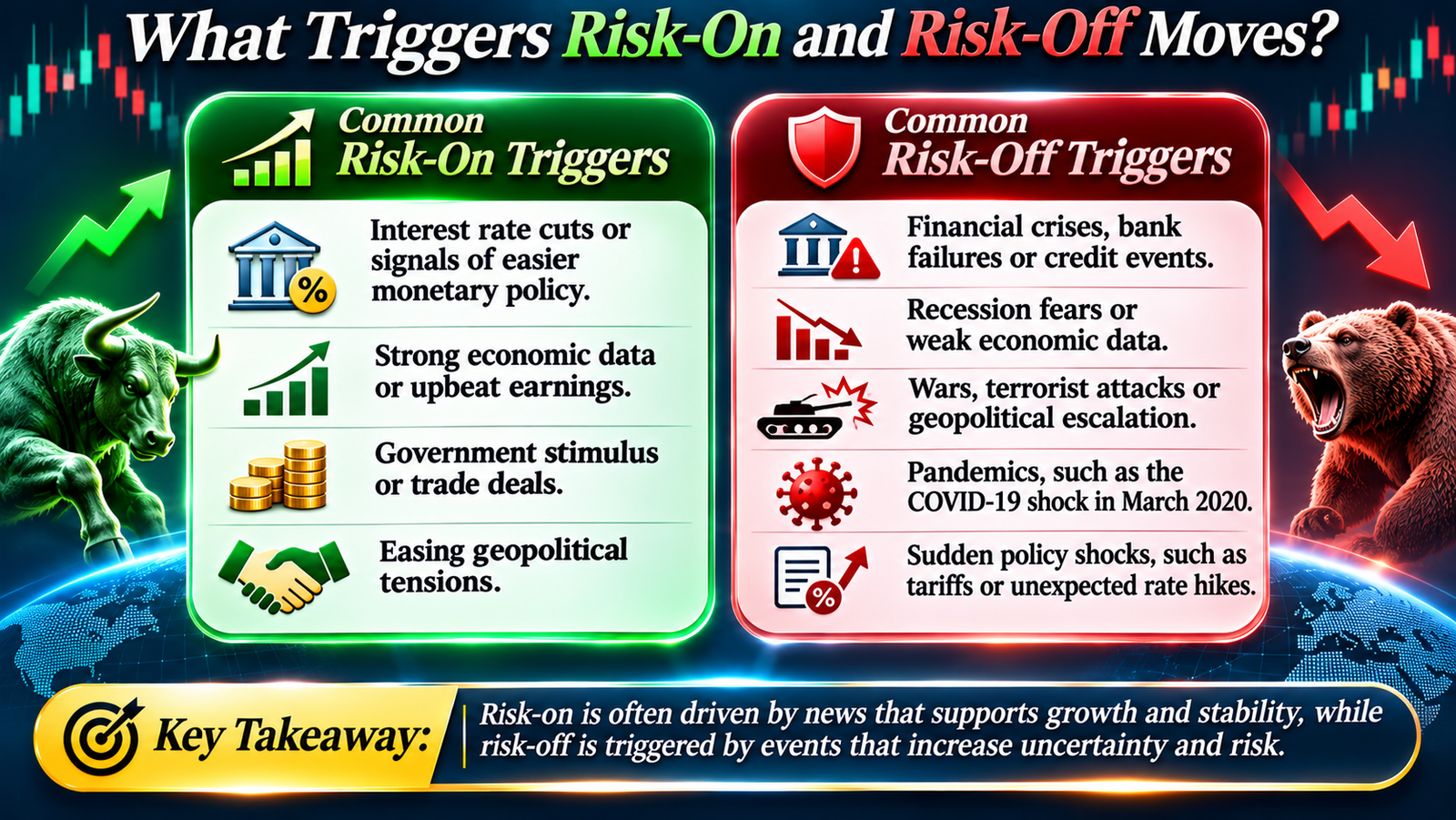
Common risk-on triggers
- Interest rate cuts or signals of easier monetary policy.
- Strong economic data or upbeat earnings.
- Government stimulus or trade deals.
- Easing geopolitical tensions.
Common risk-off triggers
- Financial crises, bank failures or credit events.
- Recession fears or weak economic data.
- Wars, terrorist attacks or geopolitical escalation.
- Pandemics, such as the COVID-19 shock in March 2020.
- Sudden policy shocks, such as tariffs or unexpected rate hikes.
 Historical Risk On Risk Off Episodes
- 2008 global financial crisis: a classic risk-off period. The yen and dollar strengthened, while commodity and emerging market currencies fell sharply.
- March 2020 COVID-19 shock: a dash for dollars as investors raised cash. AUD/USD fell to its lowest level in nearly two decades before recovering as central banks and governments stepped in.
- August 2024 carry trade unwind: a rate hike by the Bank of Japan, weak US jobs data and crowded positioning triggered a sharp yen rally and a spike in volatility.
- April 2025 tariff shock: stocks fell sharply, but the dollar also weakened, showing that the usual risk on risk off playbook can change when the shock comes from the US itself.
How the Indian Rupee Reacts to Risk On Risk Off
The rupee is an emerging market currency, so it is sensitive to global risk sentiment, mainly through foreign portfolio investment (FPI) flows.
- Risk-on: foreign investors buy Indian stocks and bonds, increasing dollar supply and supporting the rupee.
- Risk-off: foreign investors sell Indian assets and take money home, raising demand for dollars and pushing USD/INR higher.
- Oil: India imports most of its crude oil, so a risk-off shock that pushes oil prices up (for example, a Middle East conflict) can hurt the rupee twice: through capital outflows and a higher import bill.
- RBI intervention: the Reserve Bank of India manages volatility by buying or selling dollars, so USD/INR moves are often smoother than those of other emerging market currencies.
Indian traders can follow these effects through exchange-traded currency derivatives on NSE and BSE, including USD/INR, EUR/INR, GBP/INR and JPY/INR, as well as EUR/USD, GBP/USD and USD/JPY. Leveraged forex through offshore brokers is not permitted for Indian residents under FEMA.
Using Risk On Risk Off in Your Trading
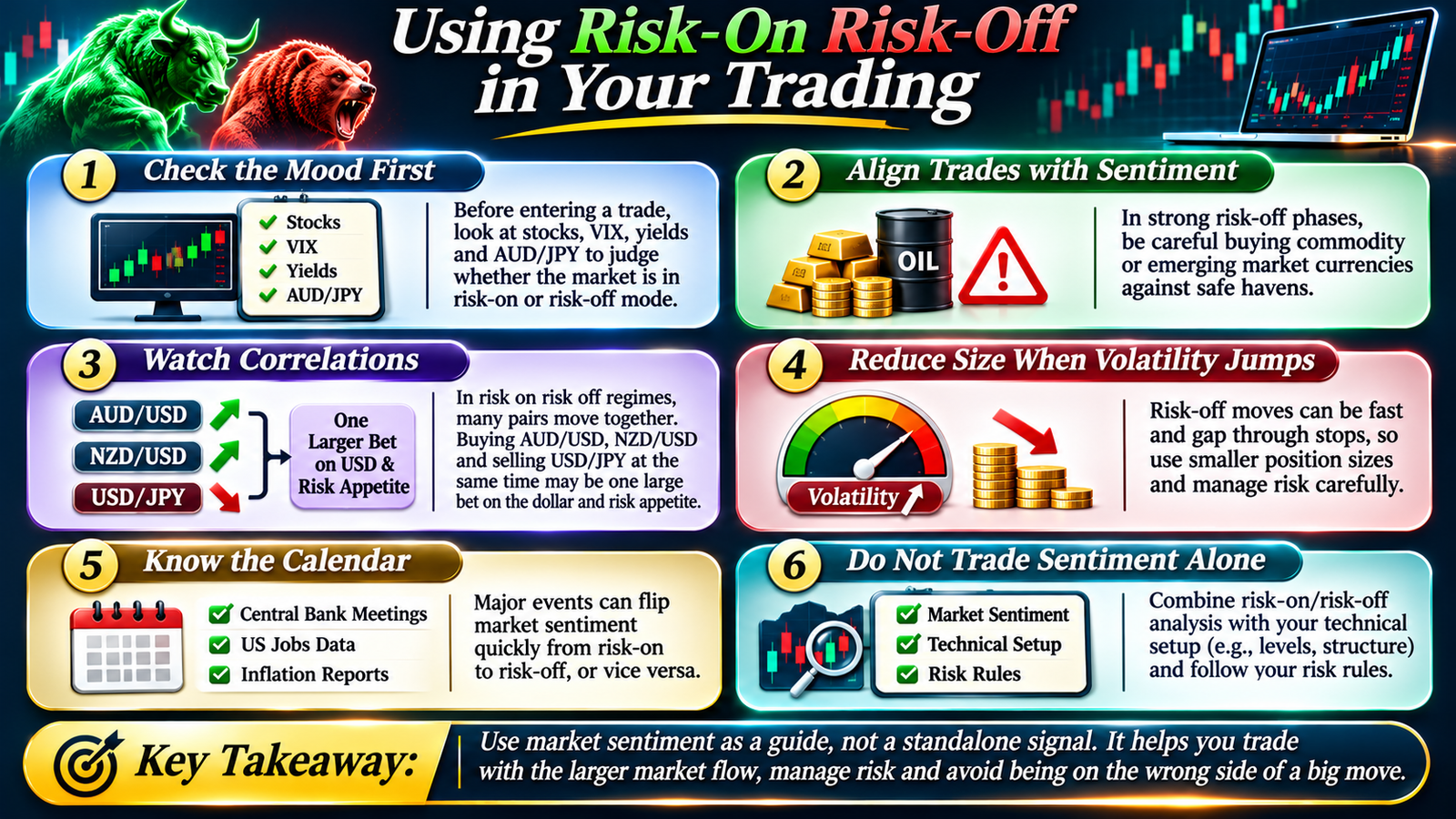
- Check the mood first: before entering a trade, look at stocks, VIX, yields and AUD/JPY to judge whether the market is in risk-on or risk-off mode.
- Align trades with sentiment: in strong risk-off phases, be careful buying commodity or emerging market currencies against safe havens.
- Watch correlations: in risk on risk off regimes, many pairs move together. Buying AUD/USD, NZD/USD and selling USD/JPY at the same time may be one large bet on the dollar and risk appetite.
- Reduce size when volatility jumps: risk-off moves can be fast and gap through stops.
- Know the calendar: central bank meetings, US jobs data and inflation reports can flip sentiment quickly.
- Do not trade sentiment alone: combine it with your technical setup and risk rules.
Worked Example: A Risk-Off Day
This example is illustrative and uses hypothetical prices.
A trader in India holds a long USD/INR futures position at 88.40, expecting a modest rise. Overnight, a geopolitical shock hits the Middle East. The next morning:
- Global stocks are down 2%, and the VIX has jumped.
- Crude oil is up 5%.
- FPIs are reported to be selling Indian equities.
- USD/INR opens at 88.75, up 35 paise.
With 5 lots, the 35-paise gain equals 35 × ₹10 × 5 = ₹1,750. Had the trader been short USD/INR instead, the same move would have produced a ₹1,750 loss. Understanding risk on risk off dynamics helps explain the move and reminds the trader to manage position size around event risk.
Limitations of the Risk On Risk Off Framework
- Relationships change: as the April 2025 example shows, safe-haven behaviour depends on where the shock starts.
- Interest rates matter: a currency with rising rates may strengthen even in a mild risk-off phase.
- Mixed signals: stocks can rise while bonds also rally, making sentiment unclear.
- Regime shifts: the strength of risk on risk off correlations varies; in calm periods, country-specific factors often dominate.
- Hindsight bias: it is easier to label a move risk-off after it happens than to predict it.
Quick Checklist
- What are stocks and the VIX doing today?
- Is AUD/JPY rising or falling?
- Are bond yields up or down?
- What are oil and gold doing?
- Are FPIs buying or selling Indian assets?
- Are any major events due in the next 24 hours?
- Are my open positions all exposed to the same risk on risk off theme?
FAQs
What does risk on risk off mean in forex?
It describes shifts in investor sentiment. In risk-on periods, investors buy riskier assets and currencies; in risk-off periods, they move into safe havens such as the dollar, yen and Swiss franc.
Which currencies are safe havens?
Traditionally the US dollar, Japanese yen and Swiss franc, along with gold. Their behaviour can vary with the source of the shock.
Which currencies are risk-on currencies?
Commodity currencies such as AUD, NZD and CAD, and emerging market currencies such as the Indian rupee, Mexican peso and South African rand.
How does the rupee react to risk-off?
It usually weakens as foreign investors sell Indian assets, though RBI intervention often limits volatility.
What is the best indicator of risk on risk off?
No single one. Traders combine the VIX, stock indices, bond yields, credit spreads and AUD/JPY.
Can I trade risk sentiment from India legally?
Yes, through currency futures and options on NSE and BSE via SEBI-registered brokers. Offshore leveraged forex is not permitted for residents under FEMA.
Conclusion
The risk on risk off framework explains why currencies often move in groups. When confidence is high, commodity and emerging market currencies tend to rise; when fear takes over, money flows to the dollar, yen, Swiss franc and gold. For Indian traders, these swings show up in USD/INR through FPI flows, oil prices and RBI action.
Use market mood as context, not a trading signal on its own. Check sentiment indicators, watch correlations, reduce size when volatility spikes and remember that the classic patterns can change when the source of the shock changes.