
Introduction
Proprietary trading firms, or prop firms, offer traders the chance to manage a funded trading account in return for a share of the profits. To get that account, you usually have to pass an evaluation, often called a prop firm challenge.
Most firms offer two main formats: a one-step challenge, where you pass a single phase, and a two-step challenge, where you pass two phases in a row. At first glance, the one-step route looks faster and easier. In practice, the trade-offs are more subtle, and the one step vs two step prop firm choice can make a real difference to your odds of getting funded.
This guide explains:
- How each challenge format works
- The key rule differences: targets, loss limits, drawdown type and minimum days
- The costs and hidden risks of each
- How to make the one step vs two step prop firm decision for your trading style
- What Indian traders should know before signing up
What Is a Prop Firm Challenge?
A prop firm challenge is a test of your trading skill and discipline on a demo or simulated account. You pay a fee, trade under a set of rules, and if you hit the profit target without breaking any loss limits, you move on to a funded or “rewarded” account.
Common rules include:
- Profit target: The percentage gain you must reach to pass.
- Maximum daily loss: How much you can lose in a single day.
- Maximum overall loss (drawdown): How far your account can fall in total.
- Minimum trading days: The least number of days you must trade.
- Consistency rules: Limits on how much of your profit can come from a single day.
Every one step vs two step prop firm comparison comes down to how these rules are set in each format.
How a One-Step Challenge Works
To make sense of any one step vs two step prop firm comparison, start with how each format is built.
In a one-step challenge, you pass a single evaluation phase. Once you hit the profit target within the rules, you qualify for a funded account.
Typical features include:
- A single profit target, often around 8–10%
- Tighter daily loss limits, sometimes around 3%
- Smaller maximum drawdown, often trailing rather than static
- Fewer or no minimum trading days at some firms
- Consistency rules at some firms, such as a cap on your best day’s share of total profit
For example, according to a July 2026 comparison, FTMO’s 1-Step challenge used a 10% profit target, a 3% daily loss limit, a 10% maximum loss that trails end-of-day highs, no minimum trading days and a “Best Day” consistency rule.
How a Two-Step Challenge Works
A two-step challenge splits the evaluation into two phases. You must pass Phase 1, then pass Phase 2, before you get a funded account.
Typical features include:
- Phase 1 profit target of around 8–10%
- Phase 2 profit target of around 4–5%
- More generous daily loss limits, often around 5%
- Larger maximum drawdown, often static and based on the starting balance
- Minimum trading days in each phase at some firms
Using the same July 2026 comparison, FTMO’s 2-Step challenge listed targets of 10% and then 5%, a 5% daily loss limit, a 10% static maximum loss and a minimum of four trading days in each phase.
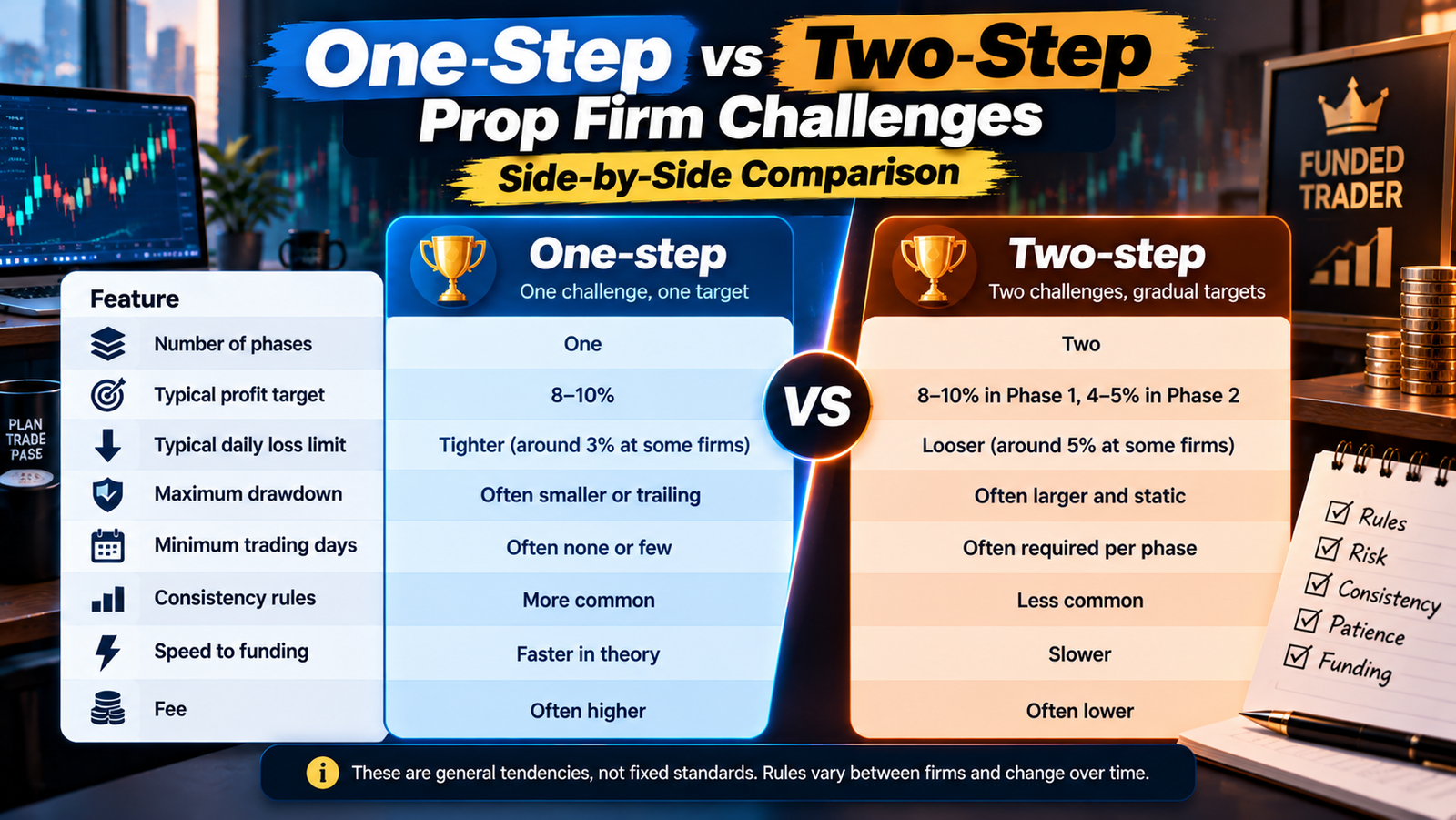
One Step vs Two Step Prop Firm Challenges: Side-by-Side Comparison
| Feature | One-step | Two-step |
|---|---|---|
| Number of phases | One | Two |
| Typical profit target | 8–10% | 8–10% in Phase 1, 4–5% in Phase 2 |
| Typical daily loss limit | Tighter (around 3% at some firms) | Looser (around 5% at some firms) |
| Maximum drawdown | Often smaller or trailing | Often larger and static |
| Minimum trading days | Often none or few | Often required per phase |
| Consistency rules | More common | Less common |
| Speed to funding | Faster in theory | Slower |
| Fee | Often higher | Often lower |
These are general tendencies, not fixed standards. Rules vary between firms and change over time.
One Step vs Two Step Prop Firm Profit Targets
Many traders think the one-step route needs less profit overall. That is often true: a single 10% target is less than a 10% plus 5% total across two phases.
But the pressure is different. In a two-step challenge, the second phase target is lower, and the account is usually reset between phases. You prove yourself twice, but each phase gives you a fresh loss allowance.
In the one step vs two step prop firm debate, the key question is not just “how much profit?” but “how much room do I have to make it?”
Daily Loss Limits: The Silent Account Killer
The daily loss limit is where many traders fail. A 3% daily limit leaves far less room than 5%. A couple of losing trades at normal size, plus open floating losses, can breach a tight limit quickly.
Note that many firms count open (floating) losses, commissions and swaps towards the daily limit, not just closed trades. Check how your firm calculates it and what time the day resets.
For traders who hold trades through volatile periods or use wider stops, a looser daily limit can be the deciding factor in the one step vs two step prop firm choice.
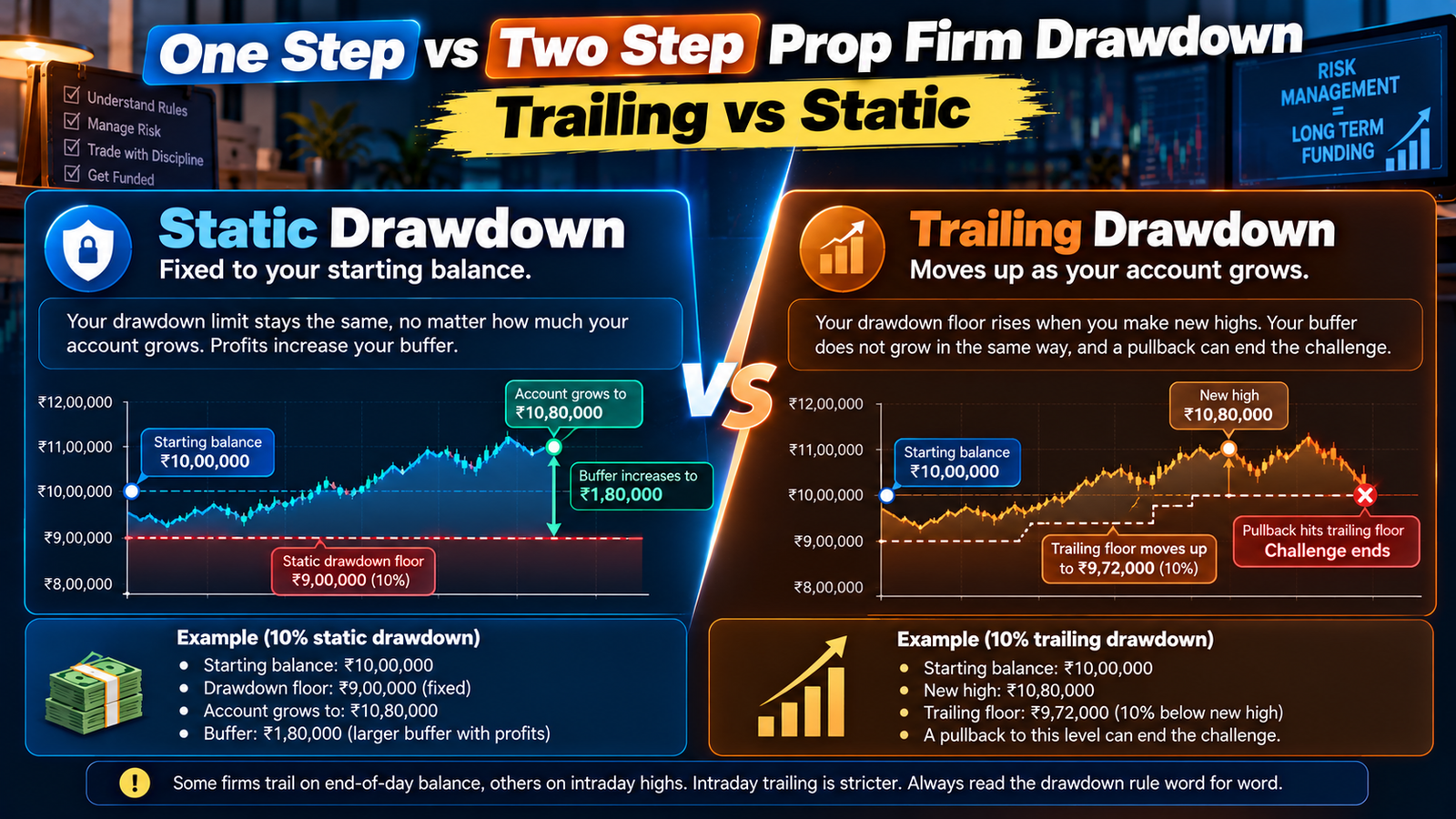
One Step vs Two Step Prop Firm Drawdown: Trailing vs Static
This is one of the most important differences, and one of the least understood.
Static drawdown
A static drawdown is fixed to your starting balance. On a ₹10,00,000-equivalent account with a 10% static limit, your floor is always ₹9,00,000. If you grow the account to ₹10,80,000, your buffer grows to ₹1,80,000.
Trailing drawdown
A trailing drawdown moves up as your account grows. With a 10% trailing limit, if your account reaches a new high, your floor rises too. Your buffer does not grow with profits in the same way, and a pullback after a strong run can end the challenge.
Some firms trail on end-of-day balance, others on intraday highs. Intraday trailing is stricter. When comparing any one step vs two step prop firm offer, read the drawdown rule word for word.
Minimum Days and Consistency Rules
Two-step challenges often require a minimum number of trading days in each phase. That slows things down, but it also stops traders from rushing.
One-step challenges may have no minimum days, but they often add consistency rules instead. A common example is a “best day” rule, which limits how much of your total profit can come from one day. If one big win makes up most of your profit, you may need to keep trading until the rest of your results catch up.
These rules are easy to overlook, yet they shape the real one step vs two step prop firm difficulty more than the headline profit target.
One Step vs Two Step Prop Firm Costs, Resets and Refunds
Fees
One-step challenges are often priced higher for the same account size, because they offer a shorter path. Two-step challenges are often cheaper. Some firms refund the two-step fee with your first profit payout, while one-step fees may be non-refundable. Check the terms carefully.
Resets
If you fail Phase 2 of a two-step challenge, some firms require you to start again from Phase 1. That doubles the time and, often, the cost. Others offer discounted resets or free retries if you finish in profit without breaching rules.
True cost of funding
The real cost is the fee multiplied by the number of attempts you need. A cheaper challenge you pass on the second try may cost more than an expensive one you pass first time, and vice versa. A realistic one step vs two step prop firm cost comparison includes your likely number of attempts.
Which Format Suits Your Trading Style?
A one-step challenge may suit you if:
- You trade with tight stops and small, controlled losses
- Your daily results rarely swing more than 1–2%
- You have a consistent strategy that spreads profit across many days
- You value speed and are comfortable with trailing drawdown
- You are an experienced trader with a proven track record
A two-step challenge may suit you if:
- You use wider stops or swing trade
- Your strategy has occasional larger losing days
- You want more room for error and a static drawdown
- You prefer lower fees and are happy to take longer
- You are newer to prop firm challenges
For many beginners, the extra breathing room in a two-step evaluation outweighs the slower path. For disciplined, experienced traders, the one-step route can save time. There is no universal winner in the one step vs two step prop firm question; it depends on how you trade.
A Simple One Step vs Two Step Prop Firm Example
Consider two traders, each starting with a ₹10,00,000-equivalent account.
Trader A (one-step): Faces a 10% target, a 3% daily limit and a 10% trailing drawdown. They gain 8% over two weeks, then have a 3.2% losing day after a news spike. The daily limit is breached and the challenge ends.
Trader B (two-step): Faces a 10% target in Phase 1, a 5% daily limit and a 10% static drawdown. They gain 8%, suffer the same 3.2% losing day, and stay within the rules. They recover and pass Phase 1, then pass the 5% target in Phase 2.
This hypothetical example shows why the one step vs two step prop firm decision should be based on your normal daily volatility, not just the speed of funding.
Tips for Passing Either Challenge
Whichever side of the one step vs two step prop firm choice you land on, the same habits improve your odds.
- Risk small: Many traders risk 0.5–1% per trade during a challenge.
- Set a personal daily limit: Stop trading well before the firm’s limit, for example at half of it.
- Avoid high-impact news: Some firms restrict news trading, and spikes can breach limits.
- Know every rule: Weekend holding, news trading, lot size caps and copy trading rules all vary.
- Ignore the deadline pressure: Many firms now have no time limit, so there is no need to rush.
- Practice first: Run your strategy on a demo account with the same rules before you pay.
- Keep a journal: Track your daily ranges and losses to judge which format fits you.
Important Note for Indian Traders
Before you buy any challenge, understand the legal position in India. Under FEMA, Indian residents may not remit money abroad for leveraged forex or CFD trading, and the RBI has published an Alert List of unauthorised forex trading platforms. Prop firms usually charge fees in foreign currency and run accounts on offshore platforms, so their legal status for Indian residents is not clear-cut.
- Check whether a firm or its platform appears on the RBI Alert List.
- Understand how fees are paid and how payouts are received.
- Keep records for tax purposes, as payouts may be taxable income.
- Consult a chartered accountant or legal adviser before participating.
Legal currency trading in India is available through NSE and BSE currency derivatives with SEBI-registered brokers.

FAQs
In the one step vs two step prop firm comparison, is one-step easier?
Not necessarily. It needs less total profit and is faster, but it often has tighter daily limits, trailing drawdown and consistency rules.
Which is better for beginners?
Weighing the one step vs two step prop firm trade-offs, many beginners find two-step challenges more forgiving because of looser daily limits and static drawdown, though they take longer.
Do I get the same profit split with both?
It depends on the firm. Some offer the same split for both formats; others differ. Check the funded account terms.
What happens if I fail Phase 2?
At many firms, you must restart from Phase 1, though some offer discounted resets or free retries.
Is trailing drawdown worse than static drawdown?
Generally, yes for the trader. A static drawdown leaves more room as profits grow, while a trailing one follows your gains.
Are prop firms legal in India?
The position is unclear. FEMA restricts remittances for leveraged forex trading, so Indian residents should seek professional advice first.
Conclusion
The one step vs two step prop firm decision is less about speed and more about fit. One-step challenges offer a faster, simpler path, but often with tighter daily limits, trailing drawdown and consistency rules. Two-step challenges take longer and need more total profit, but they usually give you more room to absorb a bad day.
Look at your own trading data: your typical daily swings, your worst days and how evenly your profits are spread. Match those to the rules, read the fine print on drawdown and resets, and factor in the legal position in India before you commit any money.