
Introduction
If you look at USD/INR quotes, you will notice something consistent: the rate for one month, three months or one year ahead is almost always higher than today’s spot rate. Futures on NSE and BSE show the same pattern, with each later expiry priced a little above the one before. Why?
The answer is interest rate parity. It is one of the most important ideas in currency markets, linking spot rates, forward rates and the interest rates in two countries. Banks use it to price forward contracts every day, exporters and importers rely on it when they hedge, and traders use it to understand carry trades and futures pricing.
This guide explains interest rate parity in plain language: the formula, covered and uncovered versions, forward premiums and discounts, the USD/INR forward premium, worked examples, why parity sometimes breaks down and how traders and businesses use it.
What Is Interest Rate Parity?
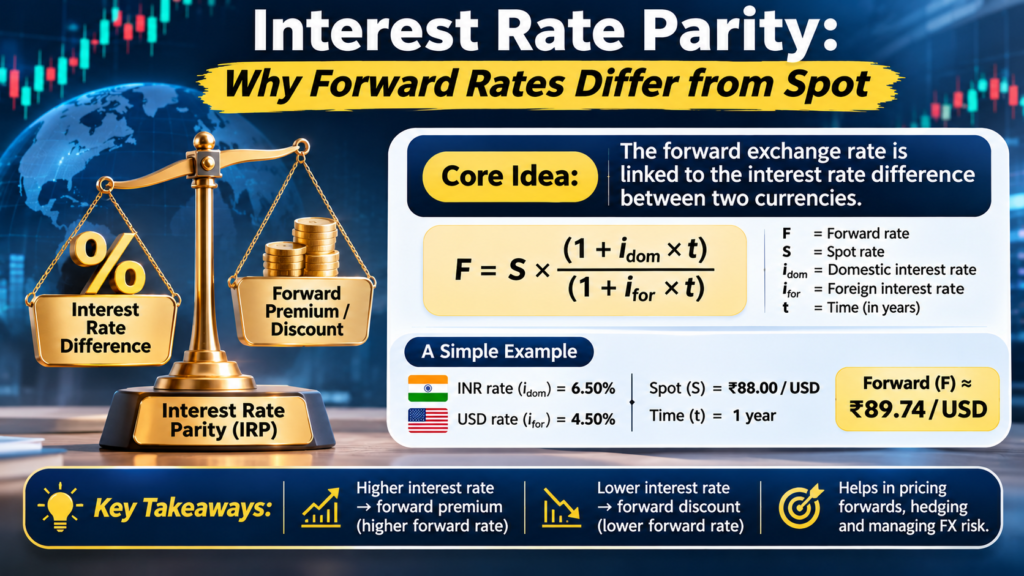
Interest rate parity is the principle that the difference between the forward rate and the spot rate of a currency pair should reflect the difference in interest rates between the two currencies.
The logic is simple. Imagine you could earn 6% a year on rupees and 4% a year on dollars. If you could convert dollars to rupees today, earn 6%, and lock in a forward rate to convert back at the same exchange rate, you would make a risk-free extra 2%. Markets do not allow such free money for long. So the forward rate adjusts: the higher-yielding currency trades at a forward discount, and the lower-yielding currency trades at a forward premium.
In short, interest rate parity says you cannot earn a risk-free profit by moving money between currencies and hedging the exchange rate, because the forward rate removes the interest advantage.
The Interest Rate Parity Formula
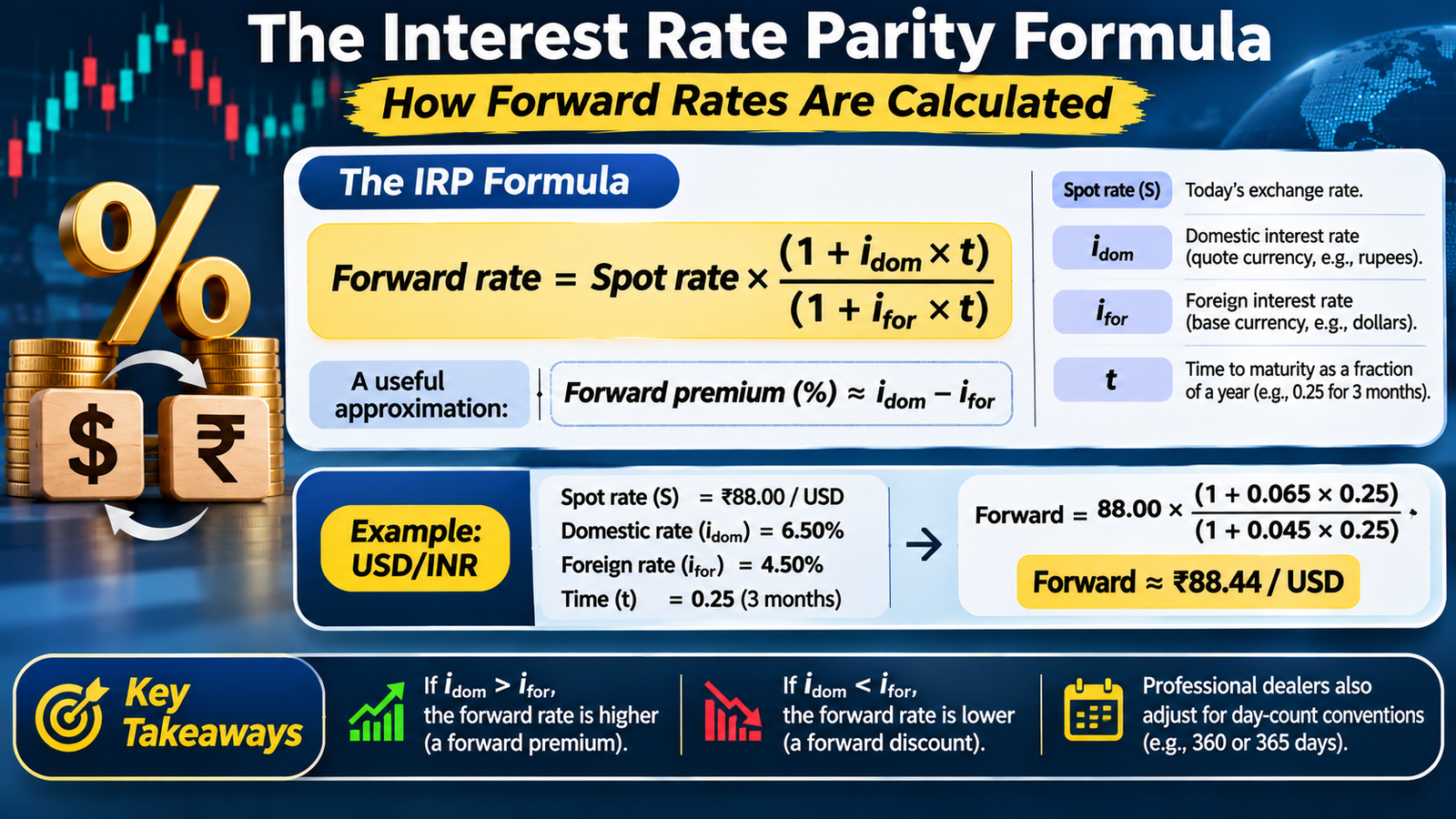
For a pair quoted as units of domestic currency per one unit of foreign currency (such as USD/INR, rupees per dollar):
Forward rate = Spot rate × (1 + domestic interest rate × t) ÷ (1 + foreign interest rate × t)
- Spot rate: today’s exchange rate.
- Domestic interest rate: the rate on the quote currency (rupees in USD/INR).
- Foreign interest rate: the rate on the base currency (dollars in USD/INR).
- t: time to maturity as a fraction of a year, such as 0.25 for three months.
A useful approximation is:
Forward premium (%) ≈ domestic interest rate − foreign interest rate
Professional dealers also adjust for day-count conventions, since some markets use a 360-day year and others a 365-day year, but the simple formula captures the idea well.
Forward Points, Premiums and Discounts
In the interbank market, forward rates are often quoted as forward points, which are added to or subtracted from the spot rate.
| Situation | Effect on forward rate | Example |
|---|---|---|
| Quote currency has higher interest rate | Forward rate above spot (base currency at a premium) | USD/INR forward above spot when Indian rates exceed US rates |
| Quote currency has lower interest rate | Forward rate below spot (base currency at a discount) | USD/JPY forward below spot when Japanese rates are below US rates |
| Equal interest rates | Forward rate equals spot | Rare in practice |
So when you see USD/INR futures priced above spot, the formula explains why: rupee interest rates have historically been higher than dollar rates, so the dollar trades at a forward premium against the rupee.
Interest Rate Parity: Worked Example with USD/INR
This example is illustrative and uses hypothetical rates.
Suppose:
- USD/INR spot = 88.00
- One-year rupee interest rate = 6%
- One-year dollar interest rate = 4%
Using the formula:
- One-year forward = 88.00 × (1.06 ÷ 1.04) = 89.69 (rounded).
- Forward premium = 89.69 − 88.00 = ₹1.69, or about 1.92%.
- The approximation (6% − 4% = 2%) gives a similar answer.
Three-month forward
- t = 0.25
- Three-month forward = 88.00 × (1 + 0.06 × 0.25) ÷ (1 + 0.04 × 0.25) = 88.00 × 1.015 ÷ 1.01 ≈ 88.44.
- Forward premium ≈ 44 paise, or about 2% annualized.
This is why the near-month USD/INR futures contract is usually only slightly above spot, while far-month contracts sit progressively higher.
Covered Interest Rate Parity
Covered interest rate parity (CIP) is the version described above. It is “covered” because the investor uses a forward contract to remove exchange rate risk.
Covered interest arbitrage example
This example is illustrative and ignores transaction costs.
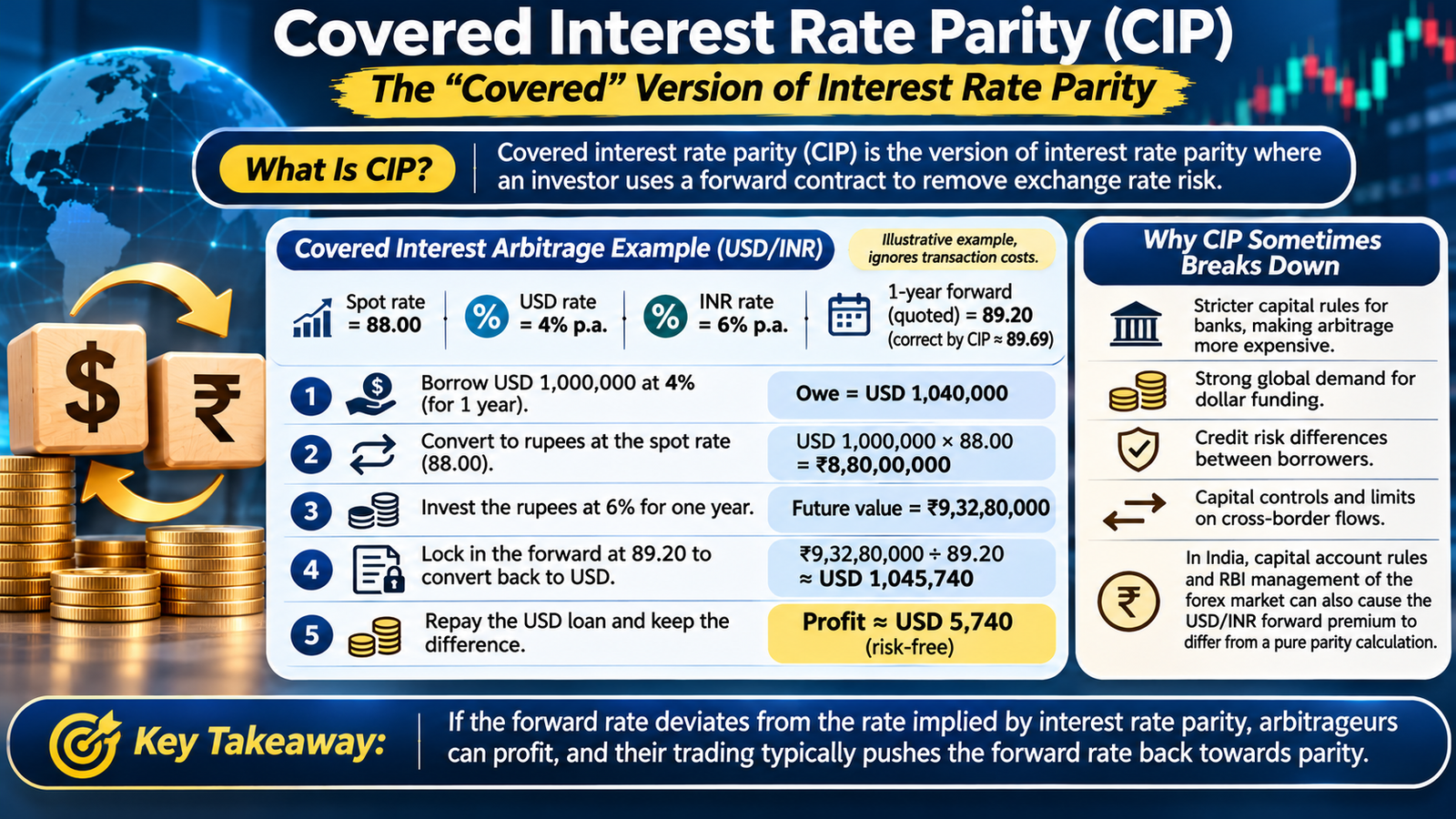
Using the rates above, suppose a bank mistakenly quotes the one-year USD/INR forward at 89.20 instead of 89.69.
- Borrow $1,000,000 at 4% for one year; you will owe $1,040,000.
- Convert to rupees at spot: $1,000,000 × 88.00 = ₹8,80,00,000.
- Invest the rupees at 6%: after one year you have ₹9,32,80,000.
- Lock in the forward at 89.20 to convert back: ₹9,32,80,000 ÷ 89.20 ≈ $1,045,740.
- Repay $1,040,000 and keep about $5,740 risk-free.
Arbitrageurs would rush to exploit this, pushing the forward rate back towards 89.69. That is how CIP is enforced in liquid markets.
Why CIP sometimes breaks down
Before the 2008 financial crisis, CIP held very closely for major currencies. Since then, persistent deviations, measured by the cross-currency basis, have been documented, especially for dollar funding. Reasons include:
- Banks face stricter capital rules, making arbitrage more expensive.
- Strong global demand for dollar funding.
- Credit risk differences between borrowers.
- Capital controls and limits on cross-border flows.
In India, capital account rules and RBI management of the forex market can also cause the USD/INR forward premium to differ from a pure parity calculation.
Uncovered Interest Rate Parity
Uncovered interest rate parity (UIP) makes a stronger claim: even without a forward hedge, the expected change in the spot rate should offset the interest rate difference.
- Under this version, if rupee rates are 2% higher than dollar rates, the rupee should be expected to weaken by about 2% over the year.
- An investor earning the higher rupee interest rate should, on average, lose the gain through currency depreciation.
The forward premium puzzle
In practice, UIP often fails, especially over short and medium horizons. Research going back to Eugene Fama’s work in the 1980s found that high-yielding currencies frequently do not depreciate as much as UIP predicts, and sometimes even appreciate. This is known as the forward premium puzzle.
That failure is the foundation of the carry trade.
Interest Rate Parity and the Carry Trade
In a carry trade, traders borrow or sell a low-yielding currency (historically the Japanese yen or Swiss franc) and buy a higher-yielding one. If UIP held perfectly, the expected currency move would wipe out the interest gain. Because it often does not, carry trades can earn steady returns for long periods.
The risk is that carry trades can unwind violently. When fear rises, investors rush to buy back funding currencies, and high-yielders can fall sharply. The rapid yen carry trade unwind in August 2024 is a recent example.
Understanding parity helps traders see carry trades for what they are: a bet that the currency will not move enough to cancel the interest advantage.
CIP vs UIP: Side by Side
| Feature | Covered (CIP) | Uncovered (UIP) |
|---|---|---|
| Uses a forward hedge? | Yes | No |
| What it predicts | Forward rate based on interest differential | Expected future spot rate based on interest differential |
| Risk | No exchange rate risk | Full exchange rate risk |
| How well it holds | Closely in liquid markets, with some deviations since 2008 | Often fails in the short to medium term |
| Practical use | Pricing forwards and futures | Understanding carry trades and expectations |
Interest Rate Parity and Indian Currency Futures
Exchange-traded USD/INR futures on NSE and BSE are priced in line with covered parity, adjusted for market conditions.
- Futures for later expiries usually trade above near-month futures, reflecting the rupee-dollar interest rate gap.
- The difference between consecutive expiries is often called the forward premium or “roll cost” for traders who move positions from one month to the next.
- One USD/INR lot is $1,000, so every one-paisa difference is worth ₹10 per lot.
- Contracts expire two working days before the last working day of the month and settle against the FBIL reference rate.
For a trader holding a long USD/INR futures position over several months, the forward premium is a cost: if spot does not move, the futures price tends to drift down towards spot as expiry approaches. For a short position, the premium works in the trader’s favour. This is parity at work in everyday trading.
How Businesses Use Interest Rate Parity
- Importers buying dollars in the future pay the forward premium when they hedge. The parity formula helps them understand the cost of hedging compared with waiting.
- Exporters selling dollars forward receive the premium, which can make hedging attractive.
- Treasury teams compare hedged foreign borrowing costs with domestic borrowing costs using the same calculation.
- Investors holding foreign assets assess hedged returns by adjusting for the forward premium or discount.
What Moves the Forward Premium?
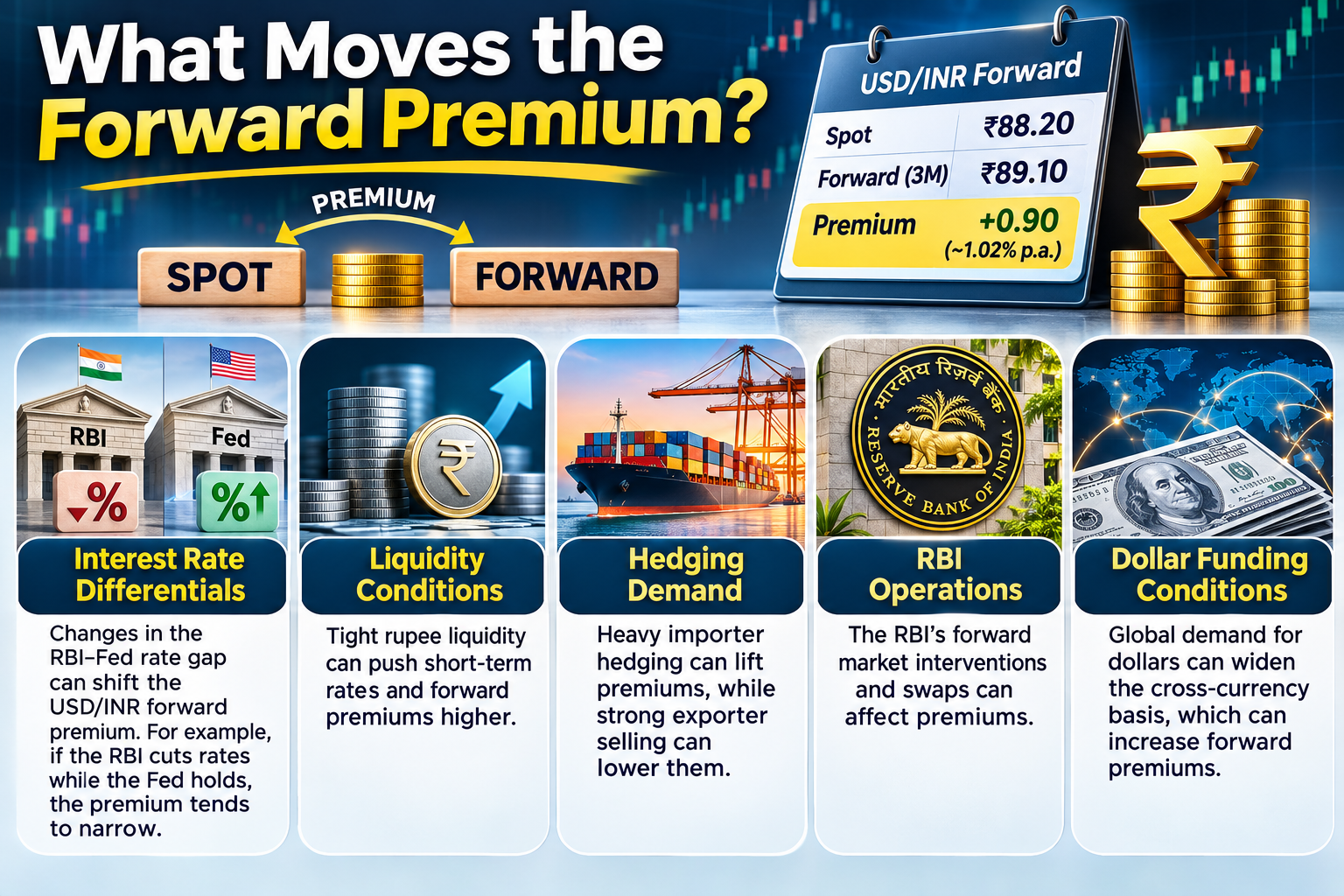
- Changes in interest rate differentials: if the RBI cuts rates while the Fed holds, the USD/INR forward premium tends to narrow.
- Liquidity conditions: tight rupee liquidity can push short-term rates and premiums higher.
- Hedging demand: heavy importer hedging can lift premiums; strong exporter selling can lower them.
- RBI operations: the RBI’s forward market interventions and swaps can affect premiums.
- Dollar funding conditions: global demand for dollars can widen the cross-currency basis.
 Common Mistakes
- Treating the forward rate as a forecast: under CIP, the forward reflects interest differentials, not a prediction of where spot will go.
- Ignoring roll costs: holding futures across expiries means paying or earning the forward premium.
- Assuming UIP holds: high-yielding currencies do not always depreciate as theory suggests.
- Overlooking day counts and compounding: small differences matter in professional pricing.
- Using offshore platforms: Indian residents should trade only exchange-traded currency derivatives through SEBI-registered brokers, as offshore leveraged forex is not permitted under FEMA.
Quick Reference
| Term | Meaning |
|---|---|
| Interest rate parity | Forward minus spot reflects the interest rate differential |
| Forward premium | Forward rate above spot |
| Forward discount | Forward rate below spot |
| Forward points | Difference between forward and spot, quoted in pips or paise |
| Cross-currency basis | Measured deviation from CIP |
| Carry trade | Borrowing a low-yielder to buy a high-yielder, betting UIP fails |
FAQs
What is interest rate parity in simple terms?
It is the idea that the difference between forward and spot exchange rates reflects the difference in interest rates between two currencies.
Why are USD/INR forward rates higher than spot?
Because rupee interest rates have generally been higher than dollar rates, so the dollar trades at a forward premium against the rupee.
What is the difference between covered and uncovered interest rate parity?
Covered parity uses a forward hedge and holds closely in practice. Uncovered parity assumes no hedge and often fails in the short term.
Is the forward rate a prediction of the future spot rate?
Not really. It mainly reflects interest rate differentials, not a forecast.
How does interest rate parity affect futures traders?
It explains why later expiries trade at a premium and why rolling positions has a cost or benefit.
Does interest rate parity always hold?
Covered parity holds closely in liquid markets but has shown deviations since 2008. Uncovered parity often does not hold.
Conclusion
Interest rate parity explains why forward rates differ from spot: the gap reflects the interest rate differential between two currencies. Covered parity is enforced by arbitrage and is used every day to price forwards and futures, including USD/INR contracts on Indian exchanges. Uncovered parity is weaker in practice, and its failure helps explain the carry trade.
For traders, it explains futures premiums and roll costs. For businesses, it shows the true cost or benefit of hedging. Understanding it turns forward quotes from a mystery into simple arithmetic.