
Introduction
Search online for how to become a forex trader in India and you will find two very different pictures. One shows quick profits, expensive cars and “signal groups” promising daily income. The other, quieter picture is of people who spend years building skills, trading small, managing risk carefully and slowly becoming consistent.
The second picture is the real one. Becoming a currency trader is possible in India, either as an independent trader using exchange-traded currency derivatives or as a professional in a bank, corporate treasury or trading firm. But it takes time, discipline and an understanding of Indian rules.
This guide explains how to become a forex trader in India step by step: the legal framework, the skills you need, how to open an account, the career paths available, a realistic timeline, costs and tax, and the mistakes that stop most beginners.
Step 1: Understand What Is Legal in India
The first lesson in how to become a forex trader in India is about the law, not charts.
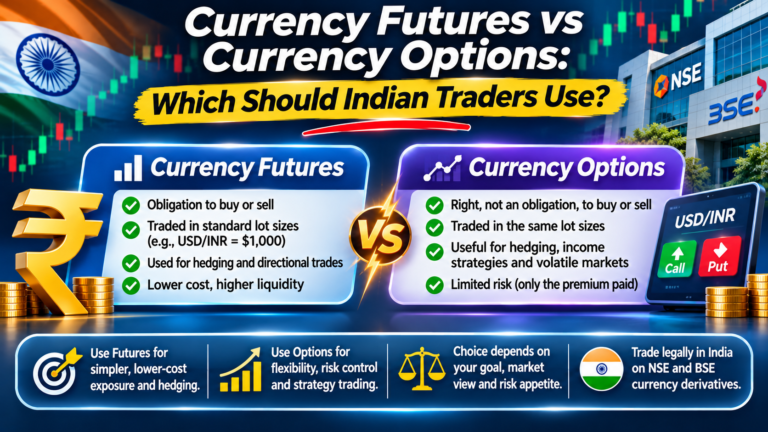
- Legal: trading currency futures and options on recognised exchanges, NSE and BSE, through a SEBI-registered broker.
- Not permitted: trading leveraged forex or CFDs through offshore brokers and apps. Under the Foreign Exchange Management Act (FEMA), Indian residents cannot do this, and remitting money abroad for margin trading is not permitted under the Liberalized Remittance Scheme.
- Warning list: the Reserve Bank of India publishes an Alert List of entities not authorised to deal in forex or run forex trading platforms.
On Indian exchanges, you can trade USD/INR, EUR/INR, GBP/INR and JPY/INR, along with cross-currency pairs EUR/USD, GBP/USD and USD/JPY. Rupee pairs trade from 9am to 5pm IST, while cross-currency contracts trade for longer into the evening.
Step 2: Choose Your Path
There is more than one answer to how to become a forex trader in India, because there are several kinds of currency traders.
| Path | What you do | Typical entry route |
|---|---|---|
| Independent (retail) trader | Trade your own money in currency derivatives | Self-study, a broker account and practice |
| Bank treasury or forex dealer | Quote rates and manage the bank’s currency positions and client flows | Finance degree or MBA, joining a bank’s treasury team |
| Corporate treasury | Hedge a company’s currency exposure from imports, exports and borrowings | Finance, CA or MBA background, treasury roles |
| Proprietary trading desk | Trade a firm’s capital under strict risk limits | Demonstrated skill, quantitative ability, interviews and tests |
| Broker or research roles | Advise clients, write research or support trading | Finance qualifications and certifications such as NISM |
Many people start as independent traders and later move into professional roles, or the other way around. Be careful with offshore “prop firm” challenges: they often involve paying fees to overseas entities and trading offshore instruments, which raises FEMA questions for Indian residents.
Step 3: Build the Core Skills
Whichever path you choose, the skills behind how to become a forex trader in India are broadly the same. They fall into five groups.
Market knowledge
- How currency pairs, quotes, lots and tick sizes work.
- How Indian currency futures and options are structured, including expiry and settlement using the FBIL reference rate.
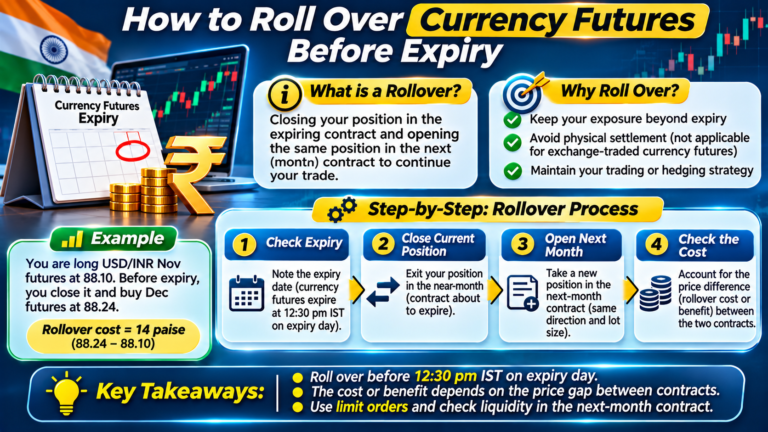
- One USD/INR lot is $1,000, so a one-paisa move is worth ₹10 per lot.
Fundamental analysis
- How interest rates, inflation, trade balances and capital flows move currencies.
- How the RBI, the US Federal Reserve and other central banks communicate.
- How oil prices and foreign portfolio flows affect the rupee.
Technical analysis
- Trends, support and resistance, chart patterns and price action.
- A small set of indicators you understand well, rather than many you use poorly.
- Multiple timeframe analysis.
Risk management
- Position sizing, often risking 1% or less of capital per trade.
- Stop-losses, maximum daily loss limits and understanding margin.
- Expectancy: how win rate and reward-to-risk combine.
Psychology and discipline
- Following a written plan, avoiding revenge trading and handling losing streaks.
- Keeping a journal and reviewing your behaviour honestly.
Useful extra skills
- Spreadsheets for tracking trades and results.
- Basic Python or a backtesting tool for testing ideas.
Step 4: Get Educated and Certified
No formal degree is required to trade your own money, but structured learning helps. Useful options include:
- NISM Series-I: Currency Derivatives Certification: from the National Institute of Securities Markets. It is required for certain people who work in currency derivatives at brokers, and it is an excellent foundation for anyone learning how to become a forex trader in India.
- Degrees: economics, commerce, finance or mathematics are common backgrounds for professional roles.
- Professional qualifications: an MBA in finance, CA, CFA or FRM can help for bank treasury, corporate treasury and risk roles.
- Books and exchange material: classic trading books, plus NSE and BSE education resources on currency derivatives.
Step 5: Open the Right Account
For an independent trader, the practical side of how to become a forex trader in India looks like this:
- Choose a SEBI-registered broker that offers currency derivatives on NSE and/or BSE. Check its registration on SEBI’s website.
- Complete KYC with your PAN, Aadhaar or other address proof, a bank account and a photograph.
- Activate the currency derivatives segment. Brokers usually ask for income or financial proof, such as bank statements or an income tax return, before enabling derivatives trading.
- Understand the costs: brokerage, exchange transaction charges, GST, SEBI fees and stamp duty.
- Learn the platform: order types, margin display, position view and contract notes.
Step 6: Practise Before Risking Real Money
- Backtest: test your strategy on historical USD/INR or EUR/USD charts with clear rules.
- Paper trade: record trades in real time without money for at least a few months.
- Go live small: start with one lot and a strict daily loss limit.
- Review weekly: compare results with your plan and fix one problem at a time.
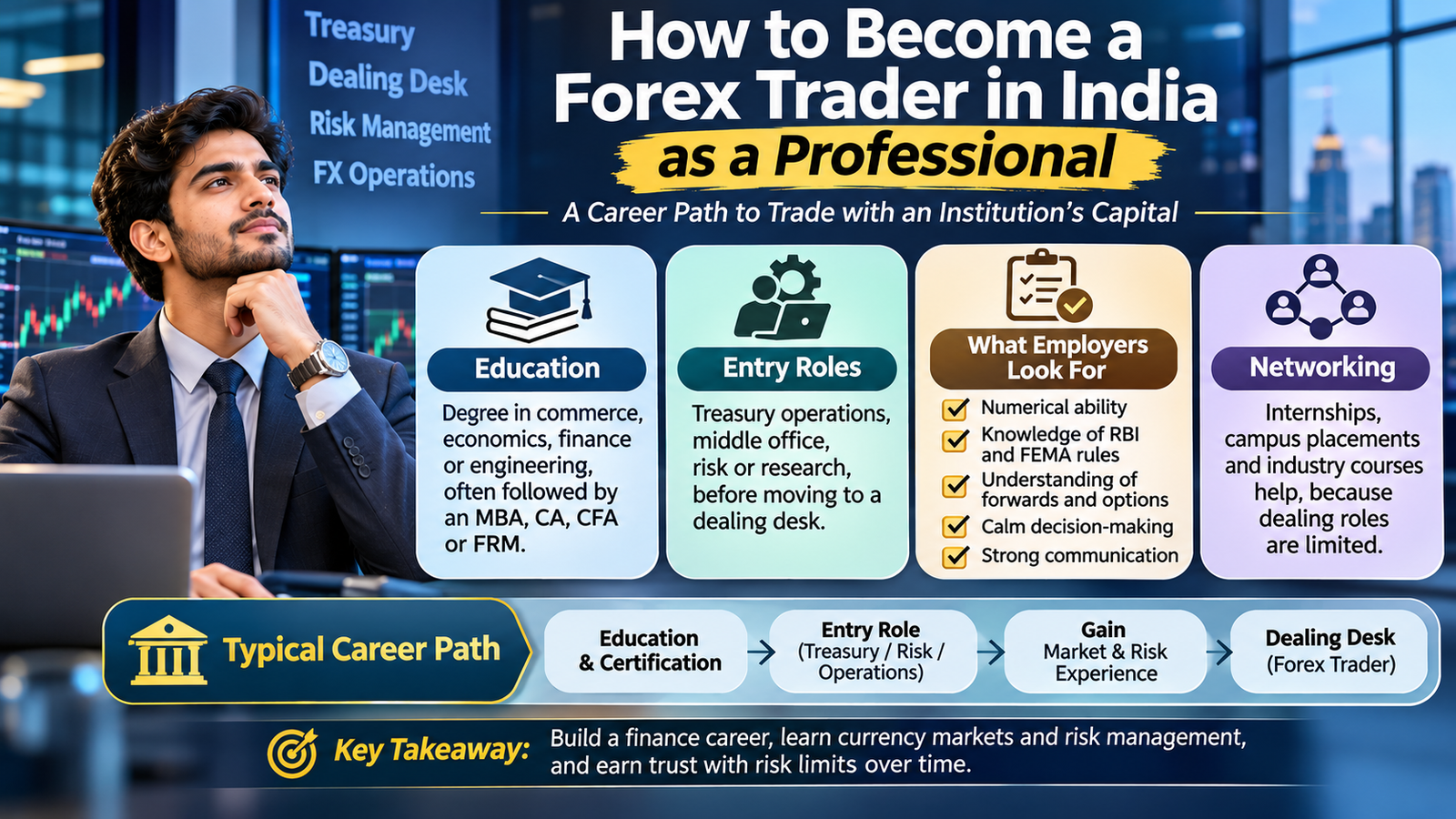
How to Become a Forex Trader in India as a Professional
If you would rather trade with an institution’s capital than your own, the route is different. Banks that deal in foreign exchange run treasury desks where dealers quote rates to corporate clients, manage the bank’s currency positions and trade in the interbank market. Large companies employ treasury teams to hedge import and export exposure.
- Education: a degree in commerce, economics, finance or engineering, often followed by an MBA, CA, CFA or FRM.
- Entry roles: treasury operations, middle office, risk or research, before moving to a dealing desk.
- What employers look for: numerical ability, knowledge of RBI and FEMA rules, understanding of forwards and options, calm decision-making and strong communication.
- Networking: internships, campus placements and industry courses help, because dealing roles are limited.
For this route, learning how to become a forex trader in India means building a finance career first and earning trust with risk limits over time, rather than proving yourself with your own money.
A Realistic Timeline: How to Become a Forex Trader in India
There is no fixed schedule, but this outline reflects how long the process usually takes for someone studying seriously alongside a job or studies.
| Period | Focus | Milestone |
|---|---|---|
| Months 0–3 | Market basics, Indian rules, platform, NISM study | Understand contracts, costs and the legal route |
| Months 3–6 | Choose one strategy, backtest it, start a journal | A written trading plan with entry, exit and risk rules |
| Months 6–9 | Paper trading and forward testing | At least 50 recorded trades following the plan |
| Months 9–12 | Live trading with one lot and strict limits | Following rules consistently, even if profits are small |
| Months 12–24 | Refine strategy, review statistics, scale slowly if justified | Evidence of a stable edge over many trades |
For many people, reaching consistency takes two years or more, and some never get there. Be wary of anyone who says otherwise. Understanding how to become a forex trader in India realistically means accepting that the learning curve is long.
How Much Capital Do You Need?
Exchange-traded currency derivatives have small contract sizes, so you do not need a large amount to start. But capital affects how well you can manage risk.
- If you risk 1% per trade, a stop-loss of 10 paise on one USD/INR lot means a ₹100 risk, which suits capital of about ₹10,000.
- Margin requirements are set by the exchange’s risk system and change with volatility, so check your broker’s margin calculator.
- Only trade with money you can afford to lose, and never borrow to trade.
The figures above are illustrative; actual margins and suitable capital depend on your strategy and market conditions.
A Sample Daily Routine
| Time (IST) | Activity |
|---|---|
| 8:30am | Check overnight moves in the dollar, US yields, oil and global stocks |
| 8:45am | Review the economic calendar and RBI or Fed events |
| 9:00am | Indian currency market opens; watch the first move |
| Morning to afternoon | Execute planned trades only; avoid impulsive entries |
| Around 1:30pm (winter) | London open can increase activity in cross-currency pairs |
| Evening | Journal trades, review mistakes and plan the next day |
Tax and Compliance
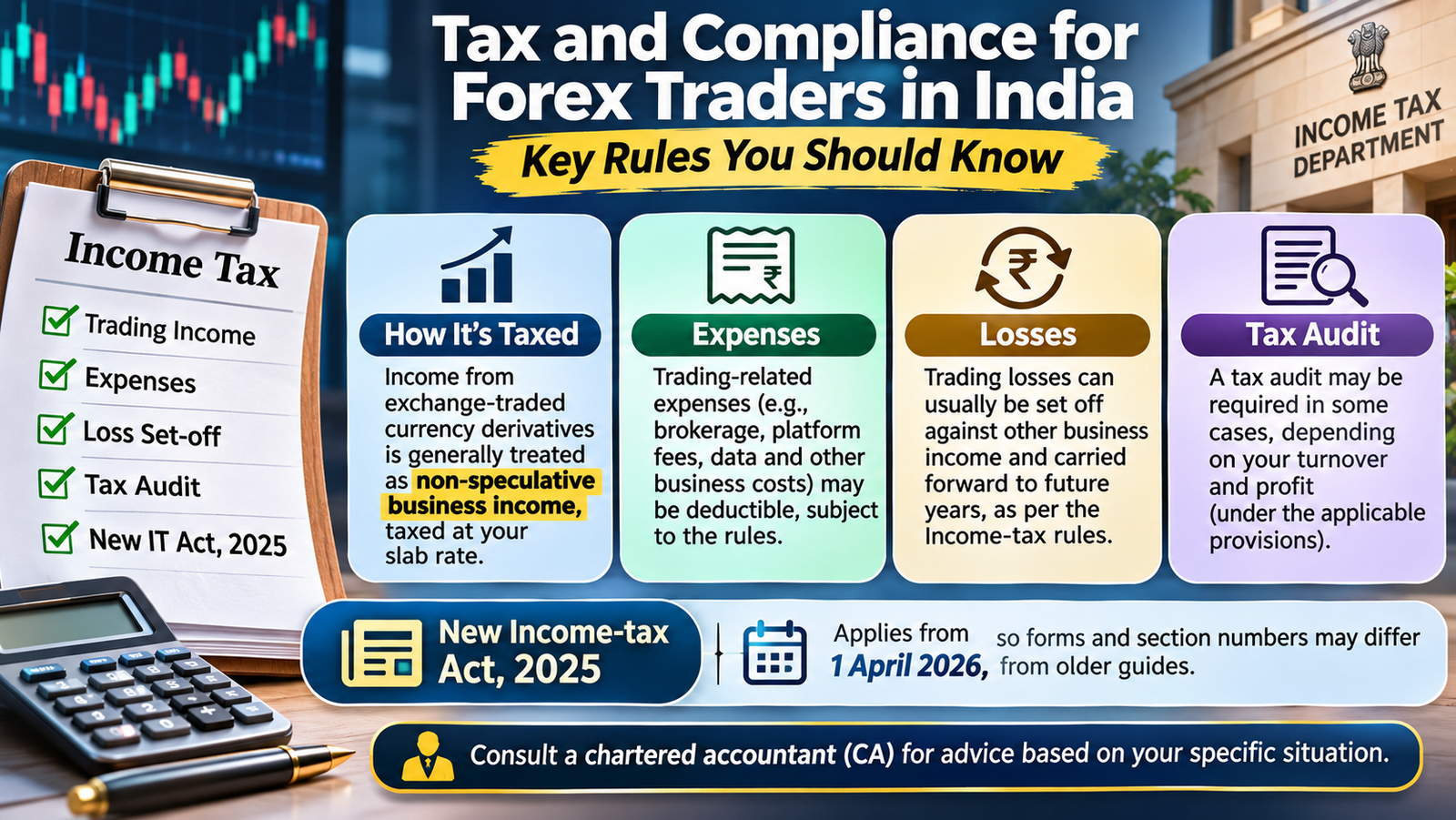
- Income from exchange-traded currency derivatives is generally treated as non-speculative business income, taxed at your slab rate.
- Expenses related to trading may be deductible, and losses can usually be set off and carried forward, subject to the rules.
- A tax audit may be required in some cases depending on turnover and profit.
- The new Income-tax Act, 2025 applies from 1 April 2026, so forms and section numbers may differ from older guides. Consult a chartered accountant.
 Common Mistakes When Learning How to Become a Forex Trader in India
- Using offshore apps: illegal for residents under FEMA and risky for your money.
- Paying for “guaranteed” signals or courses: legitimate education does not promise fixed returns.
- Skipping risk management: one oversized loss can undo months of progress.
- Switching strategies constantly: you never gather enough data to know what works.
- Quitting a job too early: keep a stable income until you have long-term evidence of consistency.
- Ignoring tax: poor record-keeping creates problems at filing time.
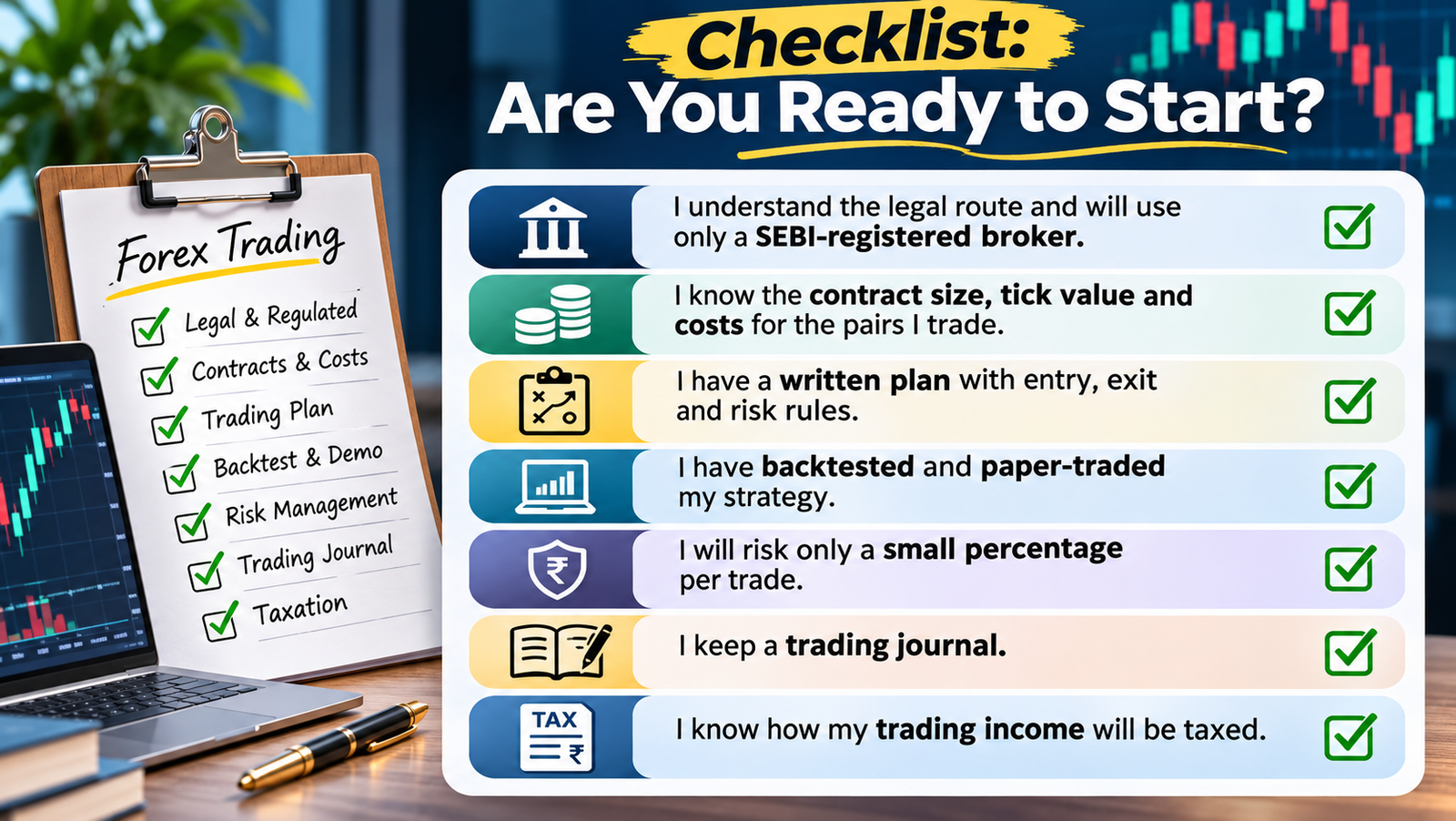
Checklist: Are You Ready to Start?
- I understand the legal route and will use only a SEBI-registered broker.
- I know the contract size, tick value and costs for the pairs I trade.
- I have a written plan with entry, exit and risk rules.
- I have backtested and paper-traded my strategy.
- I will risk only a small percentage per trade.
- I keep a trading journal.
- I know how my trading income will be taxed.
 FAQs
How to become a forex trader in India legally?
Open an account with a SEBI-registered broker, activate the currency derivatives segment and trade currency futures and options on NSE or BSE. Avoid offshore leveraged forex platforms.
Do I need a degree to trade forex?
Not to trade your own money. Professional roles in banks and treasuries usually require finance-related degrees or qualifications.
Is NISM certification required?
It is required for certain roles at brokers dealing in currency derivatives. For independent traders it is optional but highly useful.
How long does it take to become consistent?
Often two years or more of study, practice and live trading, and results vary widely.
Can I trade EUR/USD from India?
Yes, through EUR/USD futures and options on Indian exchanges, along with GBP/USD and USD/JPY.
Can I become a full-time trader quickly?
It is wiser to keep another source of income until you have a long, documented record of consistent results.
Conclusion
Learning how to become a forex trader in India starts with the legal route: currency derivatives on NSE and BSE through SEBI-registered brokers. From there, build market knowledge, analysis skills, risk management and discipline, then practise before trading small with real money.
Expect a timeline measured in years rather than weeks. Whether you aim to trade your own capital or join a bank treasury or trading desk, the traders who last are the ones who respect risk, keep learning and stay patient.