
Introduction
Central banks move currencies not only through what they do, but through what they say. A single word in a policy statement, a change in tone at a press conference or a new phrase in the minutes can send a currency sharply higher or lower within seconds.
Traders sum up this tone with two words: hawkish and dovish. Understanding hawkish vs dovish language is one of the most practical skills in fundamental forex analysis, because it helps you judge where interest rates are likely to go next, and interest rates are among the strongest long-term drivers of exchange rates.
This guide explains what hawkish vs dovish means, the phrases to look for, how central banks such as the US Federal Reserve and the Reserve Bank of India communicate, how currencies react, and how to read central bank events step by step.
What Do Hawkish and Dovish Mean?
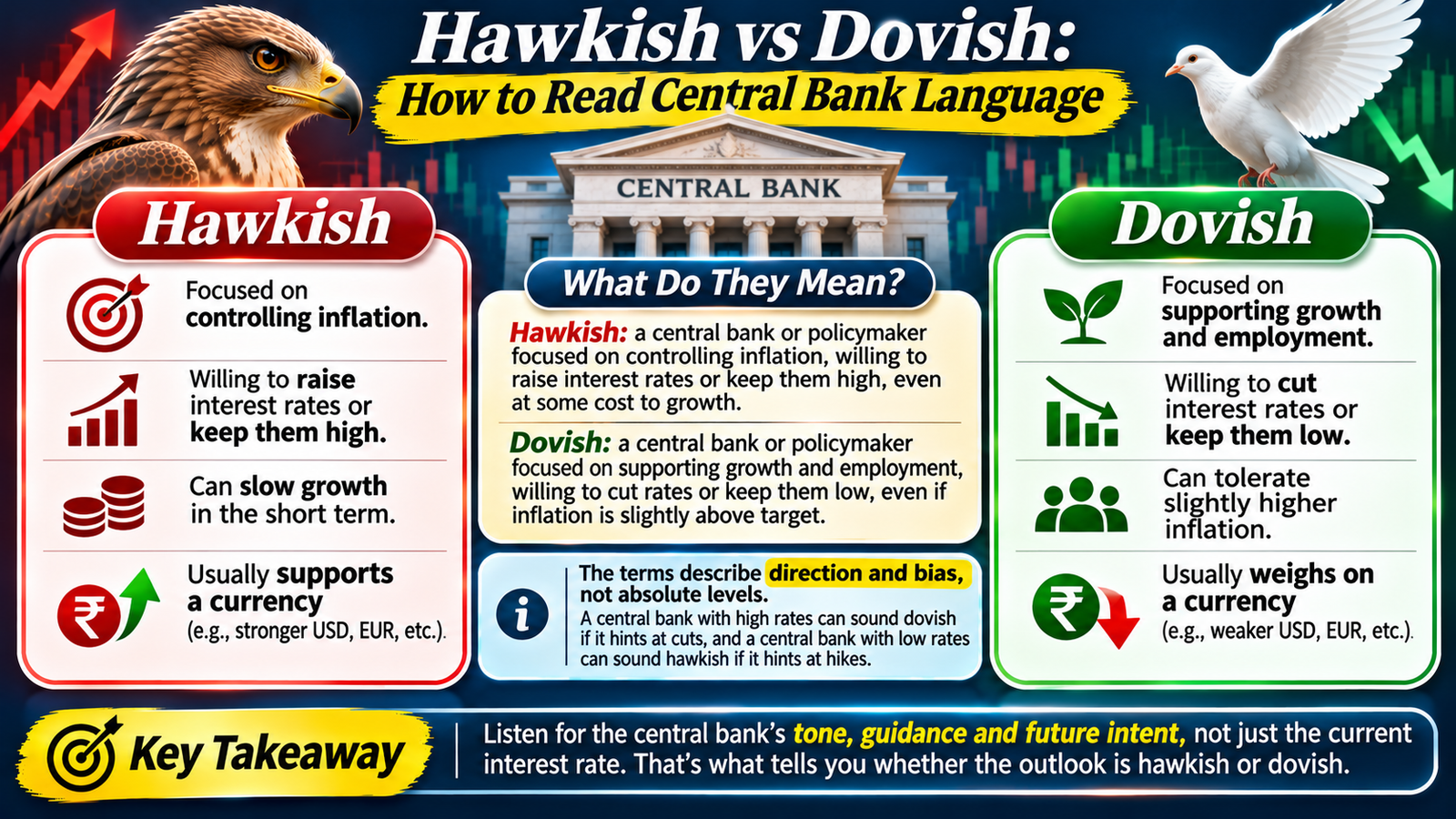
- Hawkish: a central bank or policymaker focused on controlling inflation, willing to raise interest rates or keep them high, even at some cost to growth. Hawkish signals usually support a currency.
- Dovish: a central bank or policymaker focused on supporting growth and employment, willing to cut rates or keep them low, even if inflation is slightly above target. Dovish signals usually weigh on a currency.
The terms describe direction and bias, not absolute levels. A central bank with high rates can sound dovish if it hints at cuts, and a central bank with low rates can sound hawkish if it hints at hikes.
Hawkish vs Dovish: Side-by-Side Comparison
| Feature | Hawkish | Dovish |
|---|---|---|
| Main concern | Inflation | Growth and employment |
| Rate bias | Hike or hold high | Cut or hold low |
| Balance sheet | Shrink (quantitative tightening) | Expand (quantitative easing) |
| Typical currency reaction | Stronger | Weaker |
| Typical bond yield reaction | Higher | Lower |
| Typical stock market reaction | Often weaker | Often stronger |
Why Hawkish vs Dovish Matters for Currencies
Currencies respond to interest rate differentials, the gap between rates in two countries. Higher expected rates make a currency’s deposits and bonds more attractive, drawing in capital. When a central bank turns hawkish, markets price in higher future rates and the currency tends to rise. When it turns dovish, markets price in lower rates and the currency tends to fall.
What matters most is the change in expectations. If a rate hike is fully expected, the currency may barely move, or even fall, if the accompanying message hints that the hiking cycle is ending. Reading hawkish vs dovish signals is really about comparing what the central bank says with what the market already expected.
Hawkish vs Dovish Phrases to Watch
| Hawkish phrases | Dovish phrases |
|---|---|
| “Inflation remains elevated” | “Inflation has eased considerably” |
| “Further tightening may be appropriate” | “The committee will be patient” |
| “Upside risks to inflation” | “Downside risks to growth” |
| “Rates will need to stay higher for longer” | “Policy is well positioned to respond to weakness” |
| “The labour market remains tight” | “The labour market has cooled” |
| “Vigilant”, “resolute”, “determined” | “Supportive”, “accommodative”, “flexible” |
| “Inflation expectations must stay anchored” | “Room to ease” |
Watch for changes from one statement to the next. Removing a word can matter as much as adding one. For example, dropping “further” from “further tightening” can signal that hikes are over.
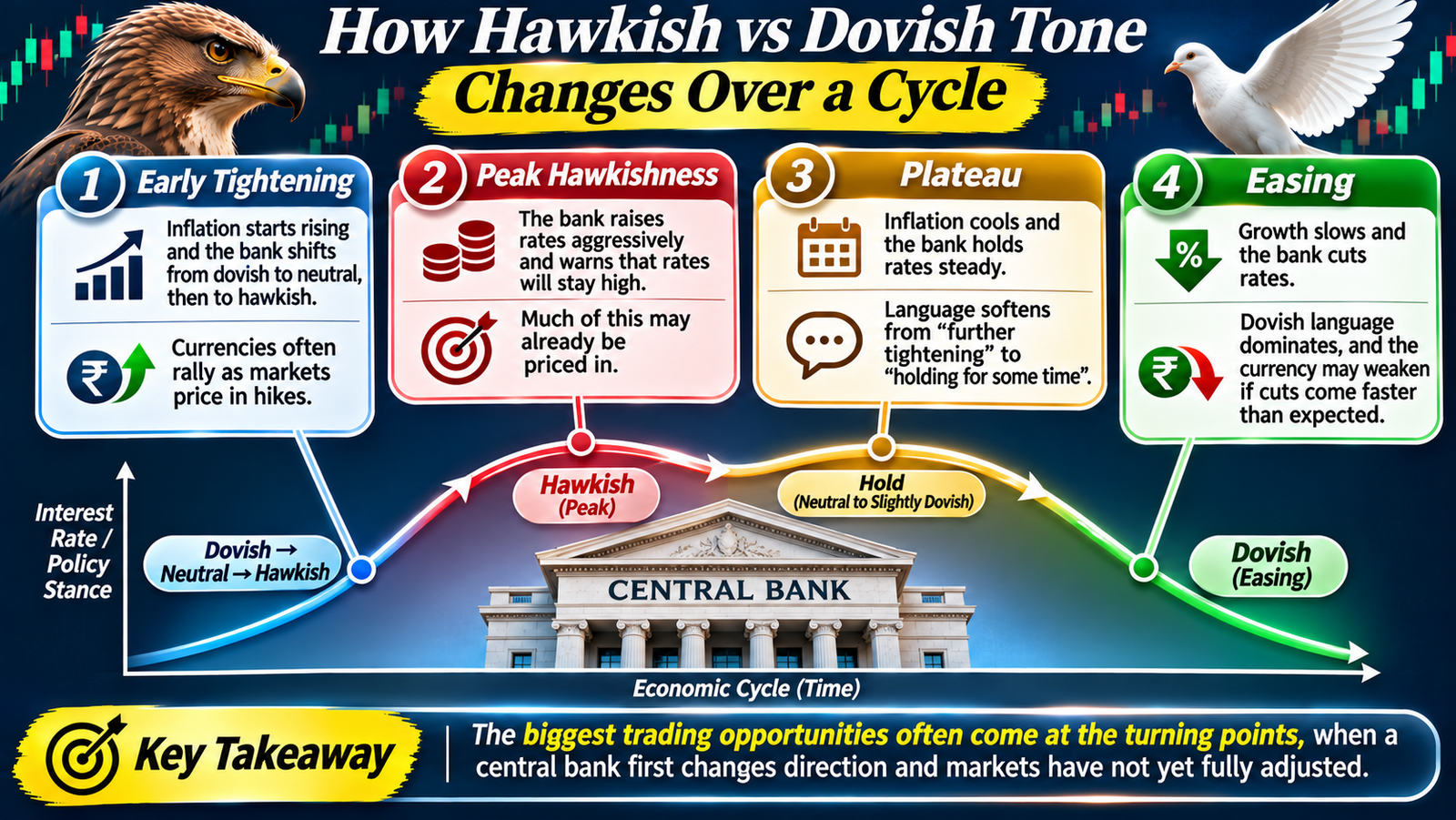
How Hawkish vs Dovish Tone Changes Over a Cycle
Central bank tone tends to follow the economic cycle. Recognizing where a bank sits in that cycle makes it easier to judge whether the next signal is likely to be hawkish or dovish.
- Early tightening: inflation starts rising and the bank shifts from dovish to neutral, then to hawkish. Currencies often rally as markets price in hikes.
- Peak hawkishness: the bank raises rates aggressively and warns that rates will stay high. Much of this may already be priced in.
- Plateau: inflation cools and the bank holds rates steady. Language softens from “further tightening” to “holding for some time”.
- Easing: growth slows and the bank cuts rates. Dovish language dominates, and the currency may weaken if cuts come faster than expected.
The most profitable hawkish vs dovish shifts for traders often come at the turning points, when a bank first changes direction and markets have not yet adjusted.
Data That Drives Hawkish vs Dovish Shifts
Central banks respond to data, so watching the same indicators helps you anticipate their tone:
- Inflation: consumer price index (CPI) and core inflation readings.
- Jobs: unemployment, payrolls and wage growth.
- Growth: GDP, purchasing managers’ indices and retail sales.
- Inflation expectations: surveys and market-based measures.
How Central Banks Communicate
- Policy statements: the official decision and a short explanation, published at a fixed time.
- Press conferences: the governor or chair explains the decision and answers questions. Unscripted answers often move markets more than the statement.
- Minutes: detailed records of the meeting, published later, showing the range of views.
- Projections: forecasts for growth, inflation and, in some cases, rates.
- Voting records: how many members voted for each option.
- Speeches and interviews: individual members share their views between meetings.
Reading the US Federal Reserve
The Federal Open Market Committee (FOMC) meets eight times a year. Key tools for reading Fed hawkish vs dovish signals include:
- The statement: released at 2:00pm US Eastern Time. In Indian time, that is 11:30pm IST when the US is on daylight saving time and 12:30am IST in winter.
- The press conference: starts 30 minutes after the statement.
- The dot plot: published four times a year, showing where each participant expects rates to be. A higher median dot is hawkish; a lower one is dovish.
- Dissents: a member voting for a bigger hike signals hawkish pressure; a member voting for a cut signals dovish pressure.
- Minutes: released three weeks after each meeting.
Traders also follow market-based tools, such as fed funds futures, to see what probability the market assigns to each outcome before the meeting.
Reading the Reserve Bank of India
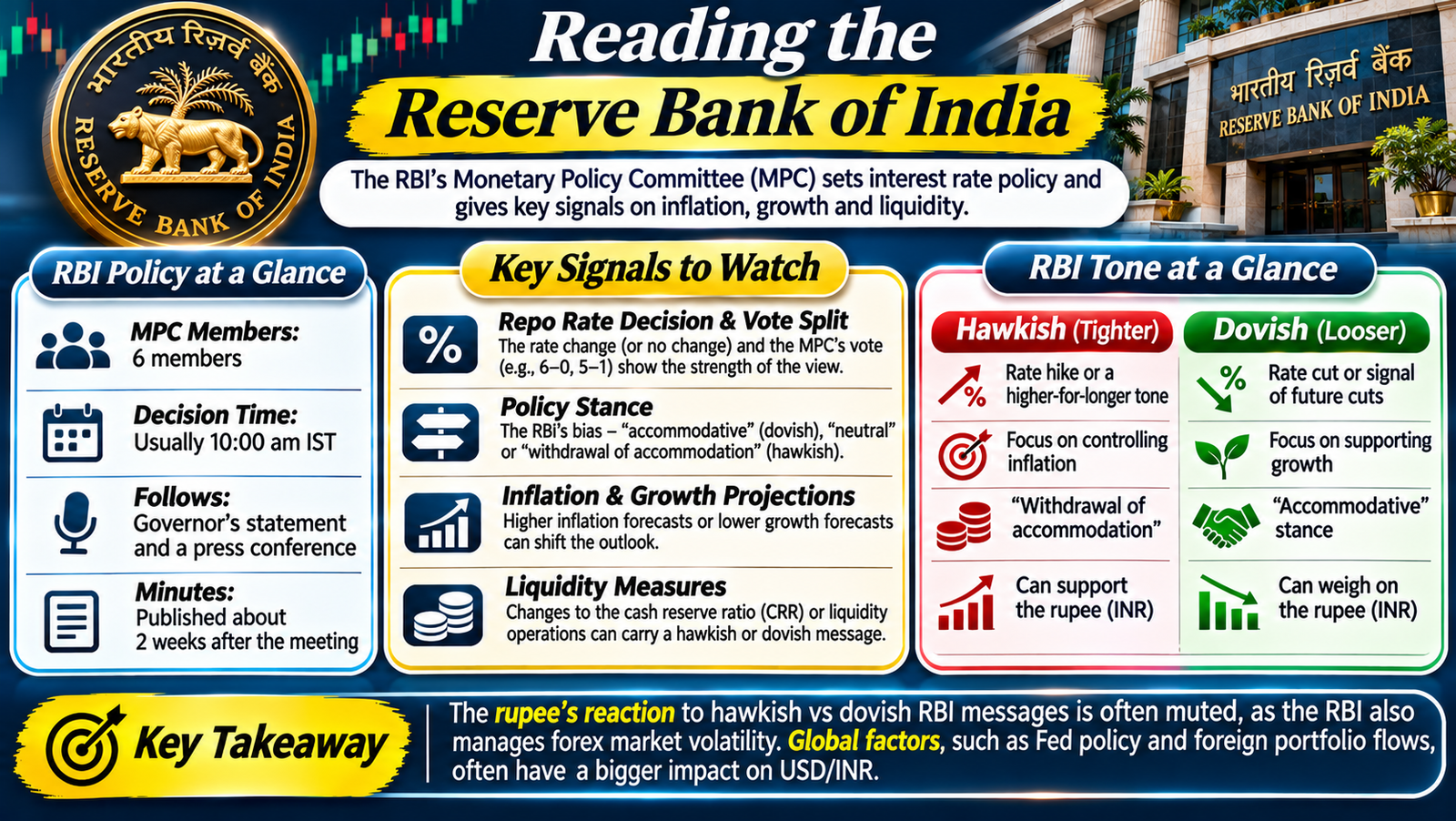
The RBI’s Monetary Policy Committee (MPC) has six members and usually announces decisions at 10:00am IST, followed by the Governor’s statement and a press conference. Signals to watch include:
- The repo rate decision and the vote split.
- The policy stance: terms such as “accommodative” (dovish), “neutral” and “withdrawal of accommodation” (hawkish) describe the RBI’s bias.
- Inflation and growth projections: higher inflation forecasts or lower growth forecasts can shift the outlook.
- Liquidity measures: changes to the cash reserve ratio or liquidity operations can carry a hawkish or dovish message.
- Minutes: published about two weeks after the meeting, showing each member’s reasoning.
The rupee’s reaction to hawkish vs dovish RBI messages is often muted compared with major currencies, because the RBI also manages volatility in the foreign exchange market. Global factors, such as Fed policy and foreign portfolio flows, often matter more for USD/INR.
Other Central Banks Traders Watch
- European Central Bank (ECB): often stresses a “data-dependent, meeting-by-meeting” approach. Watch inflation projections and the press conference.
- Bank of England (BoE): its nine-member committee publishes a vote split, which is a key hawkish vs dovish signal for sterling.
- Bank of Japan (BoJ): any hint of moving away from very low rates can trigger a sharp yen rally.
Hawkish Cuts and Dovish Hikes
Central bank decisions are not always simply hawkish or dovish. Two common mixed outcomes are:
- Hawkish cut: the bank cuts rates but signals that further cuts are unlikely or will be slow. The currency may rise despite the cut.
- Dovish hike: the bank raises rates but signals that the hiking cycle is over or nearly over. The currency may fall despite the hike.
These examples show why reading hawkish vs dovish tone is about the message for the future, not just the decision on the day.
Worked Example: Reading a Policy Statement
This example is illustrative and uses a hypothetical statement and prices.
Before a meeting, markets fully expect a central bank to hold rates. EUR/USD trades at 1.1650. The statement says:
“Inflation has continued to ease, but remains above target. The committee judges that the risks to achieving its goals are moving into better balance. The committee will remain attentive to the risks to both sides of its mandate.”
Compared with the previous statement, the phrase “further policy firming may be appropriate” has been removed.
- Removal of tightening language: dovish.
- “Risks moving into better balance”: dovish, suggesting less focus on inflation.
- “Remains above target”: slightly hawkish, but expected.
Overall, the statement leans dovish. If the statement comes from the Fed, the dollar might weaken and EUR/USD could rise, for example to 1.1690, a 40-pip move. If the chair then sounds more hawkish at the press conference, part of that move could reverse.
A Step-by-Step Approach to Central Bank Events
- Know the expectations: check what the market expects for rates and tone.
- Compare with the last statement: use a side-by-side or “redline” comparison to spot changed words.
- Read the projections: look for changes in inflation, growth and rate forecasts.
- Check the vote: dissent in either direction is informative.
- Listen to the press conference: unscripted answers can shift the hawkish vs dovish balance.
- Watch bond yields: two-year government bond yields react quickly to rate expectations and often lead the currency.
- Wait for the dust to settle: first moves are often volatile and can reverse.
Common Mistakes When Reading Hawkish vs Dovish Signals
- Ignoring expectations: a hike can be dovish if markets expected more.
- Focusing only on the decision: the guidance usually matters more.
- Overreacting to one speaker: one member’s view may not represent the committee.
- Trading the first spike: spreads widen and prices whip around in the first minutes.
- Forgetting the other side of the pair: a hawkish Fed may matter less if the ECB is even more hawkish.
- Over-leveraging around events: gaps and slippage can turn small positions into big losses.
Trading Hawkish vs Dovish Shifts from India
Indian residents can trade the effect of central bank policy through exchange-traded currency derivatives on NSE and BSE via SEBI-registered brokers. Contracts include USD/INR, EUR/INR, GBP/INR and JPY/INR, along with EUR/USD, GBP/USD and USD/JPY. Leveraged forex through offshore brokers is not permitted for Indian residents under FEMA.
Because FOMC decisions usually land around midnight in India, some cross-currency contracts may have closed for the day, and the reaction shows up when Indian markets open the next morning.
FAQs
What is the difference between hawkish vs dovish?
Hawkish means a bias towards higher interest rates to control inflation; dovish means a bias towards lower rates to support growth.
Is hawkish good for a currency?
Usually yes, because higher expected rates attract capital. But the reaction depends on what markets already expected.
What does a neutral stance mean?
The central bank has no clear bias towards hiking or cutting and will respond to incoming data.
What is forward guidance?
Communication about the likely future path of policy, used to shape market expectations.
What is a hawkish cut?
A rate cut accompanied by signals that further cuts are unlikely or will be slow.
How do I trade hawkish vs dovish news?
Compare the outcome with expectations, watch bond yields, wait for initial volatility to settle and use strict risk management.
Conclusion
Hawkish vs dovish describes the bias in central bank thinking, towards fighting inflation with higher rates or supporting growth with lower rates. Because interest rate expectations drive capital flows, central bank tone is one of the strongest forces in currency markets.
To read it well, compare each message with market expectations, track changes in wording, check projections and votes, and watch bond yields. Treat central bank events with caution: spreads widen, prices whip around, and the first reaction is not always the lasting one.