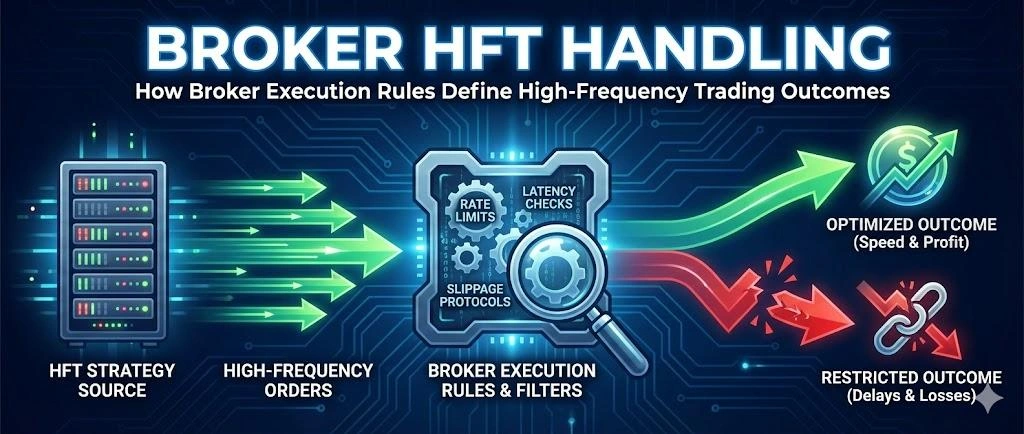
Forex broker selection in Vietnam requires verifying the broker’s regulatory tier, execution quality, and local payment support.
Quick Summary
Brokerage plays a very important role in trading and selecting one is a crucial step for a trader. When you are selecting a Forex broker in Vietnam you need to evaluate many things like their execution quality, the charges, the platform reliability and how the country’s rules work. Many traders often get distracted by fancy advertisements, but if they want long term success they need to focus on broker’s fill quality, liquidity and stability. To learn how forex broker selection in Vietnam works keep reading, here you’ll learn how to decide which broker is good for you by focusing on solid risk management and execution standards.
Is Forex Trading Legal in Vietnam?
Forex trading in Vietnam is not explicitly banned, but it is also not directly regulated under a domestic forex-specific legal framework. The State Bank of Vietnam (SBV) oversees foreign currency activities, while the State Securities Commission of Vietnam (SSC) handles securities markets. This means most Vietnamese traders access forex through international offshore brokers — a practice that carries cross-border regulatory risk but remains widely used.
Key Comparison Table: Broker Selection Factors
| Factor | Why It Matters | Risk if Ignored | What to Check |
| Regulation | Protects funds and dispute rights | Withdrawal issues or fraud | Tier-1 or recognized regulators |
| Execution Quality | Impacts slippage and fills | Hidden trading costs | Order execution reports |
| Trading Costs | Direct profitability impact | Overpaying spreads/fees | Spread + commission model |
| Platform Stability | Prevents execution delays | Missed trades | Server uptime, latency |
| Deposit/Withdrawal | Operational convenience | Funds stuck or delayed | Local payment methods |
| Customer Support | Problem resolution | Slow issue handling | 24/7 multilingual support |
Broker Comparison Table (Real Data)
| Broker | Regulator | Min. Deposit | Spread (EUR/USD) | VND Deposit | MT4/MT5 |
|---|---|---|---|---|---|
| IC Markets | ASIC | $200 | 0.0 pips | Bank Transfer | Both |
| Pepperstone | FCA, ASIC | $0 | 0.0 pips | Bank Transfer | Both |
| Fusion Markets | ASIC | $0 | 0.9 pips | Limited | Both |
| XM | CySEC, ASIC | $5 | 1.6 pips | Bank Transfer | Both |
| JustMarkets | FSA Seychelles | $10 | 0.3 pips | Momo, Visa | Both |
Note: Data is indicative and subject to change. Always verify directly with the broker before opening an account.
How Big Is the Forex Market in Vietnam?
Vietnam’s retail forex trading volume has grown significantly, driven by increased internet penetration, a young demographic, and growing interest in alternative investment assets. With over 97 million people and a rising middle class, Vietnam ranks among the fastest-growing forex trading markets in Southeast Asia, alongside Thailand, Indonesia, and the Philippines.
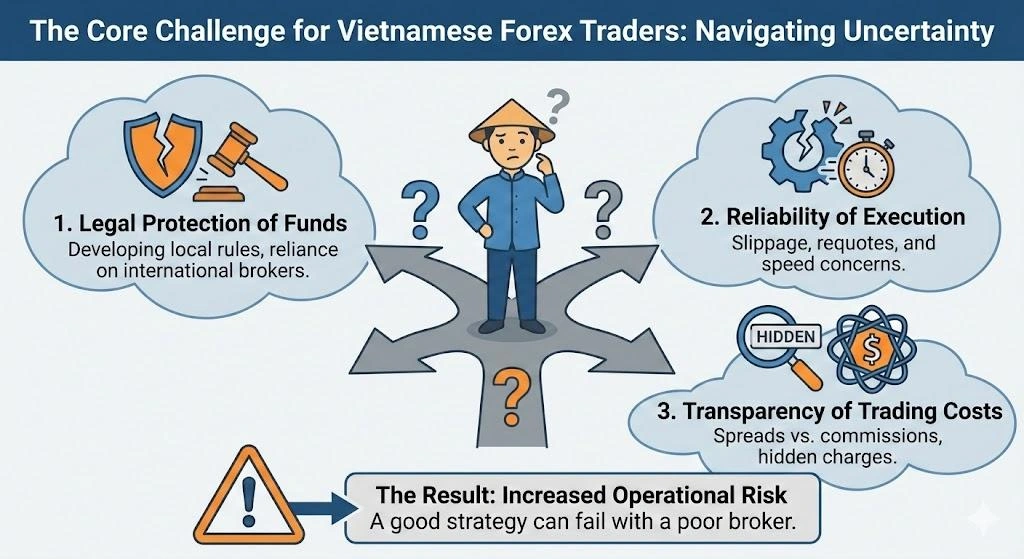
The Core Problem: Why Forex Broker Selection in Vietnam Is Complex
As Vietnam’s rules and regulations regarding financial markets are still developing, the international brokers have become the sole providers for most of the local traders. This creates uncertainty in three areas:
- Legal protection of funds
- Reliability of execution
- Transparency of trading costs
Most of the traders get swayed by flashy bonuses or easy apps instead of looking at the brokers actual structure. This increases the probability of operational risks rather than trading risks.
In simple terms:
A good strategy with a poor broker can still produce poor results.
Understanding the Role of Regulation in Broker Selection
We often misunderstand the rules & regulations, assuming that any license means they’re safe, but the regulatory quality is different for every country.
Why Regulation Matters
Regulations are important because they ensures:
- Segregation of client funds
- Audit requirements
- Complaint resolution channels
- Capital adequacy requirements
Without these protections, traders rely entirely on broker integrity.
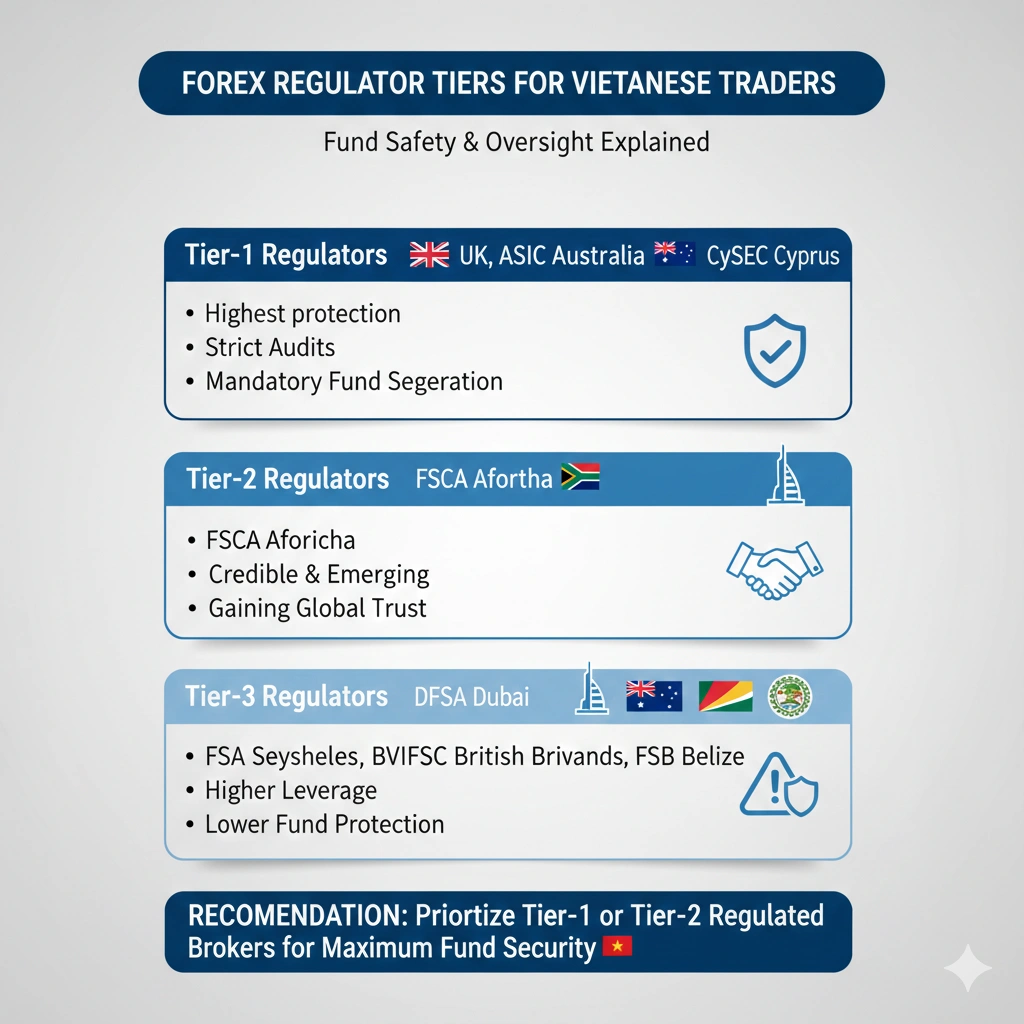
Tier-1 vs Tier-2 vs Tier-3 Regulators Explained for Vietnamese Traders
When doing forex broker selection in Vietnam, the regulator tier matters more than the license itself:
- Tier-1 Regulators (FCA UK, ASIC Australia, CySEC Cyprus) — Highest protection, strict audits, fund segregation mandatory
- Tier-2 Regulators (FSCA South Africa, DFSA Dubai) — Credible, emerging regulators gaining global trust
- Tier-3 Regulators (FSA Seychelles, BVIFSC British Virgin Islands, FSB Belize) — Lighter oversight, higher leverage allowed but lower fund protection
For Vietnamese traders, prioritizing a Tier-1 or Tier-2 regulated broker is strongly recommended, as it provides the highest level of fund security and legal recourse in case of a dispute — a critical factor when trading through international brokers without domestic forex regulation.
MetaTrader 4 vs MetaTrader 5 — Which Is Better for Vietnamese Traders?
Most international brokers offer Vietnamese traders access to either MetaTrader 4 (MT4) or MetaTrader 5 (MT5). MT4 remains the most widely used for forex-only trading due to its simplicity and large community of Expert Advisors (EAs). MT5 supports multi-asset trading including stocks, futures, and commodities, making it more suitable for advanced traders. Some brokers also offer cTrader and proprietary platforms, which may feature better charting and ECN execution environments.
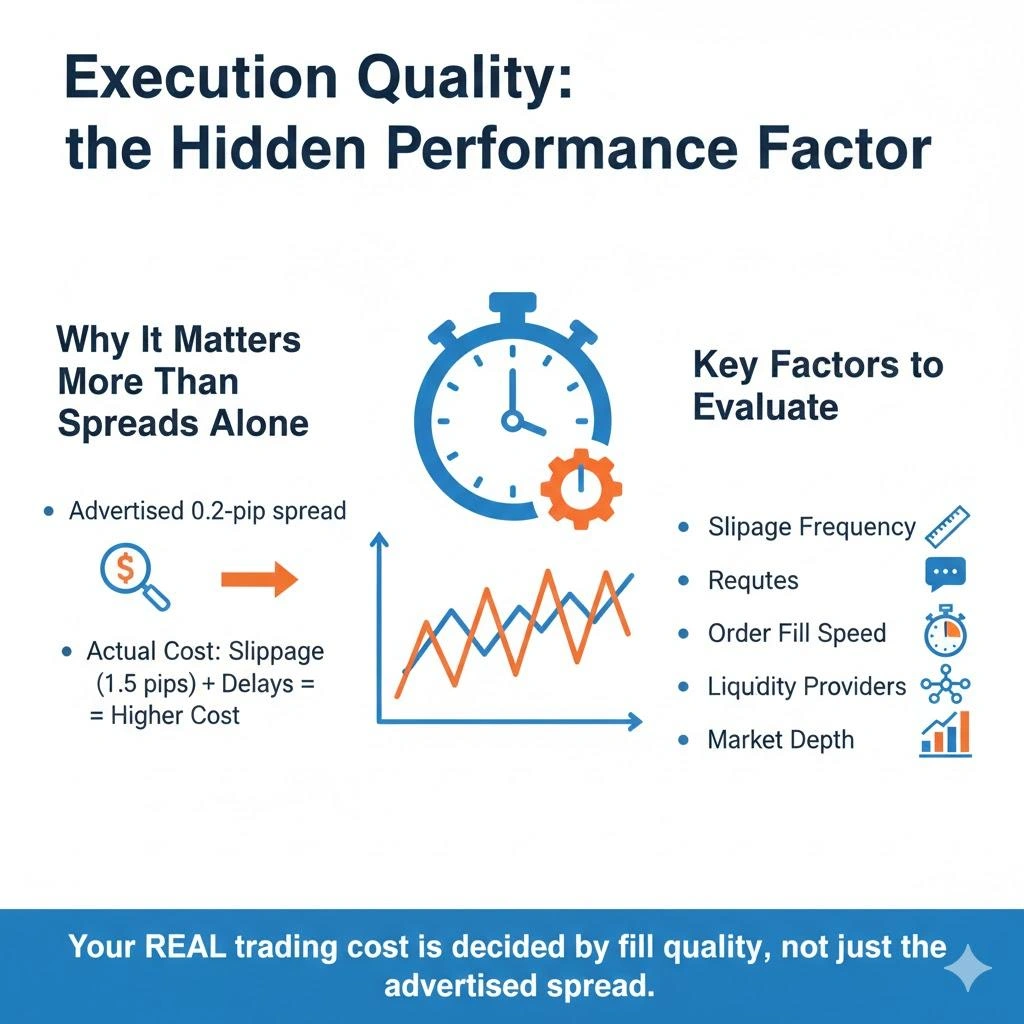
Execution Quality: The Hidden Performance Factor
How your trades are executed directly affects your profitability, yet execution quality remains one of the most overlooked factors in forex broker selection in Vietnam.
That’s why when selecting a broker you should evaluate their execution process like:
- Slippage frequency
- Requotes
- Order fill speed
- Liquidity providers
- Market depth
Why Execution Matters More Than Spreads Alone
A trader is advertising an offer of 0.2-pip spreads isn’t actually cheaper if:
- Slippage averages 1.5 pips
- Orders experience delays during volatility
- Stop losses execute poorly
In the end, your real trading cost is decided by the quality of your fills, not just from some flashy spread you see in the ad.
Demo Account Testing — Why It’s Non-Negotiable
Before committing real capital, every trader should open a forex demo account to evaluate execution speed, platform stability, and spread accuracy under real market conditions. A demo trading environment mirrors live market behavior and lets you test a broker’s order fill quality without financial risk. This step is especially important in forex broker selection in Vietnam where live customer support may vary significantly between brokers.
Trading Costs: Spread vs Commission Reality
Many traders evaluating best broker Vietnam options compare only spreads. However, total cost includes:
- Spread
- Commission
- Swap/overnight fees
- Conversion fees
- Withdrawal charges
Therefore, forex broker selection in Vietnam must align with trading strategy.
Platform Stability and Latency Considerations
Apart from checking the features that can affect your trading outcome, you should also check how reliable and stable the platform is during the market pressure.
If your platform is unstable it can cause:
- Missed entries
- Delayed exits
- Stop loss failures
- Execution slippage
This sort of risk occurs when:
- News events
- Market openings
- High volatility periods
Payment Systems and Operational Convenience
A lot of traders in Vietnam face difficulty with the payment system.
Key considerations include:
- Local bank support
- E-wallet options
- Processing speed
- Withdrawal charges
- Currency conversion charges
Problems in payments can affect your trading flow and shake your confidence.
Risk Management Perspective: Broker Risk vs Market Risk
Most traders assume that risk is only present in:
- Price movement uncertainty
- Volatility
- Strategy accuracy
However, broker risk includes:
- Counterparty risk
- Execution manipulation
- Withdrawal risk
- Technology failure
That’s why Forex broker selection in Vietnam can reduce these hidden risks and make your overall result more steady and predictable.
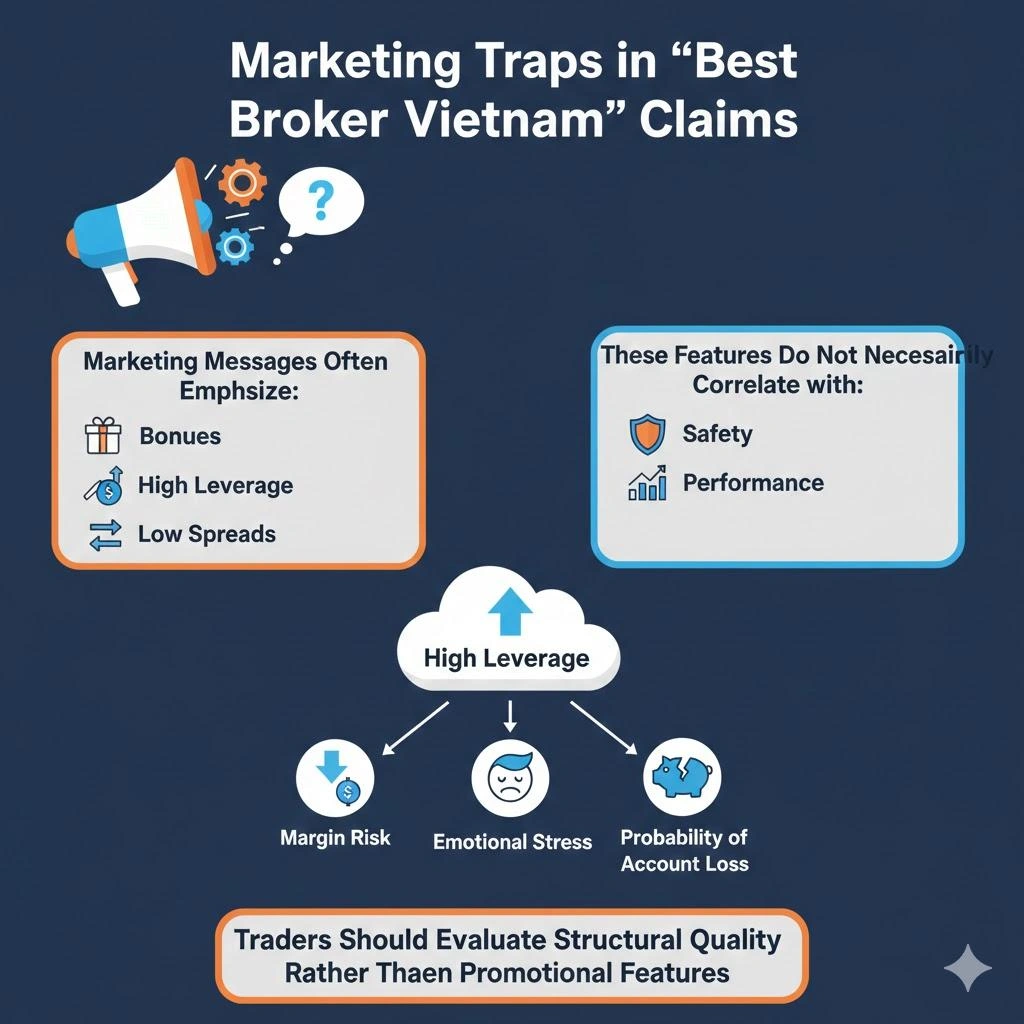
Marketing Traps in “Best Broker Vietnam” Claims
Marketing messages often emphasize:
- Bonuses
- High leverage
- Low spreads
- Fast profits
These features do not necessarily correlate with safety or performance.
High leverage, for example, increases:
- Margin risk
- Emotional stress
- Probability of account loss
Traders should evaluate structural quality rather than promotional features.
A Practical Framework for Forex Broker Selection in Vietnam
Here is a structured decision process:
Step 1: Regulation Check
First of all select the broker which is watched or under the eye of some well-known, reputed Global authorities.
Step 2: Execution Testing
Always take a demo before selecting to evaluate things like slippage, spreads and platform stability.
Step 3: Cost Analysis
Calculate the total amount charged monthly on your trading
Step 4: Withdrawal Testing
Try to withdraw a small amount first to ensure the process is smooth and fast.
Step 5: Support Evaluation
Connect with the team. And evaluate how they respond to your queries and how helpful and friendly they are.
These are the simple steps that you should consider while forex broker selection in Vietnam.
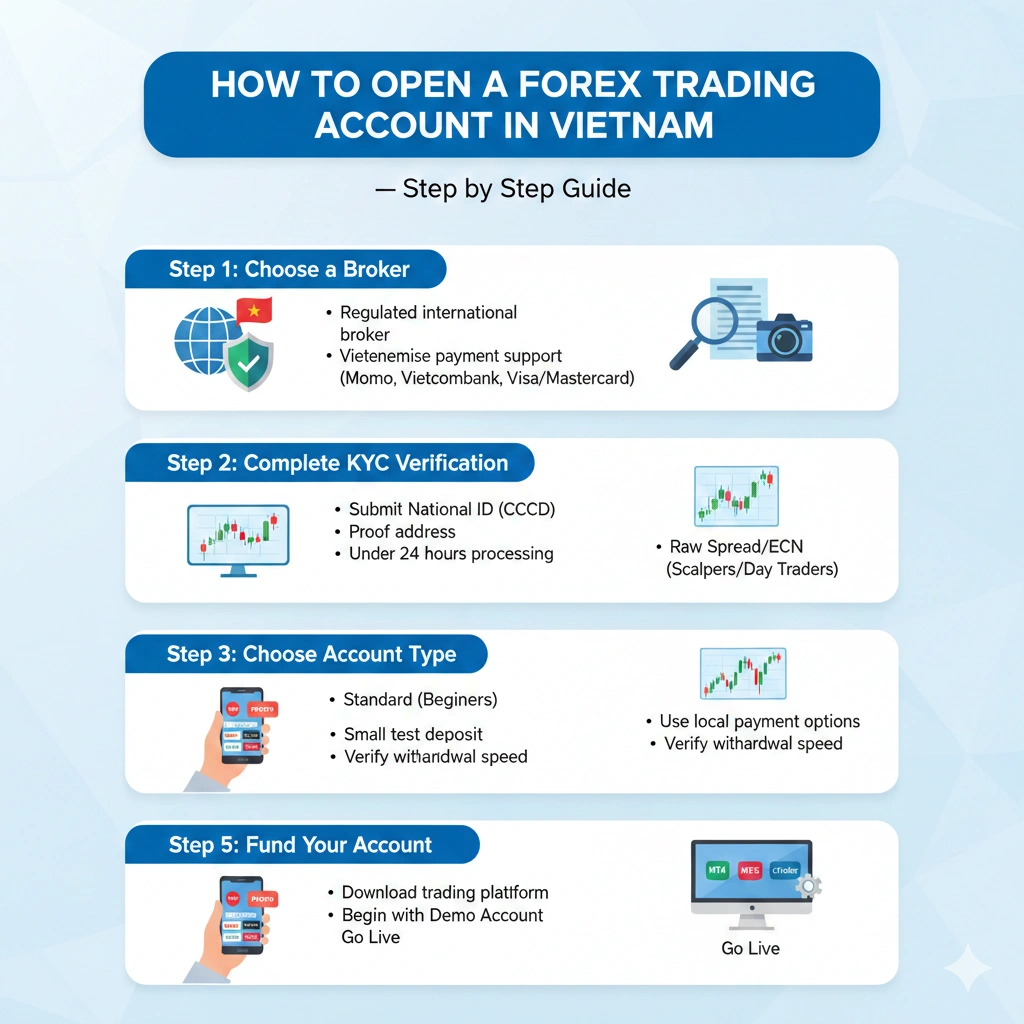
How to Open a Forex Trading Account in Vietnam — Step by Step
Opening a forex account in Vietnam as a first-time trader typically follows these steps:
Step 1 — Choose a regulated international broker with Vietnamese payment support (look for Momo, Vietcombank transfers, or Visa/Mastercard).
Step 2 — Complete KYC verification by submitting your national ID (CCCD), proof of address, and a selfie. Most brokers complete KYC in under 24 hours.
Step 3 — Choose your account type — Standard accounts suit beginners; Raw Spread or ECN accounts suit scalpers and day traders.
Step 4 — Fund your account using local payment options. Start with a small test deposit to verify withdrawal processing speed.
Step 5 — Download your trading platform (MT4, MT5, or cTrader) and begin with the demo account before going live.
Forex Taxes in Vietnam — What Traders Must Know
Profits from forex trading in Vietnam may be subject to Personal Income Tax (PIT) depending on how they are classified by Vietnamese tax authorities. Traders are advised to consult a local tax professional, as cross-border income reporting requirements can differ based on whether income is considered investment income or business income. Keeping detailed trade journals and broker statements is essential for accurate tax filing for forex traders in Vietnam.
Compliance Considerations for Vietnamese Traders
When you are trading across the border it means staying on top of the rules:
- Knowing the local currency laws
- Your tax duties
- Reporting international money moves
- Where your broker is based
You should consider learning local laws before entering into trading.
Compliance risk can affect fund accessibility and legal exposure.
Technology Tools That Help Broker Evaluation
Reliable broker evaluation tools include Edgewonk and TraderVue for trade journalling, MyFXBook for spread and execution tracking, and WikiFX and BrokerChooser for independent broker verification and licence checks.
By monitoring these things you can judge your broker’s performance rather than just believing your gut feeling.
Common Mistakes in Forex Broker Selection
We often make decisions based on their outer surface which leads to some common mistakes like:
- Selecting a broker based on bonuses
- Not testing in advance how you can get your money back
- Focusing only on spreads while ignoring the other hidden costs
- Using large leverage size
- While completely ignoring whether the platform can handle it when things get busy
To improve your trading outcome you need to identify these mistakes and avoid them.
Risk Diversification Strategy
To reduce their risk, many traders often:
- Use different brokers at once
- Divide their strategies into different parts
- And diversify their cash around various assets
This approach limits the damage if any single broker runs into trouble.
Conclusion: Forex Broker Selection in Vietnam
You won’t be able to achieve success with just strategies or indicators, you’ll also need a reliable broker on whom you can depend when the market is highly volatile or is running thin. Forex broker selection in Vietnam plays a very important part, to select the best you need to thoroughly check your broker’s execution quality, cost efficiency, and operational confidence. And apart from this focusing on strong regulations, fast execution and reliable withdrawal you can cut out the hidden risk that often ruins your result.
So connect with experts like InsightfulTrade, as they know that your trading environment matters as much as your strategy.
FAQs: Forex Broker Selection in Vietnam
Q1. What tools help evaluate forex brokers effectively in Vietnam?
To judge a broker fairly, Vietnamese traders can use trade journalling software like Edgewonk or TraderVue, spread comparison tools like MyFXBook, and broker fill quality trackers that log slippage data over time. Cross-referencing reviews on WikiFX and BrokerChooser also helps verify broker reliability before committing real capital.
Q2. How can Vietnamese traders check forex broker safety?
Vietnamese traders should verify the broker’s regulatory licence on the official regulator website (FCA, ASIC, or CySEC), confirm that client funds are held in segregated accounts, and conduct a small withdrawal test (as low as $10–$20) before depositing larger amounts. These three steps are the most reliable way to reduce risk in forex broker selection in Vietnam.
Q3. What is the safest way to deposit funds with international forex brokers?
The safest deposit method is using a traceable bank transfer via trusted Vietnamese banks like Vietcombank or Techcombank, or a verified e-wallet like Momo. Always start with a small test deposit before transferring large amounts, and avoid brokers that only accept cryptocurrency deposits as these offer no chargeback protection.
Q4. Which forex brokers accept Vietnamese dong (VND) deposits?
Brokers like JustMarkets and XM support Vietnamese payment methods including local bank transfers and Momo e-wallet. Always confirm VND deposit support directly with the broker, as policies change frequently.
Q5. What is the minimum amount needed to start forex trading in Vietnam?
Most international brokers serving Vietnamese traders allow you to start with as little as $5–$10 (XM, JustMarkets). However, a more practical starting balance for meaningful risk management is $200–$500, which allows proper position sizing without overleveraging on each trade.
Author: Kumkum Chandak
Trading Research & Financial Content Strategist | 3+ Years | Forex, Technical Analysis & Broker Research
Kumkum Chandak specializes in forex market research, broker evaluation, and trading education content for retail traders across Asia. Over the past 3 years she has covered topics including broker regulation, risk management frameworks, trading platform comparisons, and Southeast Asian forex markets — helping beginner to intermediate traders make more informed decisions.
Her research approach focuses on execution quality analysis, regulatory compliance, and cost transparency — the three pillars that most retail traders overlook when selecting a broker. She writes for Insightful Trade, where her content bridges the gap between complex market structure and practical trader decisions.
Risk Disclaimer:
All content by Kumkum Chandak is independently researched and strictly educational. For personalized financial advice, consult a licensed financial advisor.
Last Updated: 26 February 2026