Introduction
When the rupee falls against the US dollar, news reports often use the words “devaluation” and “depreciation” as if they mean the same thing. They do not. Both describe a currency losing value, but they happen in different ways, for different reasons and under different exchange rate systems.
Understanding devaluation vs depreciation helps you read economic news correctly, understand central bank decisions and anticipate how currency moves may affect trade, inflation, investments and trading positions. This guide explains each term, compares them side by side, looks at real examples from India and around the world, and explains what both mean for businesses, investors and traders.
What Is Currency Devaluation?
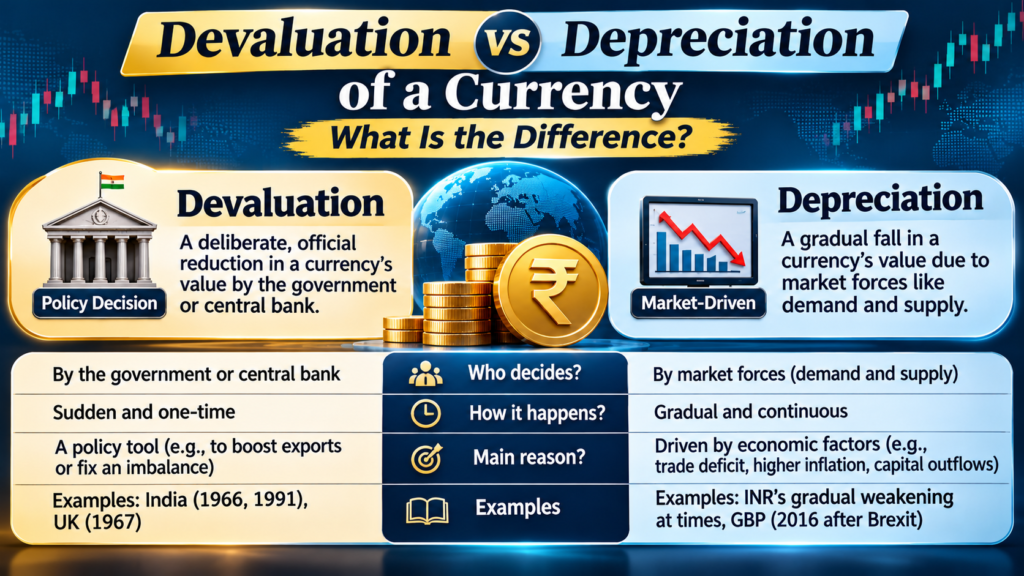
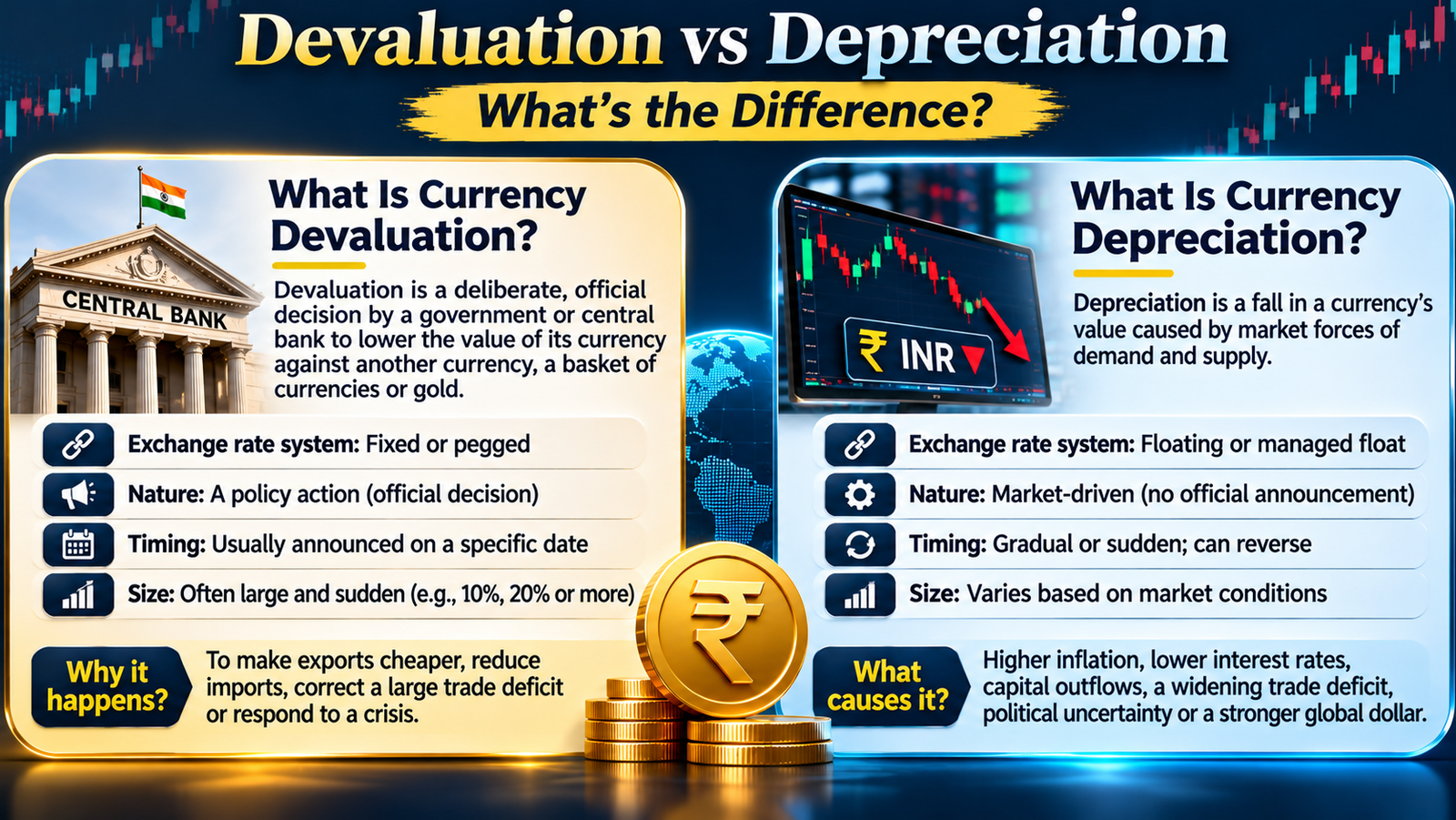
Devaluation is a deliberate, official decision by a government or central bank to lower the value of its currency against another currency, a basket of currencies or gold.
- It happens under a fixed or pegged exchange rate system, where the authorities set the currency’s value.
- It is a policy action, usually announced on a specific date.
- The change is often large and sudden, for example 10%, 20% or more in one step.
Governments usually devalue to make exports cheaper, reduce imports, correct a large trade deficit or respond to a crisis when they can no longer defend the existing rate.
What Is Currency Depreciation?
Depreciation is a fall in a currency’s value caused by market forces of demand and supply.
- It happens under a floating or managed floating exchange rate system.
- No official announcement is needed; the price simply moves in the market.
- It can be gradual or sudden, and it can reverse when market conditions change.
Depreciation can be caused by higher inflation than in other countries, lower interest rates, capital outflows, a widening trade deficit, political uncertainty or a stronger global dollar.
Devaluation vs Depreciation: Key Differences
| Feature | Devaluation | Depreciation |
|---|---|---|
| Cause | Official policy decision | Market forces of demand and supply |
| Exchange rate system | Fixed or pegged | Floating or managed float |
| Who decides | Government or central bank | The market |
| Timing | Announced on a specific date | Continuous, day to day |
| Speed | Usually a one-time, sudden step | Gradual or sudden, and reversible |
| Opposite term | Revaluation | Appreciation |
| Typical trigger | Crisis, trade deficit, unsustainable peg | Inflation, rates, capital flows, sentiment |
In short, the core of devaluation vs depreciation is who causes the fall: the authorities or the market.
Devaluation vs Depreciation: A Simple Analogy
Think of a shop with fixed prices and a market stall where prices change with demand. If the shopkeeper decides to cut the price of an item by 20% overnight, that is like devaluation: one decision, one clear date. At the market stall, the price drifts lower as buyers lose interest and sellers compete, which is like depreciation. Both end with a lower price, but the process is completely different. Keeping this picture in mind makes devaluation vs depreciation easy to remember.
The Opposites: Revaluation and Appreciation
- Revaluation is an official increase in a fixed currency’s value. China, for example, revalued the yuan by about 2% in July 2005 when it moved away from its strict dollar peg.
- Appreciation is a market-driven rise in a floating currency’s value, for example when strong foreign investment flows push the rupee higher.
Real Examples of Devaluation
India, 1966
In June 1966, during a period of drought, war-related strain and a severe balance of payments problem, India devalued the rupee from 4.76 to 7.50 rupees per US dollar. The rupee lost about 36.5% of its value, which meant the dollar became about 57% more expensive in rupee terms.
India, 1991
In July 1991, facing a balance of payments crisis and very low foreign exchange reserves, India devalued the rupee in two steps, by roughly 18–19% in total. This was part of the wider economic reforms that opened the Indian economy. Soon after, India moved towards a market-determined exchange rate, completed in March 1993.
United Kingdom, 1967
The UK devalued the pound by about 14% in November 1967, from $2.80 to $2.40, under the Bretton Woods system of fixed exchange rates.
China, 2015
In August 2015, China surprised markets by lowering the yuan’s daily reference rate by nearly 2%, the largest single move in years. Although China does not run a fully fixed regime, the step was widely described as a devaluation because it was a deliberate policy decision.
Real Examples of Depreciation
These cases show the other side of devaluation vs depreciation: no official announcement, just market forces at work.
The rupee since the 1990s
Since India moved to a market-determined exchange rate in 1993, the rupee has generally depreciated against the US dollar over time. It traded around 45 per dollar in 2010 and in the high 80s by late 2025. This long-term decline reflects factors such as India’s higher inflation compared with the US, trade deficits and global capital flows, with the RBI intervening along the way to smooth sharp moves.
The British pound in 2016
After the UK’s Brexit referendum in June 2016, the pound fell sharply in the market. No government announced a devaluation; investors simply sold the currency because of uncertainty.
The Japanese yen in 2022
The yen depreciated significantly against the dollar in 2022 as US interest rates rose rapidly while Japan kept rates very low. Japan’s authorities eventually intervened to slow the fall.
Devaluation vs Depreciation in India Today
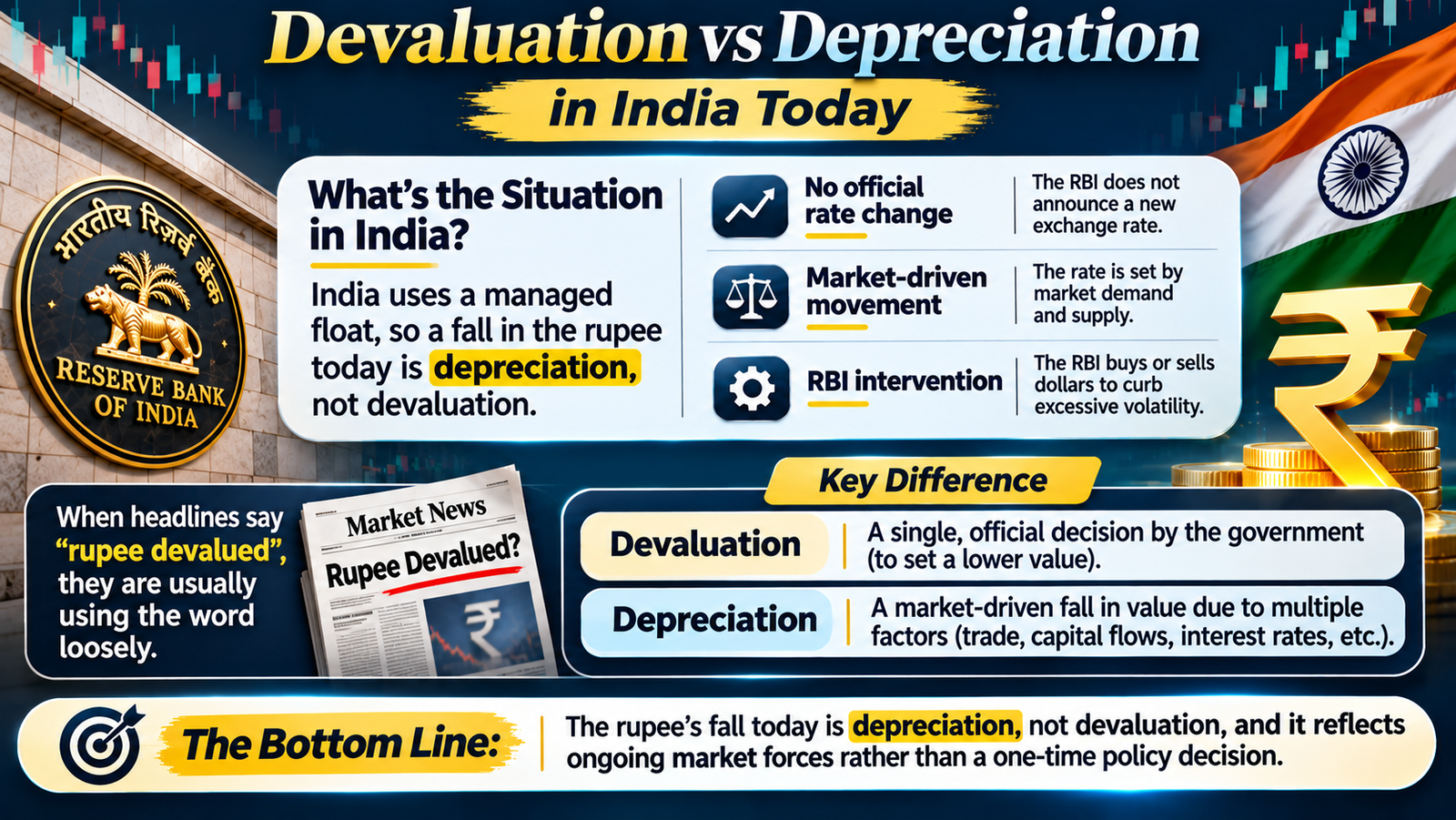
Because India now uses a managed float, a fall in the rupee today is depreciation, not devaluation. The RBI does not announce a new official rate. Instead, the market sets the rate, and the RBI buys or sells dollars to curb excessive volatility.
When headlines say “rupee devalued”, they are usually using the word loosely. The accurate term for a market-driven fall is depreciation. This distinction in devaluation vs depreciation also matters for policy: a devaluation is a single government decision, while depreciation is the result of many forces at work in the market.
Effects of Devaluation vs Depreciation on the Economy
Whether the cause is devaluation or depreciation, a weaker currency tends to have similar effects:
| Area | Typical effect |
|---|---|
| Exports | Become cheaper for foreign buyers, which can boost demand |
| Imports | Become more expensive, such as oil, electronics and gold for India |
| Inflation | Can rise, as imported goods and inputs cost more |
| Foreign debt | Becomes more expensive to repay in local currency |
| Remittances | Families receiving money from abroad get more rupees |
| Foreign investors | May see lower returns in their own currency, which can trigger outflows |
| Travel and education abroad | Becomes more expensive for Indians |
The main practical difference in devaluation vs depreciation is speed and predictability. A devaluation hits all at once, often with little warning. Depreciation can be gradual, giving businesses time to adjust, though it can also be sudden during market stress.
Worked Example: A 5% Fall in the Rupee
This example is illustrative and uses hypothetical figures.
Suppose USD/INR rises from 84.00 to 88.20, a 5% rise in the dollar’s price in rupees.
- An exporter who earns $100,000 now receives ₹88,20,000 instead of ₹84,00,000, an extra ₹4,20,000.
- An importer paying $100,000 for goods now pays ₹88,20,000 instead of ₹84,00,000, an extra ₹4,20,000 in cost.
- A student paying $40,000 in fees abroad pays ₹35,28,000 instead of ₹33,60,000.
- A family receiving a $1,000 remittance gets ₹88,200 instead of ₹84,000.
The effects are the same whether the fall came from devaluation or depreciation. What differs is how it happened and how quickly people had to adjust.
Why Governments Choose Devaluation
- To restore competitiveness when a fixed rate has become overvalued.
- To reduce a large trade or current account deficit.
- To stop the loss of foreign exchange reserves spent defending the peg.
- As part of an IMF-supported adjustment programme during a crisis.
In the devaluation vs depreciation debate, this is the key advantage of devaluation: the government chooses the timing and size of the change. The risks include higher inflation, loss of confidence and the possibility that other countries respond with their own devaluations, sometimes called “currency wars”.
How to Tell Which One Is Happening
When you see a headline about a falling currency, a few quick questions settle the devaluation vs depreciation question:
- Is the currency pegged or floating? A fall in a pegged currency is usually devaluation; in a floating currency, depreciation.
- Was there an official announcement? A new official rate or reference rate points to devaluation.
- Did the change happen in one step? A single large step suggests devaluation; daily moves suggest depreciation.
- What does the central bank say? A statement about “market-determined” rates and “curbing volatility” points to depreciation.
Applying these checks to India, today’s rupee moves are clearly depreciation or appreciation, not devaluation.
What Devaluation vs Depreciation Means for Traders
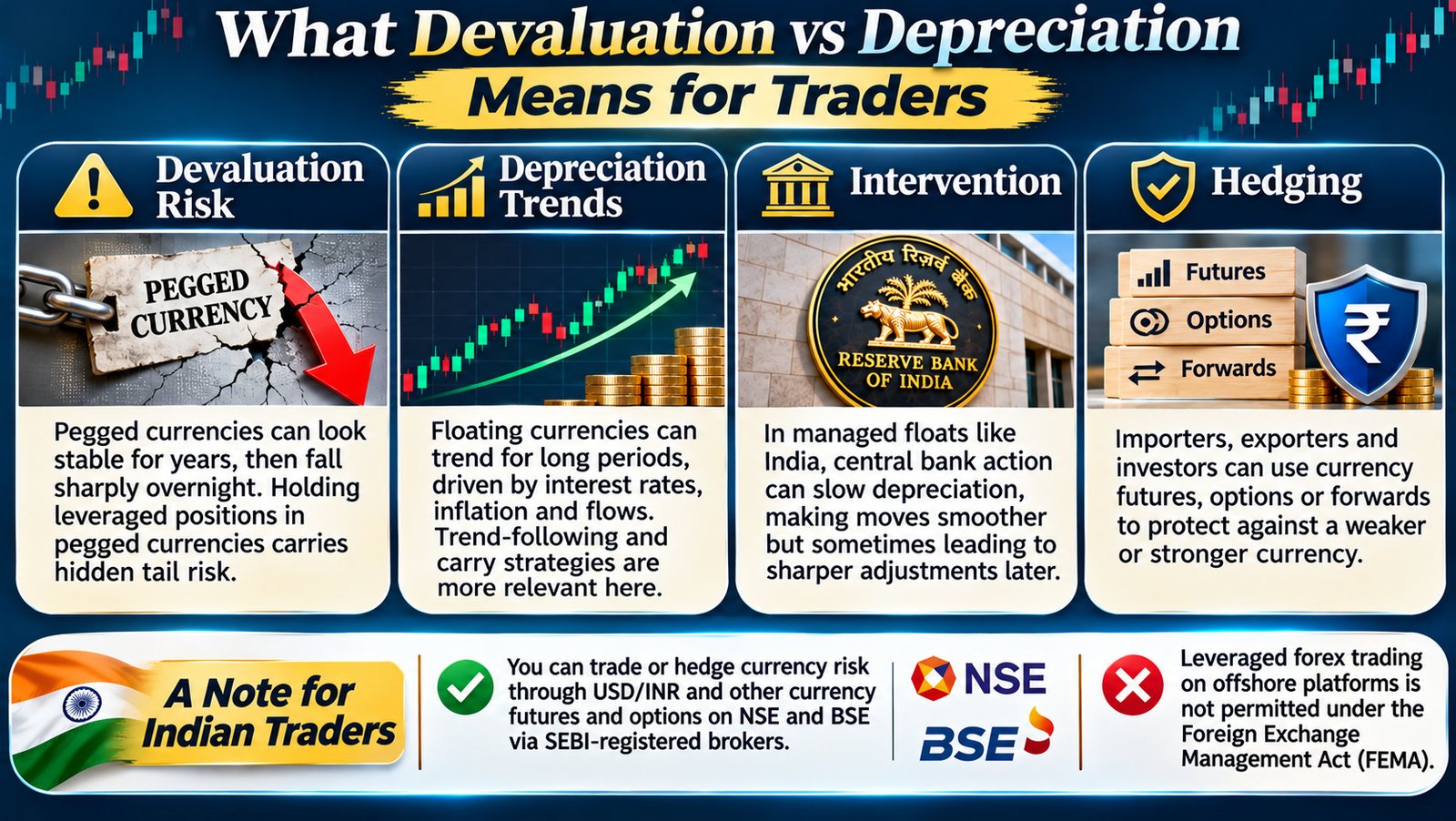
- Devaluation risk: pegged currencies can look stable for years, then fall sharply overnight. Holding leveraged positions in pegged currencies carries hidden tail risk.
- Depreciation trends: floating currencies can trend for long periods, driven by interest rates, inflation and flows. Trend-following and carry strategies are more relevant here.
- Intervention: in managed floats like India, central bank action can slow depreciation, making moves smoother but sometimes leading to sharper adjustments later.
- Hedging: importers, exporters and investors can use currency futures, options or forwards to protect against a weaker or stronger currency.
Indian residents can trade or hedge currency risk through USD/INR and other currency futures and options on NSE and BSE via SEBI-registered brokers. Leveraged forex trading on offshore platforms is not permitted under the Foreign Exchange Management Act (FEMA).
Common Mistakes When Discussing Devaluation vs Depreciation
- Using the terms interchangeably: a market fall in a floating currency is depreciation, not devaluation.
- Assuming a weaker currency is always bad: it helps exporters and remittance receivers, even as it hurts importers.
- Assuming depreciation only goes one way: floating currencies can appreciate again.
- Ignoring the regime: the same fall means different things under a peg and under a float.
FAQs
What is the main difference in devaluation vs depreciation?
Devaluation is an official decision to lower a fixed or pegged currency’s value. Depreciation is a market-driven fall in a floating currency’s value.
Is the rupee devalued or depreciated today?
Today, a fall in the rupee is depreciation, because India uses a market-determined exchange rate with RBI intervention.
When did India last devalue the rupee?
In July 1991, in two steps, during a balance of payments crisis. India moved to a market-determined rate by March 1993.
Why does the devaluation vs depreciation distinction matter?
Because it tells you who is driving the move and how predictable it is. Understanding devaluation vs depreciation helps businesses, investors and traders choose the right response, from hedging to adjusting positions.
What is the opposite of devaluation?
Revaluation, an official increase in a fixed currency’s value. The opposite of depreciation is appreciation.
Do devaluation and depreciation have the same effects?
Broadly yes: exports become cheaper and imports dearer. The main difference is how suddenly the change happens and who causes it.
Conclusion
The key to devaluation vs depreciation is the cause. Devaluation is a policy choice by authorities running a fixed or pegged currency, usually sudden and announced. Depreciation is the market lowering a floating currency’s value, often gradually and sometimes reversibly. Their effects on exports, imports, inflation and investment are similar, but the speed and predictability are not.
For India, past devaluations in 1966 and 1991 marked turning points, while today’s rupee moves are market-driven depreciation or appreciation, smoothed by the RBI. Understanding devaluation vs depreciation helps you interpret currency news accurately and plan hedging and trading decisions with the right expectations.