Quick answer
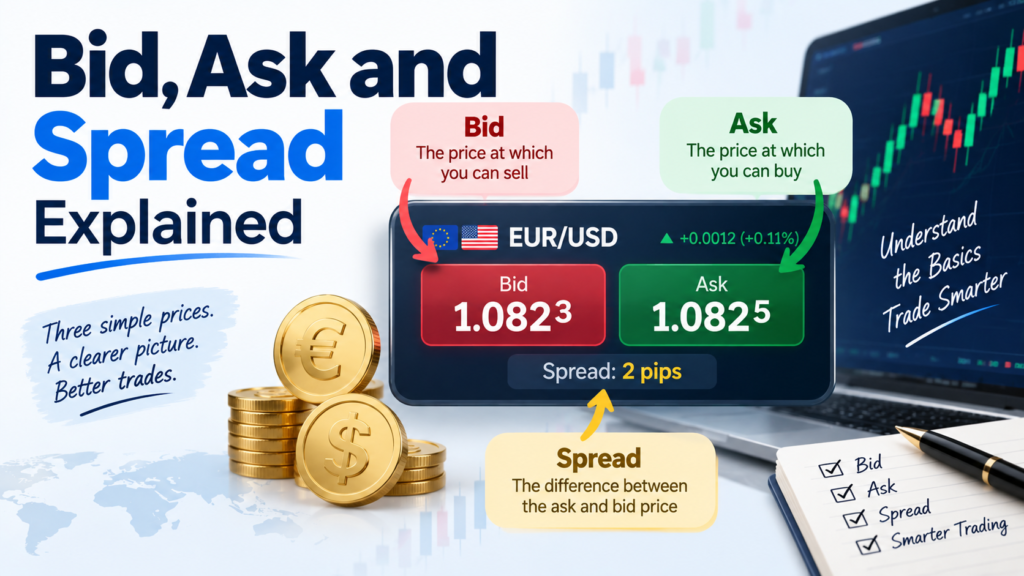
Every currency pair has two prices: the bid (what you can sell at) and the ask (what you can buy at). The bid ask spread in forex is the small gap between them, measured in pips – and it’s a real cost, because you buy at the higher ask and sell at the lower bid, starting each trade slightly down.
Introduction
Look at any forex quote and you’ll see not one price but two, sitting a whisker apart. That gap is where a lot of trading costs quietly hide. Understanding the bid ask spread in forex is one of the most useful basics you can learn, because it explains why every trade starts fractionally in the red and why some pairs and moments are cheaper to trade than others.
This guide breaks it down simply: what bid and ask prices are, what the spread is, why it’s a cost, how to measure that cost, and how spreads behave – including on Indian exchanges. Figures here were computed and verified. It’s educational information, not investment advice.
What Are Bid and Ask Prices?
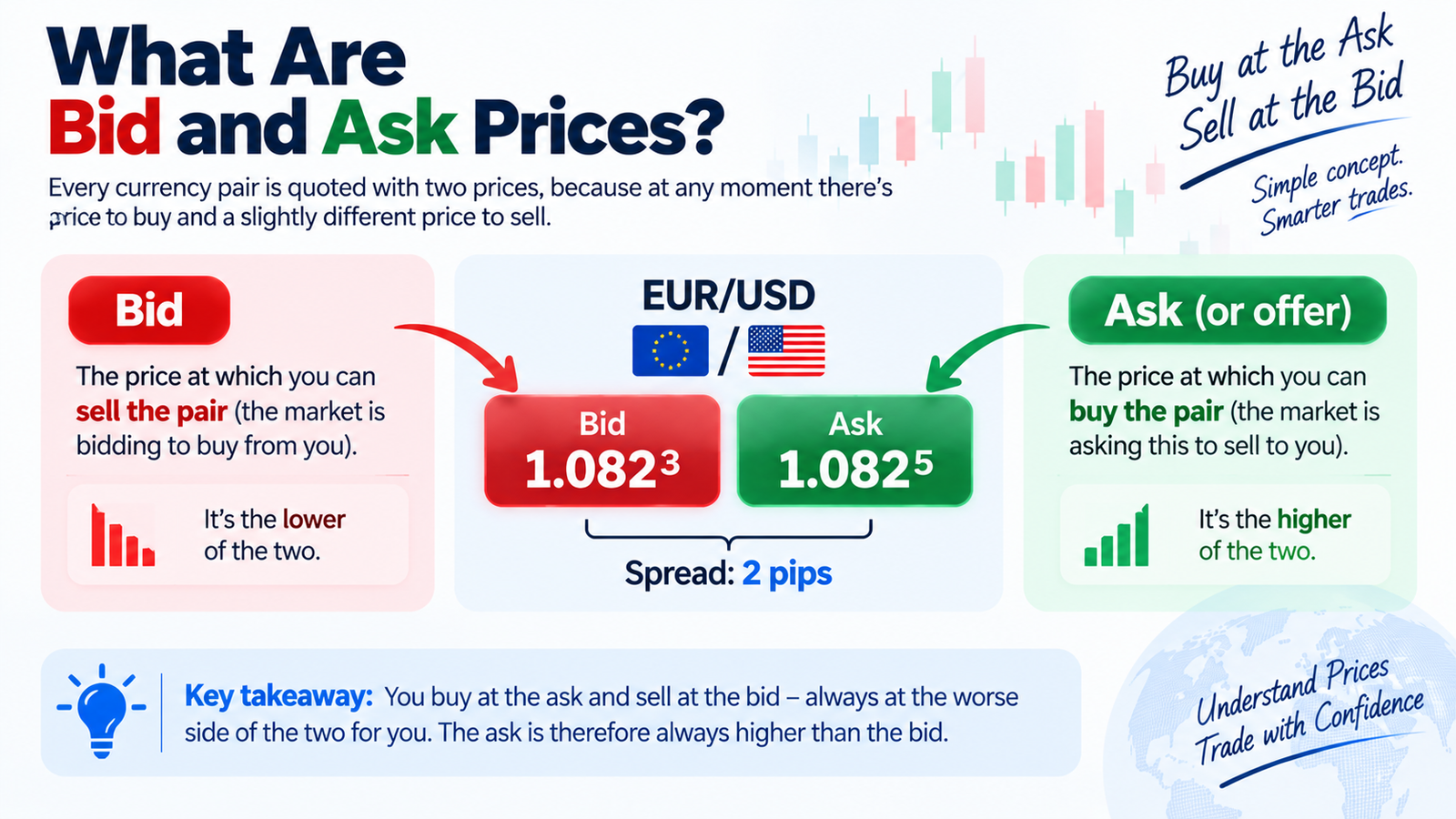
Every currency pair is quoted with two prices, because at any moment there’s a price to buy and a slightly different price to sell:
- Bid – the price at which you can sell the pair (the market is bidding to buy from you). It’s the lower of the two.
- Ask (or offer) – the price at which you can buy the pair (the market is asking this to sell to you). It’s the higher of the two.
A simple way to remember it: you buy at the ask and sell at the bid – always at the worse side of the two for you. The ask is therefore always higher than the bid.
What Is the Spread?
The spread is simply the difference between the ask and the bid, measured in pips:
Spread = Ask price – Bid price
It represents the cost of doing business in the market – the compensation to the market maker or liquidity provider for taking the other side of your trade. A ‘tight’ spread (small gap) is cheap to trade; a ‘wide’ spread is expensive. On very liquid pairs the spread can be a fraction of a pip; on illiquid or exotic pairs it can be many pips.
A Worked Example
Say EUR/USD is quoted like this:
Bid: 1.0850 Ask: 1.0851
Spread = 1.0851 – 1.0850 = 0.0001 = 1 pip
Buy at the ask: 1.0851
Sell instantly at bid: 1.0850
Result: down 1 pip (the spread) before the market even moves
That’s the key insight: the moment you open a trade, you’re already down by the spread, because you’d have to sell back at the lower bid. The market has to move in your favour by at least the spread just for you to break even.
Why the Spread Is a Real Cost
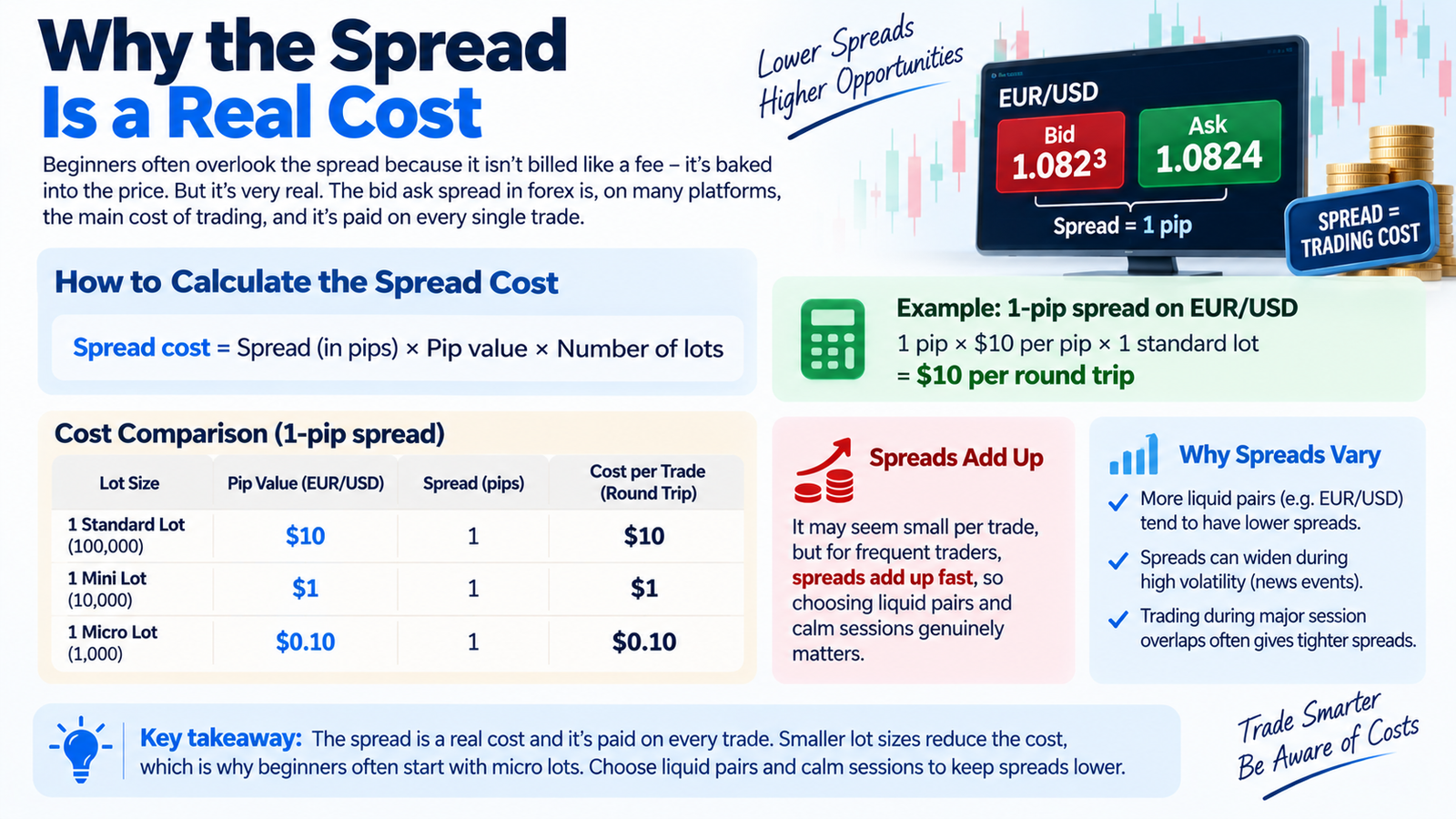
Beginners often overlook the spread because it isn’t billed like a fee – it’s baked into the price. But it’s very real. The bid ask spread in forex is, on many platforms, the main cost of trading, and it’s paid on every single trade. Its cost in money is easy to compute:
Spread cost = Spread (in pips) x Pip value x Number of lots
Example: a 1-pip spread on 1 standard lot of EUR/USD
= 1 pip x $10 per pip = $10 per round trip
On a micro lot, that same 1-pip spread costs just $0.10 – another reason beginners use small lots. For frequent traders, spreads add up fast, so choosing liquid pairs and calm sessions genuinely matters.
Fixed vs Variable Spreads
Spreads come in two forms, and which you get depends on the venue and market:
| Feature | Fixed spread | Variable (floating) spread |
|---|---|---|
| Behaviour | Stays constant | Changes with market conditions |
| In calm markets | Predictable, often wider on average | Can be very tight |
| During news/volatility | Stays put | Can widen sharply (spike) |
| Best for | Traders wanting certainty | Traders on liquid pairs in calm times |
What Affects the Spread?
Spreads aren’t random – a few clear forces move them:
- Liquidity – the more actively a pair trades, the tighter the spread. Major pairs like EUR/USD are cheapest; exotics are widest.
- Volatility – when prices move violently, spreads widen as market makers protect themselves.
- Trading session – spreads are tightest during busy hours (like the London-New York overlap) and wider in quiet ones.
- News events – around major releases, spreads can spike dramatically for a short time.
- The venue – different brokers and exchanges have different spread profiles.
Bid, Ask and Spread on Indian Exchanges
On India’s exchange-traded currency derivatives (NSE/BSE), the bid ask spread in forex works a little differently from an offshore CFD broker. Prices come from a transparent order book where buyers and sellers post bids and asks, so the spread is market-driven rather than set by a single dealer. On top of that, you pay explicit brokerage and statutory charges separately (though notably no Securities Transaction Tax on currency derivatives). Because USD/INR is highly liquid, its exchange spread is typically tight. The practical point: on Indian exchanges your total cost is the order-book spread plus transparent brokerage – not a hidden dealer spread as your only, opaque cost.
How to Keep Spread Costs Low
- Trade liquid pairs – majors like USD/INR or EUR/USD carry the tightest spreads.
- Trade active sessions – spreads narrow when the market is busy; avoid thin, quiet hours.
- Avoid trading through big news – spreads can spike around major releases.
- Factor the spread into your plan – your target must clear the spread to be profitable.
- Don’t overtrade – each trade pays the spread, so frequency multiplies the cost.
Common Mistakes
- Ignoring the spread because it isn’t shown as a fee.
- Trading illiquid pairs with wide spreads and not realising the cost.
- Scalping tiny moves where the spread eats most of the profit.
- Trading through news when spreads spike.
- Setting targets that don’t even clear the spread.
Myths vs Facts
| Myth | Fact |
|---|---|
| The spread isn’t a real cost. | It’s paid on every trade; you start each trade down by the spread. |
| All pairs have the same spread. | Liquid majors are tight; exotics can be many pips wide. |
| Fixed spreads are always cheaper. | Variable spreads can be far tighter on liquid pairs in calm markets. |
| Spreads stay constant all day. | They widen in quiet hours and spike around news and volatility. |
Risk disclaimer
This article is for educational purposes only and is not investment advice. Trading involves risk of loss, and costs like the spread reduce your returns. Prices and spreads used are illustrative and vary by pair, venue and time; verify current spreads and charges with your broker or the exchange. Trade only through SEBI-registered brokers, and consult a qualified professional before trading
Learn more about Forex Trading Sessions in Indian Time (IST)
Expert Analysis
The spread is the most under-estimated number in trading precisely because it hides in plain sight. It never appears as a line item on a bill, yet it is deducted from every trade, in both directions, before any strategy has a chance to work. This is why the bid ask spread in forex matters far more to a frequent trader than to an occasional one: a one-pip spread is trivial on a trade held for a hundred pips, but ruinous for a scalper hunting three-pip moves, where the spread can consume a third of the target before commissions. Understanding the spread is therefore inseparable from understanding what style of trading is even viable for you – some approaches simply cannot survive their own transaction costs.
For Indian traders, the exchange model offers a quiet transparency that the offshore world lacks. On a dealing-desk CFD platform, the spread is where much of the broker’s edge lives, and it can widen at the least convenient moments without explanation. On a regulated exchange, the spread emerges from a public order book and your explicit costs are itemised, so you can actually see and plan for what you pay. The practical wisdom is the same everywhere, though: treat the spread as the entry fee it is, trade the liquid pairs and busy hours where that fee is smallest, and make sure every trade idea has a target comfortably larger than the round-trip cost of getting in and out. The traders who ignore the spread don’t avoid paying it – they just pay it without noticing until the account tells the story.
Key Takeaways
- The bid is the price you sell at; the ask is the price you buy at; the ask is always higher.
- The spread is the gap between them, measured in pips – and it’s a real cost.
- You start every trade down by the spread; the market must move that far just to break even.
- Spread cost = spread in pips x pip value x lots; liquid pairs and busy sessions are cheapest.
- On Indian exchanges the spread is order-book-driven, plus transparent brokerage (no STT).
Frequently Asked Questions (FAQ)
Q: What is the bid and ask price in forex?
A: The bid is the price you can sell a pair at; the ask is the price you can buy it at. You always buy at the higher ask and sell at the lower bid.
Q: What is the spread in forex?
A: The spread is the difference between the ask and bid prices, measured in pips. It’s a cost you pay on every trade.
Q: Why do I start a trade at a small loss?
A: Because you buy at the ask and would sell at the lower bid, so you’re down by the spread the instant you open the trade.
Q: How do I calculate the spread cost?
A: Spread cost equals the spread in pips times the pip value times the number of lots. A 1-pip spread on a standard EUR/USD lot costs about $10.
Q: What is a good spread in forex?
A: Tighter is better. Major pairs like EUR/USD or USD/INR often have very tight spreads; exotic pairs are much wider.
Q: What is the difference between fixed and variable spreads?
A: A fixed spread stays constant; a variable (floating) spread changes with the market, tightening in calm times and widening in volatility.
Q: What causes spreads to widen?
A: Low liquidity, high volatility, quiet trading sessions, and major news events all cause spreads to widen.
Q: Which pairs have the tightest spreads?
A: The most liquid major pairs, such as EUR/USD, GBP/USD and USD/INR, typically have the tightest spreads.
Q: Do spreads change during the day?
A: Yes. Spreads are tightest during busy sessions like the London-New York overlap and wider in thin, quiet hours.
Q: Is the spread the only trading cost?
A: On many CFD platforms it’s the main cost, but on Indian exchanges you also pay explicit brokerage and charges (though no STT on currency derivatives).
Q: How does the spread work on NSE/BSE?
A: It comes from a transparent order book of bids and asks; USD/INR is liquid, so its exchange spread is usually tight.
Q: Does the spread affect scalpers more?
A: Yes. Because scalpers target tiny moves and trade often, the spread consumes a larger share of each trade’s profit.
Q: Can I avoid paying the spread?
A: No, but you can minimise it by trading liquid pairs during active sessions and avoiding volatile news windows.
Q: What is slippage, and is it the spread?
A: Slippage is getting a different price than expected on execution; it’s related to fast markets and liquidity but is distinct from the spread.
Q: Should I include the spread in my strategy?
A: Yes. Your profit target must clear the spread (and other costs) for a trade to be worthwhile.