

Quick answer
In forex, going long means buying a pair to profit if its price rises; going short means selling a pair to profit if its price falls. The beauty of long short forex https://www.forex.com/en/trading is that you can make money in either direction – and because every trade buys one currency and sells another, shorting is just as natural as buying
Introduction
One of the first things that surprises new traders is that you don’t need prices to go up to make money. In forex you can profit from a falling market just as easily as a rising one – the difference is simply whether you go long or short. Getting comfortable with long short forex trading doubles your opportunities, because roughly half the time a market is falling, and a trader who can only buy sits out those moves entirely.
This guide explains going long versus short from the ground up: what each means, how the profit works in both directions, why shorting isn’t the scary thing beginners assume, and how to do both on Indian exchanges. Examples here were computed and verified. It’s educational information, not investment advice.
What Does Going Long Mean?
Going long means buying a currency pair because you expect its price to rise. If you buy USD/INR at 88.00 and it climbs to 88.50, you can sell it back higher and pocket the difference. ‘Long’ is the intuitive direction – buy low, sell high – and it’s how most people first imagine trading. When you’re long, you profit as the price goes up and lose as it goes down.
What Does Going Short Mean?
Going short means selling a currency pair because you expect its price to fall. This is the part that puzzles beginners – how can you sell something you don’t own? In forex, it’s natural: you’re not borrowing an asset the way equity short-sellers do; you’re simply taking the sell side of a pair. If you short USD/INR at 88.00 and it drops to 87.50, you buy it back lower and keep the difference. When you’re short, you profit as the price falls and lose as it rises – the mirror image of a long.
The Forex Twist: Every Trade Is Long One, Short the Other
Here’s the concept that makes shorting click. A currency pair is a ratio of two currencies, so every position is simultaneously long one currency and short the other. When you buy USD/INR, you are long the US dollar and short the rupee – betting the dollar strengthens against the rupee. When you sell USD/INR, you are short the dollar and long the rupee. There’s no borrowing, no uptick rule, no special permission needed: buying and selling are perfectly symmetrical. This is why long short forex trading treats both directions as equal, unlike stock markets where short-selling is more restricted.
Worked Examples: Profit in Both Directions
Numbers make it concrete. Assume a pip value of about ₹0.10 per pip on one USD/INR contract (illustrative):
GOING LONG USD/INR
Buy at 88.0000, price rises to 88.5000
Move = +5,000 pips in your favour -> profit
GOING SHORT USD/INR
Sell at 88.0000, price falls to 87.5000
Move = 5,000 pips in your favour -> profit
GOING SHORT EUR/USD
Sell at 1.0900, price falls to 1.0850
Move = 50 pips in your favour -> profit
In each case, being on the correct side of the move produces a profit; being on the wrong side produces a loss of the same magnitude. The direction you choose – long or short – simply defines which way you need the market to go. (Illustrative figures; actual pip values depend on the pair and contract size.)
Long vs Short at a Glance
| Aspect | Going long (buy) | Going short (sell) |
|---|---|---|
| Your expectation | Price will rise | Price will fall |
| You profit when | The pair goes up | The pair goes down |
| You lose when | The pair goes down | The pair goes up |
| Currency view | Long base, short quote | Short base, long quote |
| Typical sentiment | Bullish | Bearish |
Is Shorting Riskier Than Going Long?
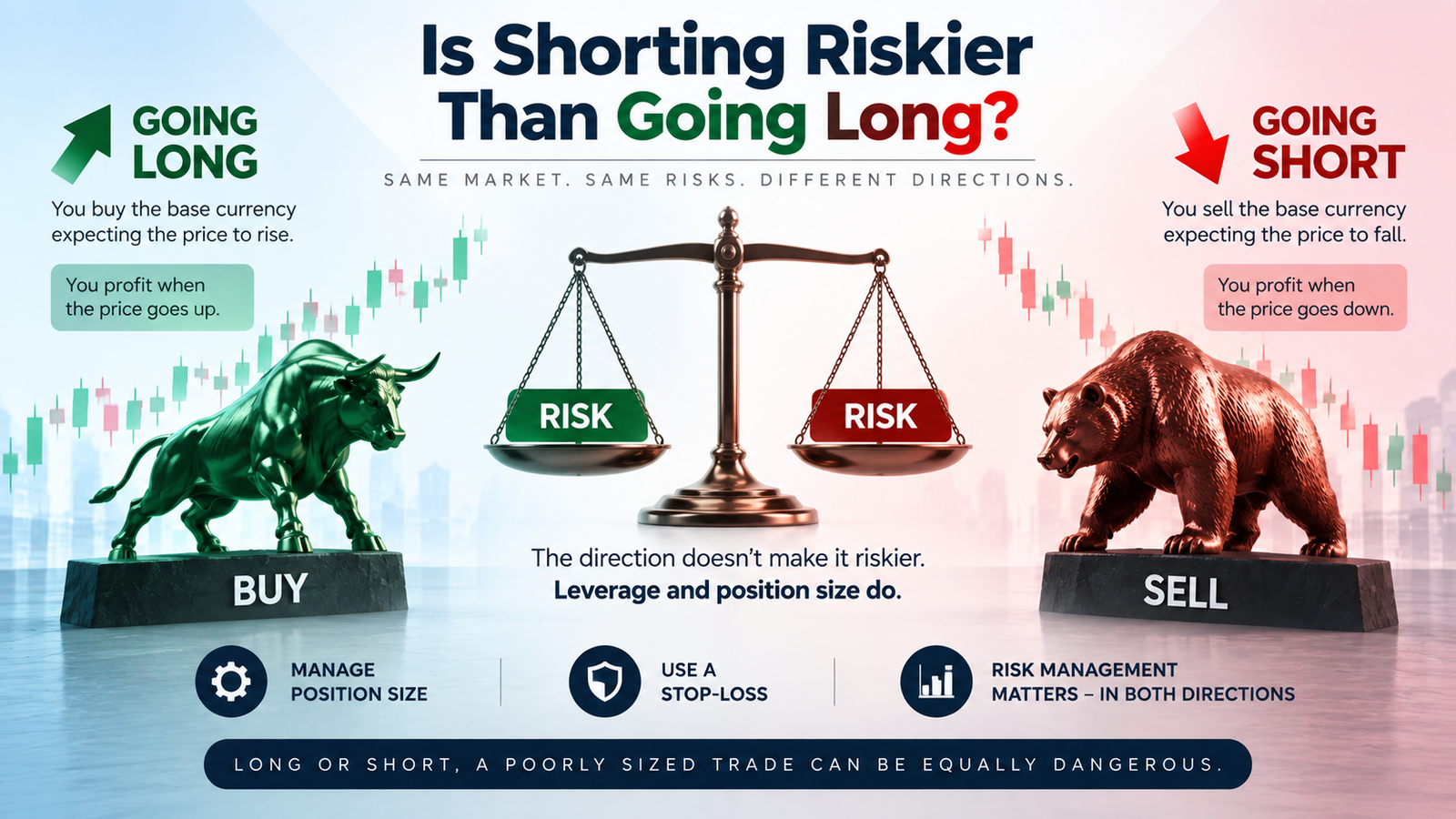
Beginners often hear that shorting is dangerous, borrowing the fear from stock markets where a shorted share can theoretically rise without limit. In forex, that framing is misleading. Currency pairs don’t go to infinity or zero the way a single stock can, and going short is mechanically identical to going long – you’re just on the other side of a pair. The real risk in both directions comes from the same source: leverage and position size, not the direction itself. A poorly sized long is exactly as dangerous as a poorly sized short. What protects you is a stop-loss and sensible sizing, whichever way you trade.
How to Go Long or Short in India
On India’s exchange-traded currency derivatives (NSE/BSE), both directions are fully available:
- Futures – you can buy a currency future to go long, or sell one to go short, with no need to ‘own’ anything first. Contracts are cash-settled in rupees.
- Options – to express a bullish view you can buy a call; for a bearish view you can buy a put. Options give defined risk (the premium) for buyers.
So an Indian trader who expects the rupee to weaken can go long USD/INR (or buy a call), while one expecting the rupee to strengthen can go short USD/INR (or buy a put) – all within the legal, SEBI-regulated framework. The seven permitted pairs can each be traded in both directions.
When to Go Long vs Short
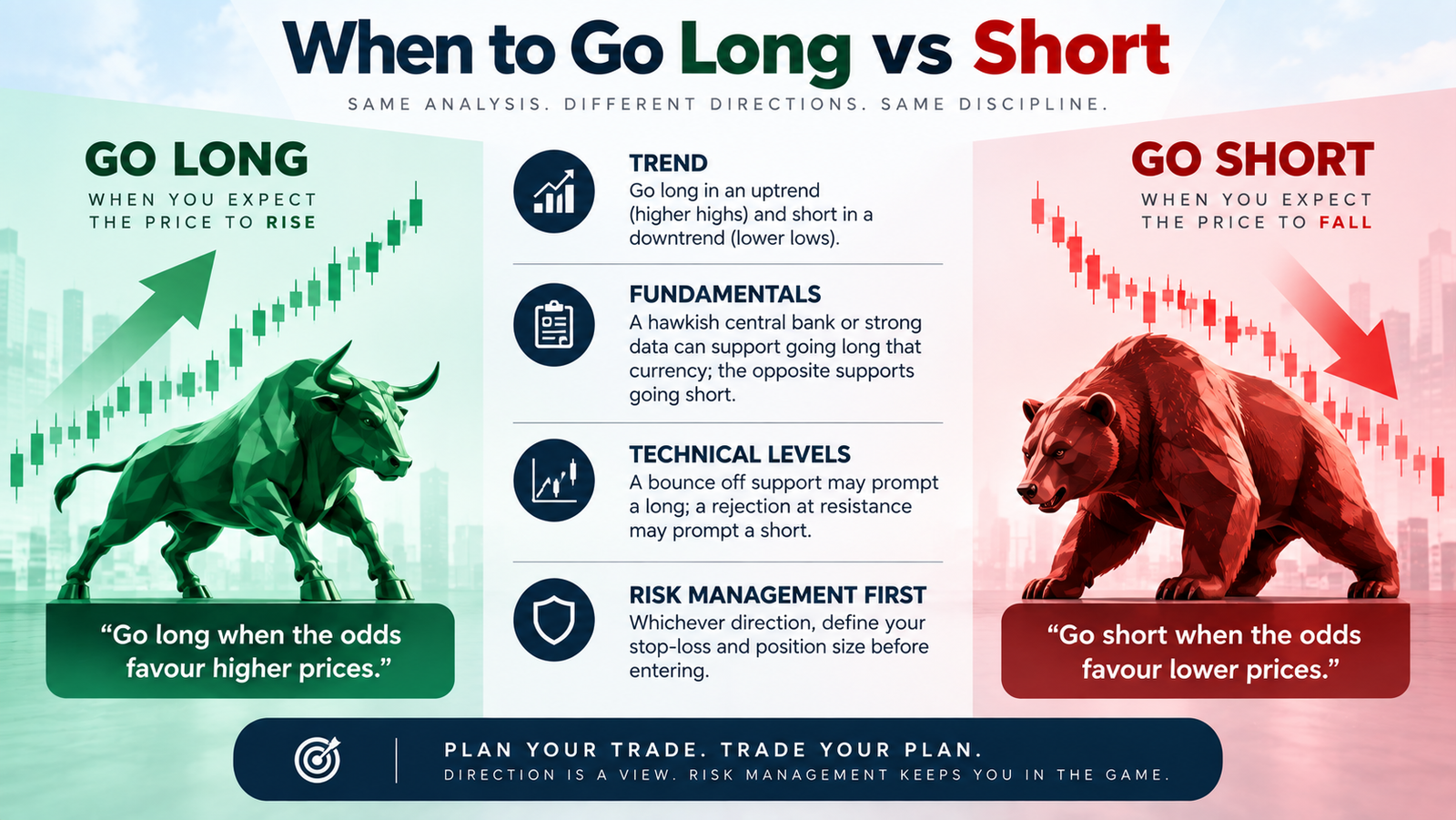
Choosing the direction is the heart of trading, and it comes down to your analysis:
- Trend – traders often go long in an uptrend (higher highs) and short in a downtrend (lower lows).
- Fundamentals – a hawkish central bank or strong data can support going long that currency; the opposite supports going short.
- Technical levels – a bounce off support may prompt a long; a rejection at resistance may prompt a short.
- Risk management first – whichever direction, define your stop-loss and size before entering.
Common Mistakes
- Only ever going long, and sitting out every falling market.
- Avoiding shorts out of unfounded fear inherited from stock markets.
- Fighting the trend – shorting a strong uptrend or buying a steep downtrend.
- Forgetting that a short’s risk, like a long’s, is controlled by sizing and stops.
- Confusing which currency you’re long or short within the pair.
Myths vs Facts
| Myth | Fact |
|---|---|
| You can only profit when prices rise. | Going short lets you profit when a pair falls. |
| Shorting forex requires borrowing. | No – you simply take the sell side of a pair; it’s symmetrical to buying. |
| Shorting is inherently riskier. | Risk comes from leverage and sizing, not the direction. |
| You can’t short in India. | Both long and short are available on exchange-traded currency derivatives. |
Risk disclaimer
This article is for educational purposes only and is not investment advice. Trading in either direction involves risk of loss, and leverage magnifies it. Examples and pip values are illustrative and vary by pair and contract size. Trade only through SEBI-registered brokers on recognised exchanges, use risk management, and consult a qualified professional before trading.
Learn more about How to Build a Trading Routine That Sticks
Expert Analysis
The ability to go short is one of the quiet advantages of forex, and beginners who fully embrace it change how they see the market. A trader limited to going long can only profit from about half of all price action; a trader comfortable with long short forex trading can pursue opportunity in both rising and falling markets, effectively doubling the situations they can act on. More importantly, shorting removes the emotional bias that leads stock-market beginners to ‘hope’ a falling market recovers – in forex, a downtrend is simply an opportunity to be short, not a disaster to endure. That mental symmetry – treating up and down as equally tradeable – is a mark of a maturing trader.
The deeper lesson is that direction is only half the decision, and often the less important half. Whether you go long or short, the outcome that actually protects your account is determined by position size, the stop-loss, and the leverage you apply – the same risk mechanics that govern every trade. A brilliant call on direction with reckless sizing still blows up; a modest edge with disciplined sizing compounds. So while learning long versus short unlocks the full opportunity set of the market, the trader’s real work remains what it always is: deciding how much to risk before deciding which way to bet. Get the direction right and you win the trade; get the risk right and you keep the account.
Key Takeaways
- Going long means buying to profit from a rising pair; going short means selling to profit from a falling pair.
- Every forex trade is long one currency and short the other, so shorting is natural and needs no borrowing.
- Shorting isn’t inherently riskier – risk comes from leverage and position size, not direction.
- In India, you can go long or short via futures, or use call/put options, on the permitted pairs.
- Choose direction from your analysis, but define your stop-loss and size first, whichever way you trade.
Frequently Asked Questions (FAQ)
Q: What does going long mean in forex?
A: Going long means buying a currency pair because you expect its price to rise, so you profit if it goes up and lose if it goes down.
Q: What does going short mean in forex?
A: Going short means selling a currency pair because you expect its price to fall, so you profit if it goes down and lose if it goes up.
Q: Can you short forex?
A: Yes. Shorting is natural in forex because every trade buys one currency and sells another – you simply take the sell side of a pair.
Q: Do I need to own a currency to short it?
A: No. Unlike equity short-selling, you don’t borrow anything; taking the sell side of a pair is mechanically the same as buying.
Q: Is shorting riskier than going long?
A: Not inherently. In forex the risk in both directions comes from leverage and position size, not from the direction itself.
Q: How do I profit from a falling market?
A: By going short – selling the pair and buying it back lower – so the fall in price becomes your profit.
Q: What is the difference between long and short?
A: Long is buying to profit from a rise; short is selling to profit from a fall. They are mirror images of each other.
Q: Which currency am I long or short in a pair?
A: Buying a pair makes you long the base currency and short the quote currency; selling reverses this.
Q: Can I go long or short on Indian exchanges?
A: Yes. On NSE/BSE currency derivatives you can buy a future to go long or sell one to go short, or use call and put options.
Q: How do I short USD/INR?
A: Sell a USD/INR future (or buy a put option) if you expect the rupee to strengthen against the dollar; it’s cash-settled in rupees.
Q: What does bullish and bearish mean?
A: Bullish means expecting prices to rise (favouring a long); bearish means expecting prices to fall (favouring a short).
Q: When should I go long vs short?
A: Base the direction on your analysis – trend, fundamentals and key levels – and always set your stop-loss and size first.
Q: Is going short the same as selling?
A: Yes. Opening a position by selling a pair you don’t already hold is going short; you profit if the price falls.
Q: Can beginners go short safely?
A: Yes, with the same discipline as a long: a stop-loss, small position size and controlled leverage.
Q: Does shorting cost more than going long?
A: Not in itself; both pay the same spread and charges. Overnight financing (swap) can differ by direction, but that’s separate from the risk.