Introduction
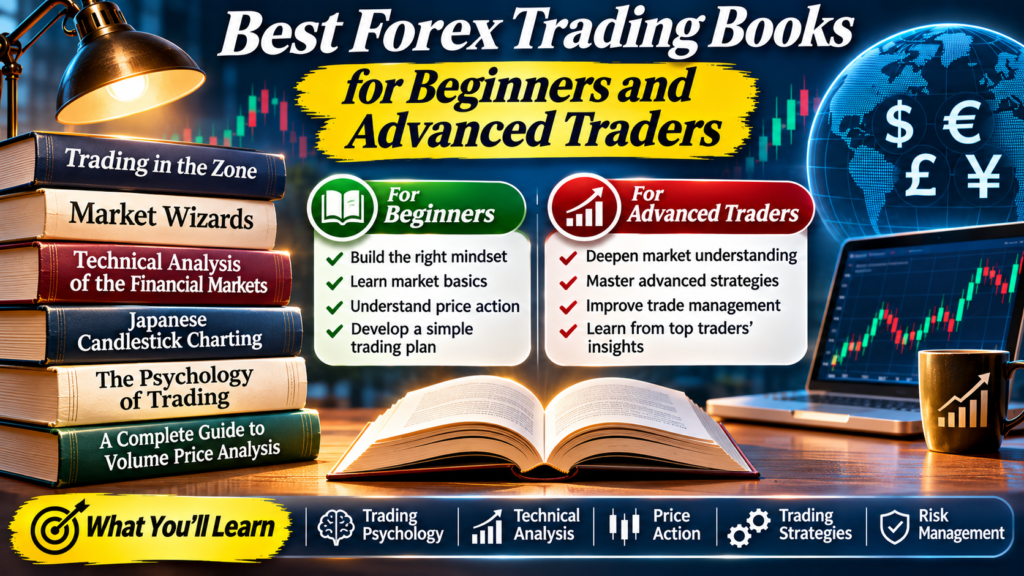
Every experienced trader has a short list of books that changed how they think about markets. Some teach chart reading, some explain how currencies are priced, and some focus on the hardest part of trading: controlling your own behaviour.
The best forex trading books will not hand you a strategy that prints money. What they do is help you build a solid foundation, avoid common mistakes and learn from traders who have already made them. Reading is also far cheaper than learning every lesson with real losses.
This guide groups the best forex trading books by level and topic: beginner guides, technical analysis, trading psychology, risk and system design, macro and fundamentals, and trader interviews. It also covers Indian resources and a reading plan.
How We Chose the Best Forex Trading Books
- Lasting value: books that traders keep recommending years after publication.
- Practical content: ideas you can apply, test and measure.
- Balanced view of risk: no promises of guaranteed profits.
- Coverage of all levels: from basic market mechanics to advanced macro thinking.
Not every book here is about forex alone. Several of the best forex trading books are really about trading in general, psychology or economics, but their lessons apply directly to currency markets.
Best Forex Trading Books for Beginners
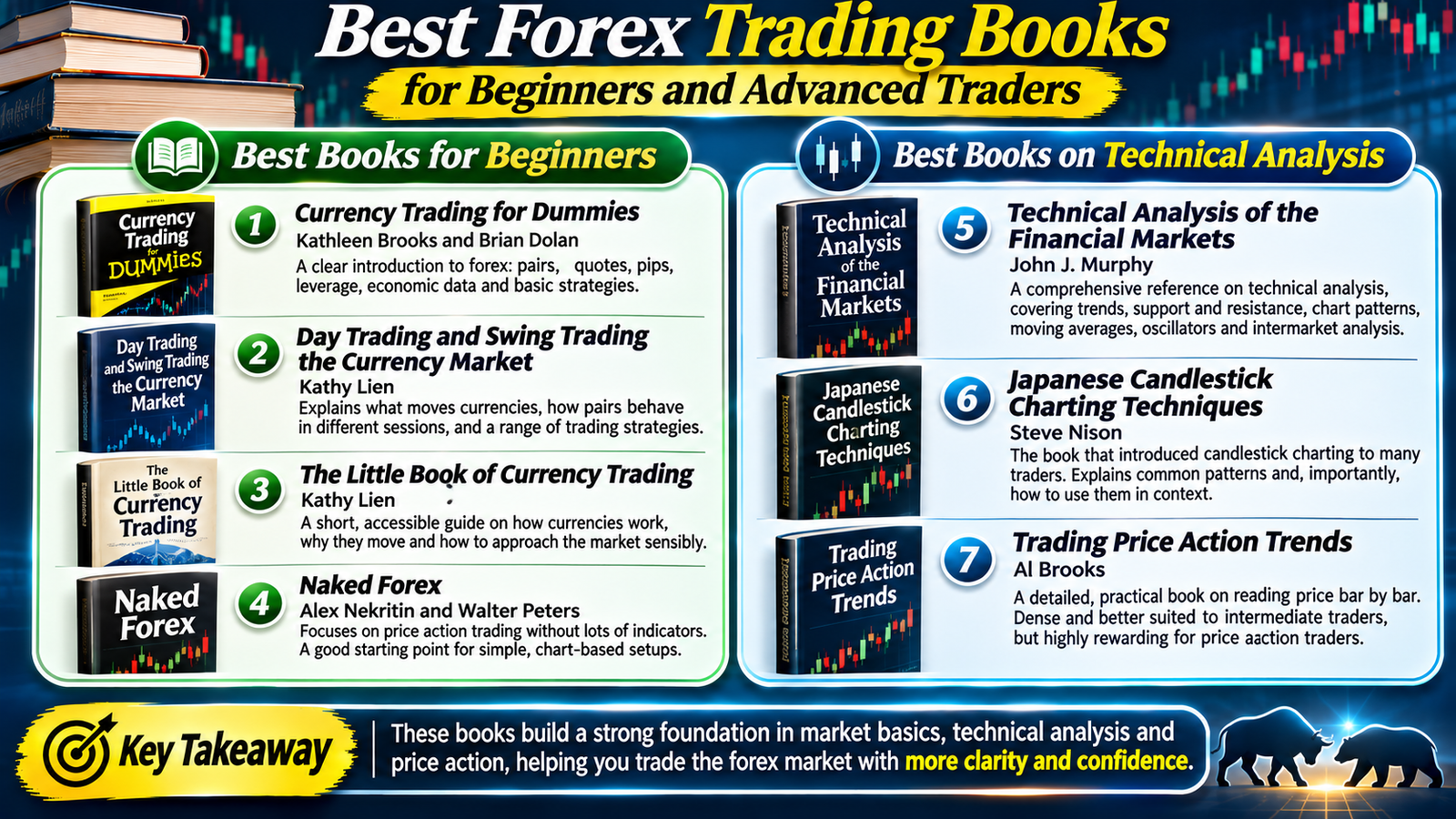
1. Currency Trading for Dummies — Kathleen Brooks and Brian Dolan
A clear introduction to how the currency market works: major pairs, quotes, pips, leverage, economic data and basic strategies. It is a good first book if you are starting from zero.
2. Day Trading and Swing Trading the Currency Market — Kathy Lien
Kathy Lien explains what moves currencies, how pairs behave in different sessions, and a range of technical and fundamental strategies. Many traders rank it among the best forex trading books written specifically for the currency market.
3. The Little Book of Currency Trading — Kathy Lien
A shorter, accessible guide covering how currencies work, why they move and how to approach the market with sensible expectations.
4. Naked Forex — Alex Nekritin and Walter Peters
Focuses on trading price action without relying on lots of indicators. Useful for beginners who want simple, chart-based setups, though every setup should be tested before use.
Best Forex Trading Books on Technical Analysis
5. Technical Analysis of the Financial Markets — John J. Murphy
Often described as the standard reference on technical analysis. It covers trends, support and resistance, chart patterns, moving averages, oscillators and intermarket analysis. It is a book to keep on your desk and return to.
6. Japanese Candlestick Charting Techniques — Steve Nison
The book that introduced candlestick charting to many Western traders. It explains common patterns and, importantly, how to use them in context rather than in isolation.
7. Trading Price Action Trends — Al Brooks
Part of a detailed series on reading price bar by bar. It is dense and better suited to intermediate traders, but rewarding for those focused on price action.
Best Forex Trading Books on Trading Psychology
8. Trading in the Zone — Mark Douglas
Probably the most recommended of all trading psychology books. Douglas explains why traders struggle with consistency and how to think in probabilities rather than individual outcomes. Many traders consider it one of the best forex trading books even though it is not specific to currencies.
9. The Disciplined Trader — Mark Douglas
Douglas’s earlier book explores the mental habits that hold traders back, such as fear of loss and the need to be right.
10. Thinking, Fast and Slow — Daniel Kahneman
Not a trading book, but a highly influential look at cognitive biases such as loss aversion and overconfidence, which affect every trading decision.
11. Fooled by Randomness — Nassim Nicholas Taleb
A thought-provoking book about luck, survivorship bias and why short-term results can mislead. It helps traders avoid confusing a lucky streak with skill.
Best Forex Trading Books on Risk and System Design
12. Trade Your Way to Financial Freedom — Van K. Tharp
Explains position sizing, expectancy and how to design a trading system that fits your personality. Its focus on “R-multiples” and risk per trade is valuable for any forex trader.
Best Forex Trading Books on Macro and Currency Fundamentals
13. The Alchemy of Finance — George Soros
Soros explains his theory of reflexivity and includes a real-time diary of his trading. It is challenging, but it offers rare insight into how a famous macro trader thinks about currencies and markets.
14. Inside the House of Money — Steven Drobny
Interviews with global macro hedge fund managers about how they analyse interest rates, currencies and economic cycles. A strong choice for traders interested in fundamentals.
15. Exchange Rates and International Finance — Laurence Copeland
A more academic textbook covering exchange rate theories, purchasing power parity, interest rate parity and currency crises. Useful for traders who want a deeper understanding of why currencies move.
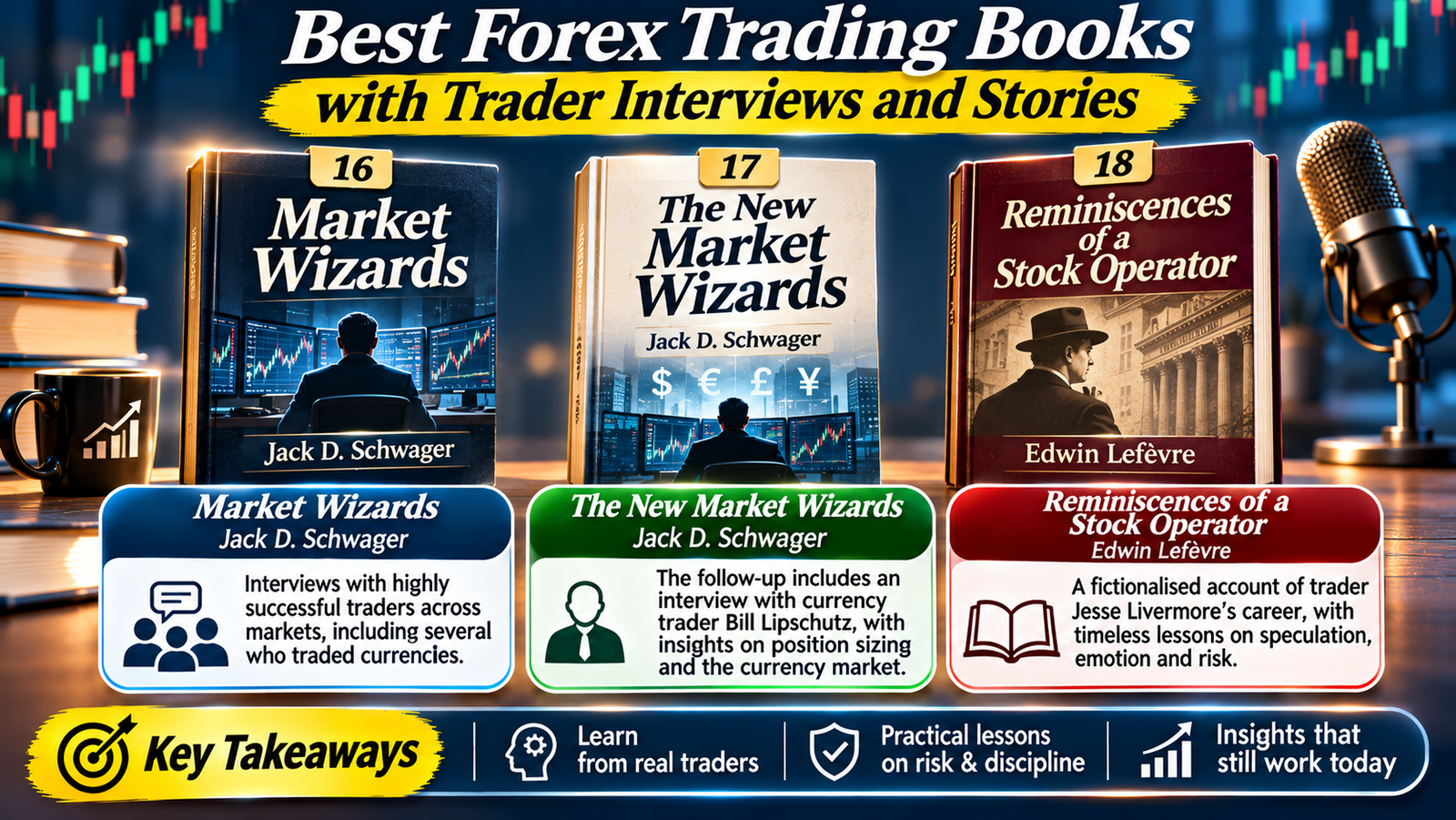
Best Forex Trading Books with Trader Interviews and Stories
16. Market Wizards — Jack D. Schwager
Interviews with highly successful traders across markets, including several who traded currencies. Its lessons on discipline, risk control and adapting to markets make it one of the best forex trading books for all levels.
17. The New Market Wizards — Jack D. Schwager
The follow-up includes an interview with currency trader Bill Lipschutz, whose insights on position sizing and the currency market are especially relevant to forex traders.
18. Reminiscences of a Stock Operator — Edwin Lefèvre
First published in 1923, this fictionalised account of trader Jesse Livermore’s career remains popular because the lessons on speculation, emotion and risk have not changed.
What to Look for in a Trading Book
New trading books appear every month, and many are written mainly to sell courses or signal services. Before buying, ask a few questions:
- Who is the author? Look for real trading, research or professional market experience, not just social media popularity.
- Does it discuss losses? Honest books explain drawdowns, losing streaks and the role of risk control.
- Are the claims testable? Good books describe rules clearly enough for you to backtest them.
- Is it still relevant? Older books on psychology and risk age well, but books about specific platforms, brokers or regulations may be out of date.
- Does it fit your level? A dense advanced book read too early can confuse more than it helps.
Books vs Courses and Videos
Books are not the only way to learn, but they have clear advantages. They are inexpensive, usually reviewed by editors, and written to explain ideas in depth rather than to hold attention for a few minutes. Videos and courses can be useful for seeing a platform or a setup in action, but quality varies widely, and some are designed mainly to sell expensive mentorship or signal groups.
A sensible approach is to use books for core principles, exchange and regulator material for rules and contract details, and a demo account or small live positions to practise. Be especially careful with any course that promises fixed monthly returns or encourages you to trade through offshore apps.
Best Forex Trading Books Compared
| Book | Author | Level | Main focus |
|---|---|---|---|
| Currency Trading for Dummies | Brooks and Dolan | Beginner | Forex basics |
| Day Trading and Swing Trading the Currency Market | Kathy Lien | Beginner to intermediate | Forex strategies |
| Technical Analysis of the Financial Markets | John J. Murphy | All levels | Technical analysis |
| Japanese Candlestick Charting Techniques | Steve Nison | Beginner to intermediate | Candlesticks |
| Trading Price Action Trends | Al Brooks | Intermediate to advanced | Price action |
| Trading in the Zone | Mark Douglas | All levels | Psychology |
| Trade Your Way to Financial Freedom | Van K. Tharp | Intermediate | Risk and system design |
| The Alchemy of Finance | George Soros | Advanced | Macro and reflexivity |
| Inside the House of Money | Steven Drobny | Advanced | Global macro |
| Market Wizards | Jack D. Schwager | All levels | Trader interviews |
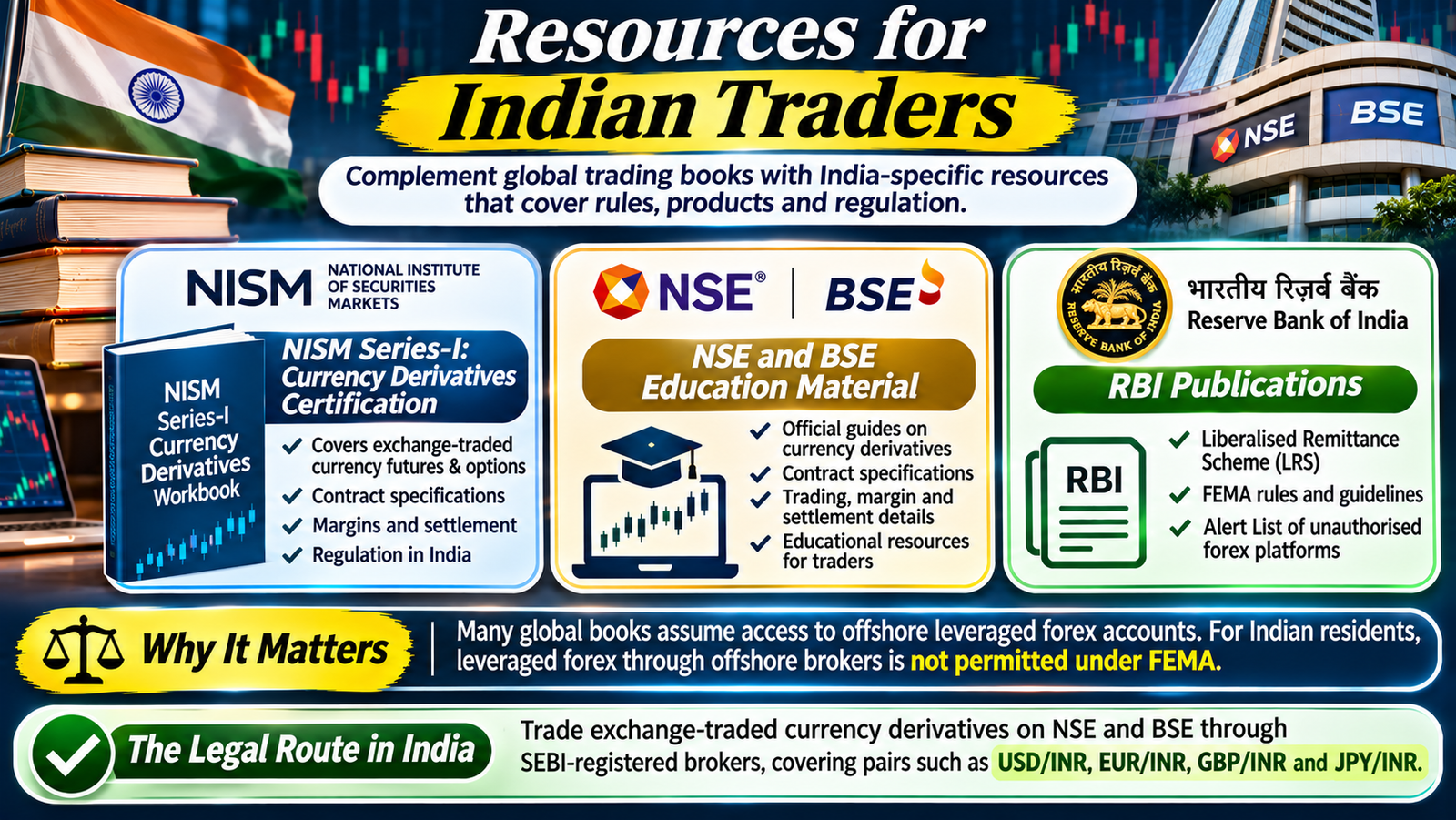
Resources for Indian Traders
Most of the best forex trading books are written for global or US audiences. Indian traders should add resources that cover local rules and products:
- NISM Series-I: Currency Derivatives Certification workbook: published by the National Institute of Securities Markets, it covers exchange-traded currency futures and options in India, contract specifications, margins, settlement and regulation.
- NSE and BSE education material: both exchanges publish guides and contract specifications for currency derivatives.
- RBI publications: the RBI’s website includes information on the Liberalised Remittance Scheme, FEMA rules and the Alert List of unauthorised forex platforms.
This matters because many global books assume access to offshore leveraged forex accounts. For Indian residents, leveraged forex through offshore brokers is not permitted under FEMA. The legal route is exchange-traded currency derivatives on NSE and BSE through SEBI-registered brokers, covering pairs such as USD/INR, EUR/INR, GBP/INR, JPY/INR, EUR/USD, GBP/USD and USD/JPY.
A Suggested Reading Plan
| Stage | Books | Goal |
|---|---|---|
| Months 1–2 | Currency Trading for Dummies; NISM currency derivatives workbook | Understand market basics and Indian rules |
| Months 3–4 | Murphy; Nison | Learn to read charts |
| Months 5–6 | Trading in the Zone; Tharp | Build psychology and risk management |
| Months 7–9 | Kathy Lien; Market Wizards | Develop strategies and learn from professionals |
| Months 10–12 | Drobny; Soros; Copeland | Deepen macro and fundamental understanding |
How to Get the Most from the Best Forex Trading Books
- Read actively: take notes and write down ideas you want to test.
- Test before trading: backtest and demo-trade any strategy before using real money.
- Focus on principles: markets change, but lessons on risk and psychology last.
- Revisit key books: many traders reread Trading in the Zone or Market Wizards each year.
- Combine reading with a journal: link what you read to your own trades and mistakes.
- Be sceptical: avoid books or courses promising guaranteed returns.
Common Mistakes When Learning from Books
- Reading without practising: knowledge only helps when applied and tested.
- Jumping between strategies: mastering one approach is better than sampling many.
- Ignoring psychology: many traders skip the mindset books, then struggle with discipline.
- Copying setups blindly: markets and costs differ; test everything yourself.
- Ignoring local rules: global books may not reflect Indian regulations.
FAQs
What are the best forex trading books for beginners?
Currency Trading for Dummies, Kathy Lien’s books, Japanese Candlestick Charting Techniques and Trading in the Zone are popular starting points.
Which book is best for trading psychology?
Trading in the Zone by Mark Douglas is the most widely recommended.
Are the best forex trading books enough to become profitable?
No. Books build knowledge, but you also need practice, testing, risk management and discipline.
Which books help with fundamental analysis?
Inside the House of Money, The Alchemy of Finance and Exchange Rates and International Finance.
What should Indian traders read first?
The NISM currency derivatives workbook, alongside a beginner forex book, to understand both the market and Indian rules.
Is Market Wizards useful for forex traders?
Yes. Its lessons on risk, discipline and adaptability apply to all markets, and several interviewees traded currencies.
Conclusion
The best forex trading books cover more than charts. Start with the basics, learn technical analysis, then invest serious time in psychology and risk management, which are where most traders fail. As you progress, macro books and trader interviews will deepen your understanding of how professionals think.
Read actively, test every idea, keep a journal and, for Indian traders, pair global classics with the NISM workbook and the rules for trading currency derivatives on NSE and BSE.