

Introduction
One of the first tax questions currency traders in India ask is whether their profits and losses count as “speculative” income. The answer matters a great deal. Speculative losses can only be set off against speculative profits and carried forward for a shorter period, while non-speculative business losses are far more flexible.
For decades, the answer came from section 43(5) of the Income-tax Act, 1961, which defined a speculative transaction and listed exceptions. One of those exceptions covers derivatives traded on recognised stock exchanges. This guide explains section 43(5) currency derivatives treatment in detail: what the section says, why exchange-traded currency futures and options are non-speculative, how intraday trades are treated, how the rule carries over to the Income-tax Act, 2025, and what it means for losses, turnover, audits and your return.
What Section 43(5) Says
Section 43(5) of the 1961 Act defined a speculative transaction as a contract for the purchase or sale of any commodity, including stocks and shares, that is periodically or ultimately settled otherwise than by actual delivery or transfer of the commodity or scrips.
On that definition alone, almost every derivative would be speculative, because futures and options are usually cash-settled rather than delivered. That is why the proviso to the section matters. It listed transactions that are not speculative, including:
- Clause (a): hedging contracts by manufacturers or merchants for raw materials or merchandise, to guard against price losses on actual delivery contracts
- Clause (b): hedging contracts by dealers or investors in stocks and shares, to guard against price losses on their holdings
- Clause (c): jobbing or arbitrage contracts by members of a forward market or stock exchange, in the ordinary course of business
- Clause (d): an eligible transaction in respect of trading in derivatives referred to in section 2(ac) of the Securities Contracts (Regulation) Act, 1956 (SCRA), carried out in a recognised stock exchange
- Clause (e): eligible transactions in commodity derivatives on recognised associations or exchanges
Clause (d) is the key to section 43(5) currency derivatives treatment.

Why Exchange-Traded Currency Derivatives Are Non-Speculative
Currency futures and options on NSE and BSE are derivatives within the meaning of the SCRA. Because they are traded electronically on a recognised stock exchange through SEBI-registered brokers, they fall within clause (d). That means profits and losses from them are not speculative, even though they are cash-settled.
To qualify as an “eligible transaction”, the trade must broadly:
- be carried out electronically on the screen-based system of arecognised stock exchange
- be done through a SEBI-registered stock broker or other permitted intermediary
- be supported by a time-stamped contract note showing the client’s unique client code and PAN
recognised stock exchanges also had to meet conditions set out in the Income-tax Rules (Rule 6DDA) for their records and audit trails. In short, section 43(5) currency derivatives rules make normal exchange trades non-speculative business income.
Section 43(5) Currency Derivatives Under the Income-tax Act, 2025
The Income-tax Act, 2025 replaced the 1961 Act from 1 April 2026 (tax year 2026-27 onwards). The concepts carry over, but the section numbers change:
| Concept | Income-tax Act, 1961 | Income-tax Act, 2025 |
|---|---|---|
| Definition of speculative transaction | Section 43(5) | Section 66(31), as reported by commentators |
| Exchange-traded derivatives excluded from speculation | Proviso clause (d), “eligible transaction” | Excluded as a “specified derivative transaction”, defined in section 66(33) |
| Hedging exceptions for merchants and investors | Proviso clauses (a) and (b) | Retained as exclusions in section 66(31) |
Under the new definition, specified derivative transactions include trading in SCRA derivatives carried out electronically on a recognised stock exchange through a registered intermediary and supported by a time-stamped contract note with the client’s identity and PAN. The practical result for section 43(5) currency derivatives treatment is unchanged: exchange-traded currency futures and options remain outside the speculation net. Verify the exact clause numbers against the official text of the Act, as commentary may differ.
What About Intraday Currency Trades?
Many traders assume intraday trades are always speculative. That is true for intraday equity cash trades (buying and selling shares the same day without delivery), because they are settled without delivery and are not covered by any exception.
Intraday trades in currency futures and options are different. They are derivatives traded on a recognised exchange, so they fall within the exclusion. Under section 43(5) currency derivatives treatment, an intraday USD/INR futures trade is generally non-speculative business income, just like a positional trade.
| Activity | Usual tax treatment |
|---|---|
| Intraday equity cash trades | Speculative business income |
| Equity futures and options | Non-speculative business income |
| Currency futures and options on NSE/BSE, intraday or positional | Non-speculative business income |
| Commodity derivatives on recognised exchanges | Non-speculative business income |
| Offshore leveraged forex (illegal for residents under FEMA) | Not an eligible exchange transaction; also raises FEMA issues |
Why the Classification Matters
| Feature | Speculative business | Non-speculative business (currency derivatives) |
|---|---|---|
| Set-off of losses in the same year | Only against speculative income | Against any income except salary |
| Carry forward of losses | Up to 4 years, against speculative income only | Up to 8 years, against business income |
| Tax rate | Normal slab rates | Normal slab rates |
| Expenses deductible | Yes, related expenses | Yes, brokerage, exchange charges, data and other business expenses |
Because of section 43(5) currency derivatives treatment, a currency trader with a loss can usually set it off against other income such as rental or interest income (but not salary) in the same year, and carry any balance forward for up to eight years.
Worked Example: Setting Off a Currency Derivatives Loss
This example is illustrative and simplified. Actual results depend on your full tax position and the rules in force for the year.
Priya earns a salary of ₹12,00,000, interest income of ₹80,000 and rental income (after deductions) of ₹1,20,000. During the year she makes a net loss of ₹1,50,000 trading USD/INR futures and options on NSE.
- Her currency trading loss is a non-speculative business loss.
- It can be set off against her interest income (₹80,000) and rental income (₹1,20,000), but not against salary.
- The full ₹1,50,000 loss is absorbed, reducing her taxable non-salary income from ₹2,00,000 to ₹50,000.
If the same loss had been speculative, she could not have set it off against interest or rent, and could only carry it forward against future speculative profits for four years. This shows why section 43(5) currency derivatives classification matters in real money terms.
Bank Forwards and Hedging Contracts
Not every currency contract is exchange-traded. Exporters and importers often use forward contracts with banks. These are over-the-counter contracts, so they do not fall under the exchange derivatives exclusion. However:
- Forward contracts that hedge genuine business exposures, such as export receivables or import payables, have generally been treated by courts as part of the business and not speculative.
- Gains and losses on such hedges are usually taken into account in computing business income, following the relevant accounting standards and computation rules for foreign exchange.
- Contracts without any link to underlying business exposure can attract scrutiny.
Businesses should discuss hedge documentation and accounting with their chartered accountant.
Section 43(5) Currency Derivatives for Hedgers vs Traders
The exclusion does not depend on why you trade. A freelancer hedging dollar income, an exporter hedging receivables on NSE and an active trader taking short-term positions all receive the same section 43(5) currency derivatives treatment, provided the trades are eligible exchange transactions. What differs is how the result is reported: a business hedging its own exposure may account for hedge gains and losses alongside the underlying receipts, while an individual trader reports trading results as a separate business. Either way, the income is non-speculative, and section 43(5) currency derivatives rules give both groups the same flexibility on losses.
Turnover and Tax Audit
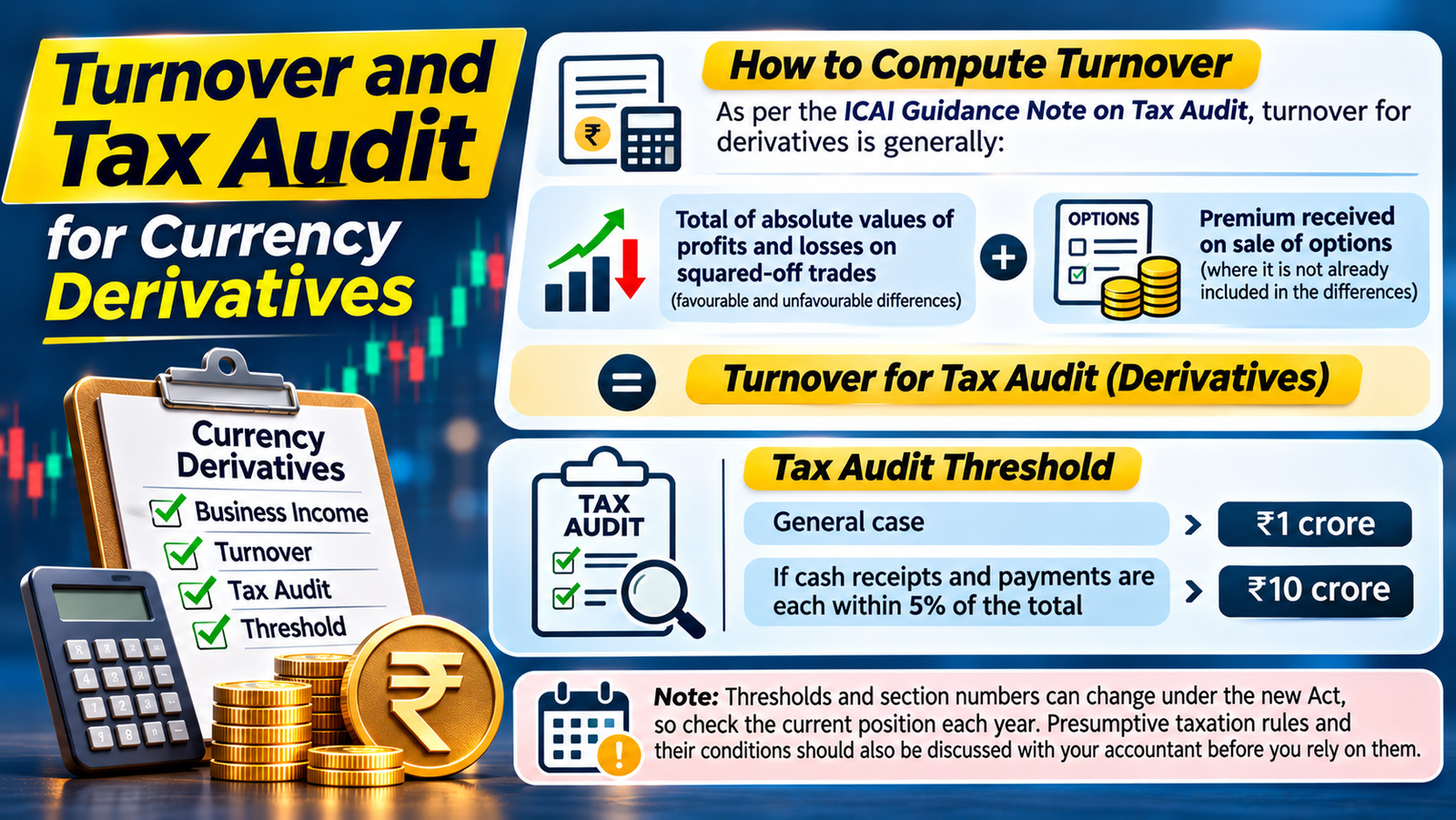
Because currency derivative income is business income, you may need to compute turnover to check tax audit applicability. Under the ICAI Guidance Note on Tax Audit, turnover for derivatives is generally:
- the total of absolute values of profits and losses on squared-off trades (favorable and unfavorable differences)
- plus the premium received on sale of options, where it is not already included in the differences
This “turnover” is usually much smaller than the contract value. The audit threshold has generally been ₹1 crore, rising to ₹10 crore where cash receipts and payments are each within 5% of the total. Thresholds and section numbers can change under the new Act, so check the current position each year. Presumptive taxation rules and their conditions should also be discussed with your accountant before you rely on them.
Filing Your Return
- Individuals with currency derivatives income generally file ITR-3, which covers business income.
- Report the income under “Profits and Gains of Business or Profession” as non-speculative business income.
- To carry forward a loss, file the return on or before the due date. A belated return generally does not preserve business loss carry forward.
- Keep contract notes, the broker’s tax P&L statement, ledgers and bank statements.
- Claim expenses such as brokerage, exchange charges, GST, internet and data subscriptions where they relate to the business.
Keeping good records makes section 43(5) currency derivatives treatment easy to support if you receive a notice.
Section 43(5) Currency Derivatives Checklist
- Were all my currency trades on NSE or BSE through a SEBI-registered broker?
- Do I have time-stamped contract notes showing my UCC and PAN?
- Have I reported the income as non-speculative business income, not capital gains?
- Have I separated any intraday equity cash trades, which are speculative?
- Have I computed turnover correctly to check tax audit applicability?
- Am I filing ITR-3 on time to carry forward any loss?
- Have I mapped old section references to the Income-tax Act, 2025 for the current year?
Common Mistakes
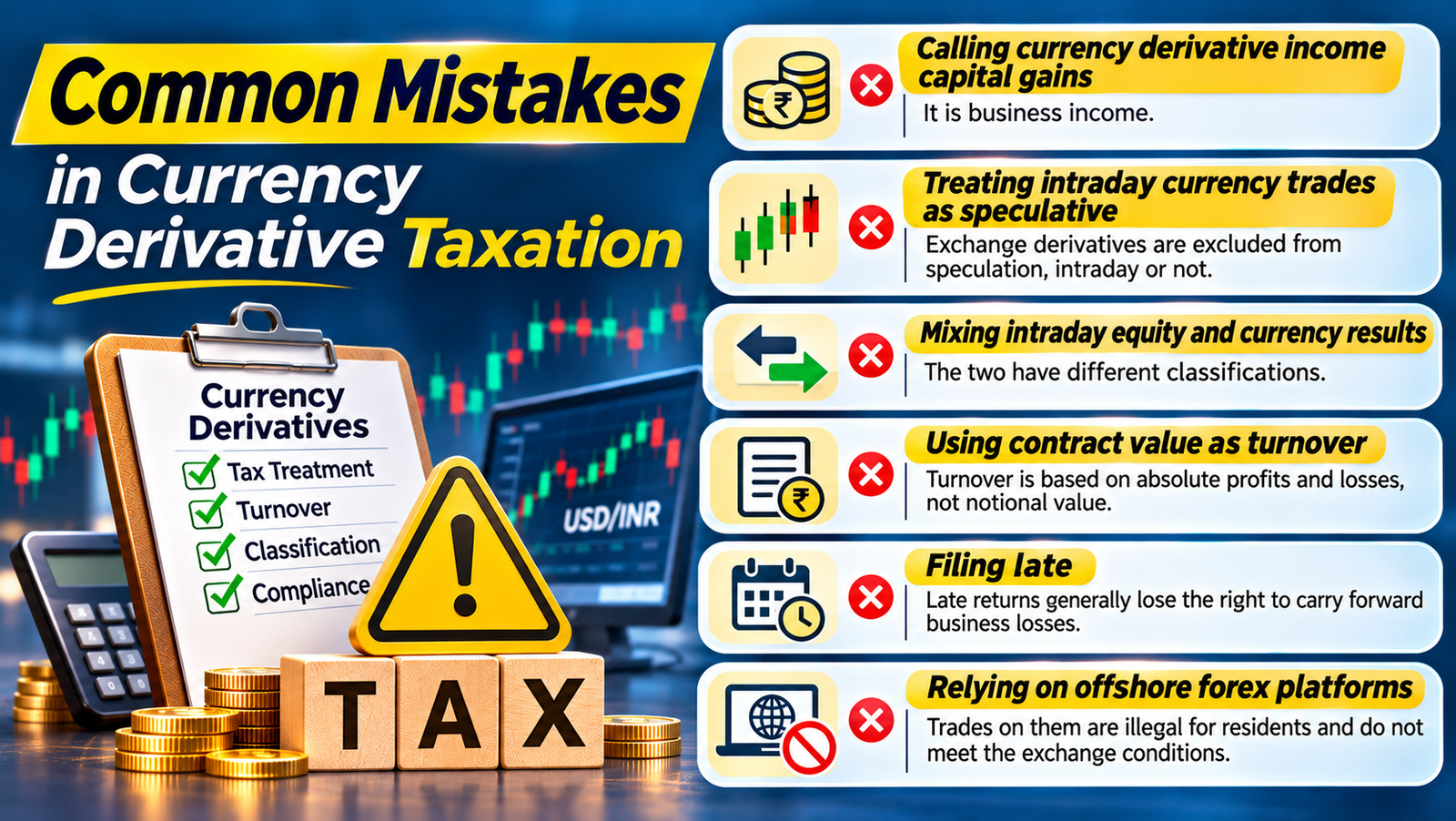
- Calling currency derivative income capital gains: it is business income.
- Treating intraday currency trades as speculative: exchange derivatives are excluded from speculation, intraday or not.
- Mixing intraday equity and currency results: the two have different classifications.
- Using contract value as turnover: turnover is based on absolute profits and losses, not notional value.
- Filing late: late returns generally lose the right to carry forward business losses.
- Relying on offshore forex platforms: trades on them are illegal for residents and do not meet the exchange conditions.
FAQs
What does section 43(5) currency derivatives mean?
It refers to how section 43(5) of the Income-tax Act, 1961 treats currency futures and options. Exchange-traded currency derivatives fall within the exclusion for eligible derivative transactions, so they are non-speculative.
Is currency derivative trading speculative income in India?
Generally no, when the trades are on a recognised stock exchange through a registered broker with proper contract notes.
Is intraday currency futures trading speculative?
Generally no. Unlike intraday equity cash trades, exchange-traded currency derivatives are excluded from the speculation definition.
Does section 43(5) currency derivatives treatment change under the new Income-tax Act?
The section numbers change, with speculative transactions and specified derivative transactions now defined in section 66, but exchange-traded derivatives remain non-speculative.
Can I set off currency derivative losses against salary?
No. Business losses cannot be set off against salary income, but they can be set off against other heads in the same year.
How long can I carry forward losses?
Non-speculative business losses can generally be carried forward for eight years against business income, if the return is filed on time.
Do hedgers get the same section 43(5) currency derivatives treatment as traders?
Yes. Eligible exchange-traded currency derivatives are non-speculative whether used for hedging or trading, though the way results are reported may differ.
Which ITR form should I use?
Usually ITR-3 for individuals with business income from derivatives.
Conclusion
Section 43(5) of the 1961 Act defined speculative transactions broadly, but its proviso carved out exchange-traded derivatives. Under section 43(5) currency derivatives treatment, futures and options on USD/INR and other pairs traded on NSE and BSE are non-speculative business income, whether intraday or positional. The Income-tax Act, 2025 carries the same idea forward through section 66.
That classification gives currency traders flexibility to set off losses against other non-salary income and carry them forward for eight years. To benefit, trade only on recognised exchanges through registered brokers, keep contract notes and records, compute turnover correctly, file ITR-3 on time and take professional advice for your situation.