
Introduction
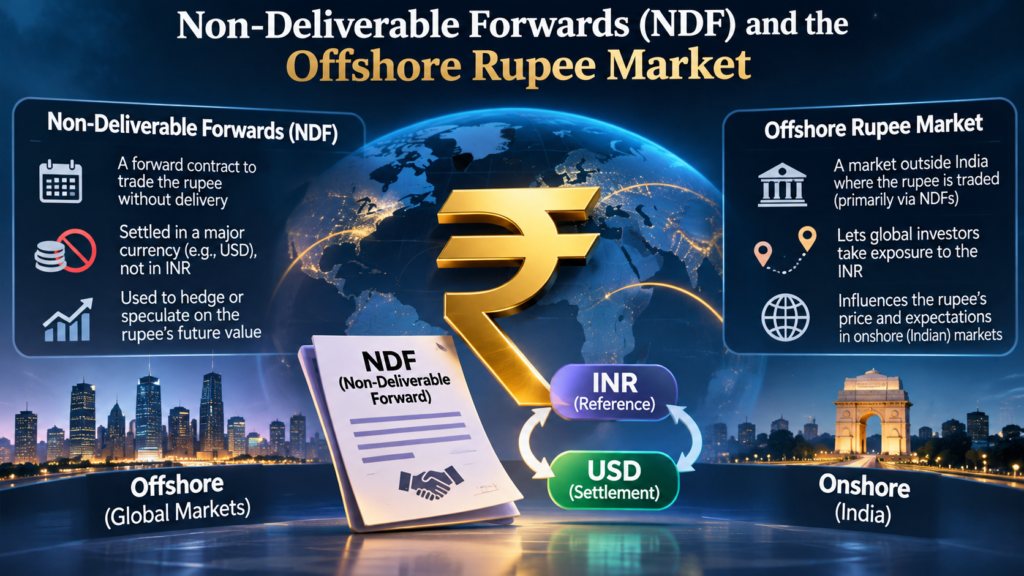
The rupee does not only trade in India. Every day, banks, hedge funds and global investors in Singapore, London, Dubai and New York trade rupee contracts that never involve the actual delivery of rupees. These contracts are called non-deliverable forwards (NDFs), and together they form the offshore rupee market.
The NDF market rupee activity matters to anyone who follows USD/INR. It trades when Indian markets are closed, often signals where the rupee will open the next morning, and can add to pressure on the currency during periods of stress. The Reserve Bank of India watches it closely and has taken steps over the years to bring more of this activity onshore.
This guide explains what NDFs are, how they are settled, why the offshore rupee market exists, how it interacts with the onshore market, RBI reforms and what Indian traders should know.
What Is a Non-Deliverable Forward?
A non-deliverable forward is a forward contract on a currency that is not freely convertible or has restrictions on offshore use. Instead of exchanging the two currencies at maturity, the parties settle only the difference between the agreed rate and the official fixing rate, usually in US dollars.
- Underlying pair: USD/INR.
- Settlement currency: usually US dollars.
- Settlement method: cash settlement of the difference; no rupees change hands.
- Fixing rate: the official USD/INR reference rate, published in India by Financial Benchmarks India (FBIL).
- Tenors: commonly one week to one year, with one-month and three-month contracts among the most active.
Because no rupees are delivered, foreign participants can take a view on the rupee or hedge rupee exposure without dealing in India’s onshore market.
How NDF Settlement Works: A Worked Example
This example is illustrative and uses hypothetical rates.
A foreign fund buys a one-month USD/INR NDF with a notional amount of $1,000,000 at a contracted rate of 89.00. At maturity, the FBIL fixing is 89.50.
- The rupee has weakened, so the buyer of USD/INR gains.
- Settlement amount = (fixing − contract rate) × notional ÷ fixing
- = (89.50 − 89.00) × 1,000,000 ÷ 89.50 ≈ $5,587, paid by the seller to the buyer in dollars.
If the fixing had been 88.60 instead, the rupee would have strengthened, and the buyer would pay the seller about (88.60 − 89.00) × 1,000,000 ÷ 88.60 ≈ $4,515.
Only the net difference changes hands. This simple structure is what makes the NDF market rupee contracts attractive to offshore participants.
Why the Offshore Rupee Market Exists
To understand the NDF market rupee activity, start with India’s currency rules. The rupee is convertible for current account transactions such as trade, but India still has rules on capital account transactions. Foreign participants without an underlying exposure in India have historically faced restrictions in the onshore forward market. NDFs grew to fill that gap.
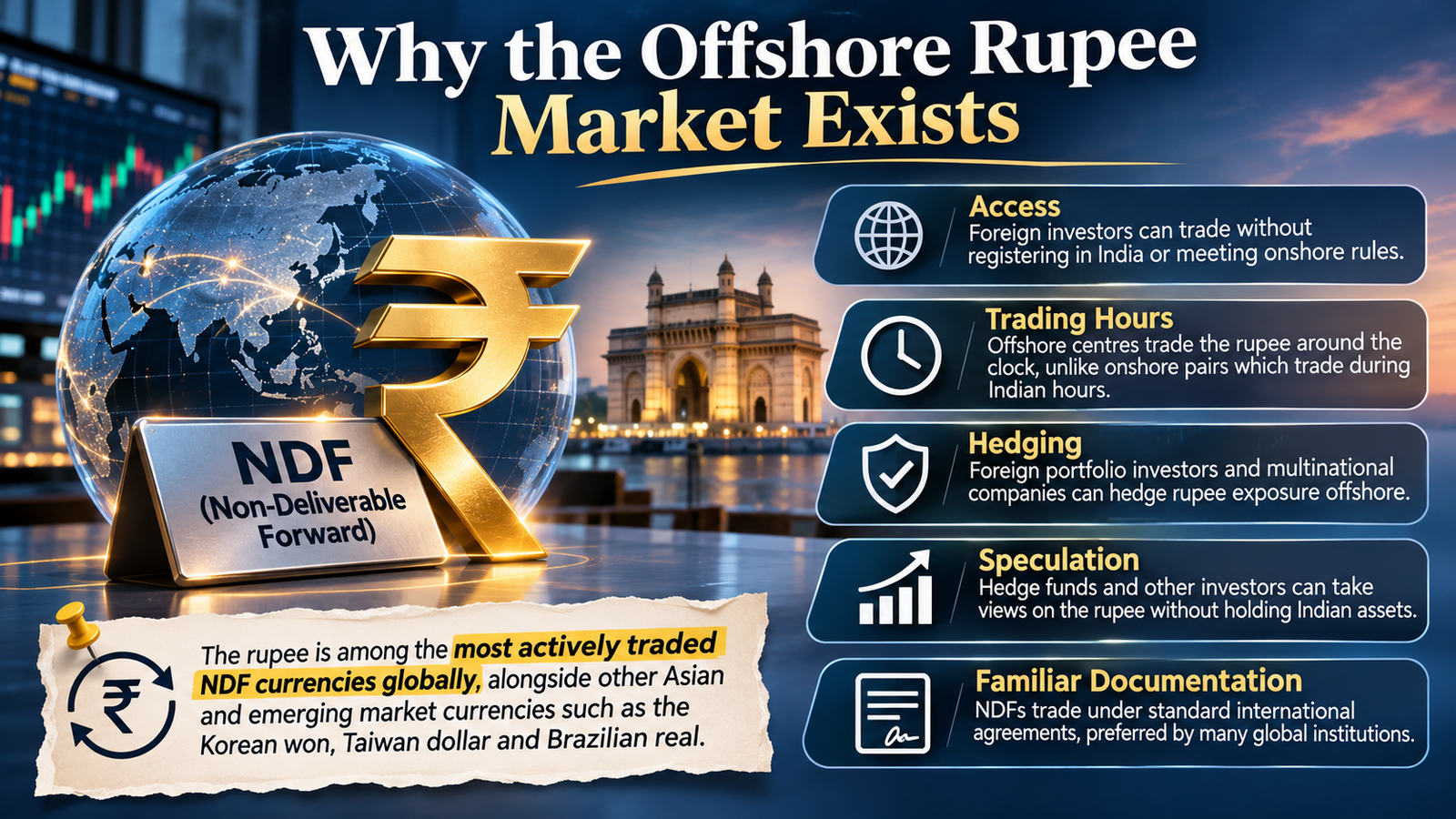
- Access: foreign investors can trade without registering in India or meeting onshore documentation rules.
- Trading hours: offshore centres trade the rupee around the clock, while onshore rupee pairs trade during Indian hours.
- Hedging: foreign portfolio investors and multinational companies can hedge rupee exposure offshore.
- Speculation: hedge funds and other investors can take views on the rupee without holding Indian assets.
- Familiar documentation: NDFs trade under standard international agreements, which many global institutions prefer.
The rupee is among the most actively traded NDF currencies globally, alongside other Asian and emerging market currencies such as the Korean won, Taiwan dollar and Brazilian real.
Who Trades in the NDF Market Rupee Segment?
| Participant | Typical purpose |
|---|---|
| Foreign portfolio investors | Hedging currency risk on Indian stocks and bonds |
| Multinational companies | Hedging rupee revenues or costs from Indian operations |
| Hedge funds and macro funds | Taking views on the rupee and interest rate differentials |
| Global banks | Market-making and managing client flows |
| Arbitrageurs | Exploiting price gaps between onshore and offshore markets |
Onshore vs Offshore: How the Two Markets Connect
| Feature | Onshore market | Offshore NDF market |
|---|---|---|
| Location | India (interbank, NSE, BSE) | Singapore, London, Dubai, New York and other centres |
| Settlement | Delivery in rupees (OTC forwards) or cash-settled in rupees (exchange futures) | Cash-settled in US dollars |
| Participants | Banks, corporates, eligible residents and non-residents | Global banks, funds, corporates |
| Hours | Mainly Indian trading hours | Nearly 24 hours across time zones |
| Regulator | RBI and SEBI | Foreign regulators; RBI influence is indirect |
Price links and arbitrage
NDF prices and onshore forward prices usually move closely together. When they diverge, arbitrageurs, including banks with access to both markets, step in to profit from the gap, which helps pull the prices back together. Differences can still appear during stress, when offshore investors rush to hedge or speculate and the NDF market rupee rate moves ahead of the onshore rate.
NDF implied yields
Like onshore forwards, NDF prices reflect interest rate differentials. But NDF-implied rupee interest rates can differ from onshore rates, because offshore supply and demand, rather than onshore money markets, set the price. A gap between the two is a sign of offshore pressure.
How the NDF Market Rupee Activity Affects Onshore USD/INR
- Overnight signals: because NDFs trade when Indian markets are shut, the overnight NDF level often indicates where USD/INR will open at 9am IST.
- Gap openings: a sharp move in the NDF market overnight, for example after a US data release or a global risk-off event, can lead to a gap opening in the onshore rupee.
- Pressure during stress: heavy offshore buying of USD/INR NDFs can push onshore rates higher through arbitrage.
- Expiry flows: large NDF maturities settling against the FBIL fixing can affect onshore trading around the fixing time.
For traders, watching the NDF market rupee quotes before the Indian open is a useful way to prepare for the day’s first move.
RBI Reforms: Bringing NDF Activity Onshore
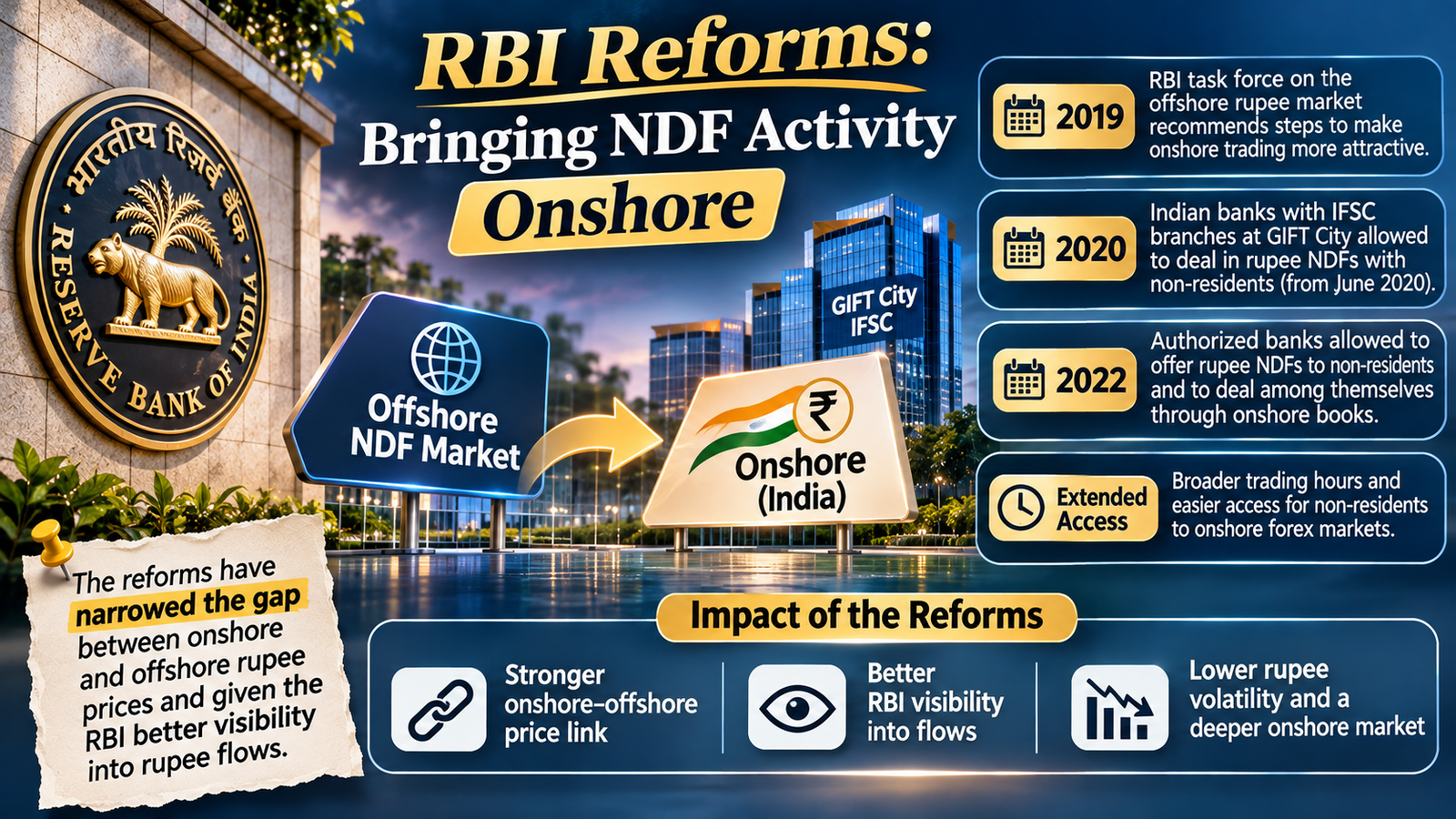
The size of the NDF market rupee segment has long been a policy concern. The RBI’s worry is that a large offshore market could weaken its ability to manage rupee volatility. In 2019, an RBI task force on the offshore rupee market examined the issue and recommended steps to make onshore trading more attractive.
Key reforms that followed include:
- 2020: Indian banks with branches in the International Financial Services Centre (IFSC) at GIFT City were allowed to deal in rupee NDFs with non-residents, starting from June 2020.
- 2022: banks authorized to deal in foreign exchange were allowed to offer rupee NDFs to non-residents and to deal among themselves through their onshore books, further connecting the onshore and offshore markets.
- Extended onshore hours and easier access: the RBI has also made it easier for non-residents to access onshore forex markets and has broadened trading hours.
These measures have changed how the NDF market rupee prices connect with onshore rates. They have helped narrow the gap between onshore and offshore prices and given the RBI better visibility into rupee flows.
RBI Intervention in the NDF Market
The RBI manages excessive volatility in the rupee, and its actions are not limited to the onshore spot market. It has been widely reported to use forward and NDF transactions at times to manage pressure on the currency, particularly during periods of heavy outflows or strong dollar demand. The RBI also discloses its outstanding forward position in its published data.
For market participants, this means the NDF market rupee quotes can be influenced by central bank activity, not just private supply and demand.
Why the NDF Market Matters for Traders
Even if you never trade an NDF yourself, the NDF market rupee quotes carry useful information:
- Morning preparation: check overnight NDF levels to anticipate the onshore opening.
- Sentiment gauge: a rising NDF premium can signal offshore bets on rupee weakness.
- Event risk: major US or global events overnight show up first in the NDF market.
- Gaps and stops: gap openings can skip past stop-loss levels set the previous day.
- Context: combine NDF signals with FPI flows, oil prices, US yields and RBI behaviour.
Worked Example: Using NDF Levels Before the Open
This example is illustrative and uses hypothetical prices.
- USD/INR closes onshore at 88.40.
- Overnight, strong US data lifts the dollar, and the one-month NDF trades at a level implying a spot rate around 88.65.
- The next morning, onshore USD/INR opens at 88.62.
A trader with 4 lots short USD/INR futures from the previous day would face a loss of about 22 paise × ₹10 × 4 = ₹880 at the open, before any further moves. Watching the NDF market rupee levels overnight would have warned the trader about the likely gap.
Can Indian Residents Trade NDFs?
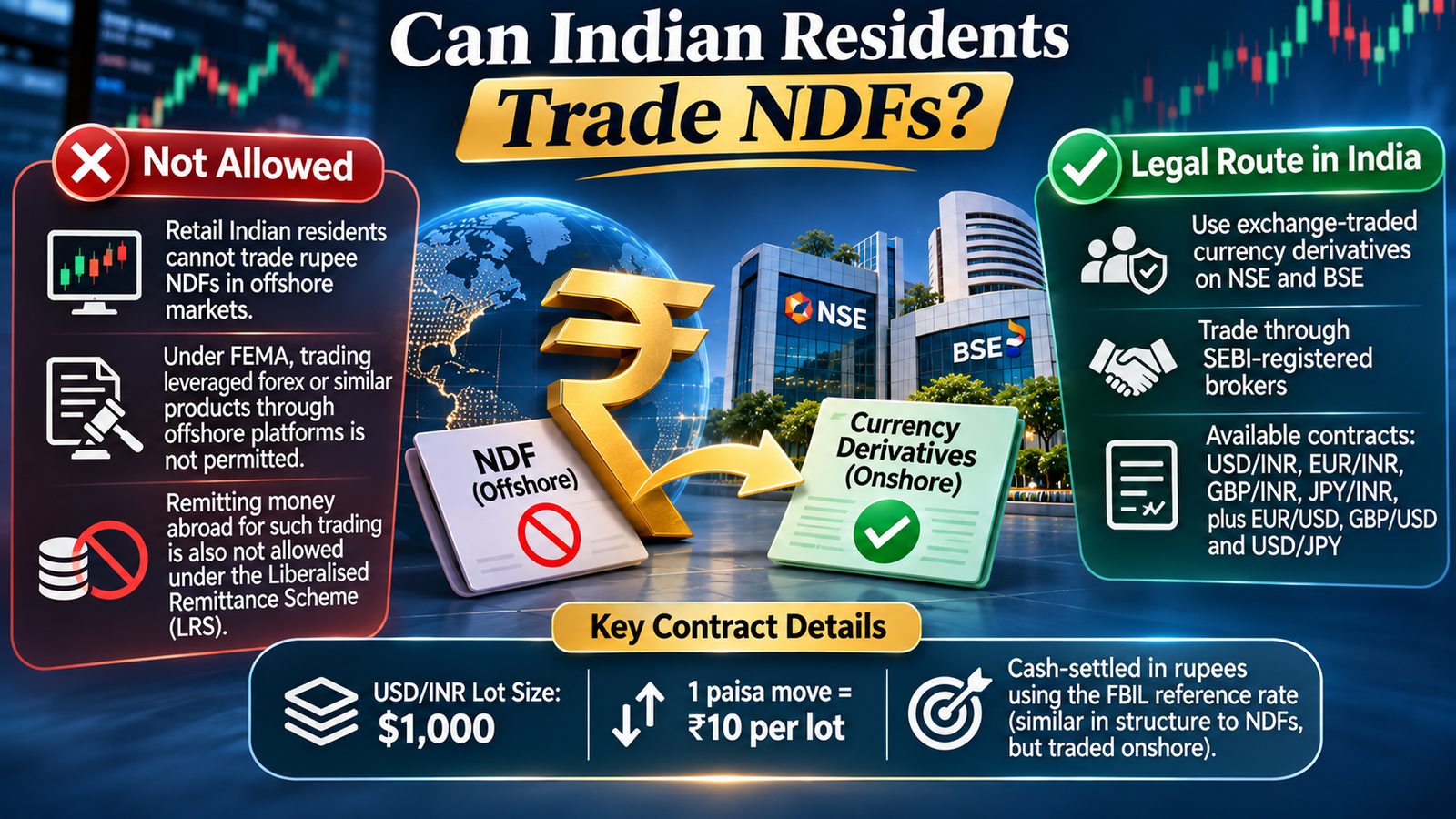
Retail Indian residents cannot trade rupee NDFs in offshore markets. Under the Foreign Exchange Management Act (FEMA), Indian residents are not permitted to trade leveraged forex or similar products through offshore platforms, and remitting money abroad for such trading is not permitted under the Liberalized Remittance Scheme.
Indian residents who want exposure to rupee movements can use exchange-traded currency derivatives on NSE and BSE through SEBI-registered brokers. Contracts include USD/INR, EUR/INR, GBP/INR and JPY/INR, along with EUR/USD, GBP/USD and USD/JPY. One USD/INR lot is $1,000, so a one-paisa move is worth ₹10 per lot. These contracts are cash-settled in rupees using the FBIL reference rate, similar in structure to NDFs but traded onshore.
Risks and Limitations
- Counterparty risk: NDFs are over-the-counter contracts, so participants depend on the other side honouring the deal, although many are now centrally cleared.
- Liquidity during stress: spreads can widen sharply in turbulent markets.
- Basis risk: NDF and onshore prices can diverge, so a hedge in one market may not perfectly offset exposure in the other.
- Regulatory change: RBI rules on onshore and offshore access continue to evolve.
- Limited transparency: NDF market rupee volumes and positions are less visible than exchange-traded data, so sentiment readings are partly based on dealer reports.
Quick Reference
| Term | Meaning |
|---|---|
| NDF | Forward contract cash-settled in dollars, with no delivery of rupees |
| Fixing rate | Official USD/INR reference rate used to settle the contract |
| Offshore rupee market | Trading in rupee NDFs outside India |
| Onshore market | Rupee trading within India’s regulated markets |
| Basis | Difference between NDF and onshore forward prices |
| Gap opening | Onshore rupee opening away from the previous close because of overnight moves |
FAQs
What is the NDF market rupee?
It refers to offshore trading in rupee non-deliverable forwards, where contracts are settled in dollars based on the difference between the agreed rate and the official fixing rate.
Is the NDF market rupee rate the same as the onshore rate?
Usually very close, because arbitrage links the two. Gaps can open during stress or when onshore markets are closed.
Why is it called non-deliverable?
Because rupees are not delivered at maturity. Only the net difference is paid, usually in US dollars.
Where are rupee NDFs traded?
Mainly in offshore centres such as Singapore, London, Dubai and New York, and now also through Indian banks’ IFSC units and onshore books.
How does the NDF market affect the rupee in India?
Overnight NDF moves often signal the onshore opening, and heavy offshore activity can add to pressure on USD/INR through arbitrage.
Can Indian retail traders use NDFs?
No. Indian residents should use exchange-traded currency derivatives on NSE and BSE through SEBI-registered brokers.
What rate are rupee NDFs settled against?
The official USD/INR reference rate published by FBIL.
Conclusion
Non-deliverable forwards give global participants a way to trade and hedge the rupee without delivering rupees. The offshore NDF market rupee trading runs almost around the clock, often signals the onshore opening and can amplify pressure during stress. RBI reforms since 2020 have tightened the link between onshore and offshore markets and improved oversight.
For Indian traders, watching NDF levels is a practical way to anticipate gap openings and gauge offshore sentiment. Trading itself should stay on the regulated route: currency derivatives on NSE and BSE through SEBI-registered brokers, with careful risk management around overnight moves.