
Introduction
Why does the rupee weaken when oil prices jump, or strengthen when foreign investors pour money into Indian stocks? Much of the answer lies in the balance of payments (BoP), the record of every transaction between India and the rest of the world.
The link between balance of payments and exchange rate movements is one of the most important ideas in currency analysis. Every rupee of imports needs dollars, every export brings dollars in, and every foreign investment or withdrawal changes demand and supply for the currency. When dollars flowing out exceed dollars flowing in, the rupee comes under pressure, unless the Reserve Bank of India steps in.
This guide explains how the balance of payments works, the difference between the current account and the capital account, India’s BoP structure, the relationship between balance of payments and exchange rate trends, historical episodes and how traders use BoP data.
What Is the Balance of Payments?
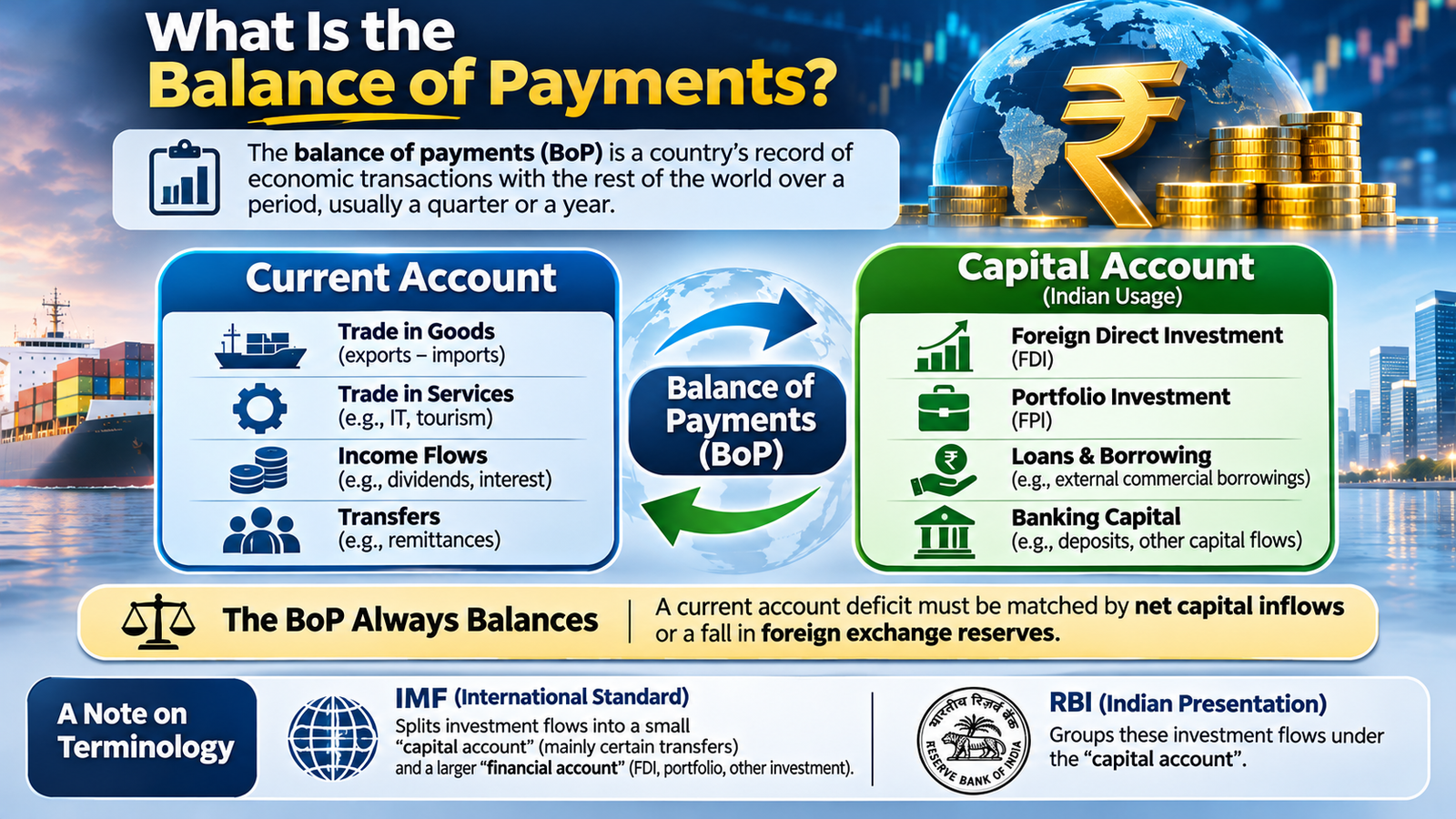
The balance of payments is a country’s record of economic transactions with the rest of the world over a period, usually a quarter or a year. It has two main parts:
- Current account: trade in goods and services, income flows and transfers such as remittances.
- Capital account (in India’s presentation): investment and borrowing flows, such as foreign direct investment, portfolio investment, loans and banking capital.
In principle, the balance of payments always “balances”. A current account deficit must be matched by net capital inflows or a fall in foreign exchange reserves. That accounting identity is the starting point for understanding balance of payments and exchange rate pressure.
A note on terminology
International standards from the IMF split cross-border investment flows into a small “capital account” (mainly certain transfers) and a larger “financial account” (FDI, portfolio investment and other investment). The RBI’s standard presentation of India’s balance of payments groups these investment flows under the “capital account”. This guide follows the Indian usage.
The Current Account
| Component | What it includes | India’s typical position |
|---|---|---|
| Merchandise trade | Exports and imports of goods | Large deficit, driven by crude oil, gold, electronics and other imports |
| Services | IT and software, business services, travel, transport | Large surplus, led by software and business services exports |
| Primary income | Interest, dividends and profits paid and received | Usually a deficit, as income paid to foreign investors exceeds income received |
| Secondary income | Transfers, mainly remittances from Indians abroad | Large surplus; India is the world’s largest recipient of remittances, according to the World Bank |
The current account balance is the sum of these items. India usually runs a current account deficit (CAD), because the goods trade deficit is larger than the combined surplus from services and remittances.
Why the current account matters for the rupee
- A wider deficit means India needs more dollars than it earns from trade and transfers.
- Higher oil prices can widen the deficit quickly, because India imports most of its crude oil.
- Strong services exports and remittances help offset the goods deficit and support the rupee.
The Capital Account
| Component | What it includes | Behaviour |
|---|---|---|
| Foreign direct investment (FDI) | Long-term investment in businesses and factories | Relatively stable |
| Foreign portfolio investment (FPI) | Foreign purchases and sales of Indian shares and bonds | Volatile; can reverse quickly |
| External commercial borrowings (ECBs) | Foreign loans taken by Indian companies | Depends on global rates and credit conditions |
| Banking capital and NRI deposits | Changes in banks’ foreign assets and liabilities, deposits by non-resident Indians | Sensitive to interest rate differentials |
| Short-term trade credit | Credit linked to imports and exports | Fluctuates with trade |
Capital inflows finance the current account deficit. When they are larger than the deficit, India’s overall balance is in surplus and the RBI typically adds to its reserves. When they are smaller, the overall balance is in deficit and reserves fall or the rupee weakens.
Balance of Payments and Exchange Rate: The Core Link
The relationship between balance of payments and exchange rate movements comes down to supply and demand for foreign currency.
- Dollar demand: importers paying for oil, gold and goods; Indian companies repaying foreign loans; foreign investors selling Indian assets and taking money home.
- Dollar supply: exporters, IT companies earning abroad, remittances, FDI and FPI inflows, and foreign borrowing.
If dollar demand exceeds supply, the rupee tends to weaken. If supply exceeds demand, it tends to strengthen. The RBI can smooth these moves by selling dollars from reserves when the rupee is under pressure and buying dollars when inflows are strong.
| Scenario | Overall BoP | Likely effect on rupee | Likely RBI response |
|---|---|---|---|
| Small CAD, strong capital inflows | Surplus | Strengthening pressure | Buys dollars, reserves rise |
| Large CAD, strong capital inflows | Roughly balanced | Stable | Limited intervention |
| Large CAD, weak or negative capital flows | Deficit | Weakening pressure | Sells dollars, reserves fall |
Worked Example: A Quarter of BoP Data
This example is illustrative and uses hypothetical figures.
| Item | US$ billion |
|---|---|
| Merchandise trade balance | −70 |
| Net services | +45 |
| Net primary income | −10 |
| Net secondary income (mainly remittances) | +30 |
| Current account balance | −5 |
| Net FDI | +5 |
| Net FPI | −8 |
| Other capital flows | +4 |
| Capital account balance | +1 |
| Overall balance (change in reserves) | −4 |
In this quarter, the current account deficit of $5 billion was not fully financed by capital inflows, mainly because foreign portfolio investors sold Indian assets. The overall deficit of $4 billion means reserves fell, implying the RBI sold dollars to limit rupee weakness. This shows how balance of payments and exchange rate pressure are linked, even when the current account deficit is small.
Historical Episodes
India’s history offers clear examples of the balance of payments and exchange rate link in action.
The 1991 balance of payments crisis
In 1991, high oil prices after the Gulf War, a large fiscal deficit and falling confidence pushed India into a severe BoP crisis. Foreign exchange reserves fell to levels covering only a few weeks of imports. India pledged gold to raise emergency funds, devalued the rupee in July 1991 and launched major economic reforms. The crisis is the clearest example in Indian history of how balance of payments and exchange rate stability depend on each other.
The 2013 taper tantrum
India’s current account deficit reached about 4.8% of GDP in 2012–13, driven by high oil and gold imports. When the US Federal Reserve signaled in May 2013 that it might slow its bond purchases, foreign investors pulled money from emerging markets. The rupee fell sharply to record lows in August 2013. The RBI and government responded with measures including a special swap window for FCNR(B) deposits and restrictions on gold imports, helping stabilize the currency.
Periods of strong inflows
In years of heavy FDI and FPI inflows, India has run overall BoP surpluses. The RBI has used these periods to build foreign exchange reserves, which act as a buffer during later outflows.
Balance of Payments and Exchange Rate: Structural Trends in India
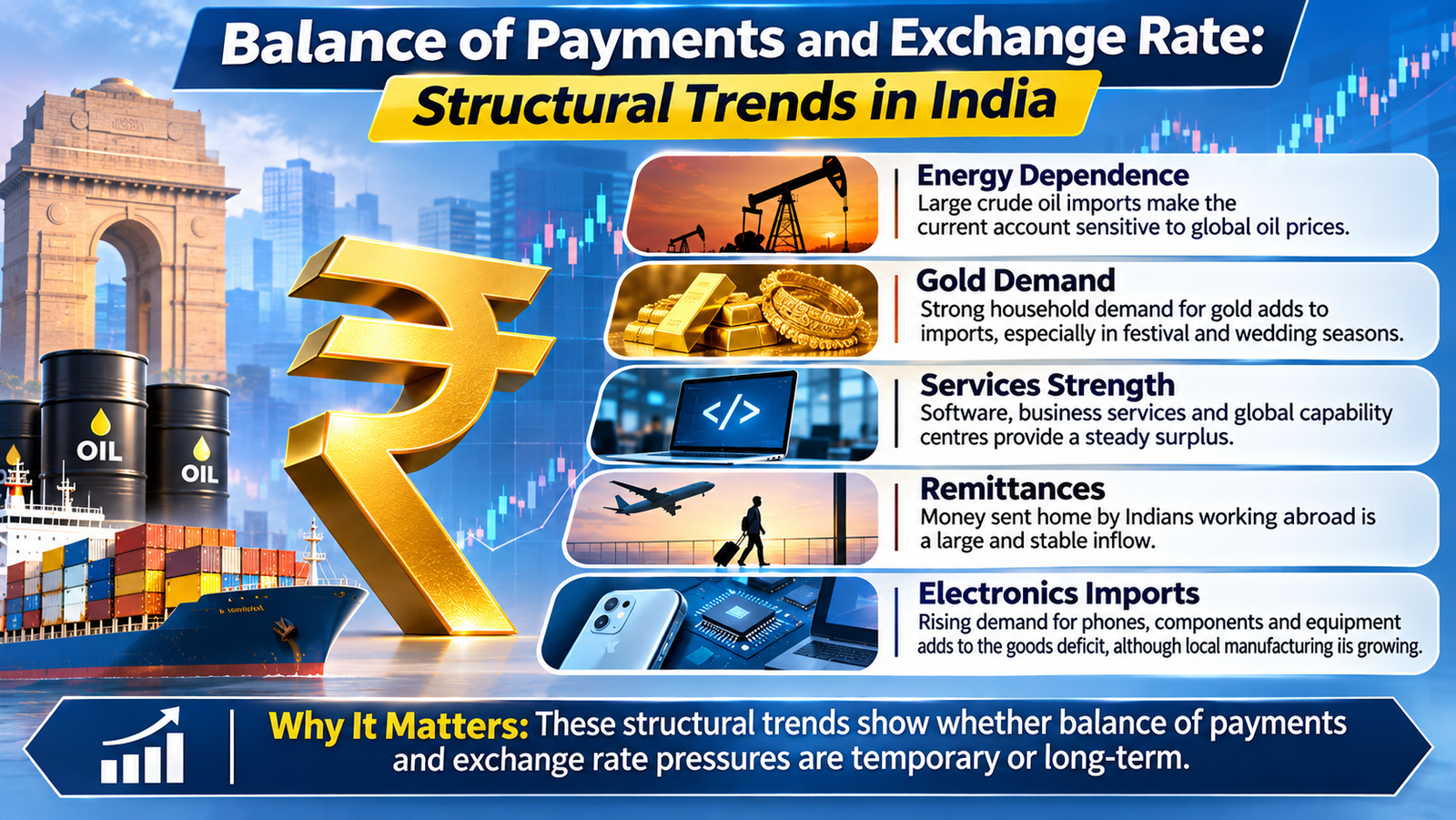
Beyond short-term swings, a few long-running features shape India’s BoP:
- Energy dependence: large crude oil imports make the current account sensitive to global oil prices.
- Gold demand: strong household demand for gold adds to imports, especially in festival and wedding seasons.
- Services strength: software, business services and global capability centre provide a steady surplus.
- Remittances: money sent home by Indians working abroad is a large and stable inflow.
- Electronics imports: rising demand for phones, components and equipment adds to the goods deficit, although local manufacturing is growing.
Watching these trends helps traders understand whether balance of payments and exchange rate pressures are temporary or structural.
The Role of Forex Reserves
Foreign exchange reserves are the RBI’s main tool for managing the gap between balance of payments and exchange rate goals. Large reserves:
- Allow the RBI to sell dollars when outflows threaten excessive rupee volatility.
- Build confidence among investors and rating agencies.
- Provide import cover, often measured in months of imports.
The IMF classifies India’s de facto exchange rate arrangement as a “crawl-like arrangement”, reflecting how the RBI manages volatility while allowing market forces to set the broad direction.
How Traders Use Balance of Payments and Exchange Rate Analysis
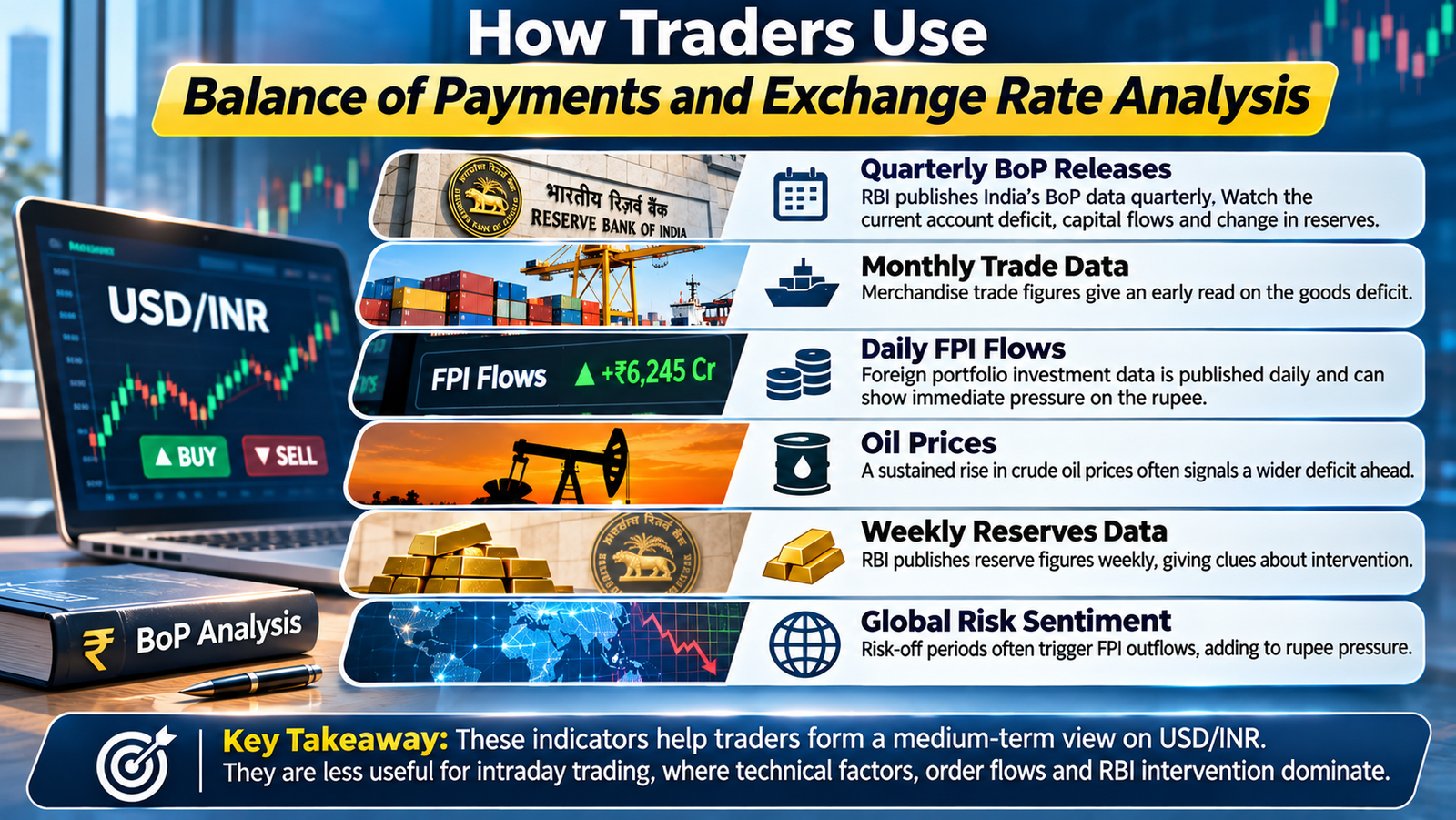
- Quarterly BoP releases: the RBI publishes India’s balance of payments data quarterly. Watch the current account deficit, capital flows and change in reserves.
- Monthly trade data: merchandise trade figures give an early read on the goods deficit.
- Daily FPI flows: foreign portfolio investment data is published daily and can show immediate pressure on the rupee.
- Oil prices: a sustained rise in crude oil prices often signals a wider deficit ahead.
- Weekly reserves data: the RBI publishes reserve figures weekly, giving clues about intervention.
- Global risk sentiment: risk-off periods often trigger FPI outflows, adding to rupee pressure.
These indicators help traders form a medium-term view on USD/INR. They are less useful for intraday trading, where technical factors, order flows and RBI intervention dominate.
Limitations
- Data lag: quarterly BoP data is released with a delay, so markets often react to monthly trade and daily flow data first.
- Revisions: BoP figures are often revised.
- Intervention: RBI action can delay or soften the exchange rate impact of BoP pressure.
- Interest rates and sentiment: capital flows respond to rate differentials and global risk appetite, which can outweigh trade balances.
- Other factors: the relationship between balance of payments and exchange rate trends is strong over time but noisy in the short run.
Trading the Rupee from India
Indian residents can act on views about the rupee through exchange-traded currency derivatives on NSE and BSE via SEBI-registered brokers. Contracts include USD/INR, EUR/INR, GBP/INR and JPY/INR, along with EUR/USD, GBP/USD and USD/JPY. One USD/INR lot is $1,000, so a one-paisa move is worth ₹10 per lot. Leveraged forex through offshore brokers is not permitted for Indian residents under FEMA.
Quick Reference
| Term | Meaning |
|---|---|
| Balance of payments | Record of all transactions between a country and the rest of the world |
| Current account | Trade in goods and services, income and transfers |
| Capital account (India) | FDI, FPI, loans, banking capital and other investment flows |
| Current account deficit | Imports and outflows exceed exports and inflows on the current account |
| Overall balance | Current plus capital account; matched by the change in reserves |
| Forex reserves | RBI’s holdings of foreign currency, gold and other reserve assets |
FAQs
What is the link between balance of payments and exchange rate?
The BoP shows the flow of foreign currency into and out of a country. When outflows exceed inflows, the currency tends to weaken unless the central bank intervenes.
Why does India have a current account deficit?
Mainly because imports of goods, especially crude oil, gold and electronics, exceed exports, even after strong services exports and remittances.
What is the difference between the current account and capital account?
The current account covers trade, income and transfers; the capital account covers investment and borrowing flows.
How do FPI flows affect the rupee?
Inflows increase dollar supply and support the rupee; outflows increase dollar demand and weaken it.
How does the RBI respond to BoP pressure?
It can sell dollars from reserves to limit volatility and take policy measures to attract inflows.
How often is India’s BoP data published?
The RBI publishes it quarterly, with monthly trade data and weekly reserves data in between.
Conclusion
The balance of payments is the foundation of long-term rupee analysis. The current account reflects trade, services and remittances, while the capital account reflects investment and borrowing. Together they determine whether dollars are flowing in or out, and that is the core of the relationship between balance of payments and exchange rate trends.
For traders, BoP data, trade figures, FPI flows, oil prices and reserves provide a useful medium-term framework for USD/INR. Combine this with interest rates, global risk sentiment and disciplined risk management, and remember that RBI intervention can shape how and when BoP pressure shows up in the rupee.