
Introduction
Today, around $9.6 trillion changes hands in the foreign exchange market every day, according to the Bank for International Settlements’ 2025 survey. Prices update in milliseconds, and traders can buy euros or yen from a phone. But the market did not always work this way. The history of forex market development stretches back thousands of years, through gold coins, empire-wide monetary systems, wars, crises and technological revolutions.
Understanding this history helps explain why currencies behave the way they do today, why central banks matter so much and why the US dollar sits at the centre of the system. This guide walks through the key stages in the history of forex market evolution, from the gold standard to Bretton Woods to the modern floating era, including India’s own currency journey.
Early History of Forex Market Activity: Money Changers and Trade
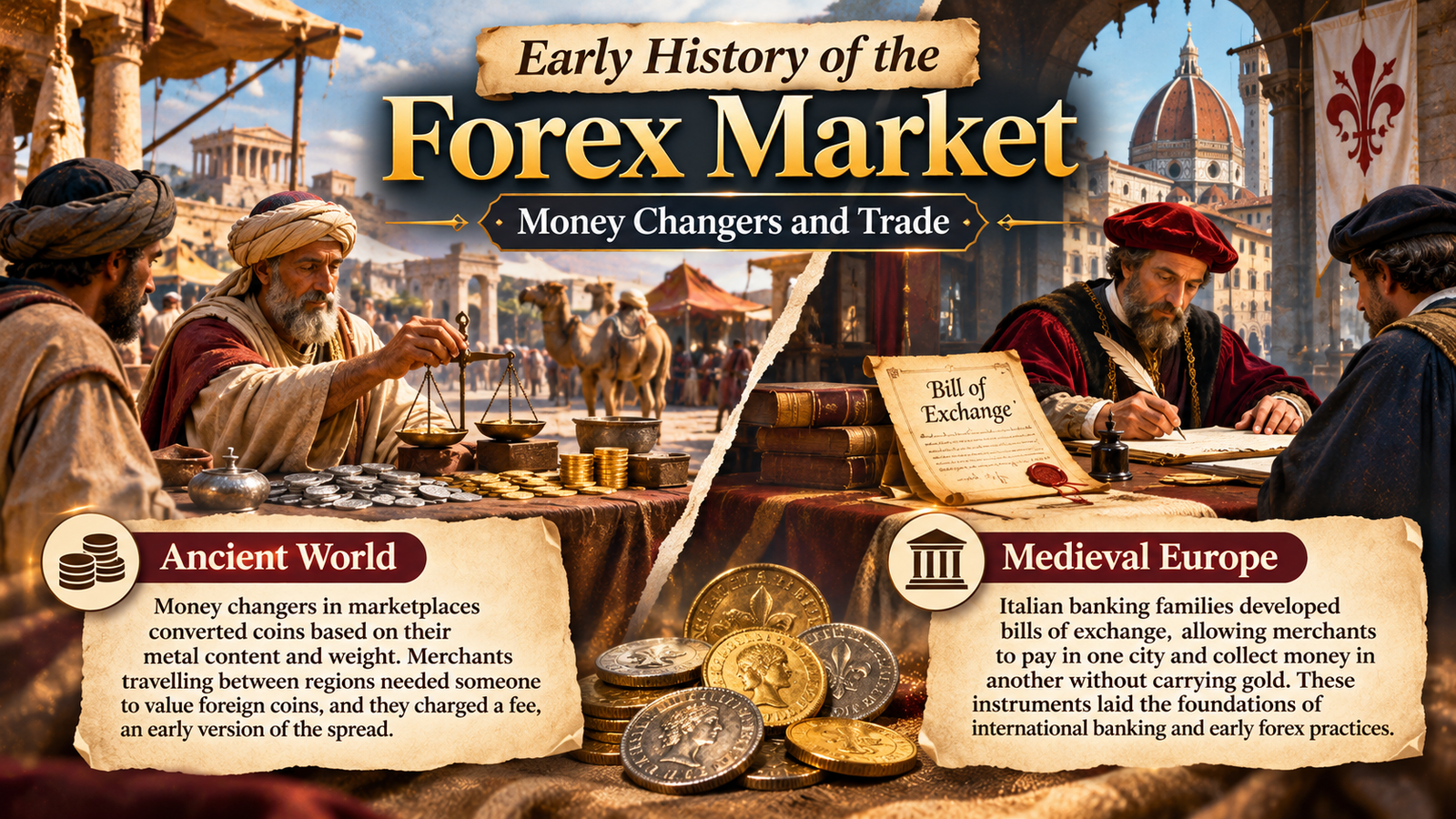
Currency exchange is as old as trade between regions with different coins. In the ancient world, money changers in marketplaces converted coins based on their metal content and weight. Merchants travelling between kingdoms needed someone to value foreign coins, and money changers often charged a fee, an early version of the spread.
In medieval Europe, Italian banking families developed bills of exchange, allowing merchants to pay in one city and collect money in another without carrying gold. These instruments laid the foundations of international banking and are an important early chapter in the history of forex market practices.
The Gold Standard (Late 1800s to 1914)
By the late 19th century, most major economies had adopted the gold standard. Each currency was defined as a fixed weight of gold, and governments promised to exchange paper money for gold at that rate.
- Because each currency had a fixed gold value, exchange rates between currencies were effectively fixed.
- Britain was at the centre of the system, and the pound sterling was the leading international currency.
- Trade imbalances were corrected through flows of gold between countries.
The gold standard brought stability and supported a period of expanding global trade. But it also limited governments’ ability to respond to economic downturns, because the money supply was tied to gold reserves. It remains the starting point for most accounts of the history of forex market regimes.
World Wars and the Interwar Years (1914 to 1944)
The First World War broke the classical gold standard. Countries suspended gold convertibility to print money for the war effort. After the war, several countries tried to restore a version of the gold standard, but the system was fragile.
The Great Depression of the 1930s brought it down. Britain left the gold standard in 1931, and the United States devalued the dollar against gold in 1933–34. Countries competed to weaken their currencies to support exports, a period of “beggar-thy-neighbour” devaluations. This turmoil is one of the most important lessons in the history of forex market policy, and it shaped the system that followed.
The Bretton Woods System (1944 to 1971)
In July 1944, representatives of 44 Allied nations met at Bretton Woods, New Hampshire, to design a new international monetary order. The resulting Bretton Woods system created:
- A fixed but adjustable exchange rate system, with currencies pegged to the US dollar.
- A US dollar convertible into gold at $35 per ounce for foreign governments and central banks.
- The International Monetary Fund (IMF) to support the system and lend to countries facing balance of payments problems.
- The International Bank for Reconstruction and Development, part of today’s World Bank.
Bretton Woods made the US dollar the centre of the world’s monetary system, a role it still largely holds. It provided stability during the post-war recovery, but strains grew in the 1960s as US spending and inflation rose and other countries accumulated more dollars than the US had gold to back them. Its rise and fall is a defining chapter in the history of forex market policy.
The Nixon Shock and the Move to Floating Rates (1971 to 1976)
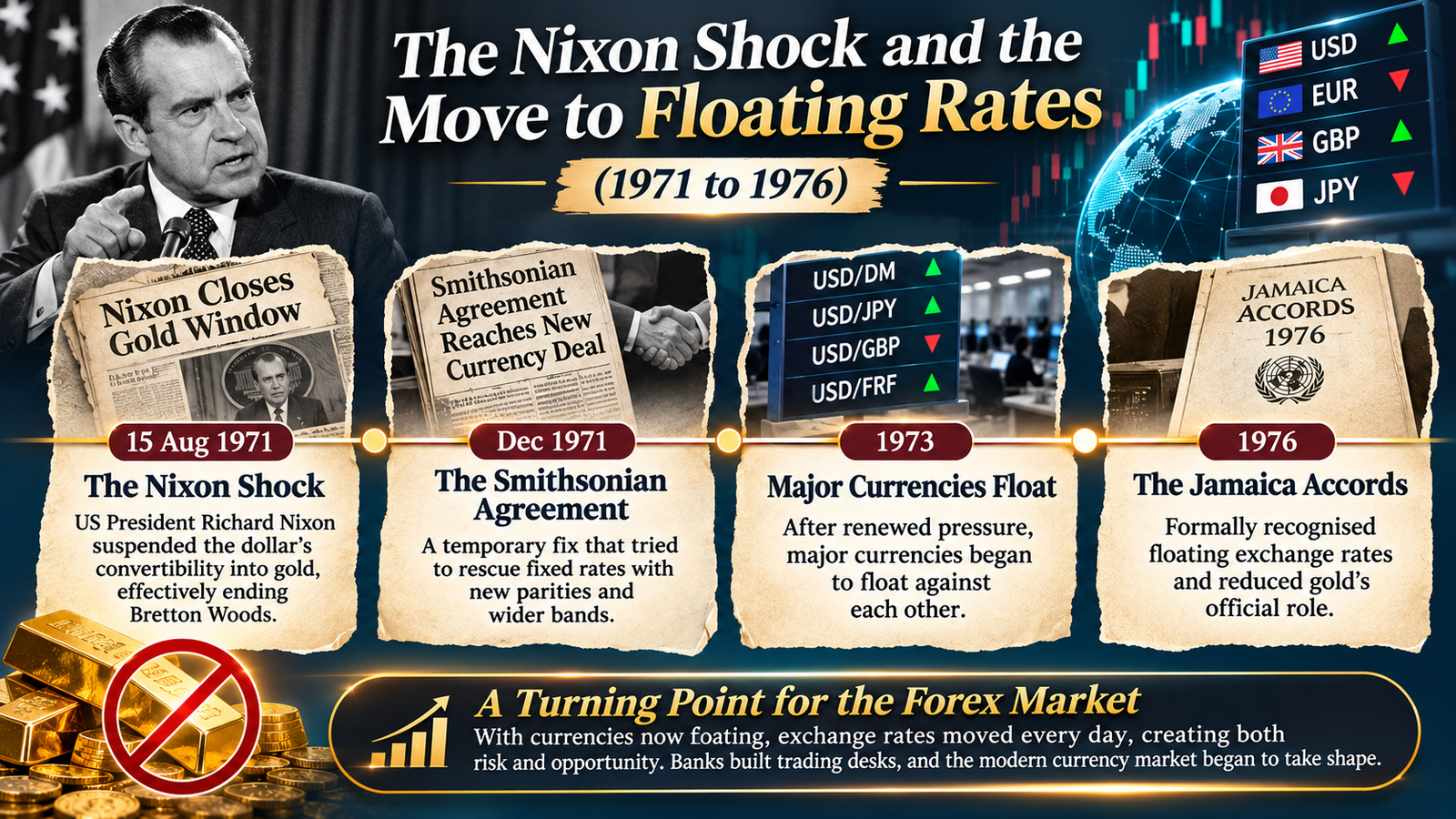
On 15 August 1971, US President Richard Nixon suspended the dollar’s convertibility into gold. This “Nixon shock” effectively ended Bretton Woods.
- December 1971: the Smithsonian Agreement tried to rescue fixed rates with new parities and wider bands.
- 1973: after renewed pressure, major currencies began to float against each other.
- 1976: the Jamaica Accords formally recognised floating exchange rates and reduced gold’s official role.
This was a turning point in the history of forex market structure. With currencies now floating, exchange rates moved every day, creating both risk and opportunity. Banks built trading desks, and the modern currency market began to take shape.
The Era of Coordination and Crises (1980s to 1990s)
- Plaza Accord (1985): the US, Japan, West Germany, France and the UK agreed to weaken the strong US dollar through coordinated intervention.
- Louvre Accord (1987): the same group, with Canada, agreed to stabilise currencies after the dollar’s decline.
- European Exchange Rate Mechanism (ERM): introduced in 1979 to keep European currencies within bands.
- Black Wednesday (16 September 1992): the UK was forced out of the ERM after heavy selling of the pound, a famous episode in which speculators profited from betting against an unsustainable peg.
- Asian financial crisis (1997): began when Thailand floated the baht in July 1997, triggering currency collapses across the region.
These events showed how powerful market forces had become and how vulnerable fixed or tightly managed currencies could be.
The Euro and the Electronic Revolution (1999 to 2000s)
- The euro (1999): launched as an accounting currency on 1 January 1999, with notes and coins following in 2002. It quickly became the world’s second most traded currency.
- Electronic trading: platforms such as Reuters’ dealing systems, from the 1980s, and EBS, from 1993, moved interbank trading from telephones to screens.
- Settlement: CLS Bank began operating in 2002 to reduce the risk of one side of a currency trade failing to pay.
- Online retail trading: from the late 1990s and 2000s, internet brokers gave individuals access to currency trading with small accounts and leverage.
This phase transformed the history of forex market access: what had been an institutional market became open to millions of retail traders worldwide.
How Trading Itself Changed
Alongside changes in monetary systems, the history of forex market trading is also a story of changing tools. For much of the 20th century, currency deals were agreed by telephone and telex between bank dealers, with brokers matching buyers and sellers by voice. Prices were not visible to outsiders, and spreads were wide.
Electronic platforms changed that. Screens showed live prices, trades were matched in fractions of a second, and spreads narrowed sharply in major pairs. Later, algorithms began to execute and manage large orders automatically. Each of these steps is part of the history of forex market efficiency, making the market faster, cheaper and more transparent for those with access. For retail traders, the arrival of online platforms and mobile apps completed this shift, and it is one of the most visible changes in the history of forex market access.

The Modern Era (2008 to Today)
- Global financial crisis (2008): extreme volatility, safe-haven flows into the dollar and yen, and tighter regulation of banks and brokers.
- Swiss franc shock (2015): the Swiss National Bank suddenly removed its cap on the franc against the euro in January 2015, causing one of the largest one-day moves in a major currency.
- Brexit (2016): the pound fell sharply after the UK’s referendum result.
- Pandemic (2020): sharp swings followed by massive central bank action.
- Growth of algorithmic trading: electronic and high-frequency firms now provide a large share of liquidity.
- Market size: daily turnover rose to about $9.6 trillion in April 2025, up 28% from 2022, with the US dollar on one side of about 89% of all trades, according to the BIS.
History of Forex Market Milestones at a Glance
| Period | Event | Impact |
|---|---|---|
| Ancient and medieval | Money changers and bills of exchange | Early currency conversion and international payments |
| Late 1800s to 1914 | Classical gold standard | Fixed rates through gold |
| 1930s | Collapse of the gold standard | Competitive devaluations |
| 1944 | Bretton Woods | Dollar-centred fixed but adjustable rates |
| 1971 | Nixon shock | End of dollar convertibility into gold |
| 1973 to 1976 | Floating rates and Jamaica Accords | Modern floating era begins |
| 1985 and 1987 | Plaza and Louvre Accords | Coordinated intervention |
| 1992 and 1997 | Black Wednesday and Asian crisis | Limits of pegs exposed |
| 1999 | Euro launched | New major currency |
| 2000s | Electronic and online trading | Retail access and faster markets |
| 2025 | BIS survey: $9.6 trillion a day | Largest financial market in the world |
India’s Place in the History of Forex Market Development
- After 1947: the rupee was linked to the pound sterling under the Bretton Woods framework.
- 1966: the rupee was devalued significantly during an economic crisis.
- 1975: India moved to a peg against a basket of currencies.
- 1991: a balance of payments crisis led to a devaluation and wide-ranging economic reforms.
- 1993: the rupee moved to a market-determined exchange rate, managed by the RBI to limit volatility.
- 1999: the Foreign Exchange Management Act (FEMA) replaced the stricter Foreign Exchange Regulation Act (FERA).
- 2008: USD/INR currency futures were launched on NSE, opening exchange-traded currency trading to Indian participants, followed later by currency options and other pairs.
- Recent years: steps to promote international trade settlement in rupees and continued RBI management of volatility.
Today, Indian residents can trade currency futures and options on NSE and BSE through SEBI-registered brokers. Leveraged forex trading on offshore platforms is not permitted under FEMA, and the RBI publishes an Alert List of unauthorised platforms.
Lessons from the History of Forex Market Evolution
- Fixed systems eventually face pressure: from the gold standard to Bretton Woods to the ERM, rigid pegs often broke when economic realities changed.
- Central banks remain powerful: intervention, coordination and policy decisions have shaped every era.
- The dollar’s central role is long-lasting: it has dominated since 1944 and is still involved in most trades.
- Technology changes access: from telephones to screens to smartphones, each step widened participation.
- Crises create volatility: major events such as 1992, 1997, 2008 and 2015 produced extreme moves that wiped out unprepared traders.
Why the History of Forex Market Matters for Traders
Knowing the past is practical. Many of today’s trading themes, such as central bank intervention, safe-haven flows, pegged currencies and sudden policy shocks, have played out before. Recognising those patterns helps traders respect risk, avoid assuming that pegs or trends will last forever, and keep stop-losses and position sizes sensible.
FAQs
When did the modern forex market begin?
Most historians date the modern market to the early 1970s, after the collapse of Bretton Woods and the move to floating exchange rates.
What was the gold standard?
A system in which each currency was defined as a fixed amount of gold, making exchange rates effectively fixed.
What was the Bretton Woods system?
A post-war system set up in 1944 in which currencies were pegged to the US dollar, which was convertible into gold at $35 per ounce.
What was the Nixon shock?
The 1971 decision by the US to suspend the dollar’s convertibility into gold, which led to the end of Bretton Woods.
What are the key events in the history of forex market development?
The main milestones in the history of forex market development include the gold standard, the collapse of the 1930s, Bretton Woods in 1944, the Nixon shock in 1971, the move to floating rates in 1973, the launch of the euro in 1999 and the rise of electronic trading.
How big is the forex market today?
About $9.6 trillion a day on average in April 2025, according to the BIS.
Conclusion
The history of forex market development is a story of moving from metal and fixed rules to flexibility and technology. Money changers gave way to the gold standard, the gold standard gave way to Bretton Woods, and Bretton Woods gave way to floating rates and today’s electronic, round-the-clock market.
Each stage left lessons that still matter: pegs can break, central banks can move markets, the dollar remains central, and crises can come suddenly. Understanding the history of forex market changes gives traders valuable context for the risks and opportunities they face today.