
Introduction
Price tells you where the market is. Volume tells you how active it was. Open interest tells you something different: how many positions are still open, and whether money is flowing into or out of a market. For traders of USD/INR and other exchange-traded currency contracts, it is one of the most useful pieces of data that spot forex traders simply do not have.
Reading open interest currency futures data correctly can help you judge whether a move is supported by fresh positions or is just short covering, whether a trend is gaining strength or running out of fuel, and where large options positions may act as support or resistance.
This guide explains what open interest is, how it changes, how it differs from volume, the four classic price and OI patterns, how to read OI around expiry and rollover, options open interest, a worked example and the main limitations.
What Is Open Interest?
Open interest (OI) is the total number of futures or options contracts that are open at the end of a trading day, meaning they have not been closed out, settled or expired.
Every futures contract has a buyer and a seller. When one new buyer and one new seller create a new contract, open interest rises by one. Open interest counts contracts, not individual traders, and it counts each contract once, not once for each side.
On Indian exchanges, open interest currency futures figures are usually shown in number of contracts (lots). For USD/INR, one lot is $1,000, so OI can also be converted into a notional dollar value.

How Open Interest Currency Futures Figures Change
| Buyer | Seller | Effect on open interest |
|---|---|---|
| Opens a new long | Opens a new short | Increases by one |
| Opens a new long | Closes an existing long | No change (position passes to a new holder) |
| Closes an existing short | Opens a new short | No change |
| Closes an existing short | Closes an existing long | Decreases by one |
In short, rising OI means new money is entering, and falling OI means positions are being closed. Unchanged OI with high volume means positions are changing hands.
Open Interest Currency Futures Data vs Volume
| Feature | Volume | Open interest |
|---|---|---|
| Measures | Number of contracts traded during a period | Number of contracts still open at the end of the day |
| Resets | Every day | Carries forward and changes daily |
| Shows | Activity and participation | Money committed to the market |
| Typical use | Confirming the strength of a move | Judging whether positions are building or unwinding |
Both matter. A price move on high volume and rising OI is usually stronger than the same move on low volume and falling OI.
The Four Open Interest Currency Futures Patterns
The most common way to read open interest currency futures data is to compare the change in price with the change in OI:
| Price | Open interest | Interpretation | What it suggests |
|---|---|---|---|
| Up | Up | Long build-up | New buyers are entering; bullish trend has support |
| Down | Up | Short build-up | New sellers are entering; bearish trend has support |
| Up | Down | Short covering | Shorts are closing; the rally may lack fresh buying |
| Down | Down | Long unwinding | Longs are exiting; the fall may lack fresh selling |
For USD/INR, remember that a rising price means a stronger dollar and a weaker rupee. A long build-up in USD/INR futures therefore suggests traders and hedgers are adding positions that benefit from rupee weakness.
Long build-up
When USD/INR rises and open interest rises, new long positions are being added. This often reflects importers hedging, traders expecting rupee weakness or both. It supports the case that the up-move has conviction.
Short build-up
When USD/INR falls and OI rises, new short positions are being added. Exporters hedging their dollar receipts and traders expecting rupee strength can drive this pattern.
Short covering
When price rises but OI falls, the rally is being driven by shorts closing their positions. Such rallies can be sharp but may fade once covering is finished.
Long unwinding
When price falls and OI falls, longs are exiting. The decline may slow once the unwinding is complete, unless fresh shorts appear.
Where to Find Open Interest Currency Futures Data
- Exchange websites: NSE and BSE publish daily contract-wise data for their currency derivatives segments, including volume and open interest.
- Broker platforms: Most Indian broker terminals show live or end-of-day OI alongside price.
- Charting platforms: Many allow you to plot OI as an indicator below the price chart.
- Global data: For major currencies such as the euro, pound and yen, the US Commodity Futures Trading Commission (CFTC) publishes the weekly Commitments of Traders (COT) report, which breaks down open positions in CME currency futures by trader type. It is based on Tuesday positions and released later that week.
 Reading Open Interest Currency Futures Data Around Expiry
Open interest behaves differently near expiry, and this is the most common source of misreading.
- In the days before the monthly expiry, which on NSE falls two working days before the last working day of the month, traders close or roll their near-month positions.
- OI in the near-month contract falls sharply, while OI in the next-month contract rises.
- A falling near-month OI at this time is mostly rollover, not necessarily long unwinding or short covering.
To avoid this trap, look at combined OI across all contract months during expiry week. If the total stays roughly stable while near-month OI drops, positions are simply moving to the next month. If total OI falls, positions are genuinely being closed.
Weekly USD/INR contracts, which expire on Fridays, add another layer. Track them separately or include them in your combined total.
Currency Options Open Interest
Options open interest is shown by strike price for calls and puts. Traders use it in several ways:
- Highest call OI: A strike with very large call OI is often seen as a resistance level, because option writers may defend it.
- Highest put OI: A strike with very large put OI is often seen as a support level.
- Changes in OI: Fresh additions at a strike show where writers are building positions now.
- Put-call ratio (PCR): Total put OI divided by total call OI. Readings are used as a sentiment gauge, though interpretation varies and should be tested.
Combining options OI with open interest currency futures trends gives a fuller picture of market positioning.
Worked Example: Reading USD/INR Open Interest Currency Futures Data
This example is illustrative. Prices and OI figures are hypothetical.
| Day | Near-month USD/INR futures close | Open interest (contracts) | Change in OI | Reading |
|---|---|---|---|---|
| Monday | 88.50 | 20,00,000 | — | Starting point |
| Tuesday | 88.70 | 21,50,000 | +1,50,000 | Long build-up |
| Wednesday | 88.82 | 22,30,000 | +80,000 | Long build-up continues |
| Thursday | 88.74 | 21,60,000 | −70,000 | Long unwinding |
| Friday | 88.90 | 21,20,000 | −40,000 | Short covering |
From Monday to Wednesday, price and OI rose together, showing fresh long positions behind the rupee’s weakness. On Thursday, some longs took profit. On Friday, price rose to a new high, but OI fell, suggesting the move was driven by shorts closing rather than new buying. A trader might treat Friday’s high with caution and wait for OI to rise again before adding new longs.
If this week were expiry week, the trader would also check the next-month contract and the combined OI before drawing conclusions.
How Traders Use Open Interest Currency Futures Analysis
- Trend confirmation: Favour trades in the direction of long or short build-up.
- Warning signs: Be cautious of rallies driven by short covering and falls driven by long unwinding.
- Levels: Use high options OI strikes as possible support and resistance.
- Event analysis: Watch how OI changes around RBI policy decisions, US data and expiry.
- Combine with price action: Use OI as confirmation for setups from support and resistance, moving averages or market structure, not as a stand-alone signal.
Limitations of Open Interest Currency Futures Analysis
- End-of-day data: Exchange OI is usually updated once a day, so it lags intraday moves.
- Hedging flows: In currency futures, much of the OI comes from importers, exporters and institutions hedging real exposures, not from directional traders. A short build-up may reflect exporters hedging rather than bearish speculation.
- Central bank activity: RBI intervention in the spot and forward markets can move USD/INR regardless of futures positioning.
- Expiry distortions: Rollover can make near-month OI misleading.
- No direction on its own: OI shows how many contracts are open, not who is right.
A Simple Daily OI Routine
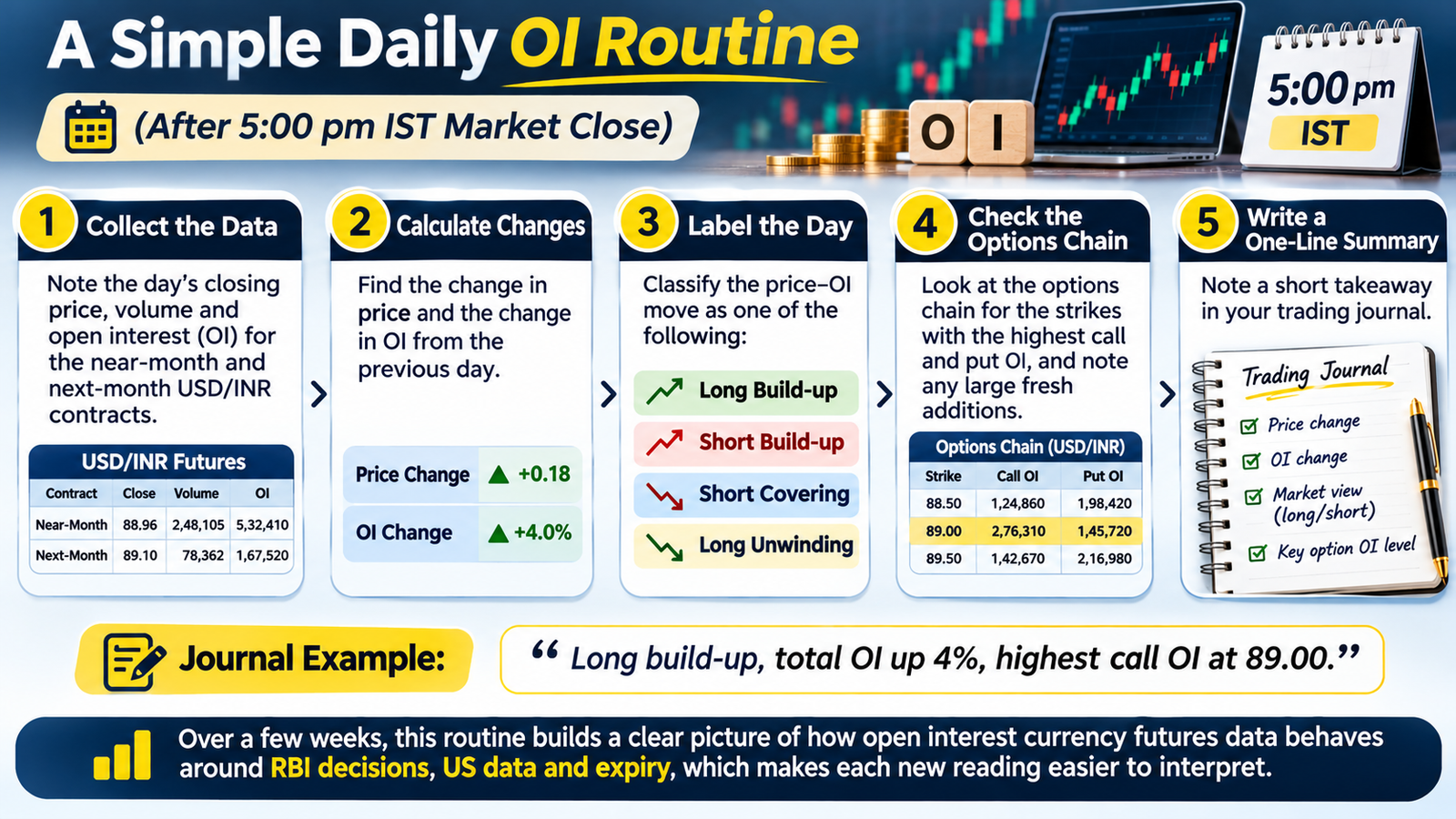
You do not need complex software to use OI well. A short routine after the market closes at 5:00pm IST is enough for most traders:
- Download or note the day’s closing price, volume and open interest currency futures figures for the near-month and next-month USD/INR contracts.
- Calculate the change in price and the change in OI from the previous day.
- Label the day as long build-up, short build-up, short covering or long unwinding.
- Check the options chain for the strikes with the highest call and put OI, and note any large fresh additions.
- Write a one-line summary in your journal, such as “Long build-up, total OI up 4%, highest call OI at 89.00”.
Over a few weeks, this routine builds a clear picture of how open interest currency futures data behaves around RBI decisions, US data and expiry, which makes each new reading easier to interpret.
Common Open Interest Currency Futures Mistakes
- Treating rising OI as automatically bullish. It depends on the direction of price.
- Reading near-month OI during expiry week without checking the next month.
- Ignoring volume alongside OI.
- Assuming high options OI strikes will always hold.
- Forgetting that USD/INR rising means the rupee is weakening.
- Using OI alone, without price action or risk management.
A Note on Rules and Access
Indian residents can trade currency futures and options on NSE and BSE through SEBI-registered brokers. Leveraged forex trading on offshore platforms is not permitted under the Foreign Exchange Management Act (FEMA), and the RBI publishes an Alert List of unauthorised platforms. Exchange-traded data, including open interest currency futures figures, is one of the advantages of trading through recognised Indian exchanges.
Open Interest Currency Futures Checklist
- Did price rise or fall today?
- Did OI rise or fall, and by how much?
- Which of the four patterns does this match?
- Is it expiry week, and have I checked combined OI?
- What is volume telling me?
- Where are the highest call and put OI strikes?
- Does the OI reading agree with my price-action setup?
FAQs
What is open interest in currency futures?
It is the total number of currency futures contracts that remain open at the end of the trading day, showing how many positions are still active.
Is rising open interest bullish?
Not by itself. Rising OI with rising price suggests long build-up, while rising OI with falling price suggests short build-up.
Why does open interest fall near expiry?
Traders close or roll near-month positions into the next month. Check combined OI across contract months to see the real picture.
Where can I find open interest currency futures data in India?
On the NSE and BSE websites, broker trading terminals and many charting platforms.
Can open interest currency futures data predict where the rupee will go?
No. It shows how positions are changing, which can support or question a price move, but it does not predict direction on its own. Always combine it with price action and risk management.
What is the difference between open interest and volume?
Volume counts contracts traded during a period, while open interest counts contracts still open at the end of the day.
Conclusion
Open interest adds a valuable layer to price and volume. By showing whether contracts are being opened or closed, it helps you judge the strength behind a move. The four patterns of long build-up, short build-up, short covering and long unwinding give a simple framework for reading open interest currency futures data each day.
Use OI as confirmation rather than as a stand-alone signal. Check combined OI around expiry, remember that hedgers and the RBI influence currency markets, and combine OI with clear price-action setups and disciplined risk management.