Key Takeaways
- Brent crude fell $8.47, or 7.47%, to $104.96 a barrel on Monday 2 November, Reuters reported, as Iran held talks with Qatari mediators on ending the West Asia war.
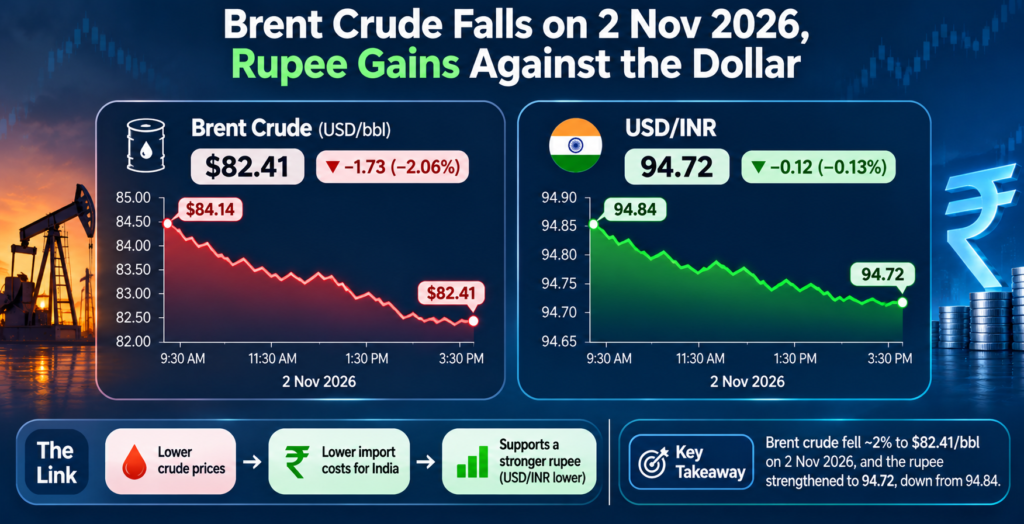
- The rupee closed Monday at 94.84 per dollar, then opened Tuesday at 94.68 and traded at 94.72, up 12 paise, PTI reported.
- Cheaper oil lowers India’s oil import bill and the dollar demand of oil marketing companies, which supports the rupee.
- On NSE USD/INR futures, one lot is US$1,000, so every 1 paisa move is worth ₹10 per lot.
- The US midterm results, due Wednesday IST, can override the oil effect quickly.
Brent lost about 7.5% on Monday after Iranian negotiators held several days of talks with Qatari mediators, and by Tuesday morning USD/INR had slipped back below 94.80. For Indian traders, the Brent crude fall November 2026 rupee impact matters because oil is one of the biggest drivers of India’s dollar demand. This news analysis covers what moved, why oil feeds into the rupee, how the move shows up in NSE USD/INR futures with rupee examples, and what to watch before the US midterm results arrive on Wednesday morning IST.
How does the Brent crude fall affect the rupee today?
A lower Brent price cuts the dollars Indian refiners need to pay for crude, so dollar demand in the onshore market eases and the rupee firms. That is what happened on Tuesday 3 November: with Brent near $104.76, the rupee opened at 94.68 and traded at 94.72, a 12-paise gain on Monday’s 94.84 close.
The gain was modest, and that is the real story. Oil dropped around 7.5% in a day, yet the rupee rose only 12 paise, because a firm dollar before the US midterm election pulled the other way. PTI, carried by Business Standard and ETV Bharat, said the rupee was “buoyed by sliding crude oil prices and inflows of foreign funds into domestic equities,” while the strong dollar kept investors cautious.

What exactly happened to oil on Monday?
Brent opened the week under pressure. Arab News reported Brent at $109.75, down 3.2%, in early Monday trade, after Iranian and Qatari officials held a third straight day of talks. By 1724 GMT (10:54 pm IST), Reuters reported Brent down $8.47, or 7.47%, at $104.96, with US crude (WTI) down 7.2% at $96.62.
Two details fuelled the selling, according to Reuters. Iranian President Masoud Pezeshkian said the Supreme Leader had granted the government “certain authorities” regarding peace talks, and an official briefed on the talks said a draft proposal was circulating with a follow-up meeting possible. Foreign Minister Abbas Araqchi said consultations with Qatari mediators would continue.
The fall came from a high base: Brent ended October at its highest level in six months, Arab News noted. Even after the drop, Brent above $100 is expensive for an importer like India.
Brent crude fall November 2026 rupee impact: USD/INR today in numbers
Here is how the rupee and its main inputs moved across the two sessions, using figures reported on 2–3 November.
| Item | Monday 2 Nov | Tuesday 3 Nov (early trade) |
|---|---|---|
| Rupee open (per US$) | 94.90 | 94.68 |
| Rupee weakest level | 95.04 | — |
| Rupee strongest level cited | — | 94.60 |
| Rupee close / last quoted | 94.84 (down 8 paise) | 94.72 (up 12 paise) |
| Dollar index | 101.61 (down 0.26%) | 101.65 (up 0.03%) |
| Brent crude | $104.96 (down 7.47%, Reuters, 10:54 pm IST) | $104.76 futures (down 0.01%) |
| FII equity flows | Net buy ₹3,114.68 crore | — |
Monday itself was not a good day for the rupee. It opened at 94.90, touched 95.04 and closed at 94.84, down 8 paise, as a firm dollar weighed on it, PTI reported. Reuters had Brent down only 3.7% at 2:30 pm IST, so a large part of the slide came after the onshore close and showed up in Tuesday’s open.
FIIs were net buyers for a second straight day on Monday, purchasing equities worth ₹3,114.68 crore, PTI reported. That lines up with the shift covered in October 2026 FII flows and USD/INR.
Why does oil matter so much for the Indian rupee?
Oil matters because India buys most of its crude abroad and pays in dollars. In a written Rajya Sabha reply reported in March 2026, the Ministry of Petroleum and Natural Gas put India’s crude oil import dependence at 88.6% for FY 2025–26 (April–January). Every dollar on the barrel therefore feeds straight into the India oil import bill.
For a fuller explanation of the mechanics, read our guide on how crude oil moves the rupee. The short version runs through three channels.
Channel 1: the current account
The current account deficit is the gap between what India pays the rest of the world for goods, services and income, and what it receives. Crude is one of the largest payment items, so a sustained fall in Brent narrows the deficit. One day of cheaper oil does not; several weeks would.
Channel 2: OMC dollar demand
Oil marketing companies (OMCs) such as IOC, BPCL and HPCL buy dollars in the onshore market to pay for cargoes. When Brent falls, each cargo needs fewer dollars, and that daily bid in USD/INR softens.
Channel 3: RBI’s room to manoeuvre
The Reserve Bank of India (RBI) manages volatility in the rupee using its foreign exchange reserves. RBI data released on Friday showed reserves fell $1.269 billion to $719.748 billion in the week ended 30 October, PTI reported. Lower oil bills ease pressure on those reserves.
What the move means for USD/INR futures NSE traders
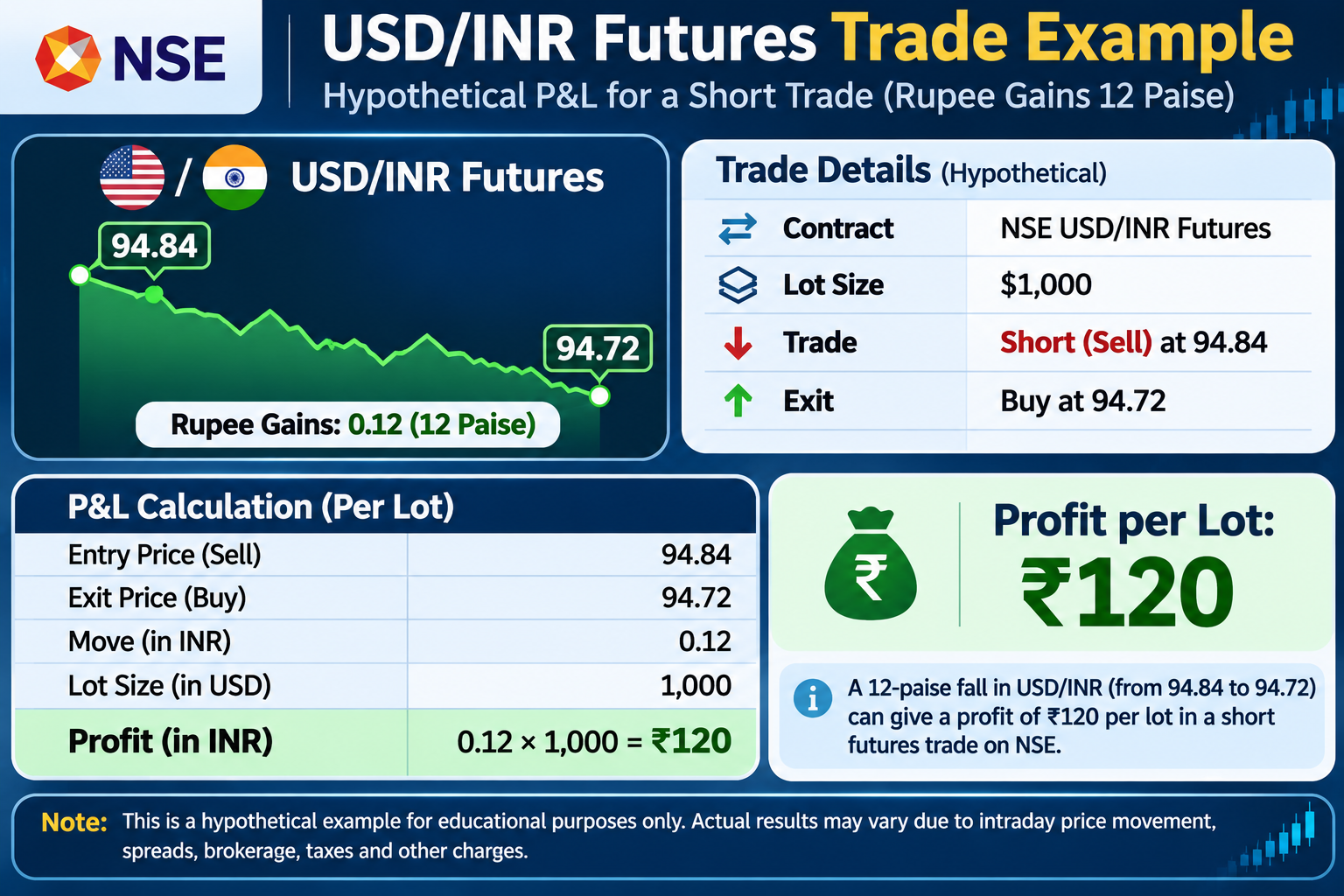
USD/INR futures NSE contracts let Indian residents trade the rupee legally on a recognised exchange. According to the NSE contract specifications for USD-INR futures, one lot is US$1,000, the tick size is 0.25 paise (₹0.0025), trading runs 9:00 am to 5:00 pm IST, Monday to Friday, and contracts are cash settled in rupees. So a 1 paisa move on one lot is worth ₹10 (US$1,000 × ₹0.01), and one tick is worth ₹2.50.
Example (hypothetical): a short USD/INR futures position
Example (hypothetical): a trader with ₹1,00,000 in the account sells 5 lots of USD/INR futures at 94.84, expecting cheaper oil to lift the rupee. The pair falls to 94.72.
- Move: 94.84 − 94.72 = 12 paise
- P&L per lot: 12 × ₹10 = ₹120
- P&L on 5 lots: ₹600, before brokerage and taxes
If the pair had instead risen 20 paise against the trader, the loss would be ₹1,000 on 5 lots. Exchange margin per lot changes with volatility, so check it with the forex margin calculator before sizing a position, and keep the account well funded for adverse moves.
Example (hypothetical): an importer’s cost
Example (hypothetical): a small importer has a US$10,00,000 payable. At 94.84 it costs ₹9,48,40,000; at 94.72 it costs ₹9,47,20,000. The 12-paise move saves ₹1,20,000.
Now scale the oil effect. A hypothetical cargo of 2,00,000 barrels priced $8.47 lower, the size of Monday’s Brent drop, needs US$16,94,000 less. At 94.72, that is roughly ₹16.05 crore saved on a single shipment, which shows why OMC dollar demand reacts so quickly to Brent.
How to read an oil-driven USD/INR move
Traders often get the direction right and the size wrong after a headline like this.
- Check the timing. Did the oil move happen in Indian hours or after the 5:00 pm IST NSE close?
- Compare oil with the dollar index. If Brent falls but the dollar index rises, as on Tuesday at 101.65, expect a smaller rupee gain.
- Look at FII flows. Equity inflows alongside cheaper oil strengthen the rupee case.
- Watch levels where RBI tends to act. Sharp moves often meet RBI smoothing.
- Size for the event, not the headline. With a major US event due, reduce lots rather than chase the open.
Is the oil relief likely to last?
Nobody can say yet, and analysts are cautious. Reuters quoted Raymond James analyst Pavel Molchanov noting many “false dawns” in recent months. The Iran Qatar talks oil price effect depends on whether talks produce something concrete, such as the follow-up meeting an official said was possible.
There is also an upside risk to oil. Arab News reported that traders are watching for possible escalation after the US midterm elections, with one analyst saying Brent could reach $120 if rhetoric rises after the vote. That is one view, not a forecast, but it shows how quickly the rupee gains on oil could reverse. Our USD/INR outlook covers the wider drivers beyond crude.
What to watch next
- US midterm results (Wednesday IST): Voting takes place on Tuesday 3 November in the US, so results arrive through Wednesday morning in India. See our explainer on US midterm elections and the dollar.
- Further Iran–Qatar talks: A confirmed follow-up meeting could pressure Brent further; a breakdown would likely lift it.
- RBI behaviour: Watch whether the RBI lets the rupee firm or buys dollars to rebuild reserves, which fell in the latest weekly data.
- India data: Trade and weekly reserve figures show whether cheaper oil is reaching the payments side.
Common mistakes after an oil headline
- Assuming a 7% oil drop means a large rupee rally; the dollar can dominate.
- Holding a large position into a vote count, which adds gap risk.
- Trading the move on offshore leveraged platforms. Indian residents may trade currency derivatives only on recognised Indian exchanges such as NSE, BSE and MSE in permitted pairs.
FAQs
Why did Brent crude fall on 2 November 2026?
Brent fell because Iranian negotiators held several days of talks with Qatari mediators on ending the West Asia war, raising hopes of a resolution. Reuters reported Brent down $8.47, or 7.47%, at $104.96 a barrel by 10:54 pm IST on Monday. Comments from Iran’s president about authority for peace talks added to the selling.
What was USD/INR today, 3 November 2026?
PTI reported that the rupee opened at 94.68 against the dollar in the interbank market on Tuesday, touched 94.60 and then traded at 94.72 in early trade. That was 12 paise stronger than Monday’s close of 94.84. The dollar index stood at 101.65 and Brent futures at $104.76 at the time.
Why did the rupee gain only 12 paise when oil fell over 7%?
The dollar stayed firm ahead of the US midterm election, which limited the rupee’s gain. A large part of Brent’s drop also came after Monday’s onshore close. Traders often see a muted rupee response when oil relief and dollar strength arrive together, because the two forces partly cancel each other out in USD/INR.
How does a lower oil price reduce India’s oil import bill?
India imports most of its crude, with government data putting import dependence at 88.6% for FY 2025–26 (April–January). Because cargoes are paid in dollars, a lower Brent price means each shipment needs fewer dollars. That reduces oil companies’ dollar purchases, narrows the trade gap over time and eases pressure on the rupee.
How much is a 1 paisa move worth in NSE USD/INR futures?
One NSE USD/INR futures lot is US$1,000, so a 1 paisa move equals ₹10 per lot. The minimum tick is 0.25 paise, worth ₹2.50 per lot. A hypothetical 12-paise move on 5 lots would therefore be worth ₹600 before brokerage, exchange charges and taxes, whether as profit or loss.
Can Indian residents trade the rupee on overseas forex platforms?
No. Indian residents may trade currency derivatives only through SEBI-registered brokers on recognised Indian exchanges such as NSE, BSE and MSE, in permitted pairs. Leveraged or margin forex on overseas online platforms through the Liberalised Remittance Scheme is not permitted, and the RBI keeps an Alert List of unauthorised platforms.
Conclusion
The Brent crude fall November 2026 rupee impact was real but restrained. Brent dropped about 7.5% on hopes from the Iran–Qatar talks, FIIs bought ₹3,114.68 crore of equities, and the rupee recovered from 94.84 to 94.72 in early Tuesday trade. A firm dollar before the US midterms kept the gain small. For traders, the lesson is to weigh oil against the dollar and the event calendar, not trade the headline alone. Before Wednesday’s results, check the timings and releases on the InsightfulTrade economic calendar and size USD/INR positions for the risk.