
Key Takeaways on bitcoin price fall november 2026
- Bitcoin fell about 5.5% to roughly $76,000 on 5 November 2026 as an AI and chip stock rout hit Wall Street.
- More than $1 billion of crypto derivatives positions were liquidated in 24 hours, mostly leveraged longs, according to CoinGlass data cited by CoinDesk.
- For Indian traders, the tax rules did not change with the price: 30% on gains, 1% TDS on sales, and losses cannot be set off.
- Tonight’s US jobs report at 19:00 IST and Friday’s options expiry can keep volatility high.
The bitcoin price fall in November 2026 has hit Indian crypto traders hard, and it came from outside crypto. On Thursday, a sell-off in US chip and AI stocks dragged Bitcoin from above $80,000 to near $76,000 within hours. This article is for Indian retail traders who hold or trade Bitcoin and want a clear picture before acting. You will learn what moved the market, how India’s 30% tax and 1% TDS treat a losing or winning trade, and a risk-first checklist for sell-offs. All times are in IST.
Why did Bitcoin fall in November 2026?
Bitcoin fell because global investors dumped risky assets after a crash in AI and semiconductor stocks. CoinDesk reported that the Philadelphia Semiconductor Index plunged about 12% and the Nasdaq about 5.5% on 5 November. Bitcoin dropped roughly 5.5% to just under $76,000, and forced selling of leveraged positions deepened the move.
A risk-off move is a phase in which investors sell volatile assets such as tech stocks and crypto and move to safer ones such as gold. Gold rose while equities and crypto fell together.
The AI and chip trigger
Finwire listed chip earnings disappointments and AI investment worries as likely drivers, pointing to Qualcomm’s handset revenue shortfall, Arm’s outlook, and concern that the Democratic midterm sweep could slow AI data-centre building. It called these “likely factors, not confirmed causes”. CoinDesk quoted Wintermute’s Jasper De Maere, who also cited disappointing AI growth figures and high investor leverage.
How the fall unfolded in IST
Most of the damage happened during Indian evening hours. CoinDesk reported Bitcoin at $78,850 at 9:42 am ET (20:12 IST Thursday) and $75,800, down 5.2% over 24 hours, by 10:36 am ET (21:06 IST). CryptoTicker, citing CoinGecko, put the 24-hour high at $80,882, set during the post-election rally.
If you follow our BTC/USD outlook, note that De Maere said Bitcoin needs to “reclaim and hold $80,000” to signal renewed strength, with $73,000 and $68,000 as downside levels. These are one desk’s views, not forecasts.
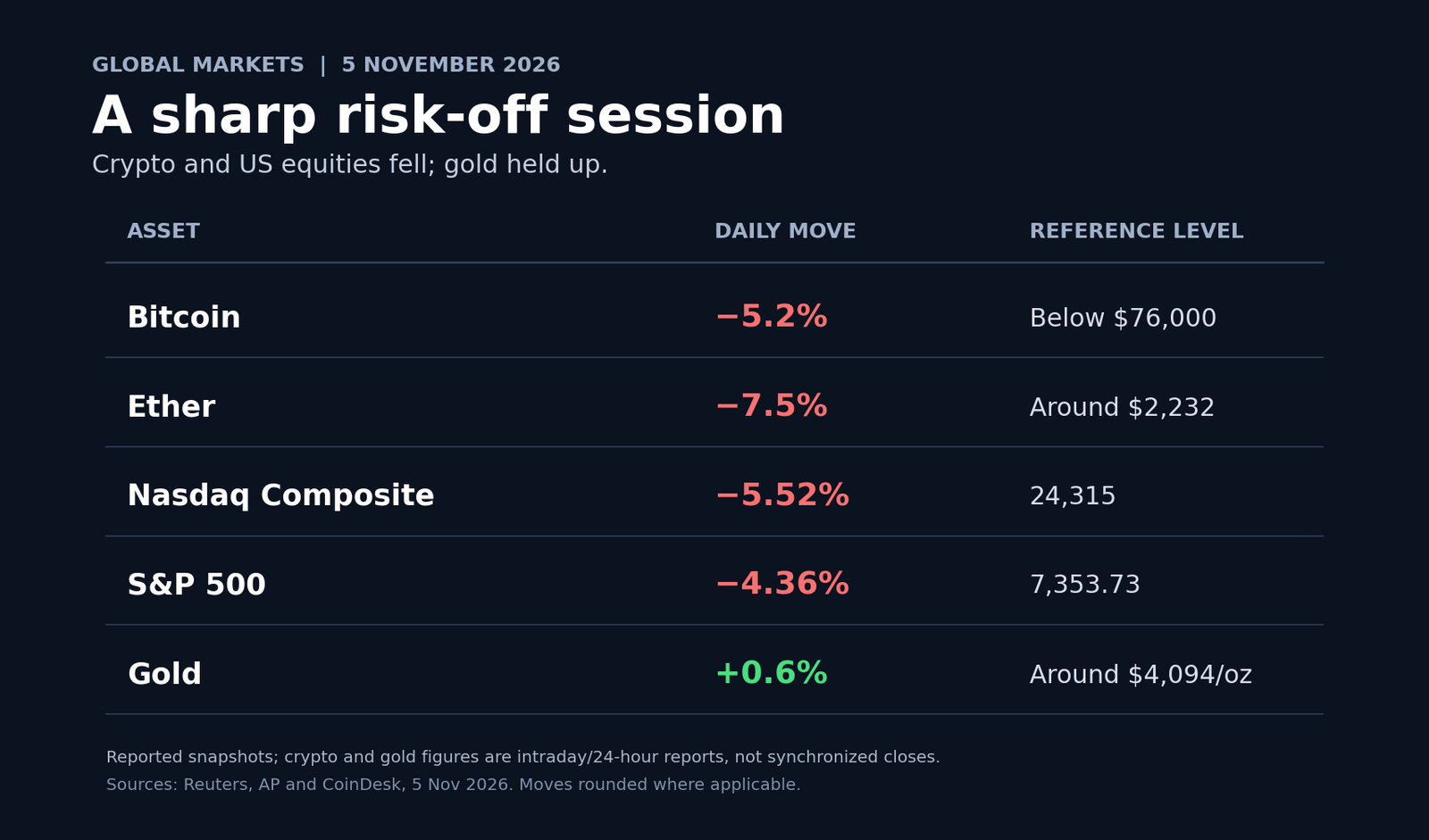
Key market moves on 5 November 2026
The table collects Thursday’s main moves. Windows differ by source, so treat percentages as approximate.
| Asset | Level reported | Move | Source and window |
|---|---|---|---|
| Bitcoin (BTC) | $76,036 | −5.54% | Finwire, 6 pm ET Wed to 4 pm ET Thu (04:30 IST Thu to 02:30 IST Fri) |
| Ether (ETH) | Not stated at close | −7.5% | CoinDesk, 24 hours to 4:10 pm ET |
| S&P 500 | 7,353.73 | about −4.4% | Finwire |
| Nasdaq Composite | 24,315.00 | about −5.5% | Finwire |
| Philadelphia Semiconductor Index | Not stated | about −12% | CoinDesk |
| Gold | $4,096.08 | +0.79% | Finwire |
| US Dollar Index (DXY) | 101.609 | +0.12% | Finwire |
| Bitcoin volatility index (BVIV) | 44 | +11% | CoinDesk, 11:03 am ET |
Gold gained while Bitcoin lost, so Bitcoin traded like a high-risk tech asset rather than a safe haven. Volatility jumped too, and our guide to the VIX, the market’s fear gauge explains why such spikes often bring wider price swings for days.
What role did liquidations and ETF flows play?
Leverage made a bad day worse. Liquidation is the forced closing of a leveraged position by an exchange when the trader’s margin can no longer cover losses.
CoinDesk reported that more than $1 billion of crypto derivatives positions were liquidated over 24 hours, mostly longs, based on CoinGlass data. Aggregate open interest, the total value of open futures positions, fell below $26 billion from $28 billion earlier in the session, per Coinalyze data.
On ETF flows, the picture is incomplete. US spot Bitcoin ETFs took in a net $74.6 million on 4 November after three days of outflows, according to crypto.news figures quoted by CryptoTicker. Data for 5 November was not available in the reports we checked.
How the bitcoin price fall November 2026 India traders face is taxed
The price fell, but India’s tax rules stayed exactly the same. The Income Tax Department’s note on taxation of virtual digital assets sets out the core rules. A virtual digital asset (VDA) is the legal term Indian tax law uses for crypto tokens such as Bitcoin.
- 30% flat tax on gains, plus surcharge and cess. Only the cost of acquisition can be deducted. Exchange fees, gas fees and advisory charges are not deductible.
- No set-off of losses. A VDA loss cannot be set off against salary, business income or gains from another VDA, and tax commentators note it cannot be carried forward.
- 1% TDS on transfers. Tax is deducted at 1% of the sale value, subject to annual thresholds of ₹50,000 for certain individuals and HUFs and ₹10,000 for others.
- 18% GST on exchange fees. GST applies to the exchange’s service fee, not to the value of the Bitcoin itself.
What changed from 1 April 2026
The Income-tax Act, 2025 replaced the 1961 Act from 1 April 2026, so section numbers moved. The 30% rule was Section 115BBH and the 1% TDS was Section 194S; CAclubindia reports VDA TDS now sits in Section 393(1), Table S. No. 8(vi). Confirm sections with your chartered accountant.
Budget 2026 did not change the 30% rate or 1% TDS, per the reports we reviewed. It added penalties for crypto reporting entities that fail to file statements under Section 509: ₹200 per day and ₹50,000 for inaccurate information, from 1 April 2026, Business Standard and TaxGuru reported.
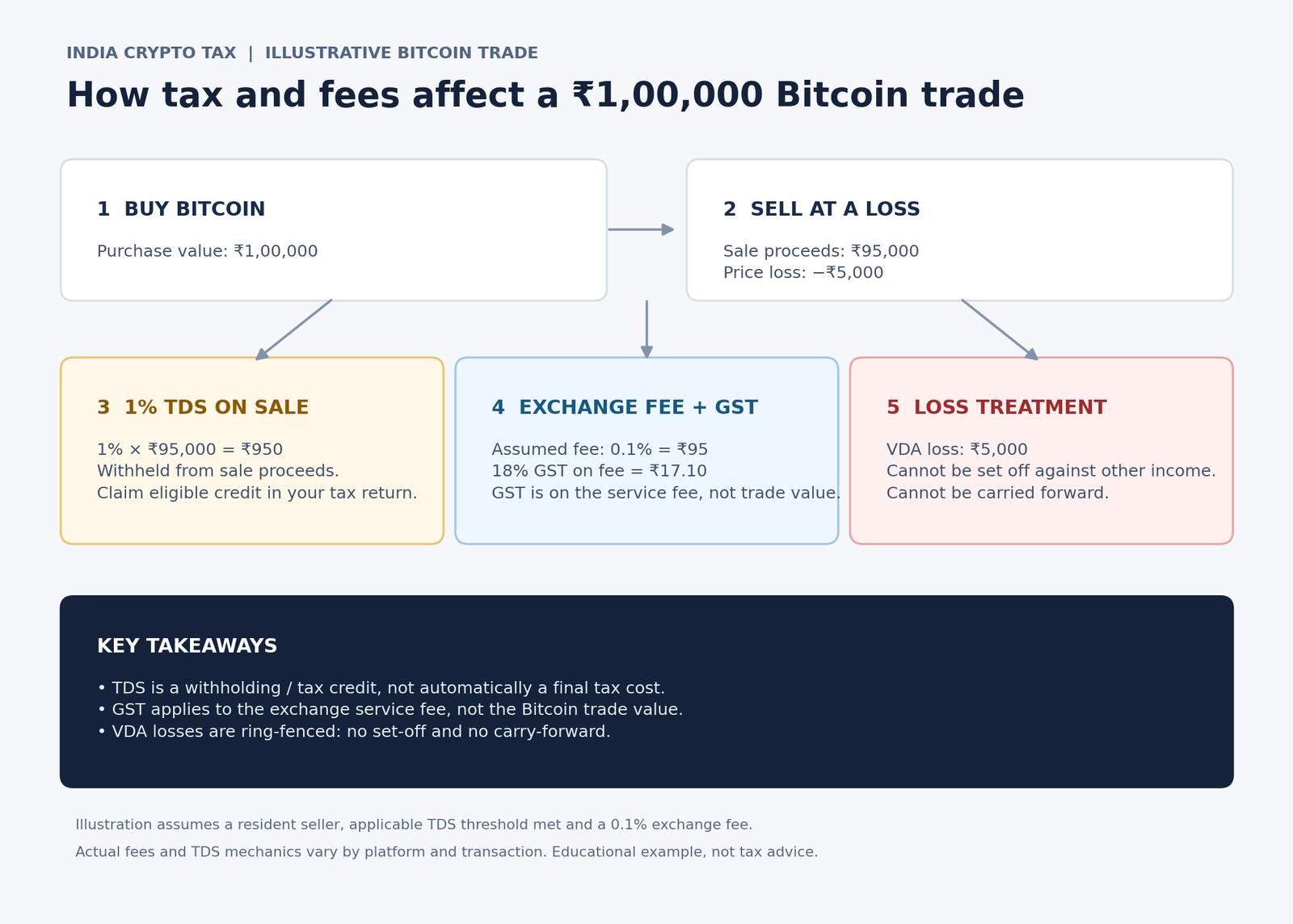
Example (hypothetical): a ₹1,00,000 Bitcoin trade during the sell-off
A trader in Pune buys ₹1,00,000 of Bitcoin on an Indian exchange. All numbers here are hypothetical and assume TDS applies.
Scenario A – selling at a loss. Panicking during the fall, the trader sells for ₹88,000.
- TDS at 1% of ₹88,000 = ₹880, deducted by the exchange.
- Exchange fee at a hypothetical 0.1% = ₹88, plus 18% GST of about ₹15.84.
- Loss = ₹12,000. This loss cannot reduce tax on the trader’s salary or on a gain from another crypto token.
- The ₹880 TDS is not lost. It appears in Form 26AS and can be claimed as credit or refund in the income tax return.
Scenario B – selling at a gain. The trader instead holds and later sells for ₹1,10,000.
- TDS at 1% of ₹1,10,000 = ₹1,100.
- Gain = ₹10,000. Tax at 30% = ₹3,000, plus applicable surcharge and cess.
- The ₹1,100 TDS is adjusted against this tax.
In India, a crypto loss gives no tax cushion, so panic selling at the bottom simply locks in the loss.
Are Indian crypto platforms and rules different during a crash?
No, the rules do not pause during volatility, and your platform matters more than ever. Crypto is not legal tender in India. The Finance Ministry told Parliament in February 2026 that VDAs are “currently not regulated”, so crypto investors lack the protections that come with SEBI-regulated products such as equities.
What does exist is anti-money-laundering oversight. VDA service providers serving Indian users, onshore or offshore, must register with FIU-IND under the Prevention of Money Laundering Act. In September 2026, FIU-IND issued notices to 15 non-compliant providers and sought takedown of their apps, News on AIR reported. Our guide to crypto AML and KYC rules in India explains how to check a platform.
What Indian crypto traders can do during a sell-off
Here is a risk-first process traders often follow when markets fall fast. None of these steps is a buy or sell call.
- Pause before acting. Fast drops tempt traders into revenge trades, so set a cooling-off time before any new order.
- Check your exposure in rupees. Value your crypto at today’s price, not your cost, and compare it with your income and emergency fund.
- Cut or avoid leverage. Thursday’s liquidations were mostly leveraged longs. Know your liquidation price if you hold leverage.
- Size trades by risk. Fix the maximum rupee loss per trade, then use a position size calculator for a given stop distance.
- Factor in tax drag. Frequent trading during volatility locks cash in 1% TDS until you file your return.
- Use only FIU-IND-registered platforms. Avoid offshore apps promising high leverage or bonuses.
- Keep records. Download trade reports and TDS statements for Schedule VDA in your return.
If you also trade currency pairs, our forex vs crypto comparison explains how the two differ. Indian residents should trade currency derivatives only through SEBI-registered brokers on recognised Indian exchanges.
What to watch next
These events can decide whether the sell-off deepens or stabilises. Add them to your economic calendar.
- US jobs report tonight, 19:00 IST. The US Bureau of Labor Statistics releases the October Employment Situation report at 8:30 am ET. Surprises can move yields, the dollar and Bitcoin within minutes.
- Bitcoin options expiry today. About $2.65 billion of options expire on 6 November, with max pain at $79,000, per CryptoTicker figures carried by Pluang.
- Fed December meeting. The FOMC meets on 8–9 December; the press conference is at 2:30 pm ET on 9 December, or 01:00 IST on 10 December.
- US tech stocks. Bitcoin moved with the Nasdaq on Thursday, so further chip weakness may weigh on crypto.
FAQs
Why did Bitcoin fall on 5 November 2026?
Bitcoin fell with US tech stocks after a sharp sell-off in AI and semiconductor shares. The Nasdaq dropped about 5.5% and the chip index about 12%, according to CoinDesk. More than $1 billion of leveraged crypto positions were liquidated, mostly longs, pushing Bitcoin just under $76,000.
Can I set off my Bitcoin loss against my salary income in India?
No. Indian tax law does not allow a loss on a virtual digital asset to be set off against any other income, including salary, business income or gains on another crypto token. Tax commentators also note that VDA losses cannot be carried forward to later years. This is why panic selling at a low brings no tax benefit for Indian traders.
Do I pay 1% TDS even if I sell Bitcoin at a loss?
Yes. TDS is charged at 1% of the sale value, not on profit, so it applies whether you gain or lose once annual thresholds are crossed. The amount appears in your tax statement, and you can claim it as credit or refund in your income tax return.
Did Budget 2026 change crypto tax rates in India?
Based on the reports we reviewed, Budget 2026 did not change the 30% tax on VDA gains or the 1% TDS. It added penalties for crypto reporting entities that fail to file transaction statements: ₹200 per day and ₹50,000 for inaccurate information. Section numbers also changed because the Income-tax Act, 2025 took effect on 1 April 2026.
Is it safe to use offshore crypto exchanges during a crash?
Offshore platforms not registered with FIU-IND carry extra risk, and FIU-IND has sought app takedowns against non-compliant providers. Such apps often promote high leverage, where most crash liquidations happen. Traders generally reduce risk by using registered platforms and avoiding heavy leverage.
Conclusion
The bitcoin price fall November 2026 India traders are living through was driven by a global AI and chip stock rout, not by any crypto-specific news. Bitcoin slid about 5.5% to near $76,000 as leveraged longs were wiped out. For Indian traders, the rules stay fixed whatever the price does: 30% tax on gains, 1% TDS on every sale, no set-off for losses, and FIU-IND registration for the platforms you use. Keep leverage low, size trades by the rupee amount you can afford to lose, and watch tonight’s jobs data. Before your next trade, work out your exposure with our position size calculator.