
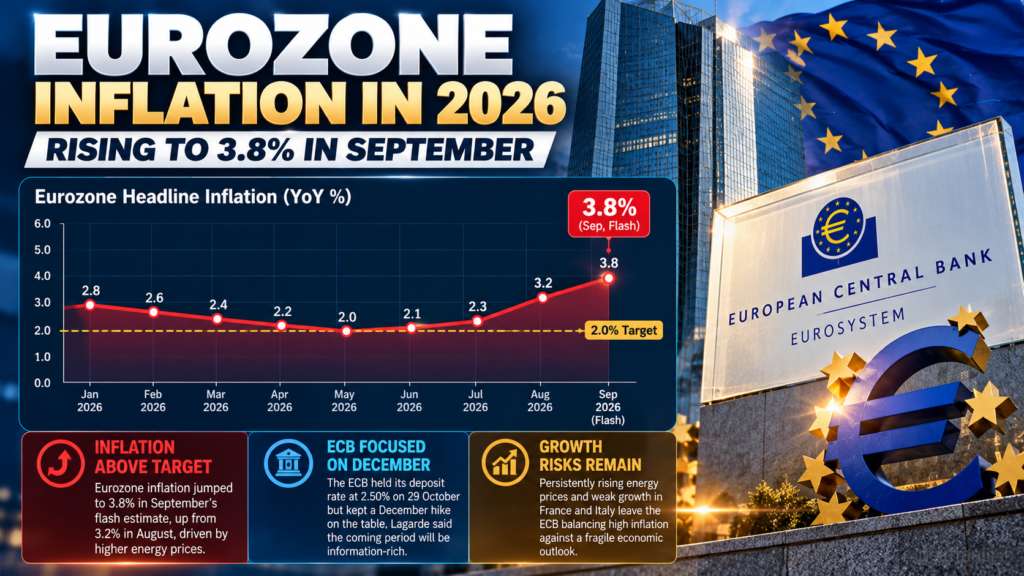
Key points on eurozone inflation EUR USD
- Eurozone GDP grew 0.4% in Q3, beating the 0.2% forecast but slowing from 0.6% in Q2.
- France contracted 0.1% and Italy stagnated, while Spain grew 0.6% and Ireland 5.5%.
- Inflation is the next test. September’s flash reading was 3.8%, a three-year high. The October flash estimate is due on 4 November.
- The ECB has signalled a December hike, so a hot inflation print would firm that view and could support EUR/USD, which hit a 17-month low of 1.1105 this week.
What happened: Q3 GDP
| GDP (Q3 2026, flash) | Q/Q | Previous (Q2) |
|---|---|---|
| Euro area | +0.4% (forecast 0.2%) | +0.6% |
| Euro area, year on year | +1.3% | +1.2% |
| Germany | +0.2% | +0.3% |
| France | −0.1% | 0.0% |
| Italy | 0.0% | +0.2% |
| Spain | +0.6% | – |
| Ireland | +5.5% | – |
Eurozone unemployment held at 6.5% in September, up from 6.3% a year earlier. Eurostat notes that flash estimates are based on incomplete data and may be revised.
Why the beat needs context: Ireland’s 5.5% jump, which often reflects the activity of multinational firms, flattered the headline. Excluding it, growth in the big economies was weak. France’s contraction adds to concerns about its public finances, at a time when French government bond yields are at their highest since 2002.
Why it matters: inflation and the ECB
Inflation is running well above target. Eurozone inflation jumped to 3.8% in September’s flash estimate, up from 3.2% in August, driven by energy prices linked to the Middle East war.
The ECB is leaning toward December. At its 29 October meeting, the ECB held its deposit rate at 2.50% but debated a hike. Lagarde said the period before December would be information-rich. Reuters sources said a 17 December hike is now all but certain. The October flash inflation figure is one of the most important data points before then.
Growth risks remain. ING’s chief economist Bert Colijn said persistently rising energy prices, including natural gas, will pose added challenges to eurozone growth over the winter. That leaves the ECB balancing high inflation against weak growth in France and Italy.
Preview: October flash inflation (4 November)
| Item | Detail |
|---|---|
| Release | Wednesday, 4 November 2026, 11:00 CET (15:30 IST) |
| Previous (September flash) | 3.8% y/y |
| Forecast (October) | – |
| Core inflation (previous) | – |
| Early signal | Germany’s October flash CPI |
What to watch: Core and services inflation matter more than the headline. Lagarde said the ECB is not yet seeing second-round effects from energy beyond what its projections assumed. A rise in core or services inflation would challenge that view and support a December hike.
EUR/USD impact
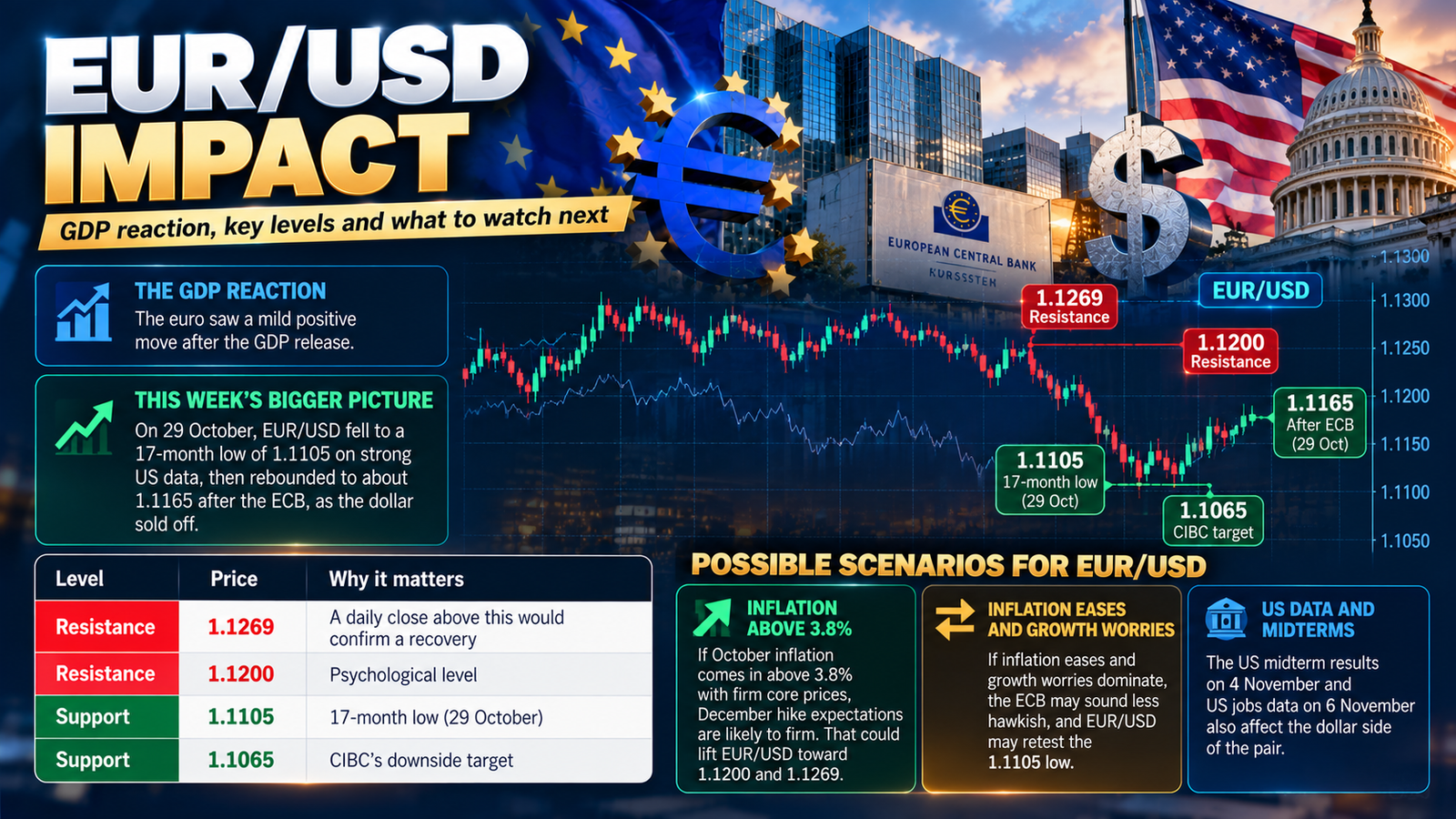
The GDP reaction: The euro saw a mild positive move after the GDP release.
The bigger picture this week: On Thursday, 29 October, EUR/USD fell to a 17-month low of 1.1105 on strong US data, then rebounded to about 1.1165 after the ECB, as the dollar sold off.
| Level | Price | Why it matters |
|---|---|---|
| Resistance | 1.1269 | A daily close above this would confirm a recovery |
| Resistance | 1.1200 | Psychological level |
| Support | 1.1105 | 17-month low (29 October) |
| Support | 1.1065 | CIBC’s downside target |
Possible scenarios:
- If October inflation comes in above 3.8% with firm core prices, December hike expectations are likely to firm. That could lift EUR/USD toward 1.1200 and 1.1269.
- If inflation eases and growth worries dominate, the ECB may sound less hawkish, and EUR/USD may retest the 1.1105 low.
- The US midterm results on 4 November and US jobs data on 6 November also affect the dollar side of the pair.
Impact on Indian traders
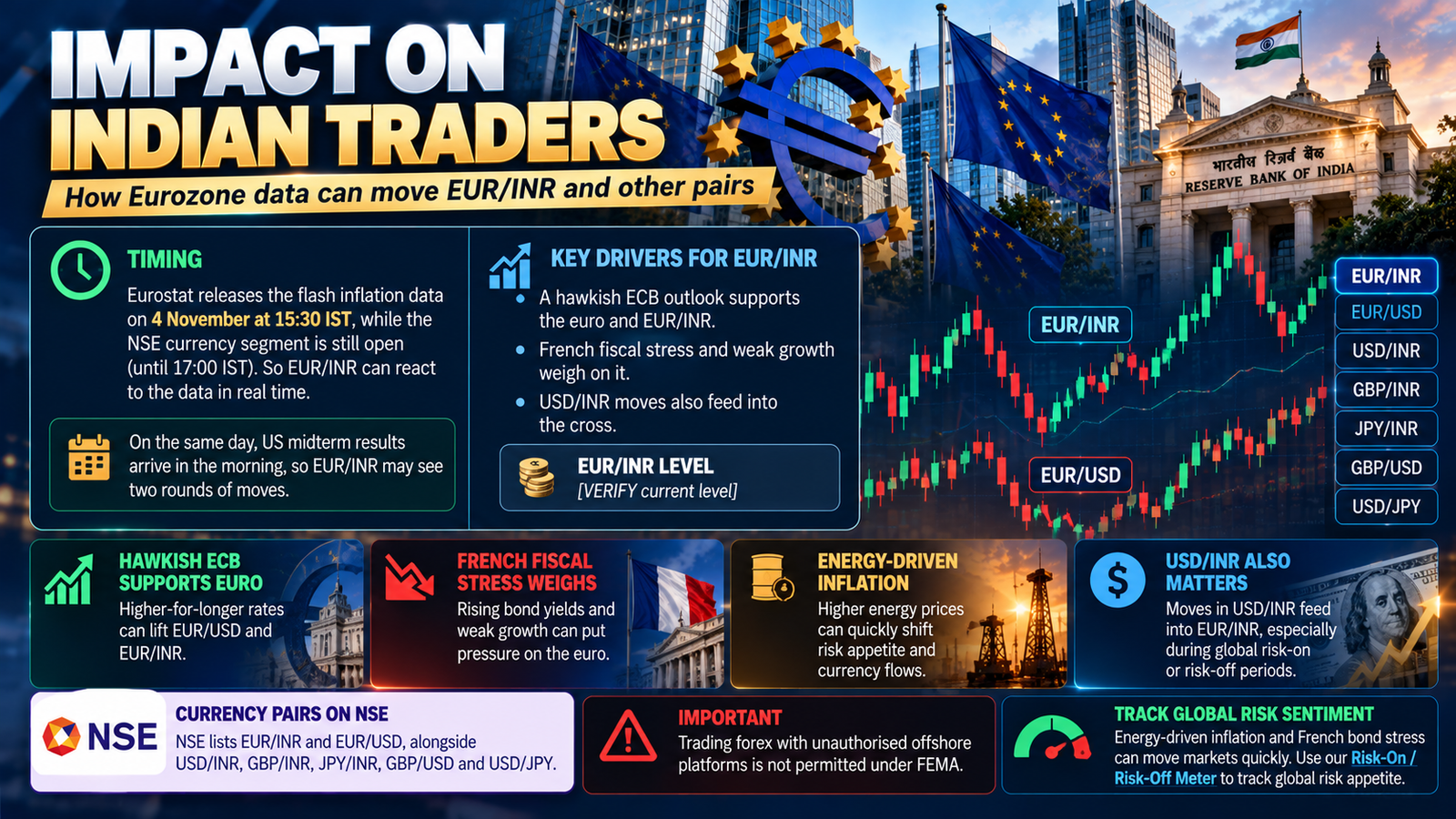
EUR/INR timing: Eurostat releases at 15:30 IST, while the NSE currency segment is still open (until 17:00 IST). So EUR/INR can react to the 4 November inflation data in real time. On the same day, US midterm results arrive in the morning, so EUR/INR may see two rounds of moves.
EUR/INR drivers: A hawkish ECB outlook supports the euro and EUR/INR. French fiscal stress and weak growth weigh on it. USD/INR moves also feed into the cross.
Currency pairs on NSE: NSE lists EUR/INR and EUR/USD, alongside USD/INR, GBP/INR, JPY/INR, GBP/USD and USD/JPY. Trading forex with unauthorised offshore platforms is not permitted under FEMA.
Energy-driven inflation and French bond stress can shift risk appetite quickly. Our Risk-On / Risk-Off Meter can help you track it.
What to watch next
| Date (IST) | Event | Why it matters |
|---|---|---|
| Mon, 2 Nov | Eurozone final manufacturing PMIs | Growth check |
| Wed, 4 Nov, ~05:30 onwards | US midterm results | Dollar side of EUR/USD |
| Wed, 4 Nov, 15:30 | Eurozone October flash inflation | The key test for a December ECB hike |
| Fri, 6 Nov | US October jobs report | Fed December odds |
| Ongoing | French bond yields and the OAT–Bund spread | Euro risk premium |
| ~Mid-Nov | Eurozone Q3 GDP second estimate; final October HICP | Confirms or revises the flash data |
| Tue, 1 Dec | Eurozone November flash inflation | The last flash before the ECB |
| Thu, 17 Dec | ECB decision, with new projections | Expected hike to 2.75% |
Track all release times on our Economic Calendar, and find more coverage in Market Analysis & News. Related: ECB October 2026 decision and Lagarde press conference, US GDP and PCE post
FAQs
How much did the eurozone economy grow in Q3 2026?
Eurozone GDP grew 0.4% quarter on quarter, beating the 0.2% forecast but slowing from 0.6% in Q2. France contracted 0.1%.
When is the eurozone October 2026 flash inflation release?
On Wednesday, 4 November 2026, at 11:00 CET (15:30 IST). September’s flash reading was 3.8%.
How does eurozone inflation affect EUR/USD?
Higher inflation raises the chance of ECB rate hikes, which tends to support the euro. Lower inflation reduces hike odds and can weigh on EUR/USD.