
Introduction
Passing a prop firm challenge is only the first step. Once you have a funded account, the next question is: how do you grow it? Most firms answer with a prop firm scaling plan, a set of rules that increases your account size if you trade profitably and consistently over time.
On paper, scaling plans sound like a path from a $50,000 account to millions in trading capital. In practice, every firm sets different conditions, and some rules can slow your progress or reset it altogether. Understanding how scaling works can help you choose the right firm and plan your trading realistically.
This guide explains:
- What a prop firm scaling plan is and why firms offer one
- The main types of scaling structures
- Typical scale-up conditions, using a real example
- How drawdown, payouts and caps affect scaling
- A realistic growth timeline
- How to evaluate a scaling plan before you pay
- What Indian traders should know
What Is a Prop Firm Scaling Plan?
A prop firm scaling plan, sometimes called a scaling program, is a set of conditions that, once met, increase the size of your funded account. In return, you can trade larger positions and, potentially, earn larger payouts.
Scaling usually depends on a combination of:
- Profit: Reaching a set profit percentage, such as 10%
- Time: Trading for a minimum period, such as four months
- Payouts: Having received a certain number of payouts
- Rule compliance: Not breaching drawdown or other rules
It is important to remember that most prop firm accounts use simulated capital. A $1 million balance is usually a notional figure. The real money for the trader comes from the payouts the firm makes based on simulated profits.

Why Prop Firms Offer Scaling Plans
For firms, scaling plans reward the small group of traders who prove they can manage risk over time. They also encourage traders to stay with the firm rather than move elsewhere.
For traders, a prop firm scaling plan offers:
- Larger position sizes without paying for a bigger challenge
- Bigger potential payouts from the same percentage returns
- Sometimes a better profit split
- A clear long-term goal
Types of Prop Firm Scaling Plan Structures
1. Percentage-based scaling
This is the most common model. When you hit a profit milestone, often 10%, your account grows by a fixed percentage of its current size, commonly 25%. Because each increase builds on the last, growth compounds over time.
2. Fixed-amount scaling
Some firms add a fixed dollar amount, such as $25,000, at each milestone. Growth is linear rather than compounding.
3. Doubling models
A few firms double the account size when certain targets are reached. These can grow accounts quickly, but targets are usually demanding.
4. Multi-account scaling
Rather than growing one account, some firms (often futures-focused ones) let you hold several funded accounts at once, up to a combined limit.
5. No scaling
Some firms offer a fixed account with no growth path. Traders who want more capital must buy a larger challenge.
| Model | How growth happens | Growth speed |
|---|---|---|
| Percentage-based | +X% of balance per milestone | Compounding |
| Fixed-amount | +fixed sum per milestone | Linear |
| Doubling | Account doubles at targets | Fast, but harder targets |
| Multi-account | More accounts, combined cap | Depends on number of accounts |
| No scaling | None | — |
A Real Example: How One Prop Firm Scaling Plan Works
To see how conditions look in practice, consider FTMO’s published scaling plan, as described on its website in 2026. To qualify for a scale-up, a trader needs:
- At least four months of trading as a funded trader (or since the last scale-up)
- At least 10% net simulated profit above the starting balance within those four months
- At least two processed reward payouts in that period
- A positive account balance at the time of the scale-up
If these conditions are met, the account size increases by 25% every four months, up to a maximum of $2,000,000 across all of a trader’s accounts with the firm. The scaling plan applies to its challenge-based accounts, not its instant-funding accounts.
This is just one example, used for illustration. Other firms use different triggers, increments and caps, and terms can change at any time.
What Changes Under a Prop Firm Scaling Plan When You Scale Up?
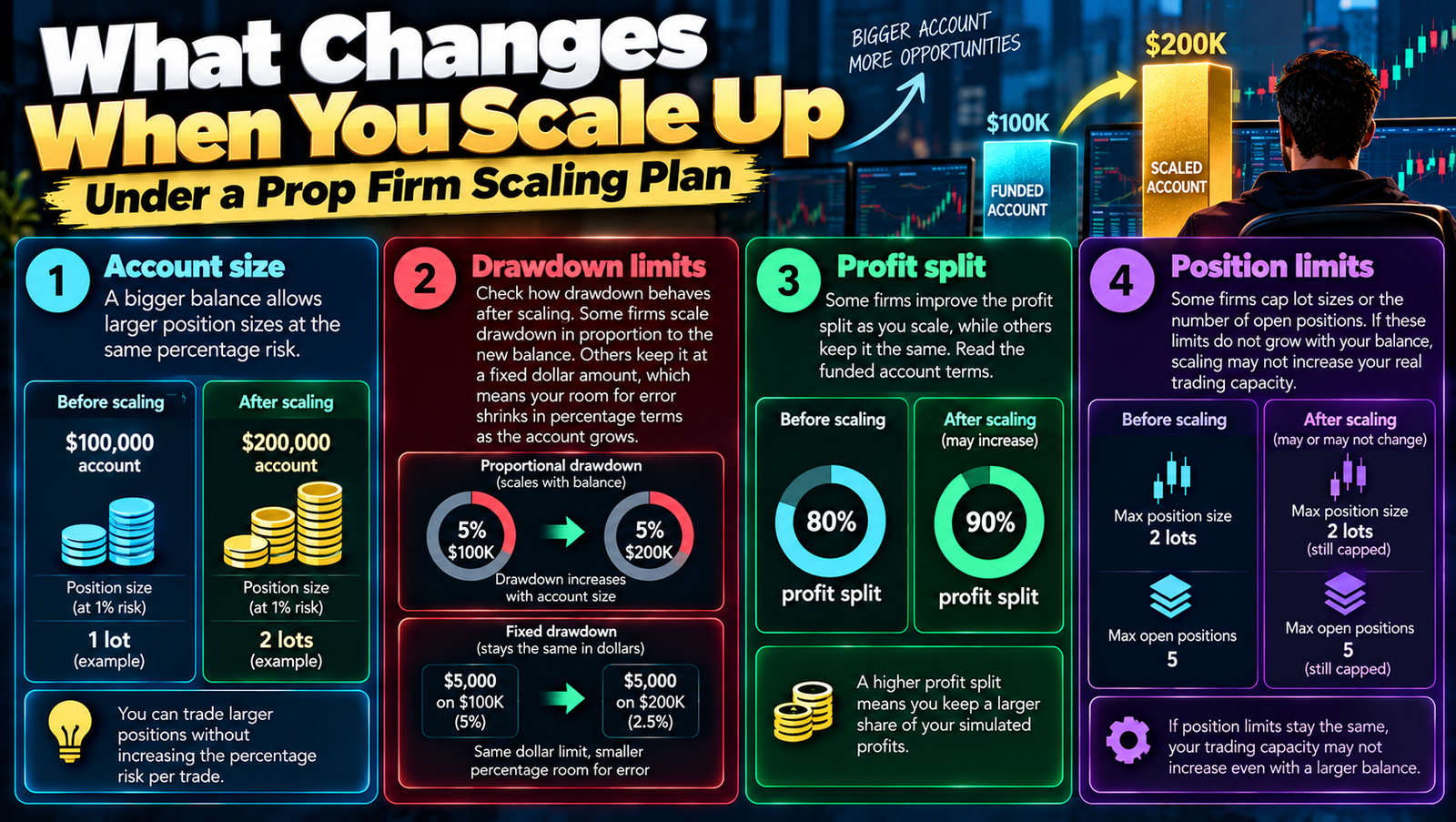
Account size
The most obvious change is a bigger balance, which allows larger position sizes at the same percentage risk.
Drawdown limits
Check how drawdown behaves after scaling. Some firms scale drawdown in proportion to the new balance. Others keep it at a fixed dollar amount, which means your room for error shrinks in percentage terms as the account grows.
Profit split
Some firms improve the profit split as you scale, while others keep it the same. Read the funded account terms.
Position limits
Some firms cap lot sizes or the number of open positions. If these limits do not grow with your balance, scaling may not increase your real trading capacity.
How Payouts Affect a Prop Firm Scaling Plan
Payouts and scaling are closely linked, and the rules vary widely:
- Some firms require a minimum number of payouts before you can scale.
- At some firms, withdrawing profits reduces the profit counted towards your next milestone.
- Other firms reset your progress after each withdrawal.
This creates a trade-off. Taking regular payouts locks in real income, but it may slow your progress towards the next scale-up. Read the payout and scaling rules together before deciding how often to withdraw.
A Realistic Prop Firm Scaling Plan Timeline
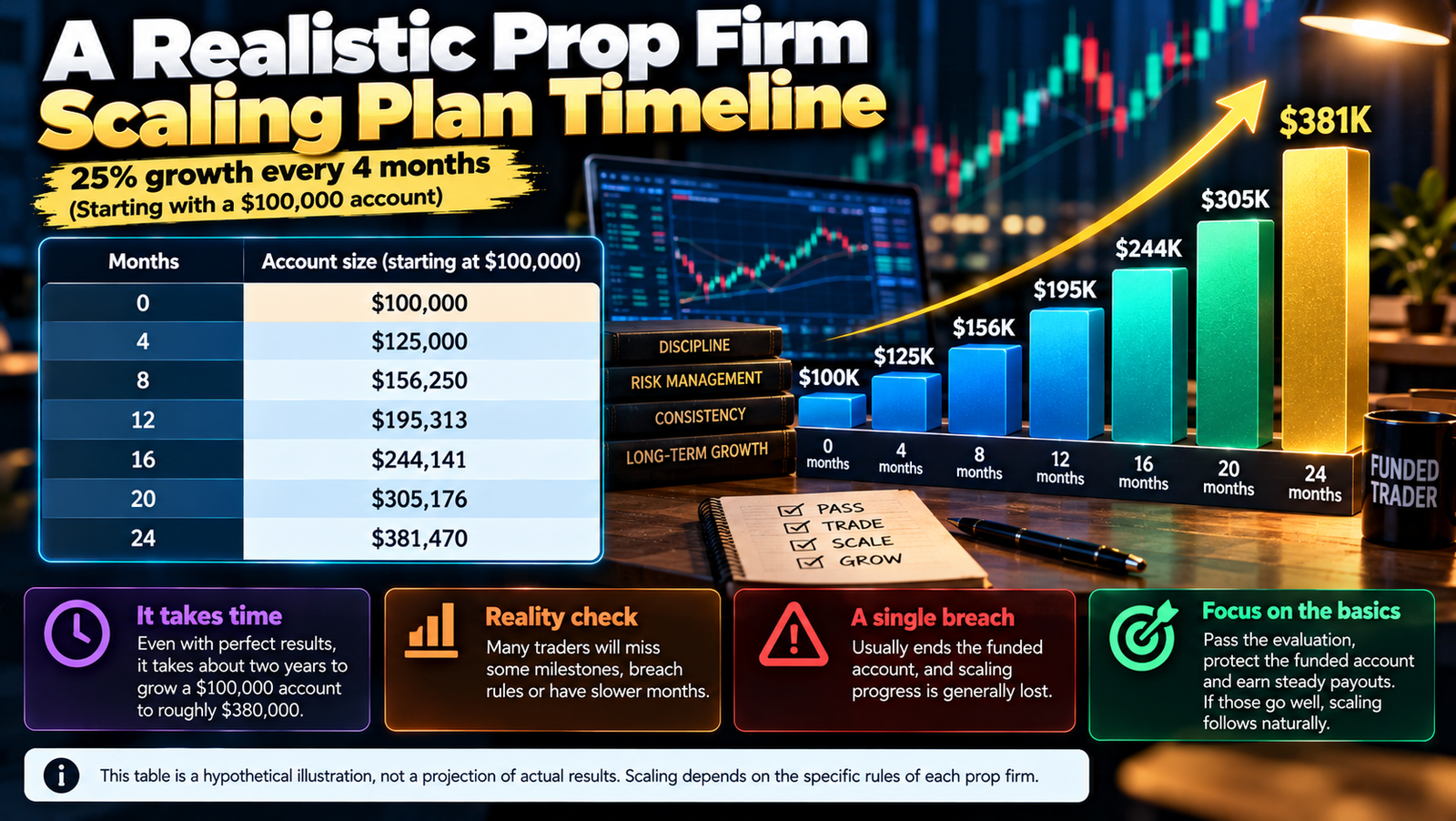
Scaling looks exciting in marketing materials, but the maths takes time. Consider a percentage-based model with a 25% increase every four months, assuming every condition is met each time.
| Months | Account size (starting at $100,000) |
|---|---|
| 0 | $100,000 |
| 4 | $125,000 |
| 8 | $156,250 |
| 12 | $195,313 |
| 16 | $244,141 |
| 20 | $305,176 |
| 24 | $381,470 |
Even with perfect results, it takes about two years to grow a $100,000 account to roughly $380,000 under this model. In reality, many traders will miss some milestones, breach rules or have slower months. A single breach usually ends the funded account, and scaling progress is generally lost.
This table is a hypothetical illustration, not a projection of actual results.
The lesson is to treat any prop firm scaling plan as a long-term bonus rather than the main reason to join a firm. Your near-term focus should be on passing the evaluation, protecting the funded account and earning steady payouts. If those go well, scaling follows naturally; if they do not, no scaling promise will help.
How to Evaluate a Prop Firm Scaling Plan
Before choosing a firm based on its scaling promises, ask these questions:
- What triggers a scale-up? Profit percentage, time, payouts or a combination?
- How big is each increase? A percentage or a fixed amount?
- Is there a cooldown? How long must you wait between scale-ups?
- What is the maximum? Per account and across all accounts.
- What happens to drawdown? Does it grow with the account?
- Do payouts reset progress?
- Is scaling automatic? Some firms require you to request it.
- Can the firm change the rules? Check whether changes apply to existing accounts.
- Does the profit split change?
- What happens if you breach a rule? Usually, progress is lost.
A generous-sounding prop firm scaling plan with strict hidden conditions may be worth less than a modest plan with clear, achievable rules.
Strategies to Qualify for a Prop Firm Scaling Plan
- Prioritise consistency over big wins: Scaling rewards steady performance across months.
- Keep risk small: Many traders risk 0.5–1% per trade on funded accounts.
- Protect the account first: Avoiding a breach matters more than hitting the target quickly.
- Plan your payouts: Understand how withdrawals affect your milestone.
- Track progress: Keep a simple spreadsheet of profit, payouts and dates.
- Avoid rule-breaking strategies: Check rules on news trading, weekend holding and copy trading.
- Do not increase risk to speed up scaling: Rushing often leads to breaches.
Common Prop Firm Scaling Plan Mistakes
- Choosing a firm only for its headline maximum account size
- Ignoring how drawdown changes after scaling
- Not realising withdrawals can reset progress
- Forgetting to request a scale-up when eligible
- Increasing risk to hit milestones faster
- Treating simulated balances as real money
- Not checking whether the firm can change scaling rules
Scaling Up vs Buying a Bigger Challenge
Some traders wonder whether it is better to wait for a prop firm scaling plan to grow their account or simply buy a larger challenge. Each route has trade-offs.
| Factor | Scaling an existing account | Buying a bigger challenge |
|---|---|---|
| Cost | No extra fee | Higher challenge fee |
| Speed | Slow, milestone-based | Immediate, if you pass |
| Risk | A breach can wipe out progress | Fee is lost if you fail |
| Proof required | Months of consistent results | Pass the evaluation again |
Many funded traders do both: they keep growing an existing account through the firm’s scaling rules while adding a second account to diversify. Whatever route you choose, check the firm’s maximum combined allocation, because most firms cap the total capital one trader can manage.

Building Your Own Prop Firm Scaling Plan
Beyond the firm’s rules, it helps to write a personal prop firm scaling plan. Decide in advance how you will adjust risk as the account grows, how much of each payout you will withdraw, and what you will do after a losing month. For example, you might keep risk per trade fixed in percentage terms, withdraw half of each payout, and pause scaling attempts after any month with a drawdown above 3%. Clear personal rules stop excitement or fear from driving decisions as the numbers get bigger.
Important Note for Indian Traders
Before joining any prop firm, understand the legal position in India. Under FEMA, Indian residents may not remit money abroad for leveraged forex or CFD trading, and the RBI publishes an Alert List of unauthorised forex trading platforms. Most prop firms charge fees in foreign currency and operate offshore platforms, so their legal status for Indian residents is not clear-cut.
- Check whether a firm or its platform appears on the RBI Alert List.
- Understand how fees are paid and how payouts are received.
- Keep records, as payouts may be taxable income.
- Consult a chartered accountant or legal adviser before participating.
Legal currency trading in India is available through NSE and BSE currency derivatives with SEBI-registered brokers.
FAQs
What is a prop firm scaling plan?
It is a set of rules that increases the size of a funded account when a trader meets conditions such as a profit target, minimum time and payout history.
How often can I scale my account?
It depends on the firm. Some allow scale-ups every few months if conditions are met; others have longer cooldowns.
Is the scaled capital real money?
Usually not. Most prop firm accounts use simulated capital, and traders are paid a share of simulated profits.
Do I lose my scaling progress if I breach a rule?
In most cases, yes. A breach typically ends the funded account and any scaling progress.
Does taking payouts slow down scaling?
At some firms, yes. Withdrawals can reduce or reset the profit counted towards your next milestone.
Are prop firms legal in India?
The position is unclear. FEMA restricts remittances for leveraged forex trading, so seek professional advice first.
Conclusion
A prop firm scaling plan can turn a successful funded account into a larger opportunity over time. But the path is slower and more conditional than marketing often suggests. Profit targets, time requirements, payout rules, drawdown changes and caps all shape how quickly you can grow.
Before choosing a firm, read the scaling rules alongside the payout and drawdown terms, run realistic numbers and focus on consistent, low-risk trading. For Indian traders, understand the legal position before paying any fees.