
Introduction
Not everyone has time to watch charts all day. If you have a job, a business or a family, scalping and day trading can feel impossible. That is where swing trading forex comes in.
Swing traders aim to capture the medium-sized moves that unfold over several days to a few weeks. Instead of chasing every small tick, they look for clear trends, wait for pullbacks to good levels, and let trades develop. Many traders find it the most practical balance between opportunity and lifestyle.
This complete guide to swing trading forex covers:
- What swing trading is and how it compares with other styles
- The best timeframes and currency pairs for swing trading
- Three popular forex swing trading strategies, step by step
- Indicators, risk management, a sample trading plan and common mistakes
What Is Swing Trading Forex?
Swing trading forex means holding currency positions for a few days to a few weeks to profit from price “swings” within a larger trend or range. Markets rarely move in straight lines. Even in a strong uptrend, price rises, pulls back, then rises again. Swing traders try to enter near the end of a pullback and exit near the end of the next move.
For example, if EUR/USD is in an uptrend and pulls back to a support level, a swing trader might buy there and target the previous high, holding the trade for five to ten days.
The approach relies mainly on technical analysis, such as support and resistance, trendlines and indicators, but swing traders also keep an eye on major economic events like central bank decisions that can move currencies sharply.
Swing Trading vs Day Trading vs Position Trading
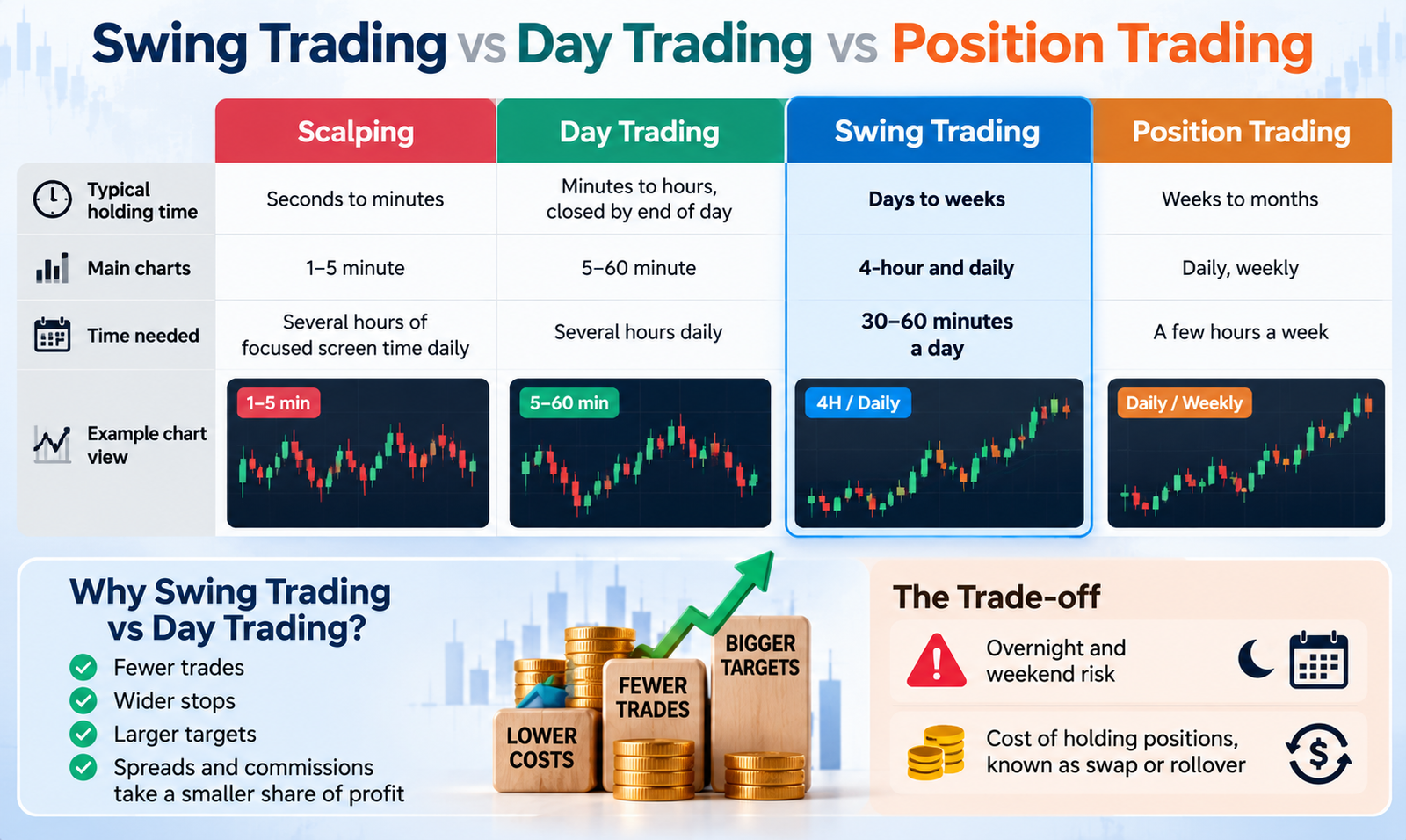
| Style | Typical holding time | Main charts | Time needed |
|---|---|---|---|
| Scalping | Seconds to minutes | 1–5 minute | Several hours of focused screen time daily |
| Day trading | Minutes to hours, closed by end of day | 5–60 minute | Several hours daily |
| Swing trading | Days to weeks | 4-hour and daily | 30–60 minutes a day |
| Position trading | Weeks to months | Daily, weekly | A few hours a week |
Compared with day trading, swing trading forex involves fewer trades, wider stops and larger targets. Spreads and commissions take a smaller share of each trade’s profit. The trade-off is overnight and weekend risk, plus the cost of holding positions, known as swap or rollover.
Why Choose Swing Trading Forex?
AdvantagesTime-friendly: You can analyse charts once or twice a day and set orders in advance.
- Less noise: Higher timeframes filter out much of the random intraday movement.
- Lower trading costs: Fewer trades mean less spent on spreads and commissions.
- Better risk-reward: Bigger moves allow targets of two or three times the risk.
- Less stress: You avoid making split-second decisions.
Disadvantages
- Overnight and weekend gaps: News can move prices while you are away.
- Swap costs: Holding positions overnight can cost or earn interest, depending on the pair and direction.
- Patience required: Good setups may appear only a few times a week.
- Wider stops: Each trade needs more room, so position sizes must be smaller.
Best Timeframes for Swing Trading
Most swing traders use a top-down approach with three timeframes:
- Weekly chart: Identify the long-term trend and major support and resistance zones.
- Daily chart: The main chart for spotting setups and planning trades.
- 4-hour chart: Fine-tune entries and stop placement.
A simple rule is to trade in the direction of the daily trend and use the 4-hour chart to time your entry. This multi-timeframe approach is the backbone of swing trading forex, because it keeps you aligned with the bigger picture while still giving precise entries.
Best Currency Pairs for Swing Trading
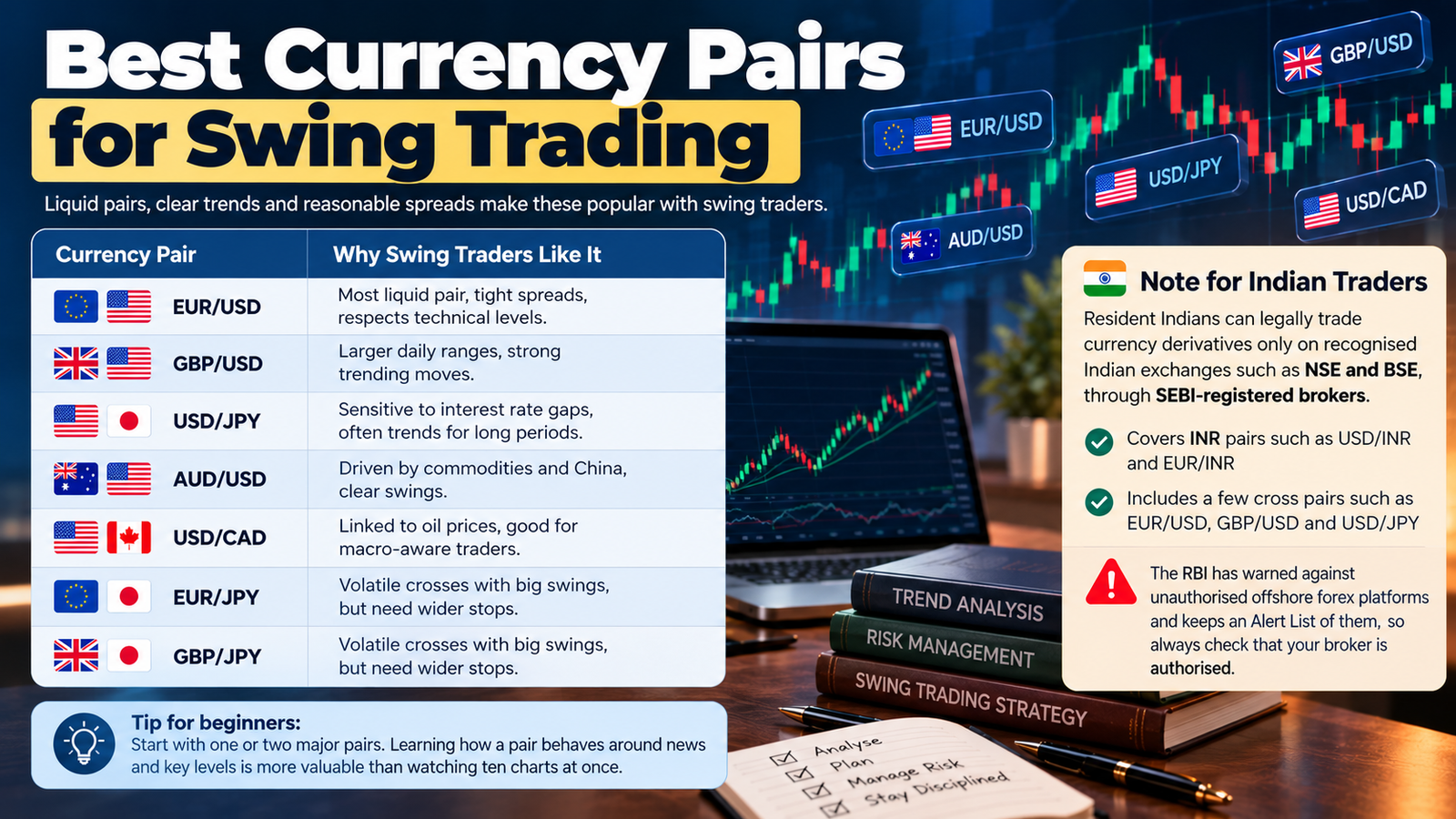
Swing traders generally prefer liquid pairs with clear trends and reasonable spreads:
| Pair | Why swing traders like it |
|---|---|
| EUR/USD | Most liquid pair, tight spreads, respects technical levels |
| GBP/USD | Larger daily ranges, strong trending moves |
| USD/JPY | Sensitive to interest rate gaps, often trends for long periods |
| AUD/USD | Driven by commodities and China, clear swings |
| USD/CAD | Linked to oil prices, good for macro-aware traders |
| EUR/JPY, GBP/JPY | Volatile crosses with big swings, but need wider stops |
Beginners should start with one or two major pairs. Learning how a pair behaves around news and key levels is more valuable than watching ten charts at once.
Note for Indian traders: Resident Indians can legally trade currency derivatives only on recognised Indian exchanges such as NSE and BSE, through SEBI-registered brokers. These cover INR pairs such as USD/INR and EUR/INR, plus a few cross pairs including EUR/USD, GBP/USD and USD/JPY. The RBI has warned against unauthorised offshore forex platforms and keeps an Alert List of them, so always check that your broker is authorised.
Three Popular Forex Swing Trading Strategies
1. Trend pullback strategy
This is the most common approach to swing trading forex. The idea is to join an existing trend after a temporary pullback.
- Confirm the trend on the daily chart: higher highs and higher lows for an uptrend, or the reverse for a downtrend.
- Wait for price to pull back to support, such as a previous swing high, a rising trendline or the 50-day moving average.
- Look for a bullish signal, such as a pin bar or engulfing candle, on the daily or 4-hour chart.
- Enter, place a stop below the pullback low, and target the previous high or a 1:2 risk-reward ratio.
2. Support and resistance range strategy
When a pair moves sideways, swing traders can buy near support and sell near resistance.
- Identify a clear range with at least two touches of both support and resistance.
- Buy near support or sell near resistance after a rejection candle.
- Place the stop just outside the range and target the opposite side.
- Exit if price closes firmly outside the range, because that may signal a breakout.
3. Breakout and retest strategy
Instead of trading inside a range, this strategy waits for price to break out and then retest the broken level.
- Mark a key resistance level or the top of a consolidation.
- Wait for a strong daily close above it.
- Enter when price pulls back to retest the old resistance as new support.
- Place the stop below the retest low and target the next major level.
Waiting for the retest helps you avoid false breakouts, one of the most common traps in swing trading forex.
Key Indicators for Swing Traders
- Moving averages: The 20, 50 and 200-day moving averages show trend direction and act as dynamic support and resistance.
- Fibonacci retracement: The 38.2%, 50% and 61.8% levels highlight where pullbacks often end.
- RSI: The Relative Strength Index shows momentum. Readings above 70 or below 30 suggest overbought or oversold conditions, and divergence can warn of a reversal.
- MACD: Helps confirm trend strength and changes in momentum.
- ATR: The Average True Range measures volatility and is useful for setting stop distances.
Keep your charts simple. Two or three indicators combined with clean support and resistance levels are usually enough for swing trading forex.
Risk Management in Swing Trading Forex
Good strategies fail without good risk management. These rules matter more than any entry signal:
- Risk 1–2% per trade: Limit the amount you can lose on any single trade to a small share of your account.
- Use position sizing: Calculate your lot size from your stop distance, so a wider stop means a smaller position.
- Aim for at least 1:2 risk-reward: If you risk 50 pips, target 100 pips or more. That way you can be profitable even if you win fewer than half your trades.
- Always use a stop loss: Place it at a logical level, not an arbitrary number of pips.
- Watch correlation: Buying EUR/USD and GBP/USD at the same time doubles your exposure to the US dollar.
- Mind the calendar: Reduce size or avoid new trades just before major events like central bank decisions or jobs data.
Position sizing example
Suppose you have a $10,000 account and risk 1% per trade, or $100. Your stop is 50 pips away on EUR/USD, where one pip on a standard lot is worth about $10. Your position size would be $100 ÷ (50 × $10) = 0.2 lots. If the stop is hit, you lose $100. If price hits a 100-pip target, you make $200.
How to Build Your Swing Trading Forex Plan
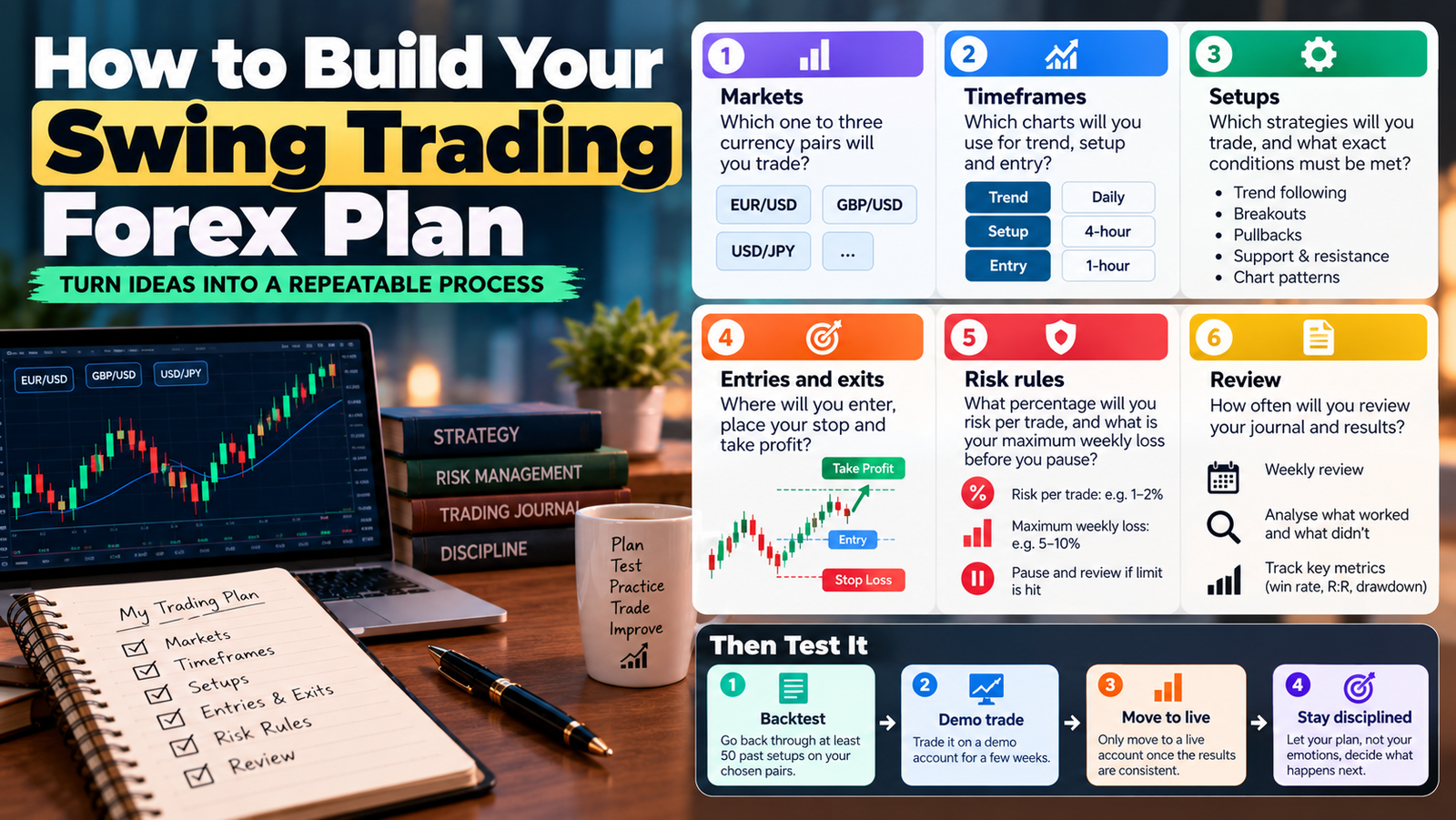
A written trading plan turns ideas into a repeatable process. Before placing real trades, answer these questions in writing:
- Markets: Which one to three currency pairs will you trade?
- Timeframes: Which charts will you use for trend, setup and entry?
- Setups: Which of the strategies above will you trade, and what exact conditions must be met?
- Entries and exits: Where will you enter, place your stop and take profit?
- Risk rules: What percentage will you risk per trade, and what is your maximum weekly loss before you pause?
- Review: How often will you review your journal and results?
Then test it. Go back through at least 50 past setups on your chosen pairs and record how the plan would have performed. After backtesting, trade it on a demo account for a few weeks. Only move to a live account once the results are consistent and you can follow the rules without hesitation.
A clear plan also protects you from emotional decisions. When a trade goes against you, the plan, not your feelings, decides what happens next. That discipline is what separates consistent swing trading forex results from random wins and losses, and it is the foundation every successful swing trading forex approach is built on.
A Sample Swing Trading Forex Routine
- Weekend: Review weekly and daily charts, mark key levels and check the economic calendar for the week ahead.
- Each evening: Spend 30 minutes after the daily close checking your watchlist for setups.
- Place orders: Use limit orders at your planned entry, with stop loss and take profit attached.
- Manage trades: Move your stop to break-even once price reaches about 1:1, or trail it behind swing points.
- Journal: Record each trade’s setup, reasons, result and lessons.
This routine fits around a full-time job, which is one of the biggest reasons people choose swing trading forex.
Common Swing Trading Mistakes
- Trading against the trend: Counter-trend trades have lower odds of success.
- Overtrading: Forcing trades when there is no clear setup.
- Moving stops further away: This turns small losses into big ones.
- Ignoring news: A central bank surprise can wipe out a well-planned trade.
- Using too much leverage: High leverage magnifies losses as much as gains.
- Closing winners too early: Cutting profits short ruins your risk-reward ratio.
FAQs
How long do swing trades last?
Typically a few days to a few weeks, depending on the setup and market conditions.
How much money do I need to start swing trading forex?
It depends on your broker and market, but start with an amount you can afford to lose and keep risk per trade to 1–2%.
Is swing trading better than day trading?
Neither is better for everyone. Swing trading suits people with limited screen time and more patience, while day trading suits those who can watch markets for hours.
What is the best timeframe for swing trading?
The daily chart for setups, with the weekly chart for trend and the 4-hour chart for entries.
Can beginners do swing trading forex?
Yes. Its slower pace makes it one of the more beginner-friendly styles, but practise on a demo account first.
Conclusion
Swing trading forex offers a practical way to trade currencies without being glued to a screen. By focusing on daily and 4-hour charts, trading with the trend, entering at strong support and resistance levels and managing risk carefully, you can build a consistent, repeatable process.
Start small, practise your chosen strategy on a demo account, keep a trading journal and refine your plan over time. Success in swing trading forex comes less from finding a perfect indicator and more from patience, discipline and sound risk management.
Disclaimer: This article is for education only and is not investment or trading advice. Forex trading involves a high risk of loss, especially with leverage. Trade only through authorised brokers and consult a registered financial adviser before trading.