

Introduction
The rupee has had a wild 2026. It fell to a record closing low of 96.88 per dollar on 8 October, then rallied more than 2% in six sessions after the RBI stepped in. Swings like that are exactly why more Indians are curious about currency derivatives, and why USD INR options trading is getting attention from importers, exporters and individual traders alike.
Options can look intimidating at first, with their own vocabulary of calls, puts, strikes and premiums. But the core idea is simple: you pay a small amount today for the right, but not the obligation, to trade dollars at a fixed rate later.
This beginner’s guide to USD INR options trading covers:
- What currency options are and how they work on Indian exchanges
- The difference between a USDINR call option and a USDINR put option
- How the option premium is priced, and what moves it
- Contract specs, margins, RBI rules and common beginner mistakes
What Is USD INR Options Trading?
A currency option is a contract that gives the buyer the right to buy or sell US dollars against the rupee at a fixed rate, called the strike price, on the expiry date. The buyer pays a price for that right, called the premium. The seller receives the premium and takes on the obligation.
In India, USD INR options trading happens on recognised exchanges such as NSE and BSE as part of their currency derivatives segment. These contracts are regulated, standardised and cash-settled in rupees. No actual dollars change hands. Instead, profits and losses are paid in INR based on where the exchange rate ends up.
That makes currency options in India one of the most accessible ways to take a view on the rupee or to hedge currency risk without opening a foreign bank account.
Calls and Puts: The Two Building Blocks
USDINR call option
A call option gives you the right to buy dollars at the strike price. You buy a call when you expect the dollar to strengthen, which means USD/INR rises and the rupee weakens.
Example: USD/INR is at 95.00. You buy one 95.50 call for a premium of ₹0.30. If USD/INR settles at 96.20 on expiry, your call is worth 96.20 − 95.50 = ₹0.70. After the ₹0.30 premium, your profit is ₹0.40 per dollar. If USD/INR stays below 95.50, the call expires worthless and you lose only the premium.
USDINR put option
A put option gives you the right to sell dollars at the strike price. You buy a put when you expect the rupee to strengthen, which means USD/INR falls.
Example: You buy one 94.50 put for ₹0.25. If USD/INR settles at 94.00, the put is worth 94.50 − 94.00 = ₹0.50, giving a profit of ₹0.25 per dollar after the premium. If the rate stays above 94.50, the put expires worthless.
| Buy a call | Buy a put | |
|---|---|---|
| Your view | USD/INR will rise (rupee weakens) | USD/INR will fall (rupee strengthens) |
| Maximum loss | Premium paid | Premium paid |
| Breakeven | Strike + premium | Strike − premium |
| Typical hedger | Importer paying dollars | Exporter receiving dollars |
Understanding this table is the first real step in USD INR options trading. Everything else builds on it.
Understanding the Option Premium
The option premium is the price you pay to buy an option. In USD INR options trading, it is quoted in rupees per dollar, such as ₹0.30. Because one lot covers $1,000, a premium of ₹0.30 costs ₹300 per lot.
The premium has two parts:
- Intrinsic value: How much the option is worth if exercised right now. A 95.00 call when USD/INR is at 95.40 has ₹0.40 of intrinsic value.
- Time value: The extra amount buyers pay for the chance that the option gains value before expiry. Time value shrinks as expiry approaches, a process called time decay.
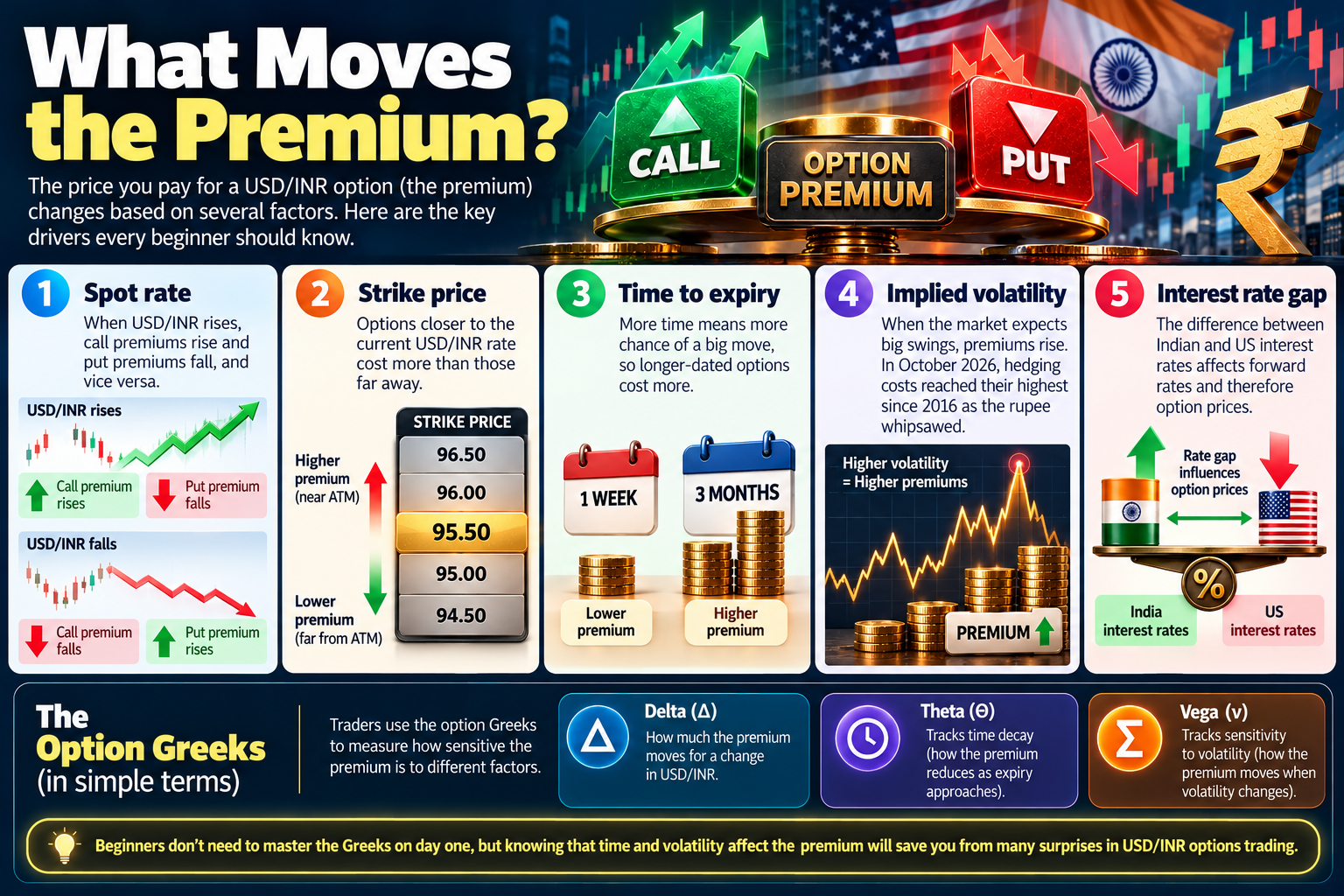
What moves the premium?
- Spot rate: When USD/INR rises, call premiums rise and put premiums fall, and vice versa.
- Strike price: Options closer to the current rate cost more than those far away.
- Time to expiry: More time means more chance of a big move, so longer-dated options cost more.
- Implied volatility: When the market expects big swings, premiums rise. In October 2026, hedging costs reached their highest since 2016 as the rupee whipsawed.
- Interest rate gap: The difference between Indian and US interest rates affects forward rates and therefore option prices.
Traders measure these sensitivities with the option Greeks. Delta tracks how much the premium moves for a change in USD/INR, theta tracks time decay, and vega tracks sensitivity to volatility. Beginners don’t need to master the Greeks on day one, but knowing that time and volatility affect the premium will save you from many surprises in USD INR options trading.
In the Money, At the Money, Out of the Money
These terms describe where the strike price sits relative to the current exchange rate. Assume USD/INR is at 95.00:
| Term | Call example | Put example | Premium |
|---|---|---|---|
| In the money (ITM) | 94.50 call | 95.50 put | Highest; has intrinsic value |
| At the money (ATM) | 95.00 call | 95.00 put | Moderate; all time value |
| Out of the money (OTM) | 95.50 call | 94.50 put | Cheapest; all time value |
Cheap out-of-the-money options tempt many beginners, but they expire worthless far more often. Cheap is not the same as good value in USD INR options trading.
USDINR Contract Specifications at a Glance
Before you start USD INR options trading, know the contract you are trading. These are the standard exchange specifications:
| Feature | Detail |
|---|---|
| Underlying | USD/INR exchange rate |
| USDINR lot size | $1,000 per contract |
| Option style | European (exercised only at expiry, but can be squared off any time) |
| Premium quotation | In rupees, tick size ₹0.0025 |
| Strike interval | ₹0.25 (for example 94.75, 95.00, 95.25) |
| Strikes available | At least 12 in the money, 12 out of the money and 1 near the money for calls and puts |
| Contract cycle | Three serial monthly and three quarterly contracts |
| Last trading day | Two working days before the last working day of the month, at 12:30 pm |
| Settlement | Cash-settled in INR at the RBI reference rate |
| Trading hours | 9:00 am to 5:00 pm, Monday to Friday |
Exchanges have also offered weekly USDINR contracts, so check with your broker which expiries are available before placing a trade.
USD INR Options Trading Margins: Buying vs Selling
Buying and selling options carry very different risks.
- Option buyers pay the full premium upfront. If you buy 10 lots at ₹0.30, you pay 0.30 × 1,000 × 10 = ₹3,000. That is also your maximum loss.
- Option sellers receive the premium but must post a margin, similar to futures. Their profit is capped at the premium received, while losses can be large if the rupee moves sharply against them. A short call has, in theory, unlimited risk.
For most beginners, buying options is the safer way to learn USD INR options trading, because the downside is known in advance. Selling options should wait until you understand margins, volatility and risk management well.

Using Currency Options for Hedging
Options are not just for speculation. Their original purpose is hedging currency risk.
- Importers who must pay dollars later can buy a call. If the rupee weakens, gains on the call offset the higher cost of dollars. If the rupee strengthens, they lose only the premium and buy dollars cheaply in the market.
- Exporters who will receive dollars can buy a put. If the rupee strengthens, the put protects their rupee earnings.
- Families funding overseas education or travel sometimes use the same logic, though they should check eligibility rules with their broker first.
Think of the premium as an insurance cost. It is the price of protection, and like insurance, you hope you don’t need to use it.
A Simple Worked Example
Let’s put the pieces of USD INR options trading together. Suppose an importer must pay $10,000 next month and USD/INR is at 95.00. They buy 10 lots of the 95.25 call at ₹0.35, paying ₹3,500 upfront.
- If USD/INR settles at 96.50: The call is worth ₹1.25 per dollar, or ₹12,500. After the premium, the net gain is ₹9,000, which offsets most of the extra cost of buying dollars at the higher rate.
- If USD/INR settles at 94.50: The call expires worthless. The importer loses ₹3,500 but buys dollars more cheaply in the market.
This is the appeal of USD INR options trading for hedgers: a known, limited cost in exchange for protection against a bad move. Traders use the same maths, only without the underlying dollar payment, so for them the trade is a pure view on direction.
RBI Rules Every Beginner Should Know
Regulation matters a lot in USD INR options trading. Currency derivatives in India are meant mainly for people with a genuine exposure to currency risk. The RBI allows participants to take positions without proving underlying exposure, but only up to a set limit.
On 10 October 2026, the RBI cut that limit from $100 million to $5 million, applying it to both over-the-counter and exchange-traded INR derivatives. Reports say the limit is combined across all INR currency pairs and exchanges. With one lot at $1,000, $5 million is about 5,000 lots, so most small retail traders are unlikely to be affected. Still, read your broker’s latest guidance, because rules in this market can change quickly.
The RBI also barred rebooking of cancelled INR forex contracts, though rollovers at maturity are allowed. These changes show how closely the central bank watches currency derivatives during periods of rupee volatility.
How to Start USD INR Options Trading: Step by Step
- Open a trading account with a SEBI-registered broker that offers currency derivatives on NSE or BSE, and activate the currency segment.
- Learn the platform: Find the option chain for USDINR and look at strikes, premiums, open interest and implied volatility.
- Start small: Buy one lot of a near-the-money option to see how the premium moves day to day.
- Set rules: Decide your maximum loss, target and exit date before you enter a trade.
- Track the drivers: Follow crude oil prices, RBI actions, the dollar index and US Fed decisions, all of which move USD/INR.
- Review every trade: Note why you entered, what happened and what you would do differently.

Common USD INR Options Trading Mistakes
- Ignoring time decay: An option can lose value even if the rupee moves your way, simply because time runs out.
- Buying only deep OTM options: They look cheap but rarely pay off.
- Overtrading around big events: Premiums rise before RBI or Fed decisions, then often fall sharply afterwards.
- Selling options without a plan: Small, steady premiums can be wiped out by one sharp move.
- Forgetting costs: Brokerage, exchange fees and taxes eat into small profits.
FAQs
Is USD INR options trading legal in India?
Yes, on recognised exchanges such as NSE and BSE through a SEBI-registered broker, subject to RBI rules on currency derivatives.
What is the minimum amount needed for USD INR options trading?
For buyers, the cost is the premium × $1,000 per lot. At ₹0.30, one lot costs ₹300, plus charges.
Can I exercise a USDINR option before expiry?
No. They are European options, exercised only at expiry, but you can square off your position any time before.
How are profits settled?
In rupees, based on the RBI reference rate on expiry day. No dollars are delivered.
Conclusion
USD INR options trading gives beginners a flexible, limited-risk way to take a view on the rupee or protect against currency swings. Start with the basics: calls profit when USD/INR rises, puts profit when it falls, and the premium is the most you can lose as a buyer.
From there, learn how time decay and volatility shape premiums, respect the RBI’s rules, and practise with small positions. With patience and discipline, USD INR options trading can become a useful tool for both hedging and trading in one of the world’s most closely watched currency pairs.
Disclaimer: This article is for education only and is not investment or trading advice. Derivatives trading carries significant risk of loss. Consult a SEBI-registered adviser before trading.