
India’s foreign exchange reserves fell for a fifth straight week in the week ended 9 October 2026, largely because the Reserve Bank of India has been selling dollars to support the rupee. Reserves are still higher than at the start of the financial year, but they are now about USD 60 billion below the record set in early September. This article explains the latest RBI data, what drove the decline, how much firepower the RBI still has, and what it means for USD/INR.
India Forex Reserves: The Latest Numbers
India’s foreign exchange reserves fell by USD 8.58 billion to USD 726.03 billion in the week ended 9 October 2026, according to RBI data released on 16 October. Foreign currency assets fell USD 7.14 billion and gold reserves fell USD 1.32 billion. Reserves remain USD 34.92 billion above their end-March 2026 level and USD 28.24 billion higher than a year earlier.
| Component | Level (USD billion) | Weekly change (USD billion) |
|---|---|---|
| Total reserves | 726.027 | Down 8.578 |
| Foreign currency assets | 597.605 | Down 7.142 |
| Gold | 105.094 | Down 1.319 |
| Special Drawing Rights | 18.548 | Down 0.109 |
| Reserve position with the IMF | 4.780 | Up 0.010 |
Source: RBI Weekly Statistical Supplement data as reported by ANI, 16 October 2026. Components add up to the total.
Compared With End-March
Since the end of March 2026, foreign currency assets have risen by USD 45.32 billion while gold reserves have fallen by USD 10.30 billion. The fall in gold reflects lower valuations rather than sales, as the value of the RBI’s gold holdings moves with international gold prices.
Five Weeks of Decline
The latest fall continues a run that began after reserves hit an all-time high of USD 785.71 billion in the week ended 4 September. That record followed a jump of USD 44.90 billion in a single week, driven by inflows from the RBI’s special foreign currency deposit scheme (explained below).
| Week ended | Reserves (USD billion) | Weekly change (USD billion) |
|---|---|---|
| 4 September | 785.71 | Up 44.90 (record) |
| 11 September | 780.78 | Down 4.93 |
| 18 September | 765.90 | Down 14.88 |
| 25 September | About 747.56 | Down about 18.34 |
| 2 October | 734.61 | Down 12.95 |
| 9 October | 726.03 | Down 8.58 |
Sources: RBI data as reported by NewsBytes, News On AIR, New Kerala, Times of Oman and ANI. The 25 September figure is derived from the 2 October level and weekly change.
Over five weeks, reserves fell by about USD 59.7 billion, or roughly 7.6% from the peak. Most of the decline came from foreign currency assets. In the week ended 18 September, for example, the RBI said the decline “was mainly driven by a fall in foreign currency assets,” which fell USD 14.82 billion that week.
Why Reserves Are Falling
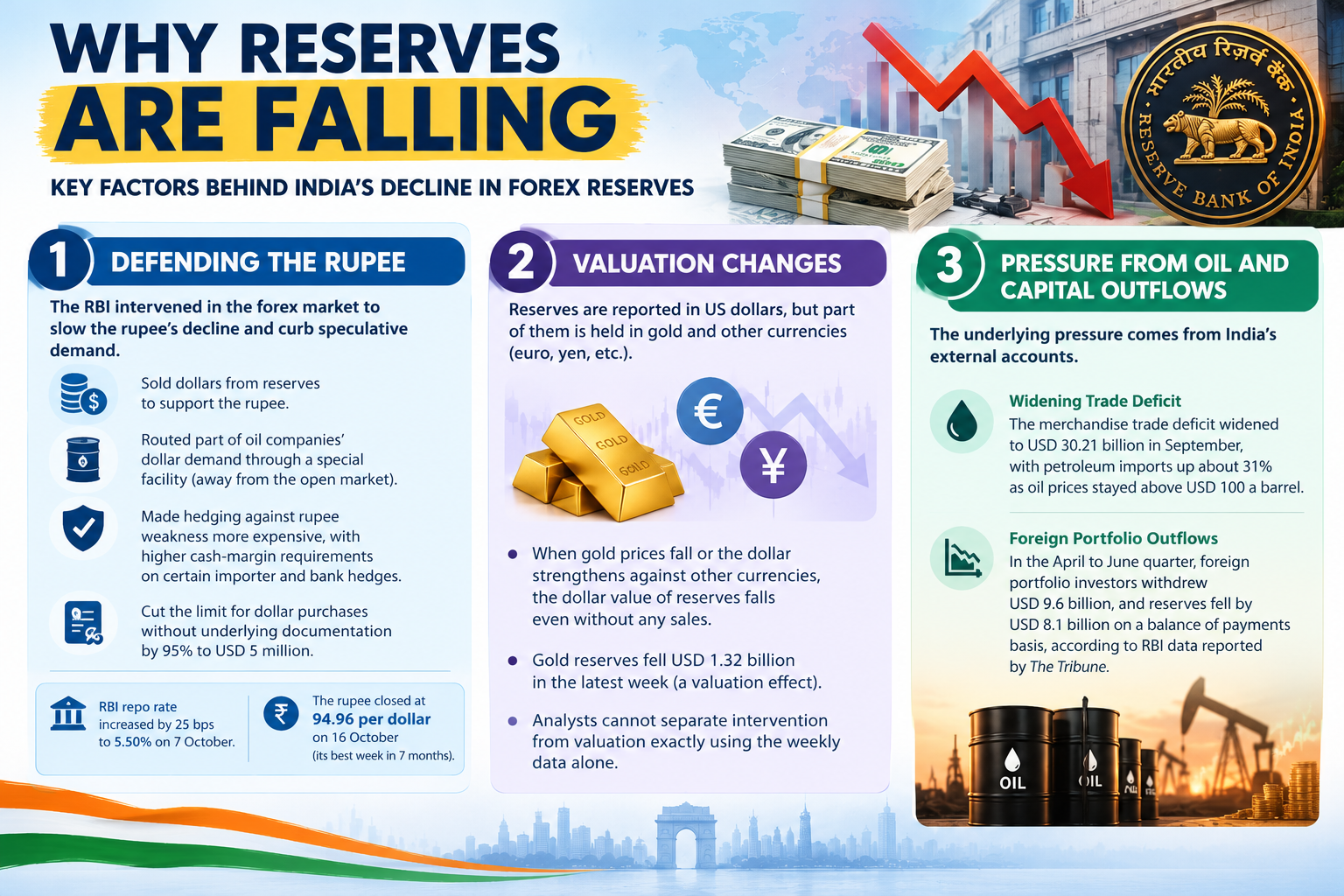
Defending the Rupee
The main reason is intervention. The rupee came close to its record low of 96.96 per dollar in early October, trading near 96.84 on 7 October, according to Business Today. To slow the decline, the RBI sold dollars from its reserves and introduced a series of measures to reduce speculative demand:
- Part of oil companies’ dollar demand was routed away from the open market through a special facility.
- Hedging against rupee weakness was made more expensive, with cash-margin requirements on certain importer and bank hedges.
- The limit for dollar purchases without underlying documentation was cut by 95% to USD 5 million, according to Reuters.
The RBI also raised its repo rate by 25 basis points to 5.50% on 7 October. The rupee responded with its best week in seven months, closing at 94.96 per dollar on 16 October.
Valuation Changes
Reserves are reported in US dollars, but part of them is held in gold and other currencies such as the euro and yen. When gold prices fall or the dollar strengthens against other currencies, the dollar value of reserves falls even without any sales. Gold reserves fell USD 1.32 billion in the latest week, a valuation effect. Analysts cannot separate intervention from valuation exactly using the weekly data alone.
Pressure From Oil and Capital Outflows
The underlying pressure comes from India’s external accounts. The merchandise trade deficit widened to USD 30.21 billion in September, with petroleum imports up about 31% as oil prices stayed above USD 100 a barrel. In the April to June quarter, foreign portfolio investors withdrew USD 9.6 billion, and reserves fell by USD 8.1 billion on a balance of payments basis, according to RBI data reported by The Tribune.
The FCNR(B) Swap Scheme: Where the Record Came From
The surge to USD 785.71 billion was not the result of strong trade or investment inflows. It came from a special scheme the RBI launched on 8 June 2026 to attract foreign currency into India.
Under the scheme, banks could swap the dollars they raised through Foreign Currency Non-Resident (FCNR(B)) deposits and certain overseas borrowings with the RBI at concessional rates. This let banks offer attractive interest rates to non-resident Indians on dollar deposits. According to EcoNiti, total inflows reached USD 136.38 billion by 31 August, including USD 127.23 billion in FCNR(B) deposits, about four times the roughly USD 34 billion raised in a similar scheme in 2013. A later report put cumulative inflows above USD 143.5 billion by 18 September.
The RBI closed the FCNR(B) window on 31 August, a month earlier than planned, after the response exceeded expectations. The windows for overseas foreign currency borrowings and external commercial borrowings remain open until 31 December 2026.
The Catch: Forward Obligations
Most of these dollars are not permanent. The RBI received them through swaps and must return them when the swaps mature, mostly over the next three to five years. This shows up in the RBI’s forward book.
The RBI’s net short position in dollar forwards, meaning dollars it has committed to deliver in future, rose to a record USD 200.06 billion at the end of August from USD 136.77 billion at the end of July, according to Business Standard. Of the short positions, USD 176.57 billion mature in more than a year. Within one year, the net short position fell to about USD 23.5 billion after netting long positions.
SBI Research estimated that the hedging cost of the scheme to the RBI is about 15% of the amount raised, according to EcoNiti.
How Strong Is India’s Reserve Position?
Headline Strength
At USD 726 billion, India still has one of the largest reserve holdings in the world, and reserves are higher than a year ago. In June 2026, when reserves were USD 682.3 billion, RBI Governor Sanjay Malhotra said they were enough to cover about 11 months of imports.
A Simple Import Cover Check
Rough illustration: India’s merchandise imports were USD 74.61 billion in September 2026. Dividing reserves of USD 726.03 billion by that monthly figure gives about 9.7 months of goods imports. This is a simplified calculation using a single high-import month; the RBI’s own measure uses projected imports and gives a different result. It shows that higher oil prices reduce import cover even when reserves are stable.
Net Reserves Matter Too
Headline reserves do not show forward commitments. A large share of the September rise is matched by future obligations to return dollars, and the net forward short of about USD 200 billion is large relative to reserves. Analysts therefore look at both the headline number and the forward book when judging how much room the RBI has to keep intervening.
Reuters reported that the RBI has used about half of the more than USD 140 billion mobilised through its special measures. HSBC’s Joey Chew said that “unless oil prices collapse, USD-INR faces upward pressure over time,” though the pair “can be capped in the near term.”
What It Means for USD/INR
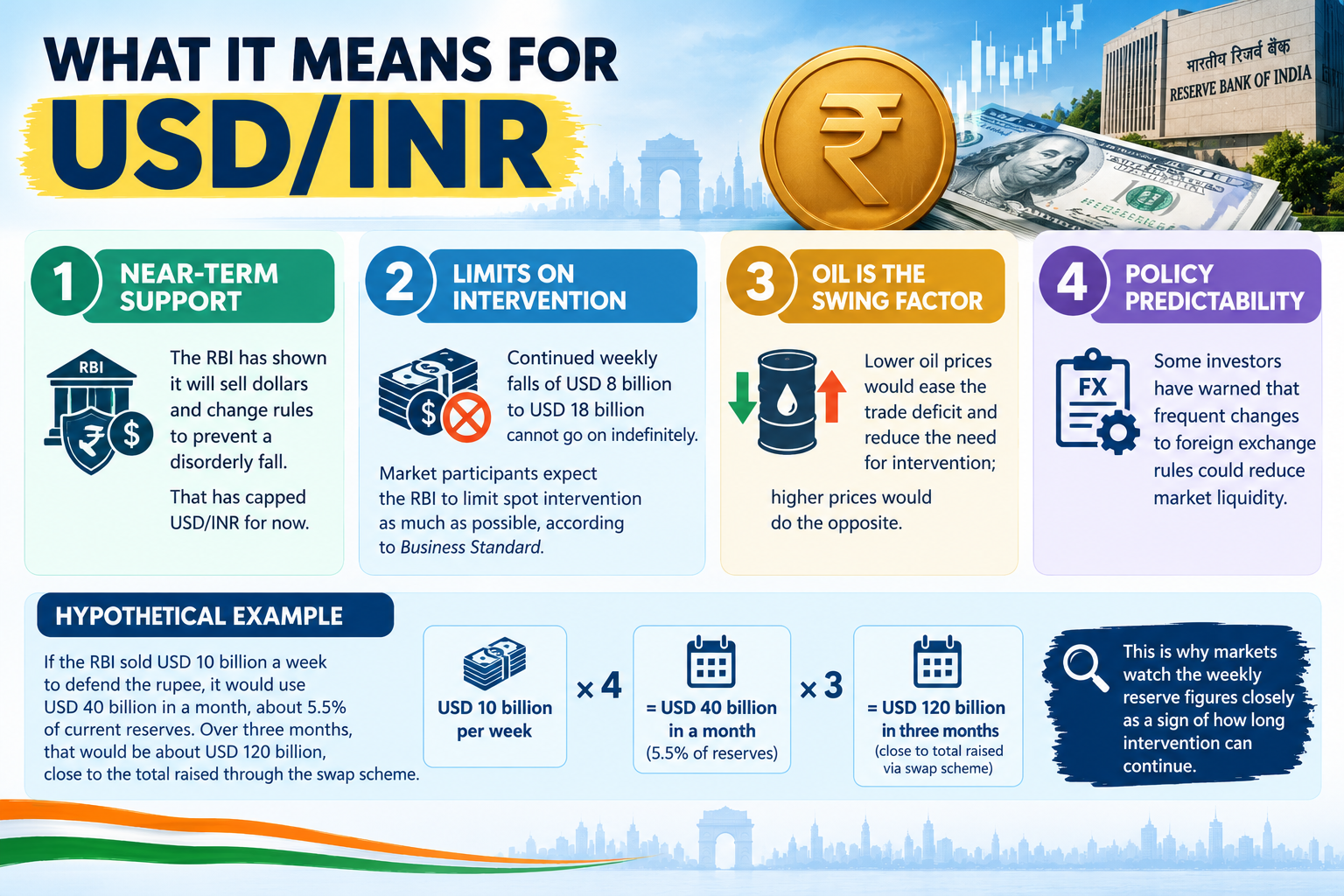
- Near-term support: the RBI has shown it will sell dollars and change rules to prevent a disorderly fall. That has capped USD/INR for now.
- Limits on intervention: continued weekly falls of USD 8 billion to USD 18 billion cannot go on indefinitely. Market participants expect the RBI to limit spot intervention as much as possible, according to Business Standard.
- Oil is the swing factor: lower oil prices would ease the trade deficit and reduce the need for intervention; higher prices would do the opposite.
- Policy predictability: some investors have warned that frequent changes to foreign exchange rules could reduce market liquidity.
Hypothetical example: if the RBI sold USD 10 billion a week to defend the rupee, it would use USD 40 billion in a month, about 5.5% of current reserves. Over three months, that would be about USD 120 billion, close to the total raised through the swap scheme. This is why markets watch the weekly reserve figures closely as a sign of how long intervention can continue.
What to Watch Next
- Weekly reserves data: released every Friday with a one-week lag. The next release covers the week ended 16 October.
- RBI forward book: monthly data, released with about a one-month lag, shows whether the net short position is shrinking.
- RBI MPC minutes: due on 21 October, they may show how the committee views the rupee and reserves.
- Oil prices and the trade deficit: October trade data is due in mid-November.
- Foreign portfolio flows: continued equity selling adds to dollar demand.
Indian residents can hedge or trade currency risk only through authorised dealers and recognised exchanges such as NSE and BSE, as permitted under FEMA.
Frequently Asked Questions
What are India’s forex reserves as of 9 October 2026?
India’s foreign exchange reserves were USD 726.03 billion in the week ended 9 October 2026, down USD 8.58 billion from the previous week, according to RBI data.
What is India’s highest ever forex reserve level?
The record is USD 785.71 billion, reached in the week ended 4 September 2026, after a weekly increase of USD 44.90 billion driven by the RBI’s FCNR(B) swap scheme.
Why are India’s forex reserves falling?
Mainly because the RBI has been selling dollars to support the rupee, which came close to its record low of 96.96 per dollar in early October. Changes in the value of gold and non-dollar assets also affect the total.
What are the components of India’s forex reserves?
Foreign currency assets (USD 597.61 billion), gold (USD 105.09 billion), Special Drawing Rights (USD 18.55 billion) and the reserve position with the IMF (USD 4.78 billion), as of 9 October 2026.
What is the FCNR(B) swap scheme?
A scheme launched by the RBI on 8 June 2026 that let banks swap dollars raised through non-resident foreign currency deposits and some overseas borrowings with the RBI at concessional rates. It brought in more than USD 136 billion by 31 August, but the dollars must be returned when the swaps mature.
When are India’s forex reserves data released?
The RBI publishes weekly reserves data every Friday in its Weekly Statistical Supplement, covering the week ended the previous Friday.
Conclusion
India’s forex reserves of USD 726.03 billion are still large by any standard and above their level a year ago. But the five-week fall of about USD 60 billion from the September record shows the cost of defending the rupee against high oil prices and capital outflows. Much of the record was built on swap inflows that carry future obligations, so the RBI’s real room to intervene is smaller than the headline suggests. For USD/INR, the weekly reserves data has become one of the most useful signals of how long the RBI can hold the line.
Disclaimer
This article is for educational purposes only and does not constitute investment, trading, tax or legal advice. Reserves data are subject to revision. Figures are drawn from published reports of RBI data. Examples and calculations are hypothetical or simplified. Currency and derivatives trading involves substantial risk of loss; Indian residents should deal only through authorised persons and recognised exchanges as permitted under FEMA, and consult a SEBI-registered adviser before making financial decisions.