
Introduction
I think this is something you must have experienced when you first started trading: that you spot the perfect trade, the indicator and pattern is supporting it, yet the price moves against us immediately after we enter. And it actually gets quite frustrating to see the perfect trade fail miserably.
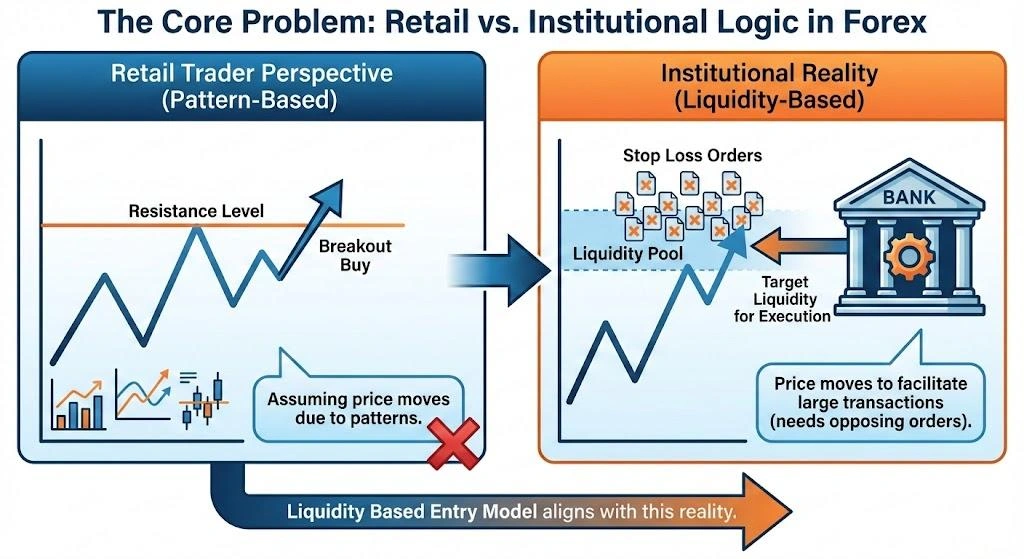
But actually the reason behind this is that the market doesn’t move because of the indicators or a pattern on charts. It moves because of orders and liquidity. Big institutions trade such huge amounts that they need a massive pool of opposing orders just to get into the market. This reality is why the liquidity based entry model exists. It focuses on finding where the money is actually sitting.
| Aspect | Retail Perspective | Institutional Logic |
| Price Driver | Patterns & Indicators | Orders & Liquidity |
| Support/Resistance | A place to Enter | A place to find Liquidity (Stops) |
| Breakouts | A signal of strength | A trap to generate counter-orders |
| Role in Market | Provides Liquidity | Consumes Liquidity |
| Entry Timing | At the level | After the “Stop Sweep” |
The Core Problem: Why Traditional Entries Fail
Retail Perspective vs Market Reality
Retail traders typically:
- Buy breakouts
- Sell breakdowns
- Enter at support and resistance
- Follow indicator signals
These approaches assume price moves because of patterns. In reality, price moves to facilitate transactions.
Large institutions (banks, hedge funds, liquidity providers) require:
- Deep liquidity
- Areas with clustered orders
- Predictable behavior from retail participants
Retail strategies often create liquidity, not profits.
Example of the Problem
Consider a textbook resistance level:
- Multiple traders place sell orders
- Stops are placed just above resistance
- Breakout traders place buy stops above the same level
This zone becomes a liquidity pool.
Price may move above resistance, not because of strength, but because institutions need that liquidity.
This is where a liquidity based entry model becomes relevant.
What Is a Liquidity Based Entry Model?
A liquidity based entry model is a trading framework that identifies areas where:
- Stop losses are concentrated
- Pending orders accumulate
- Institutions are likely to seek liquidity for execution
Instead of predicting direction, the model focuses on where price is incentivized to go before a directional move begins.
Key Principles
- Liquidity acts like magnet for price
- Institutions move price to reach those order goals
- Retail traders commonly place orders at obvious levels
- We enters after big banks and institutions have cleared their positions, not before
This approach aligns closely with institutional entry logic, which prioritizes execution efficiency rather than pattern completion.
Relationship Between Liquidity and Price Movement
Price doesn’t move just because a chart pattern looks complete; it moves because transactions are happening. Liquidity is the “gasoline” for those trades. This model connects your decisions to that real cause-and-effect, helping you finally understand why the market is actually behaving the way it does.
Understanding Institutional Entry Logic
Why Institutions Trade Differently
Institutions:
- Trades in massive sizes
- Cannot just jump at any random price
- Need someone to take the other side of every market
They often:
- They often pushes the price toward liquidity zones
- Trigger individual trader’s stop-loss
- Get their own orders filled at favorable prices
- Reverse the price once they get what they wanted
This explains why we often see so many false breakouts, stop hunts, and sharp reversals in the market out of nowhere.
Institutional Entry Logic Explained
Institutional entry logic follows this sequence:
- Identify the order pools
- Move the price towards those pools
- Absorb orders (stop loss and pending orders)
- Enter positions once liquidity is available
- Move price in the intended direction
A liquidity based entry model attempts to align retail entries with this process, rather than opposing it.
Types of Liquidity in Forex Markets
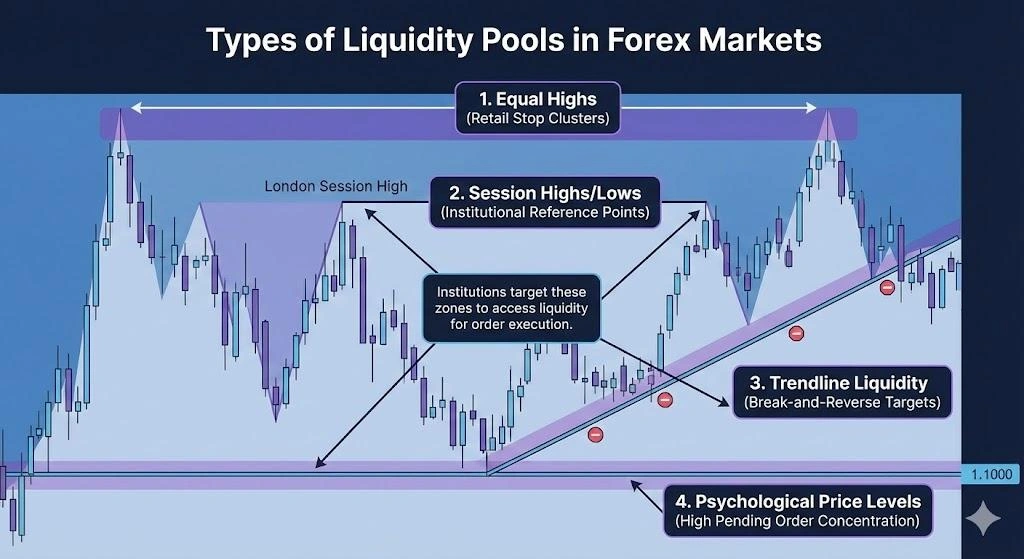
Understanding liquidity types is essential for any liquidity entry forex strategy.
1. Equal Highs and Equal Lows
- This happens when the price hits the same level multiple times
- Most of the retail traders place their stop-losses right behind the obvious spots
- Big institutions target these areas to find big groups of orders.
2. Session Highs and Lows
- Asian, London, and New York session highs/lows
- Big banks and institutions use these landmarks to find liquidity for their trades.
- Strong liquidity zones, especially during session transitions
3. Trendline Liquidity
- Most of the retail traders follow a trend and place their stops just underneath the trendlines.
- This is why you often see break-and-reverse behavior.
4. Psychological Price Levels
- Round numbers (e.g., 1.1000, 1.2500)
- High concentration of pending orders
A liquidity based entry model does not treat these levels as support or resistance, but as targets for price.
Step-by-Step Liquidity Based Entry Model
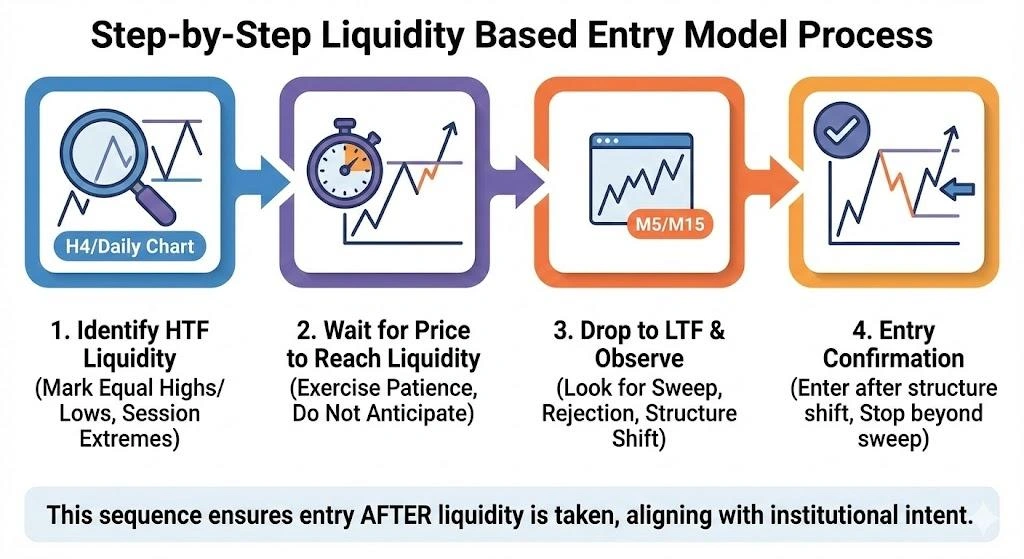
Step 1: Identify Higher Timeframe Liquidity
Your first move should be looking at the “big picture” on the H1, H4, or Daily charts. You start by looking for obvious spots where money is sitting—like equal highs, equal lows, or previous session highs. This is your map, it tells you exactly where the price is likely to head next.
Step 2: Wait for Price to Reach Liquidity
Now you don’t just jump to the trade, you wait for it to hit your target price. Institutional trading is all about patience. In this situation you’re not chasing the market, instead you’re waiting for it to walk into your trap.
Step 3: Drop to Lower Timeframe
Then switch to smaller timeframes like 5-in or 15-min:
- Watch your price clear those stop-losses
- Look for a sharp rejection or push
- Spot a shift in markets direction
Step 4: Entry Confirmation
Don’t jump to trade, enter only after:
- When liquidity is low
- The price structure has changed its direction
- The market has started respecting the new structure
Stops are placed beyond the liquidity sweep zone, not arbitrary levels.
Practical Example: EUR/USD Liquidity Entry Forex Setup
The setup
While watching the EUR/USD charts, you notice two peaks at the same level (around 1.0950) on the daily chart. And as the London session starts the price starts moving upward, breaking out from those points.
What actually happened
In reality the breakout was actually a trap. By pushing the price up, they trapped retail traders in buying the breakout, creating a pool of orders. Which the big banks and institutes needed to hide their own massive position selling.
The trade
- The Entry: You don’t chase the price as it falls. Instead, you wait for a tiny “breath” or a small bounce back up to enter your sell trade.
- The Safety (Stop Loss): You place your stop loss just above that highest spike. Since that was the “liquidity sweep,” the price shouldn’t need to go back there.
- The Goal (Take Profit): You target the next logical area where other traders’ stops are likely sitting below.
This example demonstrates a liquidity based entry model aligned with institutional entry logic.
Why Liquidity Based Models Improve Trade Quality
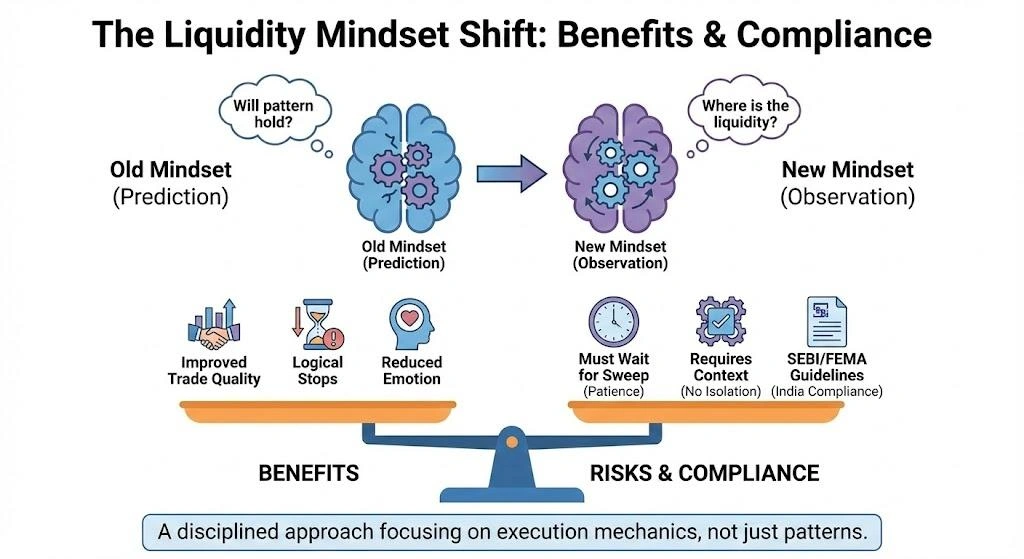
- You stop rushing: It helps you avoid making decisions in rush and let the market calm first.
- Stops that make sense: You place your stop losses at a well calculated spot, rather than just at some random number.
- Trading with professionals: You trade in the same way that large banks actually make money, not against them.
- Better payouts: Because your entry points are more precise, your risk-to-reward ratio becomes more favorable for you.
- Peace of mind: You become more disciplined in your trading and avoid being driven by your emotions.
Instead of just reacting to an indicator, you’re reading the market’s actual behavior. You don’t just watch the charts —you understand the why behind every move.
Common Mistakes When Using Liquidity Based Entry Models
1. Entering Before Liquidity Is Taken
Expectations lead to rapid entry and subsequent decline.
2. Ignoring Higher Timeframe Context
Liquidity is relative. Lower timeframe setups without context are unreliable.
3. Overcomplicating the Model
Liquidity based entry models are conceptually simple but require discipline.
4. Treating Every High or Low as Liquidity
Not all levels matter. Focus on obvious and clustered levels.
Tools That Support Liquidity Entry Forex Analysis
Well no tool can replace your understanding, but they can help in making the chart much clearer:
- Session high/low indicators
- Market structure tools
- Multi-timeframe charting platforms
These tools are helpful in executing, but they don’t help in creating strategy.
The liquidity based entry model is all about using your own judgement and common-sense market logic.
Risk Management and Compliance Perspective
From an educational standpoint:
- Liquidity based models are analytical tools
- They do not promise outcomes
- Risk management is always trader-dependent
In India, retail forex traders must ensure:
- Use of SEBI-compliant brokers
- Adherence to FEMA and RBI guidelines
- Trading permitted currency pairs only
Any liquidity entry forex strategy should be practiced within legal and regulatory boundaries.
Conclusion
A liquidity-based approach helps you understand why the market moves, not just where. By thinking like the big players, you stop guessing and start watching. Instead of chasing breakouts or old indicators, you focus on how orders are actually filled and what the market is trying to do.
If you’re looking for further guidance and more clarity of concept, then visit Insightful Trade’s website. Here they will teach you how to use this method with patience and smart risk management, it can help you sharpen your trading and stay in control.
Frequently Asked Questions (FAQs)
1. What tools do I need for a liquidity based entry model?
You don’t need to have any fancy tools. A basic charting platform that has a multi-timeframe is enough. Simple tools to mark the market session or price structure can assist visualization.
2. Is liquidity entry forex suitable for beginners?
It would be an advantage for beginners if they can study liquidity concepts, but trading them live will need a lot of patience and screen time. It is recommended to practice on demo accounts before risking capital.
3. Is liquidity based trading legal in India?
Yes, learning and applying is legal. However, traders must use SEBI-regulated brokers and trade only permitted currency pairs under Indian regulations.
4. Does this work in markets other than forex?
The concept applies to forex, indices, commodities, and crypto. However, because the forex market is so massive and structured, it’s often the best place to see the institutional liquidity behavior more clearly.
5. Is this the same thing as smart money concepts?
Institutional entry logic is very similar to the smart money concept. The main difference is that we focus a bit more on understanding the reason behind rather than on terminology. Understanding exactly why liquidity is needed and how price seeks it.
Author: Kumkum Chandak
Experience: 3+ Years in Trading Research & Market Content Strategy
Kumkum Chandak is a trading content strategist and market research writer who specializes in simplifying technical analysis, trading tools, and strategy-driven educational content. Her work is optimized for EEAT, accuracy, and user intent, ensuring every article delivers practical insights for traders of all levels.
Risk Disclaimer:
All content is strictly educational and not financial advice. Trading involves substantial risk. Always perform your own analysis or consult a professional advisor.
Last Updated: 4 January 2026