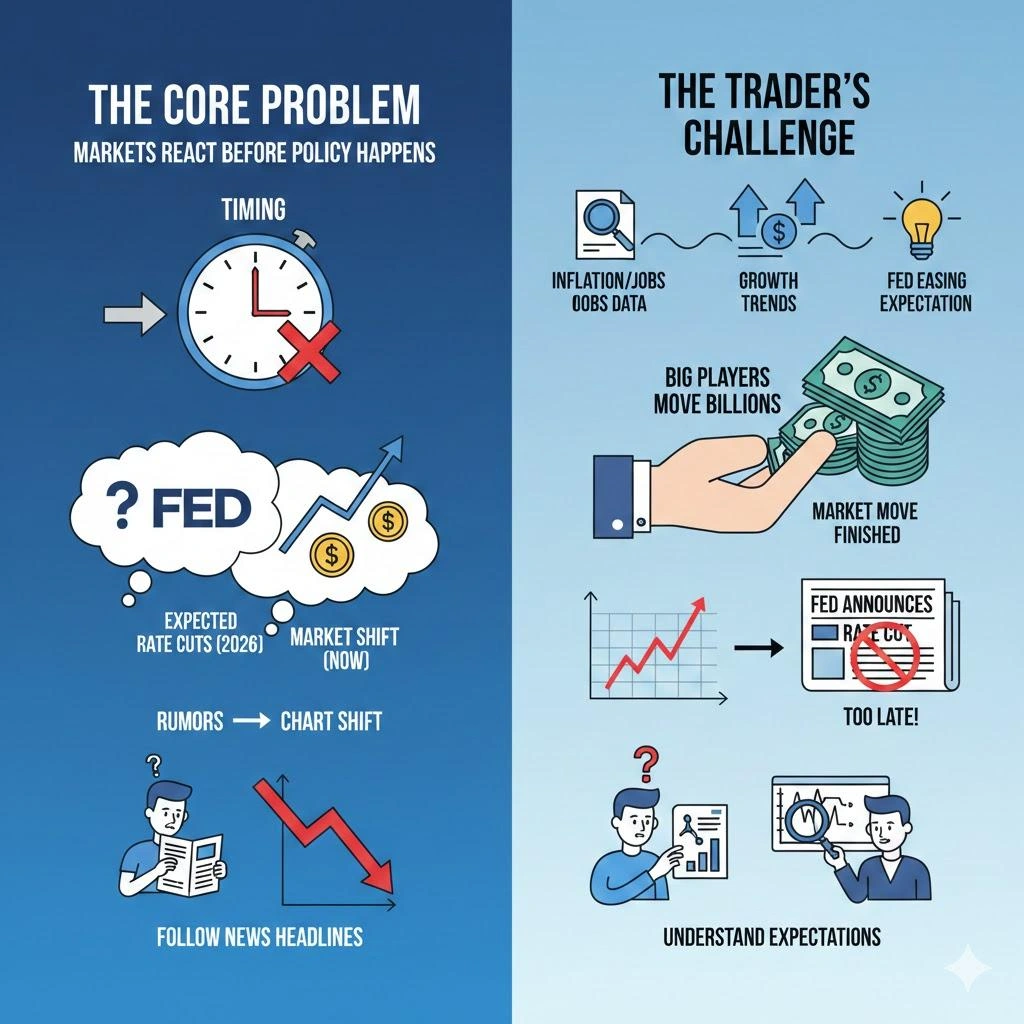

The recent reports showing a dip in forex reserves has quickly become one of the most talked-topic in the financial market. Everyone is thinking how this policy will affect the Rupee, especially with the Global market mood staying so shaky throughout 2026.
Even though the fresh figures show that India’s reserve has fallen by $6.7 billion to around $717 billion. India’s stash is still historically high, this sudden slide is raising questions about our cash buffers and what’s next for the rupee.
In this blog, we’ll learn how India forex reserves drop rupee impact, and how you can find opportunities and handle the market swings.
While the decline looks sharp on a weekly basis, India still maintains one of the strongest reserve buffers among emerging economies. The key concern is not the level — but the direction of movement.
Why the Indian Forex Reserves Drop Matters Now
Foreign reserves are the shield of the country. If ever things become uncertain like sudden oil price jumps, world conflicts, or investors pulling their money out we can use the reserves to handle such situations.
The recent dips in reserves is a big deal because it’s happening alongside several global and domestic pressures:
- US bond yields are climbing pulling money away from emerging markets
- Unpredictable oil prices are making are import bills more expensive
- Global uncertainty and riskiness in the environment are keeping investors on edge
- The US dollar is showing serious strength against almost every other currency
All these factors together make India forex reserves drop and rupee impact hits harder, leaving the rupee feeling a bit more vulnerable to losing value.
Key Drivers Behind RBI Reserve Decline USD INR Movement
Knowing this helps traders make better sense of where the market is headed. The recent dip in reserves seems to be driven by a few key things like:
1. RBI Intervention to Stabilize the Rupee
The RBI often sells dollars from reserves to prevent excessive rupee volatility. When the central bank intervenes aggressively, reserves fall temporarily.
2. Valuation Effects
Forex reserves aren’t just in dollars, they also include Euros, YEN, and Pounds. When these currencies get weak against USD the total balance looks smaller on paper even if no actual cash left building.
3. Foreign Portfolio Outflows
As the foreign investors are pulling out money from stocks and bonds, it reduces the flow of dollars into the country, causing the national reserves to decline.
4. Rising Import Costs
If the cost of oil imports increases it means we’ll need more dollars. This puts pressure on both our national reserves and the rupee at the same time.
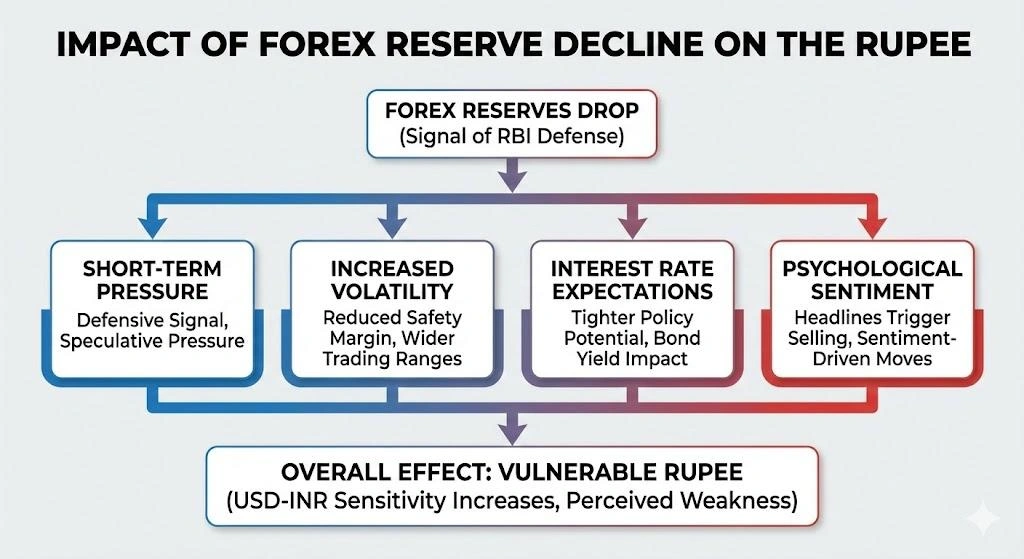
India forex reserves drop rupee impact: What It Means for the Currency
The rupee does not react to reserves in isolation, but reserves act as a confidence indicator.
Here are the main currency implications:
Short-Term Pressure on INR
This drop is proof that the central bank is actively fighting to protect the rupee. Many times the market sees this as a sign of underlying weakness, which can trigger even more selling.
Increased Volatility
When the safety net feels smaller compared to our import bills the market gets a bit jumpy. This often leads to much higher volatility in USD-INR trading ranges.
Interest Rate Expectations
If the Rupee stays weak for too long, the RBI might keep interest rates higher to support. This directly affects everything from bond yields to how much foreign money flows in.
Psychological Market Sentiment
Forex markets are driven by moods. Headlines about falling reserves create panic leading traders to sell the Rupee even if the country’s basics are still solid.
Therefore, the India forex reserves drop rupee impact extends beyond numbers—it influences trader psychology and institutional positioning.
Is the Situation Actually Concerning?
Even though there has been a drop in the reserves, India’s reserve is still one of the world’s largest. Experts usually measure reserves by:
- Import cover ratio (months of imports supported)
- External debt coverage
- Short-term liquidity needs
India is at a safe spot as per global standards, but the real concern is the direction the market and things are heading toward. If the decline continues along with investors leaving it could become a serious economic risk.
How Much Forex Reserve Is Considered Safe for India?
Economists generally consider reserves covering at least 8–10 months of imports as comfortable. India currently remains above that threshold. The real risk appears only if reserves decline continuously alongside rising oil prices and persistent capital outflows.
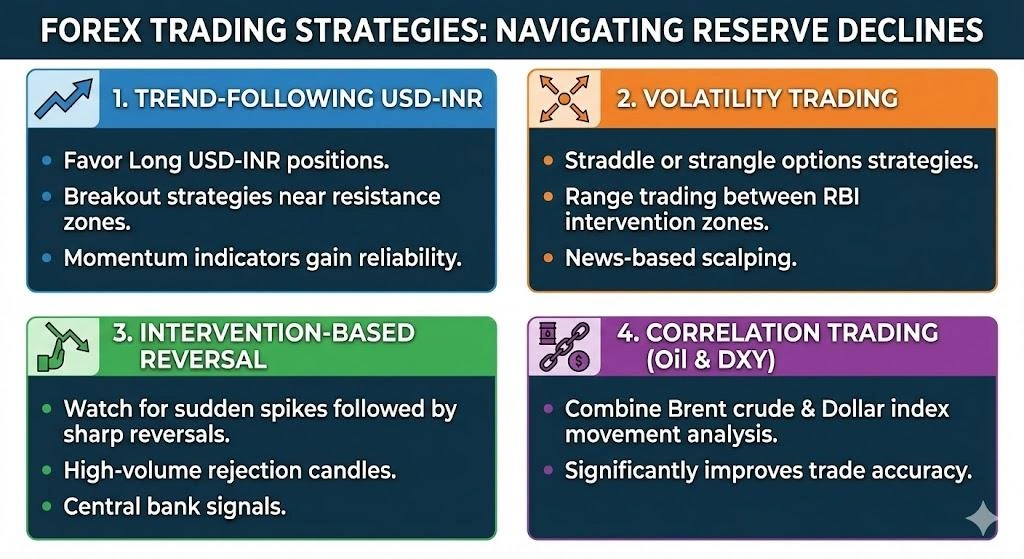
Forex Trading Strategies During Reserve Decline Phases
For traders, macroeconomic events create opportunity. The India forex reserves drop rupee impact environment offers multiple strategic angles.
1. Trend-Following USD-INR Trades
When reserves decline and the dollar strengthens globally:
- Traders often favor long USD-INR positions
- Breakout strategies near resistance zones become effective
- Momentum indicators gain reliability during macro-driven moves
2. Volatility Trading
Reserve uncertainty increases intraday volatility.
Strategies include:
- Straddle or strangle options strategies
- Range trading between RBI intervention zones
- News-based scalping during economic releases
3. Intervention-Based Reversal Trades
The RBI is known to defend specific psychological levels.
Traders watch for:
- Sudden spikes followed by sharp reversals
- High-volume rejection candles
- Central bank liquidity signals
This is particularly relevant during strong RBI reserve decline USD INR phases.
4. Correlation Trading with Oil Prices
India is a major oil importer. Rising crude prices often weaken the rupee.
Combining:
- Brent crude analysis
- Dollar index movement
- Bond yields
It can significantly improve forex trade accuracy.
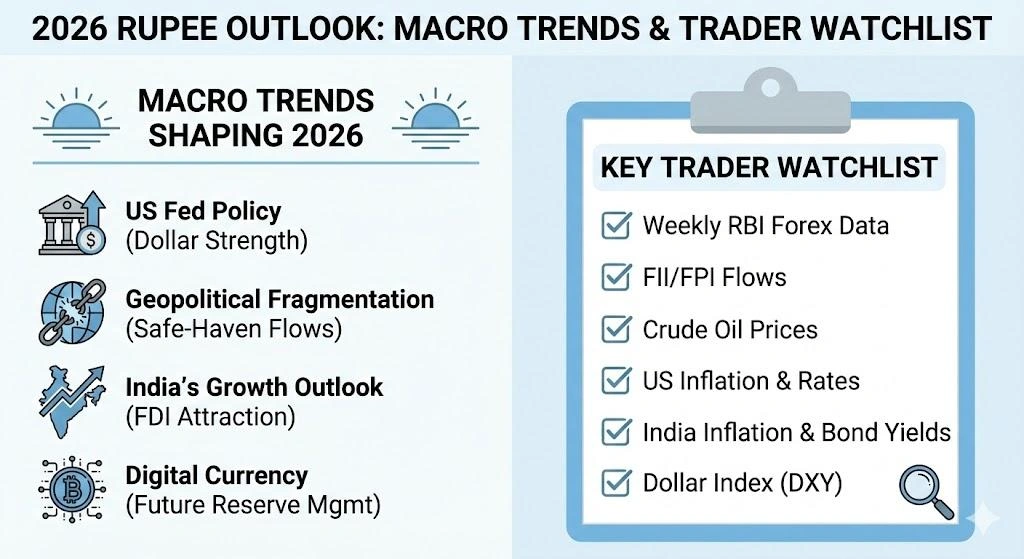
Macro Trends Shaping Rupee Outlook in 2026
The India forex reserves drop rupee impact 2026 story is tied to broader global trends:
US Federal Reserve Policy
When the US interest rate increases, money tends to flow more into Dollar assets which usually put pressure on emerging market currencies.
Geopolitical Fragmentation
Trade tension and regional conflicts are pushing investors toward the US dollar as a reliable safety net during uncertain times.
India’s Growth Outlook
A strong GDP can actually balance out worries about falling reserves by attracting fresh investment from around the world.
Digital Currency and Capital Flows
The rise of digital payments and CBDCs could completely change how countries manage their National Reserves in the long run.
Historically, every strong US rate hike cycle has created temporary pressure on emerging market currencies including the rupee.
What Traders Should Watch Next
To figure out where the Rupee is heading toward, keep a close watch on these key signals:
- Weekly RBI forex reserve data
- Foreign institutional investor (FII) flows
- Crude oil price trends
- US inflation and interest rate decisions
- India inflation and bond yields
- Dollar index (DXY) movement
To anticipate the next big move you can use these variables.
Risk Management During Reserve-Driven Volatility
When big macro news hits the market the forex market often gets unpredictable.
Pro traders focus on:
- Setting strict stop losses
- Adjusting position sizes
- Avoiding too much leverage
- Checking multiple time frames for confirmation
- Staying news aware before hitting the button
The main objective isn’t just profit, but it’s also protecting your capital during uncertain times.
Long-Term Perspective: Structural Strength of the Rupee
Even the market is occasionally up and down, solid fundamentals will keep the rupee supported for the long term:
- Strong economic growth
- Growing manufacturing sector
- Increase in foreign investment
- A booming digital economy
- Demographic advantage
No need to panic, consider this dip in Forex reserves as a normal cycle, not a major crisis unless the decline starts to speed up.
RBI’s weekly statistical data shows that valuation changes and intervention activities both play a role in reserve fluctuations.
Conclusion: India forex reserves drop rupee impact
There’s been a lot of talk about the India forex reserves drop rupee impact falling reserves to $717 billion. But you must know that India still holds a very solid financial safety net. This decline shows RBI’s active intervention and shifting Global conditions rather than any real sign of economic weakness.
For traders this drop creates fresh opportunities to trade the resulting volatility and price trends. Understanding the USD-INR markets successfully means staying on top of central banks action, global dollar strength, and capital flows. For further insights on global trends and stay updated on India’s all recent policies connect with Insightfultrade.
FAQs: India forex reserves drop rupee impact
1. Why did Indian forex reserves drop recently?
This usually happens when the RBI sells Dollar to steady the Rupee, the value of non dollar assets is shifting or foreign investors are pulling money out.
2. Does falling forex reserves mean the rupee will weaken?
Not necessarily, but if it keeps shrinking it can definitely increase the pressure on the rupee and lead to bigger price swings.
3. How do forex reserves affect USD-INR traders?
Reserve influences the overall market mood and help traders know when the RBI might intervene, both are huge factors and making trading decisions.
4. Is India’s reserve level still safe?
Yes, India holds one of the largest reserves in the world, with more than enough cash to completely cover its import bills.
5. Can RBI defend specific USD-INR levels?
The RBI does not publicly confirm target levels, but it often steps in during sharp volatility to prevent disorderly currency movements.
Author: Kumkum Chandak
Experience: 3+ Years in Trading Research & Market Content Strategy
Kumkum Chandak is a trading content strategist and market research writer who specializes in simplifying technical analysis, trading tools, and strategy-driven educational content. Her work is optimized for EEAT, accuracy, and user intent, ensuring every article delivers practical insights for traders of all levels.
Risk Disclaimer:
All content is strictly educational and not financial advice. Trading involves substantial risk. Always perform your own analysis or consult a professional advisor.
Last Updated: 14 February 2026