
Whether you’re trading EUR/USD, GBP/JPY, or XAU/USD, knowing your exact required margin before entering a position is the difference between disciplined trading and a surprise margin call. This guide explains exactly how a forex margin calculator works, the formula behind it, and how to use it to protect your account equity across different leverage ratios and lot sizes.
1. What a Forex Margin Calculator is and Why it matters for Forex Trading
In today’s world, forex trading is the new trend. In this you make many important decisions and the most critical one is your margin. Understanding the amount of margin you need before opening a position can be very difficult, it can either lead to a well planned trade or an unexpected margin loss. And that’s when the forex margin calculator comes to help traders of all experience levels.
With the help of a Forex margin calculator, you can determine the exact capital amount required to open a trade position based on your Lot size, leverage and currency pair you’re trading. With the involvement of leverage in forex trading, it allows traders to control large positions with relatively small deposits. The calculator helps by giving the amount required to trade instantly without wasting any time.
And by the time you learn how to use a forex margin calculator properly, you will be able to make your trade more effectively and manage the risk exposure and maintain a healthy account balance. In this guide, we will cover what margin is, how it works, and how to use a forex margin calculator.
2. What is a Forex Margin Calculator & How It Works
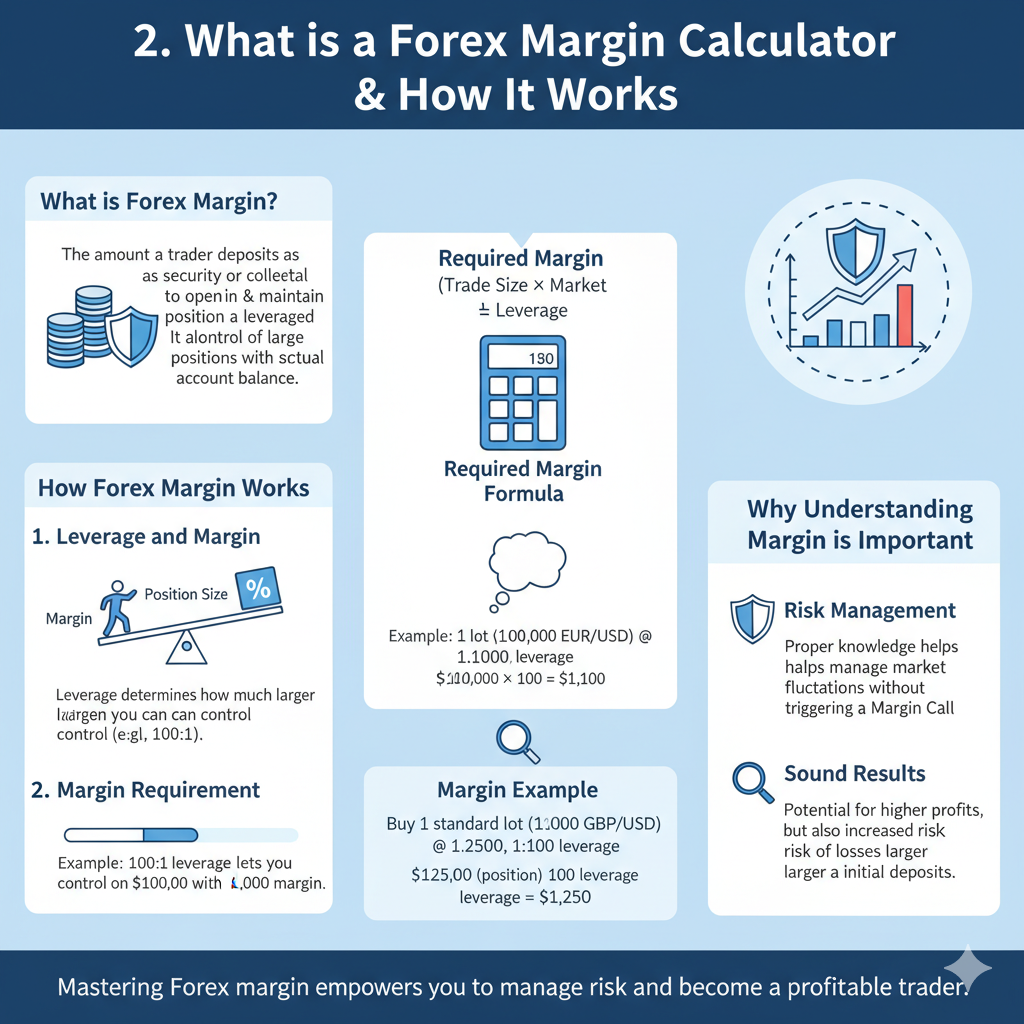
The amount that a trader deposits to their brokers to open and maintain a leverage position in the forex market is Forex margin; it’s a fixed deposit. That acts as a security deposit or collateral, on the basis of which traders are able to control large positions compared to their actual account balance.
How Forex Margin Works
- Leverage and Margin: The profits and losses in Forex trading depends on the leverage. It indicates a trader about how much larger a trading position he can control with the relative margin amount he holds, it’s expressed in a ratio such as (such as 100:1 or 50:1). For example, with 100:1 leverage, you can control $100,000 in currency value with only $1,000 in margin.
- Margin Requirement: It is a percentage of capital amount that a broker requires to make a position in Forex trading. For a 1% margin requirement, you must deposit $1,000 to own a $100,000 trade.
- Required Margin Formula:
Required Margin = Trade Size × Market Price
Leverage
- For example, if you take a trade of 1 lot (100,000 units) of EUR/USD at a market price of 1.1000 with 1:100 leverage, your margin required is:(100,000×1.1000)÷100=$1,100
- Margin Example: lets say a trader wants to buy a standard lot (100,000 units) of GBP/USD at an exchange rate of 1.2500 with leverage of 1:100. The margin required for this trade would be $125,000 (total position size) ÷ 100 (leverage) = $1,250.
Why Understanding Margin is Important
- Risk Management: With the proper knowledge of margin usage. It can ensure that you can handle the market fluctuation and volatility without triggering a Margin call.
- Sound Results: It allows traders to earn higher profits by controlling large trades with the margin available, but it also increases the risk of losses, bigger than the original amount of deposits.
Once you master how Forex margin works and how to calculate it, you can manage your risk and become a profitable trader in forex trading.
Key Margin Terms Every Trader Must Know
Used Margin — the total margin currently locked in open positions.
Free Margin — the funds available in your account to open new positions. Formula: Free Margin = Equity − Used Margin
Margin Level — the ratio of your Equity to Used Margin, expressed as a percentage. Formula: Margin Level = (Equity ÷ Used Margin) × 100. A healthy margin level is above 100%.
Margin Call — a broker notification triggered when your margin level drops below the broker’s margin call percentage (commonly 100% or 50%), warning you to deposit more funds or close positions.
Stop Out Level — the point at which the broker automatically closes your open positions to prevent further losses, typically triggered at 20%–50% margin level.
Equity — your account balance plus or minus any floating profit/loss on open trades.
Real Broker Margin Requirement Comparison Table
| Broker | Max Leverage (Retail) | Margin Call Level | Stop Out Level |
|---|---|---|---|
| Most EU Brokers (ESMA regulated) | 1:30 | 100% | 50% |
| Offshore Brokers | Up to 1:500 | 50% | 20% |
| US Brokers (NFA regulated) | 1:50 | Varies | Varies |
3. How to Use a Forex Margin Calculator — Step by Step
Forex margin requirement calculator is the process that empowers traders in determining the margin required for any position on the basis of Lot size, leverage and volatility. Here’s the step by step guide on how to use a Forex margin calculator.
Step 1: Select the Currency Pair
First you must select which Forex pair you are planning to trade (example: EUR/USD, GBP/JPY). Because the margin requirement depends on the currency pair you decide due to different market prices and lot sizes.
Step 2: Enter Your Account Currency
Select the base currency for your trading account (such as USD, EUR, or GBP). This ensures correct margin calculation and accounting for exchange rate conversions as per needed.
Step 3: Set Trade Size/Volume
Then you must select the size of your trade, which is measured in units or lots, like one standard lot is 100,000 currency units. And small traders can also use mini or micro lots.
Step 4: Specify the Leverage Ratio
Select the leverage ratio you can use offered by your broker (e.g., 1:50, 1:100, 1:500). To control your position size relative to your margin deposited. Higher leverage does reduce the required margin but increases the risk.
Step 5: Calculate and Review Results
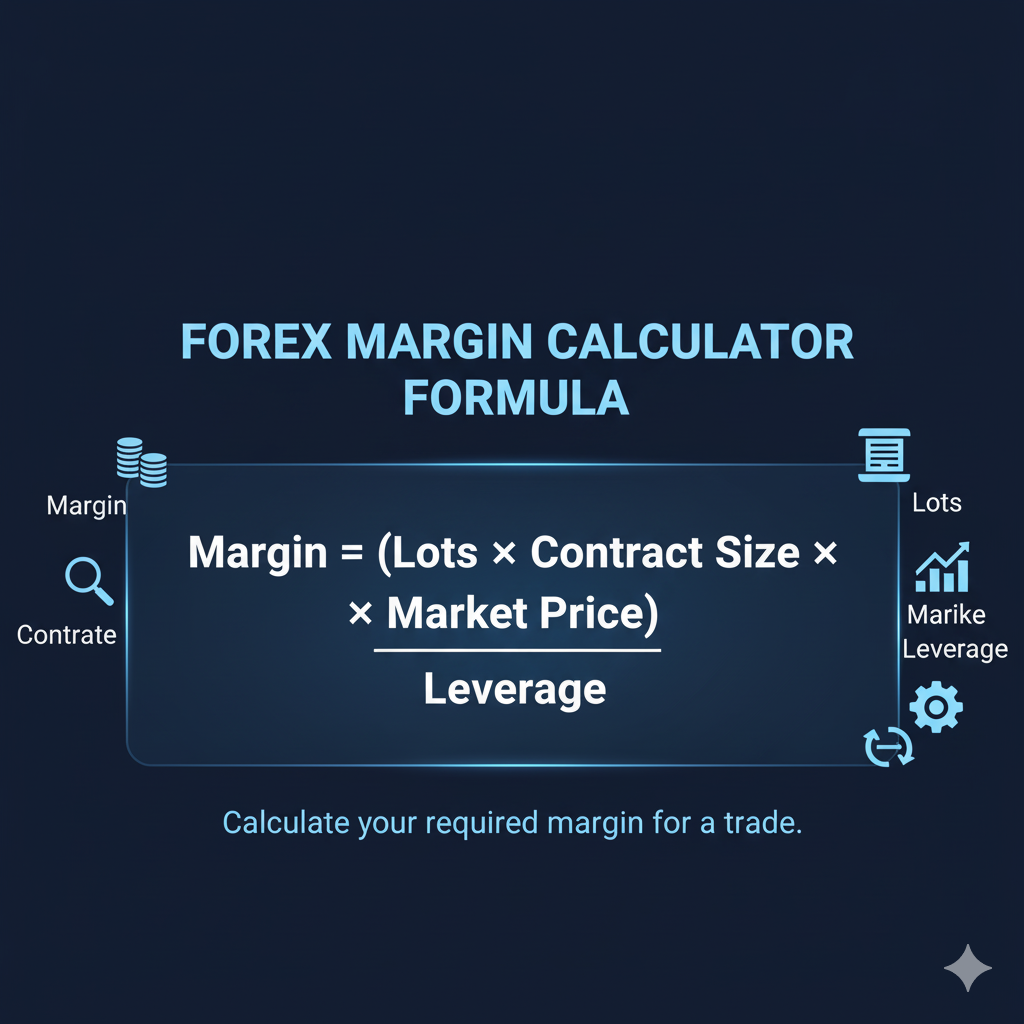
Click the “Calculate” button. The calculator will automatically multiply the trade size by the currency pair’s current price and divide it by the leverage to get the exact required margin.
Required Margin = (Lots × Contract Size × Market Price) ÷ Leverage
For example to trade 1 standard lot of EUR/USD at a price of 1.1000 with 1:50 the leverage required is:
(1×100,000×1.1000)÷50=$2,200 margin
Margin Calculator Formula Variations by Account Type
For Cross Currency Pairs (where account currency ≠ base or quote):
Required Margin = (Trade Size ÷ Leverage) × Base Currency/Account Currency Exchange Rate
Example: Trading 1 lot of GBP/JPY with a USD account at 1:100 leverage with GBP/USD at 1.2700:
(100,000 ÷ 100) × 1.2700 = $1,270 required margin
For CFD Margin :
Some brokers calculate CFD margin differently — using a margin rate percentage instead of leverage ratio. Example: 3.33% margin rate on EUR/USD = roughly 1:30 leverage.
Step 6: Adjust Parameters for Scenarios
Many calculators allow you to adjust parameters– change pair, lot size, or leverages as per different scenarios which helps you to make strategy setups and manage risk properly in a volatile market.
Step 7: Apply Insights
Use this to stay alert about your account if it has sufficient margin. Many calculators display free margin left, warning you about the risk levels of your positions (margin calls, stop outs).
By following these steps, you can ensure that every trade is precisely planned and the risk is well managed.
Margin Level vs Margin Call vs Stop Out — What’s the Difference?
| Term | Trigger Level (Typical) | What Happens |
|---|---|---|
| Margin Call | 100% Margin Level | Broker warns you to add funds |
| Stop Out | 20%–50% Margin Level | Broker auto-closes positions |
| Free Margin = 0 | Equity = Used Margin | You cannot open new trades |
4. Importance of Using a Forex Margin Calculator
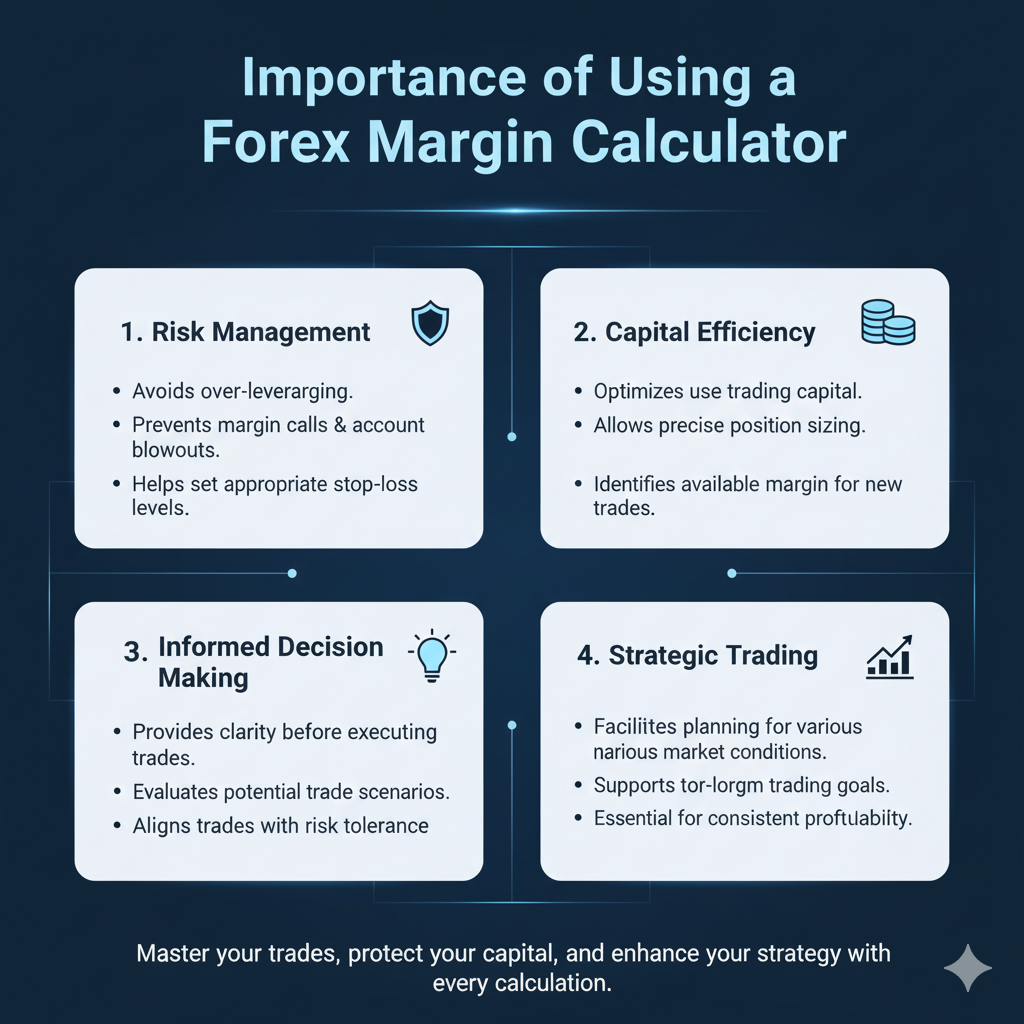
A Forex Margin Calculator is a necessity for traders because it helps simplify trading, manage risk, and ensure correct financial decisions. Here’s a list of its importance:
1. Accurate Margin Calculation
You get how much margin is needed instantly by using a forex margin calculator for a trade based on its lot size, leverage, account currency, and pair price with no doubts of manual errors. Traders can now get exact requirements of the trade before placing positions, ensuring transparency and a perfect execution.
By knowing the amount of margin required in a trade, a trader can prevent over-leveraging and avoid margin calls. This helps them in planning their margin strategy properly and making a safe position in the market with their stops and target set before any trade is executed.
3. Time and Efficiency
With quick results from the calculator, it saves time spent on manual math. And it allows a trader to evaluate multiple strategies/setups on different scenarios in the situation of a highly volatile market, ensuring timely decisions and profitable trades.
4. Informed and Confident Trading
It keeps the trader informed and confident about his trading with correct information related to margin usage and exposure so that traders can make better trading decisions. It keeps a control over leverage and disciplined, confident trading—especially for beginners and professionals alike.
Forex Margin Calculator is that important tool that gives you accuracy, efficiency, and safety. It empowers you to make profitable trades by managing leverage and trading smartly.
Helps Avoid Stop Out & Margin Calls
One of the most practical uses of a forex margin calculator is preventing involuntary position liquidation. By knowing your required margin in advance, you can maintain a safe free margin buffer — most professional traders recommend keeping at least 3x the required margin as free margin to absorb market volatility without hitting stop out levels.
Forex Margin Calculator for Different Account Types
Forex margin requirements differ depending on your lot size and account type. Here’s how the required margin varies:
- Standard Lot (100,000 units): Used by professional and experienced traders. At 1:100 leverage, a single standard lot of EUR/USD at 1.1000 requires $1,100 in margin — making account size and risk management critical.
- Mini Lot (10,000 units): Suitable for intermediate traders, requiring only $110 in margin under the same conditions — offering more flexibility with lower capital exposure.
- Micro Lot (1,000 units): Ideal for forex beginners and those testing new strategies. Required margin drops to just $11, allowing traders to practice risk management with minimal capital at risk.
- Weekend Margin Requirements: Many brokers increase overnight margin and impose stricter leverage restrictions from Friday close to Sunday open. Margin requirements can be 2–3x higher over weekends due to lower liquidity and the risk of weekend gaps. Always check your broker’s weekend margin policy before holding positions over Friday.
Frequently Asked Questions (FAQ)
Q1: What happens when you don’t have enough margin to trade?
A: If your account doesn’t have sufficient required margin, your broker will either prevent you from opening new positions or issue a margin call — warning you to deposit more funds. If you fail to act, the broker may trigger a stop out and automatically close your open positions to prevent further losses.
Q2: Is margin the same as the cost of a trade?
A: No, they are different concepts. Margin is simply a security deposit held by your broker to open and maintain a leveraged position — it is not a fee. The actual cost of a trade includes the spread, commission, and any overnight swap/rollover fees, which can be significantly larger than the margin itself, especially when using high leverage.
Q3: Can the required margin change after a trade is opened?
A: In most cases, the required margin stays fixed based on your open trade size and leverage ratio. However, brokers may adjust margin requirements during periods of high market volatility, major economic events, or over weekends when liquidity is lower — this is known as an increased margin requirement or weekend margin.
Q4: Is it possible to trade forex without using a margin calculator?
A: Yes, but it is not recommended. Trading without calculating your required margin in advance exposes you to the risk of an unexpected margin call, stop out, or even account liquidation. A forex margin calculator takes only seconds to use and can prevent costly mistakes, especially for newer traders.
Q5: Is the margin formula the same across all brokers?
A: The core margin calculation formula — Trade Size ÷ Leverage × Exchange Rate — is standard across the industry. However, individual brokers may differ in their lot size definitions, margin call levels, stop out percentages, and how they handle cross currency pair conversions when your account currency differs from the base currency of the pair you’re trading. Always check your broker’s specific margin requirements before placing a trade.
Conclusion
A forex margin calculator is one of the most essential tools in a trader’s arsenal. It removes guesswork from one of the most critical aspects of trading — knowing exactly how much required margin you need before entering a position. By understanding free margin, margin level, stop out levels, and how leverage ratios affect your exposure, you trade with clarity instead of uncertainty.
Remember, while the calculator provides mathematical precision, it does not eliminate market risk. Always consider your account equity, market volatility, and overall risk management strategy before committing to any position. Use a forex margin calculator consistently — it is the simplest habit that separates disciplined traders from those who blow their accounts. Because at Insightful Trade, we believe every trade you place should be backed by data, not guesswork — and the right tools make all the difference.
Author: Arihant Jain
Trading Experience: 5+ Years
Arihant Jain is a financial markets analyst and trading educator with expertise in Forex, Indices, Crypto, and risk-managed trading systems. His insights are based on real trading experience, data-driven analysis, and transparent market understanding. All content is reviewed for accuracy and aligns with Google’s EEAT guidelines.
Risk Disclaimer:
Trading involves substantial risk. All information is for educational purposes only and should not be taken as financial advice. Always do your own research.
Last Updated: 23 February 2026