Introduction
Every time you buy or sell a currency futures or options contract on NSE or BSE, your broker sends you a contract note, usually by email, by the end of the day. Most traders glance at it and move on. That is a mistake. The contract note is the legal record of your trade, and it is the only document that shows every rupee your broker and the government charged you.
This guide gives you a contract note explained line by line for currency trades. It covers what the document is, the rules behind it, each section of a typical layout, how currency-specific fields like the USD/INR lot size and four-decimal prices appear, a worked example with actual charge calculations, how to cross-check your trades and what to do if something does not match.
Contract Note Explained: What It Is
A contract note is a confirmation that your broker issues for trades executed on a stock exchange on your behalf. It records what you traded, when, at what price and what charges were applied. It is a legally enforceable document that can be used to settle disputes with your broker or the exchange.
Today almost every broker sends an electronic contract note (ECN), a PDF that carries the broker’s digital signature. You agree to receive ECNs when you open your account. If you have not opted for electronic delivery, the broker must send a physical copy.
With the contract note explained in simple terms: it is your receipt for the trade, and like any receipt, it is worth checking.
Rules Behind the Contract Note
Before looking at the layout, it helps to have the rules behind the document explained, because they tell you what you are entitled to receive.
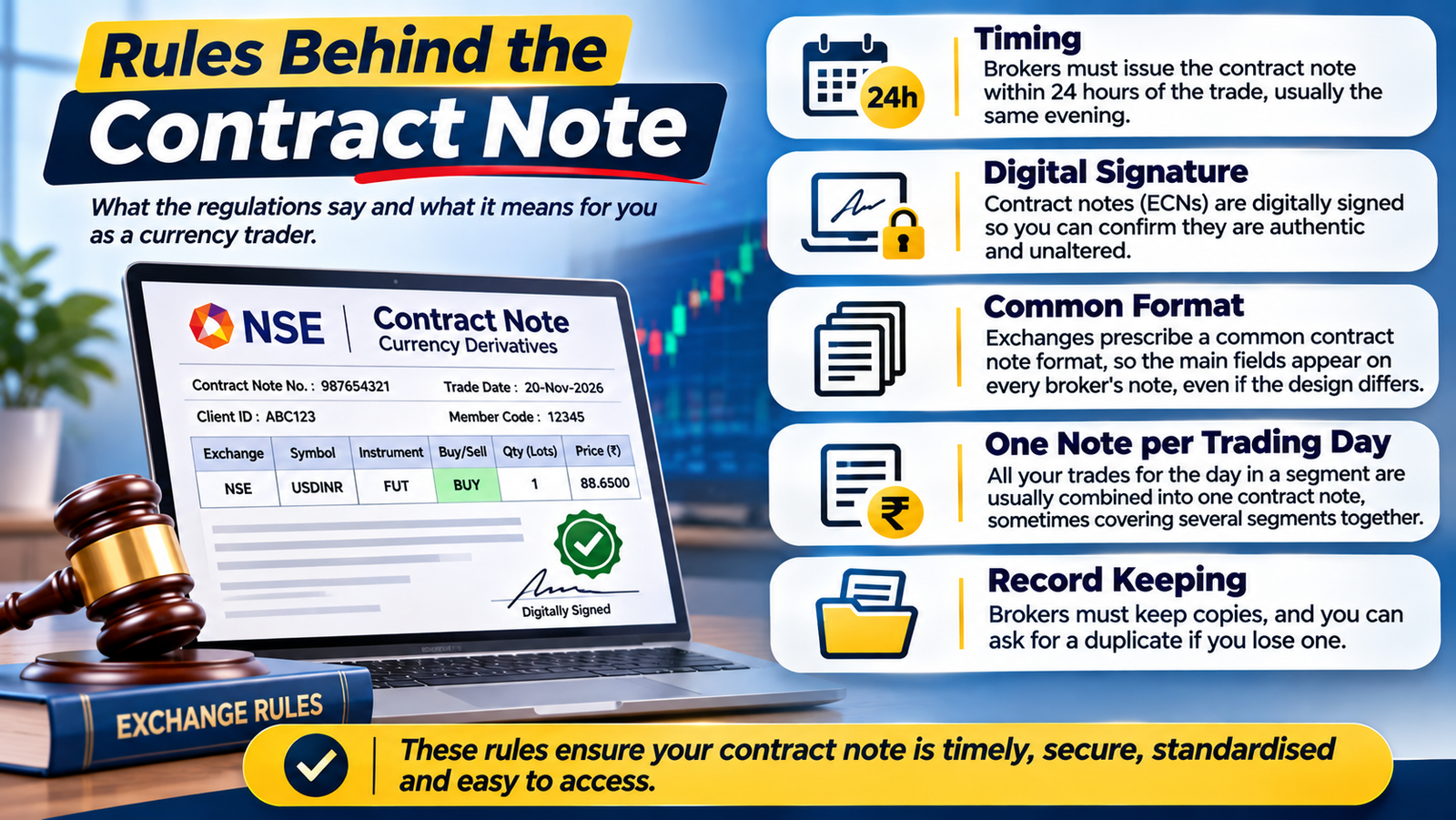
- Timing: brokers must issue the contract note within 24 hours of the trade, which in practice usually means the same evening.
- Digital signature: ECNs must be digitally signed so you can confirm they are authentic and unaltered.
- Common format: exchanges prescribe a common contract note format, so the main fields appear on every broker’s note, even if the design differs.
- One note per trading day: all your trades for the day in a segment are usually combined into one contract note, sometimes covering several segments together.
- Record keeping: brokers must keep copies, and you can ask for a duplicate if you lose one.
Contract Note Explained: The Main Sections
With the contract note explained by section, the document becomes much easier to scan. Most contract notes for currency derivatives have four parts. Here is each part of the contract note explained in turn.
1. Header: broker and client details
- Broker name, address, SEBI registration number and exchange membership codes
- Compliance officer and investor grievance contact details
- Contract note number, a unique serial number for the note
- Trade date and settlement date
- Your name, address, PAN and unique client code (UCC)
Check your PAN and UCC first. If either is wrong, the trades are recorded against the wrong client, which needs fixing immediately.
2. Trade details
This is the core of the note: one row for each trade executed on the exchange.
| Field | What it means |
|---|---|
| Order number | The exchange’s ID for your order. One order can be filled through several trades. |
| Order time | When the order was placed or reached the exchange |
| Trade number | The exchange’s ID for each individual fill |
| Trade time | When that fill was executed |
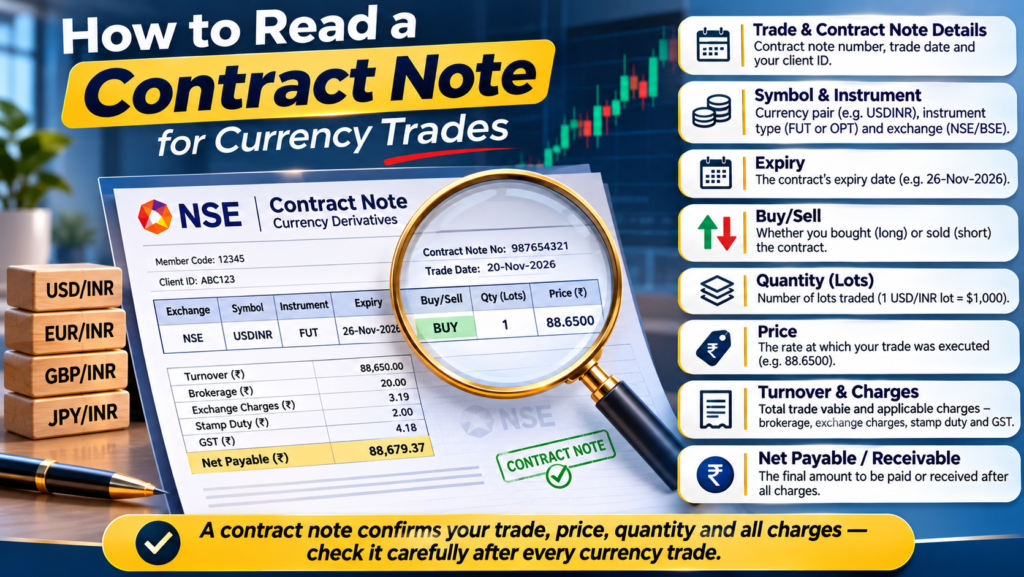
| Security or contract description | The instrument, for example a USD/INR futures contract for a given expiry, or an option with strike, type (CE or PE) and expiry |
| Buy (B) or sell (S) | Direction of the trade |
| Quantity | Number of lots, or units, depending on the broker’s format |
| Gross rate or trade price | The price at which the trade executed |
| Brokerage per unit | Brokerage, sometimes shown per unit, sometimes as a total |
| Net rate | Trade price adjusted for brokerage |
| Closing rate | The day’s settlement price for futures, used for mark-to-market |
| Net total | Value of the trade before statutory charges |
3. Charges and obligation summary
Below the trades is a summary that turns trade values into the amount payable or receivable. This is the section most worth having explained, because it shows exactly where your money goes.
- Pay-in or pay-out obligation: the net amount from trades, including mark-to-market on futures and premium on options
- Brokerage
- Exchange transaction charges
- SEBI turnover fee
- Stamp duty
- Clearing or IPFT charges, where shown separately
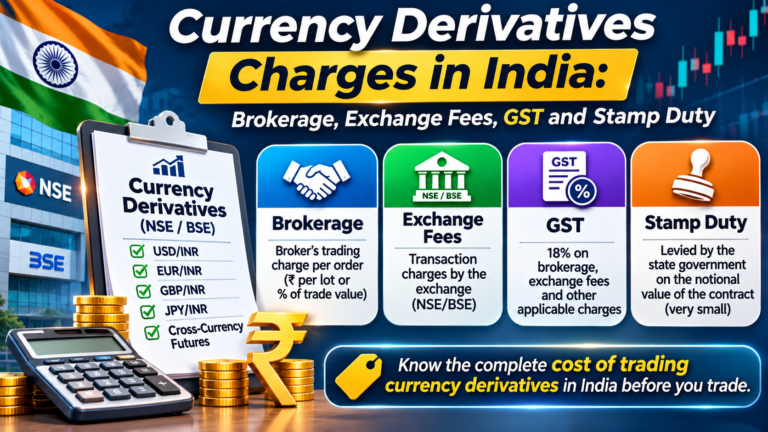
- GST at 18% on brokerage, exchange charges and SEBI fees (shown as IGST, or as CGST plus SGST)
- Net amount receivable or payable by client
There is no Securities Transaction Tax (STT) on currency derivatives, so you should not see STT on a currency-only contract note. If you do, query it.
4. Footer and annexures
- Digital signature block
- Terms, dispute resolution and arbitration details
- Sometimes a separate annexure with a breakdown per exchange or segment
Currency-Specific Fields to Understand
With the contract note explained for equities, many traders still get confused by currency entries. Here is what is different.
| Item | How it appears for currency contracts |
|---|---|
| Lot size | One USD/INR lot is $1,000. Some brokers show quantity in lots, others in units (10 lots = 10,000). |
| Price | Quoted in rupees to four decimal places, such as 88.6200 |
| Tick size | ₹0.0025 (0.25 paise) for USD/INR |
| Value per paise | ₹10 per lot for each one-paise move |
| Contract description | Includes underlying (USDINR, EURINR, GBPINR, JPYINR or cross pairs), FUT or OPT, expiry, and for options the strike and CE/PE |
| Settlement | Cash-settled in rupees against the FBIL reference rate at expiry |
| Closing rate | Daily settlement price used to mark open futures to market |
JPY/INR is quoted per 100 yen, and cross-currency pairs such as EUR/USD are quoted in dollars, so check the multiplier your broker uses for those contracts.
Worked Example: An Intraday USD/INR Futures Trade
This example is illustrative. Charges use published rates for one discount broker at the time of writing and may differ for your broker.
Here is a futures contract note explained with real numbers. A trader buys 10 lots of USD/INR near-month futures at 88.6200 and sells all 10 lots later the same day at 88.7000.
| Item | Calculation | Amount (₹) |
|---|---|---|
| Buy value | 10 × 1,000 × 88.62 | 8,86,200.00 |
| Sell value | 10 × 1,000 × 88.70 | 8,87,000.00 |
| Gross profit | 8 paise × ₹10 × 10 lots | 800.00 |
| Brokerage | ₹20 per executed order (0.03% would be higher) × 2 | 40.00 |
| NSE transaction charges | 0.00035% of ₹17,73,200 turnover | 6.21 |
| SEBI turnover fee | ₹10 per crore of turnover | 1.77 |
| Stamp duty | 0.0001% on buy value | 0.89 |
| IPFT charges | ₹0.05 per lakh of turnover | 0.89 |
| GST | 18% of brokerage, transaction, SEBI and IPFT charges | 8.80 |
| Total charges | 58.55 | |
| Net profit | 800.00 − 58.55 | 741.45 |
On the contract note, you would see two trade rows (one buy, one sell), the closing rate for the day, the gross obligation of ₹800 receivable, then each charge line and a final net receivable of about ₹741. Seeing the contract note explained in numbers like this shows that brokerage is the largest cost on small intraday trades.
Worked Example: Buying a USD/INR Call Option
This example is illustrative and uses a hypothetical premium.
Here is the same idea with an options contract note explained. A trader buys 10 lots of an 88.75 USD/INR call at a premium of ₹0.3000.
- Premium payable: 10 × 1,000 × 0.30 = ₹3,000
- Brokerage: ₹20 per order
- NSE transaction charges: 0.0311% of premium = about ₹0.93
- SEBI fee, stamp duty and IPFT: a few paise in total
- GST: about ₹3.78
- Total charges: about ₹24.78, so the net payable is about ₹3,024.78
For options, charges are calculated on the premium, not the notional value, so the trade row shows the premium as the price, along with the strike and CE or PE in the contract description.
How to Verify Your Contract Note
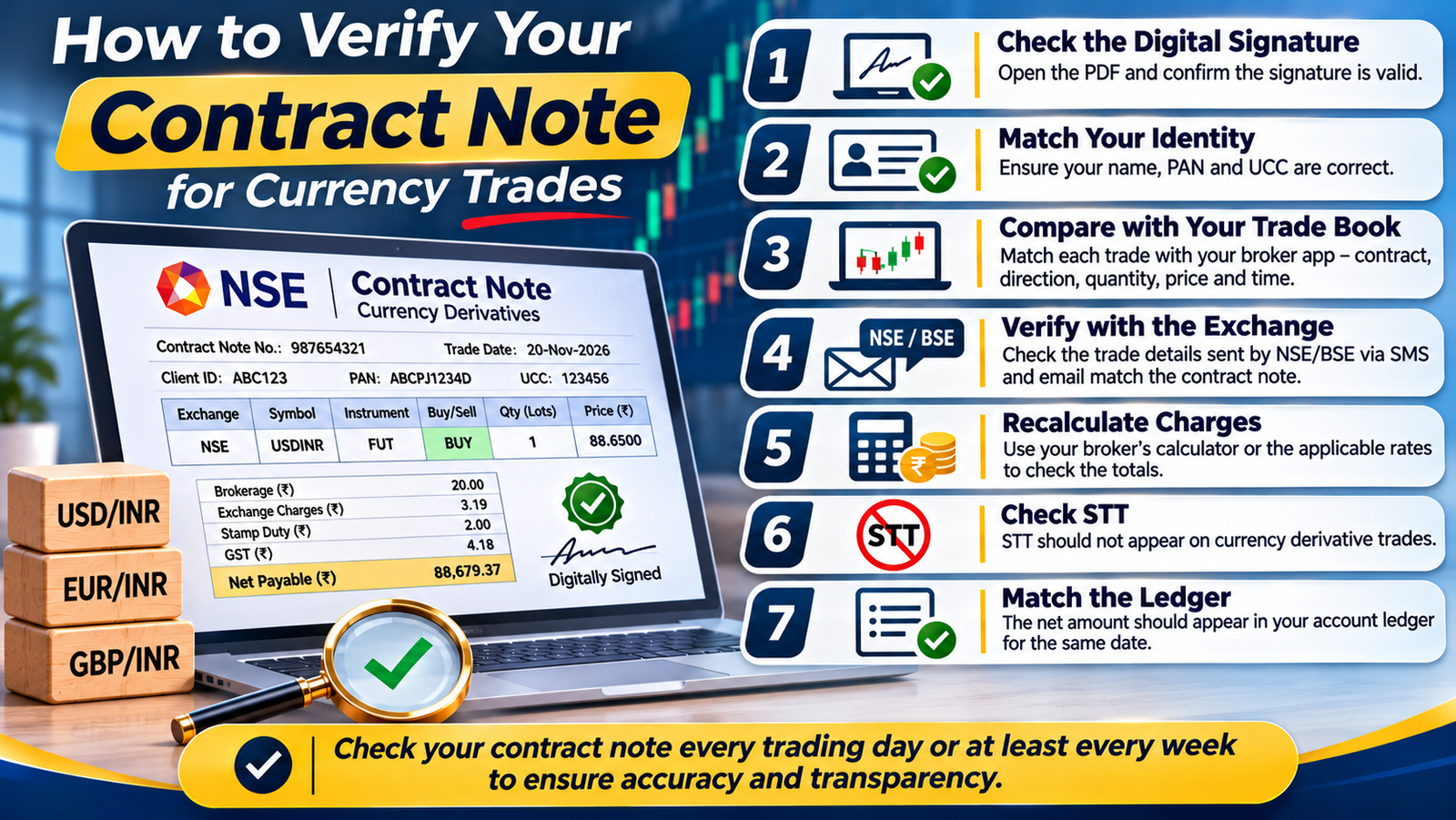
- Check the digital signature: open the PDF and confirm the signature is valid.
- Match your identity: name, PAN and UCC must be yours.
- Compare with your trade book: each trade on the note should match your broker app’s executed orders by contract, direction, quantity, price and time.
- Verify with the exchange: NSE and BSE send you trade details by SMS and email directly. Check that these match the contract note.
- Recalculate charges: use your broker’s brokerage calculator or the rates in this guide to check the totals.
- Check STT: it should not appear on currency derivative trades.
- Match the ledger: the net amount should appear in your account ledger for the same date.
Having the contract note explained once is useful, but the real value comes from checking it every trading day, or at least every week.
What to Do If Something Looks Wrong
- Contact your broker immediately: raise the issue through the support desk or the grievance email shown on the contract note.
- Keep evidence: screenshots of orders, exchange SMS or email alerts and the contract note itself.
- Escalate if unresolved: you can complain to the exchange’s investor services cell or through SEBI’s SCORES platform.
- Use online dispute resolution: SEBI’s Smart ODR portal handles disputes between investors and market intermediaries.
Common errors include trades you did not place, wrong quantities, missing trades and charges above your broker’s published rate card.
Contract Note Explained for Tax and Records
Contract notes are key evidence for your tax return. Profits and losses on exchange-traded currency derivatives are generally treated as non-speculative business income in India, and the charges shown on your contract notes are typically claimed as business expenses. The Income-tax Act, 2025 applies from 1 April 2026, so section numbers in older guides may differ.
- Download and store all contract notes for each financial year.
- Use them with your broker’s tax P&L statement and ledger to compute turnover and profit.
- Keep them for several years in case of tax queries or audits.
- Discuss turnover calculation and tax audit thresholds with a chartered accountant.
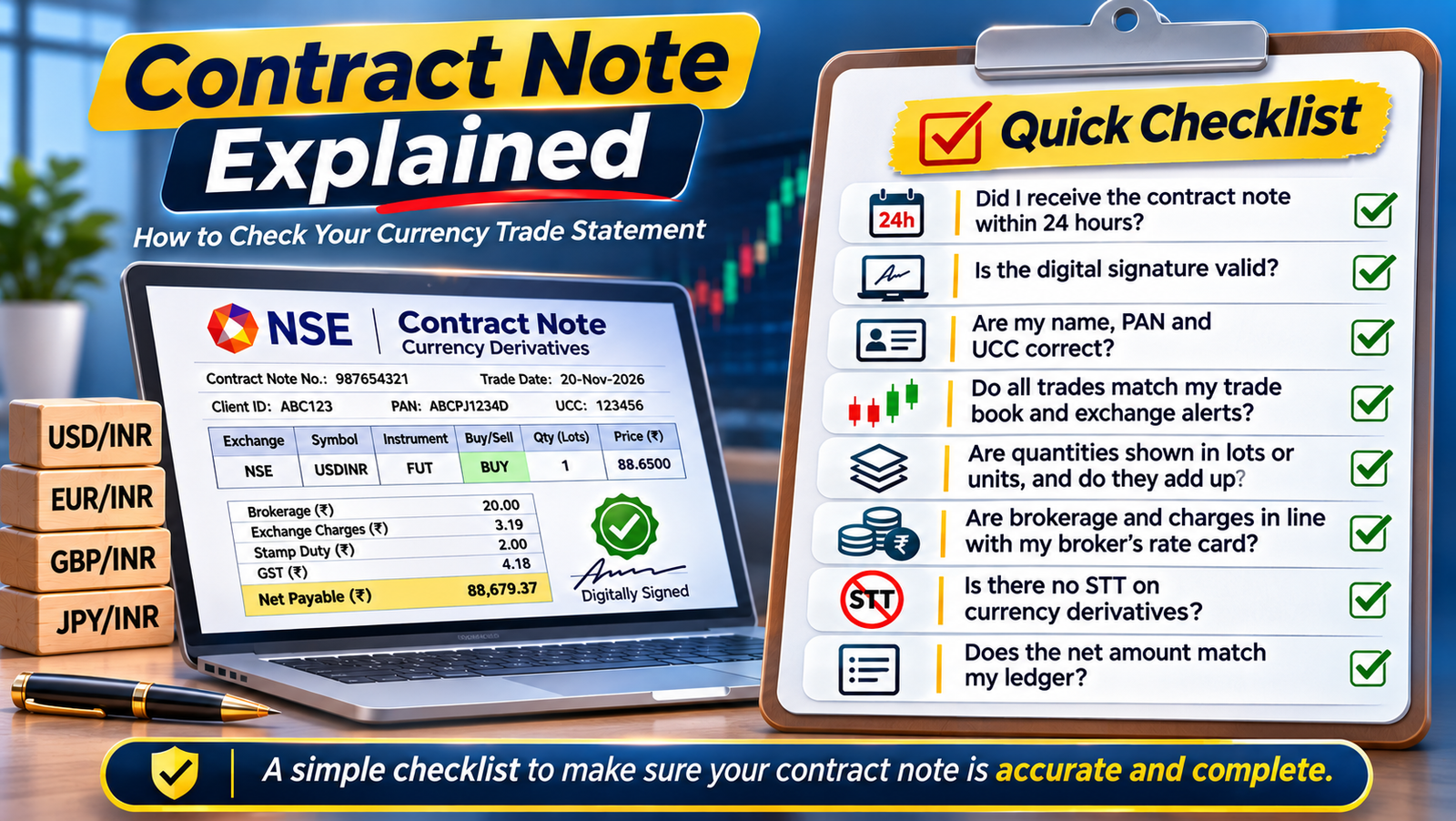
Contract Note Explained: Quick Checklist
- Did I receive the contract note within 24 hours?
- Is the digital signature valid?
- Are my name, PAN and UCC correct?
- Do all trades match my trade book and exchange alerts?
- Are quantities shown in lots or units, and do they add up?
- Are brokerage and charges in line with my broker’s rate card?
- Is there no STT on currency derivatives?
- Does the net amount match my ledger?
Common Mistakes
Even with the contract note explained, traders often slip up in these ways:
- Ignoring contract notes: errors are easier to fix within a day or two.
- Confusing lots and units: 10 lots of USD/INR is 10,000 units, not 10.
- Reading gross profit as net profit: charges reduce returns, especially for frequent intraday trades.
- Not checking exchange alerts: the exchange’s own SMS and email are an independent check.
- Deleting old notes: you will need them for tax filing and any disputes.
- Overlooking unknown trades: report any trade you did not place immediately.
FAQs
What does contract note explained mean for a beginner?
It means understanding each part of the trade confirmation your broker sends: your details, each trade, the charges and the net amount payable or receivable.
When will I receive my contract note?
Brokers must issue it within 24 hours of the trade, usually on the same evening by email.
Is an electronic contract note valid?
Yes. A digitally signed ECN is a valid legal record of your trades.
Why is there no STT on my currency trades?
STT does not apply to currency derivatives, unlike equity futures and options.
Why do charges look different for options?
Exchange charges and other fees for options are calculated on the premium, while futures charges are calculated on the contract value.
What if I find a trade I did not place?
Contact your broker immediately, keep evidence and escalate to the exchange or SEBI SCORES if it is not resolved.
Is there a sample contract note explained by my broker?
Many brokers publish a sample contract note with each field labelled in their support section. Compare it with your own note to see where each item appears.
Can I get an old contract note again?
Yes. Most brokers let you download past contract notes from their back-office portal, or you can request a copy.
Conclusion
A contract note is more than a routine email. It is your legal proof of each trade and a full record of what you paid. With the contract note explained section by section, you can check your identity details, match every trade, recalculate charges and spot errors early. For currency traders, remember the $1,000 lot size, four-decimal prices, the absence of STT and the fact that option charges are based on premium.
Make checking your contract note a daily habit, store every note for tax purposes and raise any discrepancy quickly. A few minutes of checking can save money and stress later.