Introduction
On days when foreign investors sell Indian stocks heavily, the rupee often weakens. When they return with large purchases, the rupee often firms up. This is no coincidence. Foreign investment flows are among the most powerful short- and medium-term drivers of USD/INR.
The link between FPI flows rupee moves and the broader balance of payments is something every rupee trader needs to understand. Foreign portfolio investment (FPI) can move quickly in and out of Indian markets, while foreign direct investment (FDI) is usually slower and more stable. Both affect the supply and demand for dollars in India.
This guide explains what FPI and FDI are, how each affects the rupee, what drives foreign investors, how bond index inclusion changed debt flows, how the RBI responds, and how traders can track and use flow data.
FPI vs FDI: What Is the Difference?
| Feature | Foreign portfolio investment (FPI) | Foreign direct investment (FDI) |
|---|---|---|
| What it is | Investment in listed shares, bonds and other securities | Investment to own or control a business, build factories or take a significant stake |
| Typical threshold | Below 10% of a listed company’s equity | 10% or more of a company’s equity, or new business investment |
| Investors | Mutual funds, pension funds, hedge funds, sovereign funds | Multinational companies, private equity, strategic investors |
| Time horizon | Can be short-term | Usually long-term |
| Volatility | High; can reverse quickly (“hot money”) | Lower; more stable |
| Regulator | SEBI registers FPIs; RBI sets foreign exchange rules | Government FDI policy and RBI foreign exchange rules |
How Foreign Flows Move the Rupee
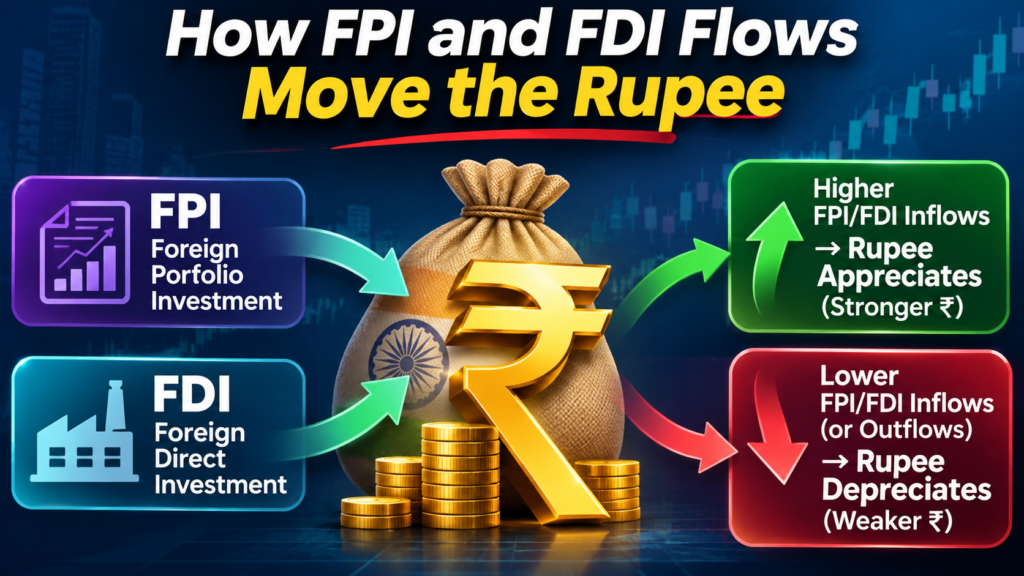
The basic mechanism behind FPI flows rupee movements is simple supply and demand for dollars.
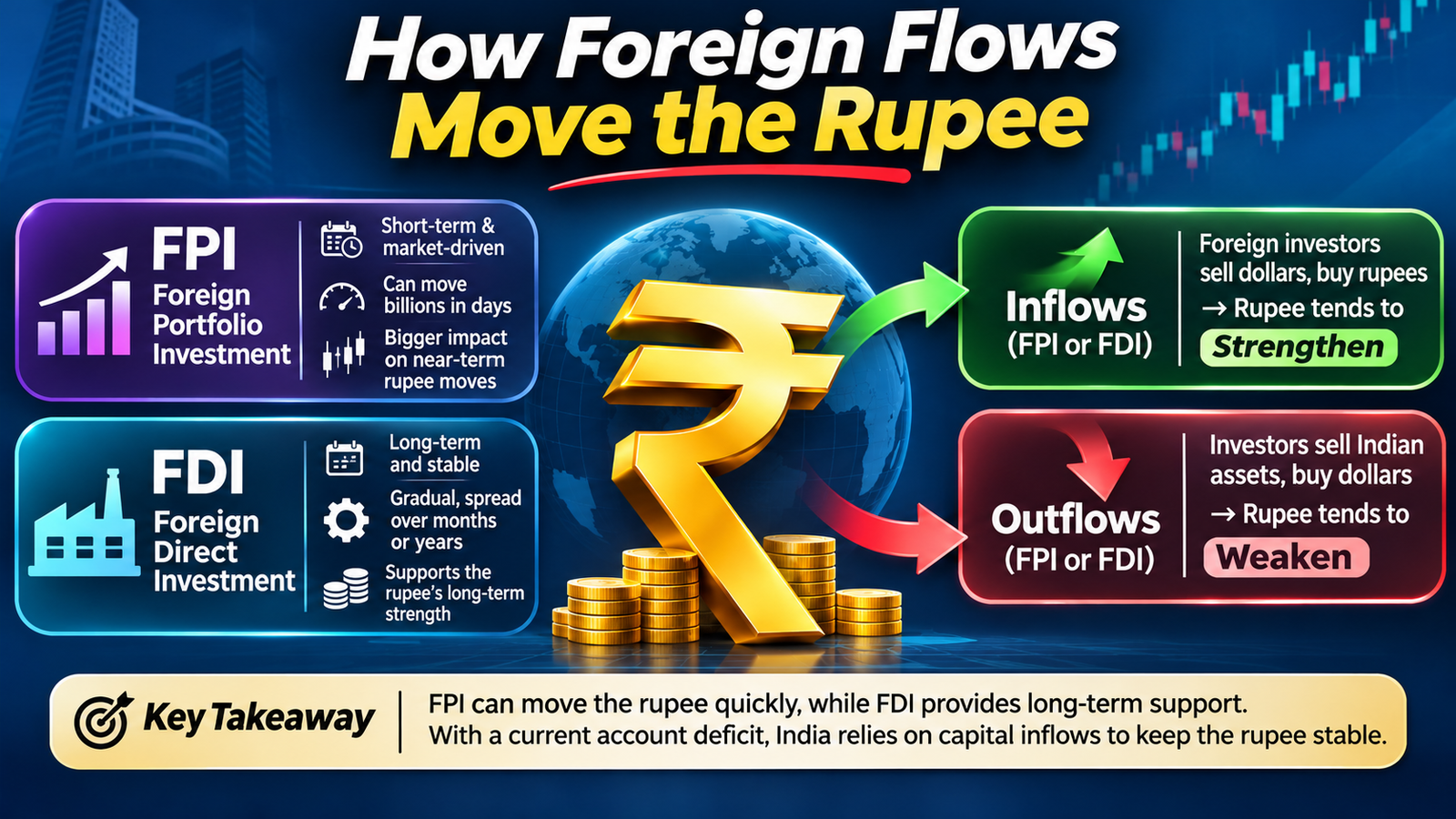
- Inflows: when a foreign investor buys Indian shares or bonds, they sell dollars and buy rupees. This increases dollar supply and tends to strengthen the rupee.
- Outflows: when they sell Indian assets and take money home, they sell rupees and buy dollars. This increases dollar demand and tends to weaken the rupee.
Because India usually runs a current account deficit, it relies on capital inflows to finance the gap. When FPI money stops flowing in or reverses, the pressure on the rupee can build quickly.
Why FPI matters more for short-term moves
FDI is usually large but steady, and it is spread over months or years. FPI can move billions of dollars in days. That is why the FPI flows rupee connection is closely watched by currency traders, while FDI matters more for the long-term trend.
What Drives FPI Flows?
- Global interest rates: higher US yields make dollar assets more attractive, often pulling money out of emerging markets like India.
- US dollar strength: a strong dollar often coincides with emerging market outflows.
- Risk sentiment: in risk-off periods, investors cut exposure to emerging markets.
- Valuations: high Indian equity valuations relative to other markets can prompt profit-taking.
- Earnings and growth outlook: strong corporate earnings and GDP growth attract inflows.
- Interest rate differentials: the gap between Indian and US bond yields matters for debt investors.
- Index changes: inclusion in global equity or bond indices can trigger large passive flows.
- Tax and policy changes: changes in capital gains tax or rules for foreign investors can shift flows.
FPI Equity vs FPI Debt
- Equity FPI: driven by growth, earnings, valuations and global risk appetite. Large sell-offs in Indian equities by foreign investors often coincide with rupee weakness.
- Debt FPI: driven by interest rate differentials, currency expectations and index inclusion. Debt investors are particularly sensitive to expected rupee depreciation, because it reduces their returns in dollar terms.
Bond index inclusion
A major change for India’s debt flows came when JP Morgan began including certain Indian government bonds, known as Fully Accessible Route (FAR) bonds, in its GBI-EM Global Index Suite from June 2024, phasing them in over several months. Bloomberg also began including Indian FAR bonds in its emerging market index from January 2025. These inclusions brought steady passive inflows into Indian government bonds, adding a new source of support in the FPI flows rupee picture.
How FDI Affects the Rupee
- Gross FDI inflows: new investment by foreign companies brings dollars into India and supports the rupee over time.
- Repatriation and disinvestment: when foreign companies or private equity investors sell stakes and take money home, it creates dollar demand.
- Net FDI: gross inflows minus repatriation and Indian companies’ investment abroad. Net FDI has at times been weighed down by large repatriations and outward investment, even when gross inflows were strong.
Because FDI flows are less volatile, they act as a stabilizing base for the rupee, while FPI provides much of the short-term volatility.
How the RBI Responds
The RBI manages excessive volatility in the rupee, and foreign flows are a major source of that volatility.
- During heavy inflows: the RBI often buys dollars to prevent sharp rupee appreciation, adding to foreign exchange reserves.
- During heavy outflows: it sells dollars from reserves to slow rupee depreciation.
- Policy measures: in stress periods, the RBI and government have used measures such as special deposit schemes and easier rules for foreign borrowing to attract inflows.
The IMF classifies India’s de facto exchange rate arrangement as a “crawl-like arrangement”, reflecting this active management. As a result, the FPI flows rupee impact is often smaller than it would be in a freely floating currency.
Worked Example: A Week of Heavy FPI Selling
This example is illustrative and uses hypothetical figures.
- US 10-year yields jump, and the dollar index rises.
- Foreign investors sell a net $3 billion of Indian equities and $1 billion of Indian bonds over five trading days.
- USD/INR rises from 88.20 to 88.75, a 55-paise move, despite reports that the RBI sold dollars to limit volatility.
A trader holding 5 long lots of USD/INR futures would gain 55 × ₹10 × 5 = ₹2,750, while a trader short the same position would lose the same amount. This illustrates why tracking FPI flows rupee data matters for position management.
FPI Flows Rupee Episodes from Recent History
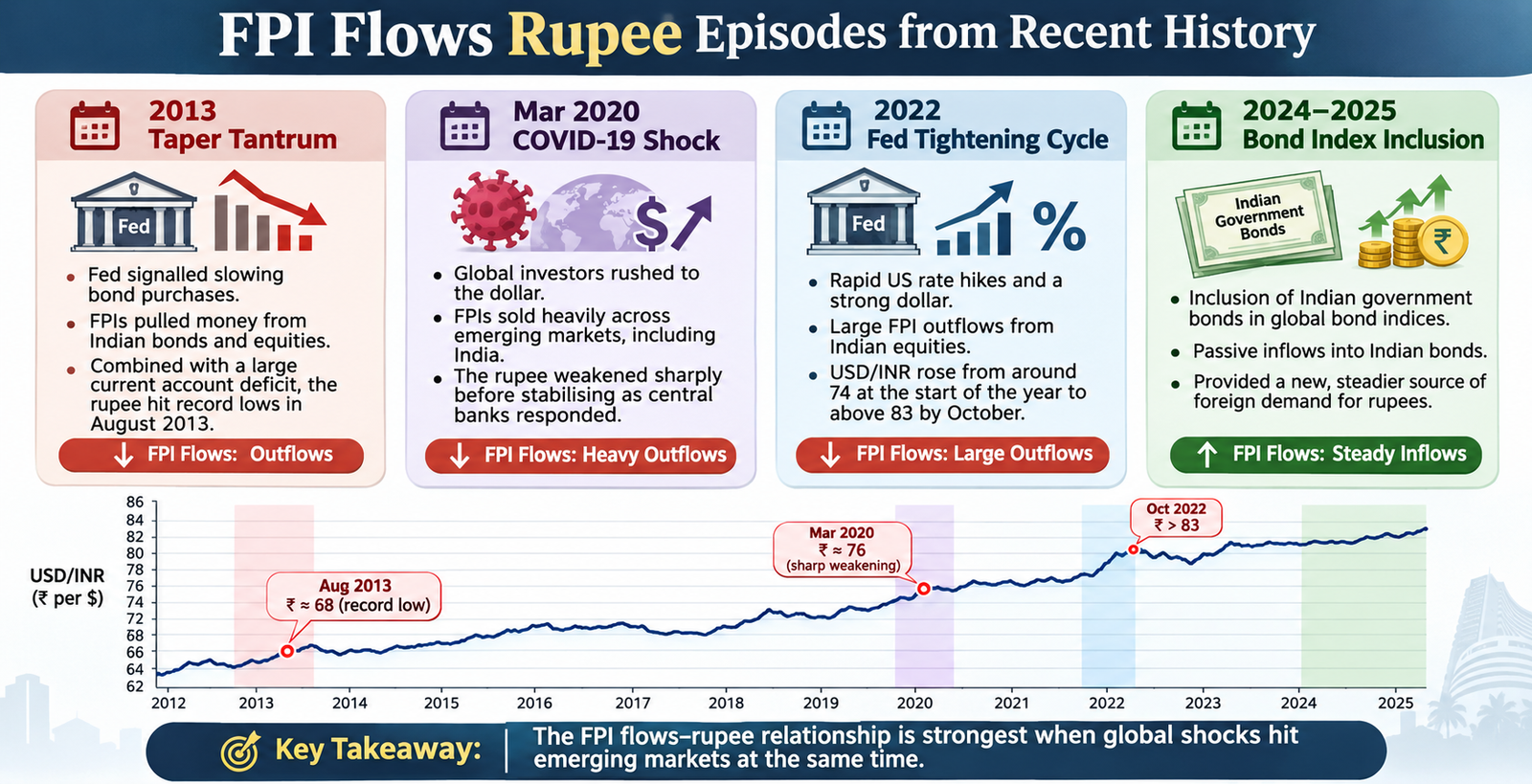
- 2013 taper tantrum: after the US Federal Reserve hinted at slowing its bond purchases, foreign investors pulled money from Indian bonds and equities. Combined with a large current account deficit, this pushed the rupee to record lows in August 2013.
- March 2020 COVID-19 shock: global investors rushed to the dollar, and FPIs sold heavily across emerging markets, including India. The rupee weakened sharply before stabilizing as central banks responded.
- 2022 Fed tightening cycle: rapid US rate hikes and a strong dollar led to large FPI outflows from Indian equities. USD/INR rose from around 74 at the start of the year to above 83 by October.
- 2024–2025 bond index inclusion: passive inflows into Indian government bonds provided a new, steadier source of foreign demand for rupees.
These episodes show that the FPI flows rupee relationship is strongest when global shocks hit emerging markets at the same time.
FPI Flows Rupee Impact Compared with Other Drivers
| Driver | Speed of impact | Typical effect on rupee |
|---|---|---|
| FPI equity and debt flows | Fast (days to weeks) | Inflows support the rupee; outflows weaken it |
| FDI flows | Slow (months to years) | Steady support when net inflows are strong |
| Crude oil prices | Medium | Higher oil widens the deficit and weakens the rupee |
| US interest rates and dollar index | Fast | Higher US yields and a stronger dollar usually weaken the rupee |
| RBI intervention | Immediate | Smooths moves in either direction |
In practice, these drivers often act together. A rise in US yields can trigger FPI selling, lift the dollar and coincide with higher oil prices, all adding to rupee pressure at the same time.
How Foreign Investors Hedge Currency Risk
Not every FPI rupee purchase is left unhedged. Some foreign investors hedge their rupee exposure using forwards or non-deliverable forwards (NDFs) traded offshore. Hedging can soften the immediate effect of FPI flows rupee demand, because the investor buys rupees spot but sells them forward. When hedging costs rise, often because the interest rate gap widens, some investors may choose to stay unhedged or reduce exposure, which can change how flows affect the currency.
How to Track Foreign Flows
| Data | Source | Frequency |
|---|---|---|
| FPI equity and debt flows | NSDL FPI monitor | Daily |
| Provisional FII/FPI cash market activity | Stock exchanges | Daily, after market close |
| FDI inflows | Government and RBI publications | Monthly or quarterly |
| Balance of payments | RBI | Quarterly |
| Foreign exchange reserves | RBI | Weekly |
Traders often compare daily FPI data with USD/INR moves to see whether flows are driving the currency or whether other factors, such as oil prices or RBI intervention, dominate.
Using FPI Flows Rupee Analysis in Trading
- Check daily flow data: sustained net selling over several days often coincides with rupee weakness.
- Watch global drivers: US yields, the dollar index and risk sentiment often signal FPI moves before they appear in Indian data.
- Track index events: MSCI, FTSE and bond index rebalancing dates can bring large one-day flows.
- Consider RBI behaviour: large reserves give the RBI room to smooth moves, so outflows may not translate fully into rupee weakness.
- Combine with fundamentals: FPI flows rupee signals work best alongside the current account, oil prices and interest rate differentials.
- Manage risk: flow-driven moves can reverse quickly when sentiment changes.

Common Mistakes
When reading FPI flows rupee signals, traders often make these errors:
- Overreacting to one day’s data: daily flows are noisy; trends over weeks matter more.
- Ignoring FDI repatriation: large exits by private equity or multinationals can add to dollar demand.
- Forgetting RBI intervention: the RBI can absorb a large share of flow pressure.
- Mixing up gross and net figures: net flows matter for the currency.
- Using offshore platforms: Indian residents should trade only exchange-traded currency derivatives through SEBI-registered brokers, as offshore leveraged forex is not permitted under FEMA.
Trading the Rupee from India
Indian residents can act on views about foreign flows and the rupee through currency futures and options on NSE and BSE. Contracts include USD/INR, EUR/INR, GBP/INR and JPY/INR, along with EUR/USD, GBP/USD and USD/JPY. One USD/INR lot is $1,000, so a one-paisa move is worth ₹10 per lot.
FAQs
How do FPI flows affect the rupee?
Inflows increase dollar supply and support the rupee; outflows increase dollar demand and weaken it. The RBI often smooths these moves.
What is the difference between FPI and FDI?
FPI is investment in listed securities and can move quickly. FDI is long-term investment in businesses and is more stable.
Do FPI flows rupee effects last?
Short bursts of selling or buying can fade within days, especially if the RBI intervenes. Sustained flows over weeks or months have a more lasting effect.
Where can I see daily FPI data?
NSDL publishes daily FPI investment data, and stock exchanges publish provisional figures after each trading day.
Why do FPIs sell Indian assets?
Common reasons include rising US yields, a strong dollar, global risk-off sentiment, high valuations or weaker earnings.
Did bond index inclusion help the rupee?
Inclusion in major bond indices brought steady passive inflows into Indian government bonds, which supported demand for rupees.
Is the FPI flows rupee link reliable for trading?
It is useful for short- and medium-term context, but RBI intervention, oil prices and global events can override it.
Conclusion
Foreign investment flows are a key driver of the rupee. FDI provides a stable, long-term base, while FPI brings fast-moving money that can strengthen or weaken the rupee within days. Global interest rates, dollar strength, risk sentiment and index inclusion all shape these flows, and the RBI works to smooth their impact.
For traders, following FPI flows rupee data, alongside global drivers and RBI behaviour, gives valuable context for USD/INR. Use it as one part of a broader framework, and always manage risk carefully when flows drive sharp moves.