Introduction
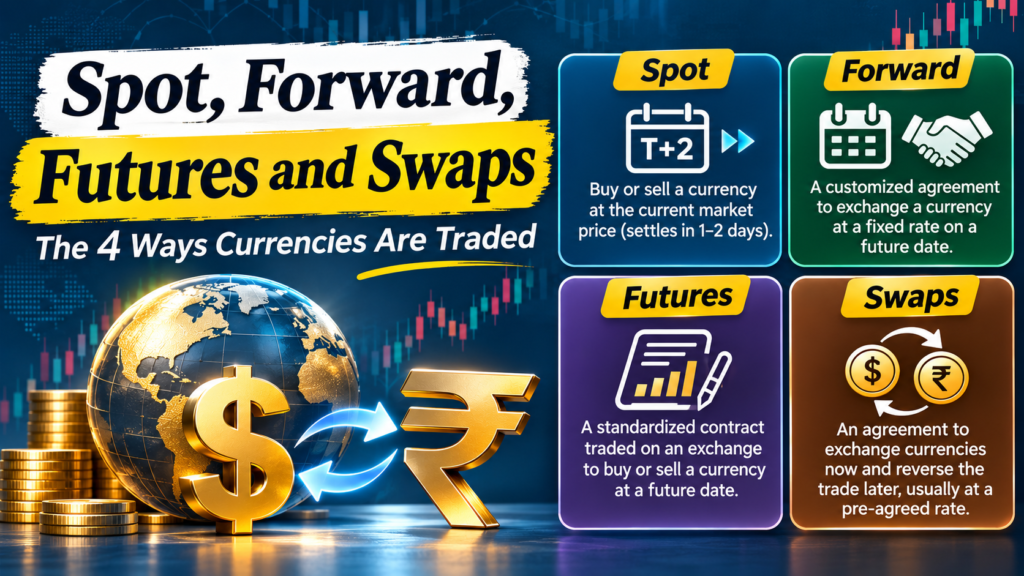
When people think of forex, they often picture a trader buying euros and selling dollars on a screen. That is just one way currencies change hands. In reality, the foreign exchange market uses four main instruments: spot, forwards, futures and swaps. Each has a different purpose, settlement date and set of users.
Understanding spot vs forward vs futures forex contracts, and how swaps fit in, helps traders choose the right instrument, helps businesses hedge correctly and helps anyone reading market news understand what the numbers mean. According to the BIS, the market traded about $9.6 trillion a day in April 2025, and most of that was not spot trading at all.
This guide explains each of the four instruments, compares them side by side, shows how forward rates are calculated, gives Indian examples and helps you decide which suits your needs.
Spot vs Forward vs Futures Forex: The Basics in One Minute
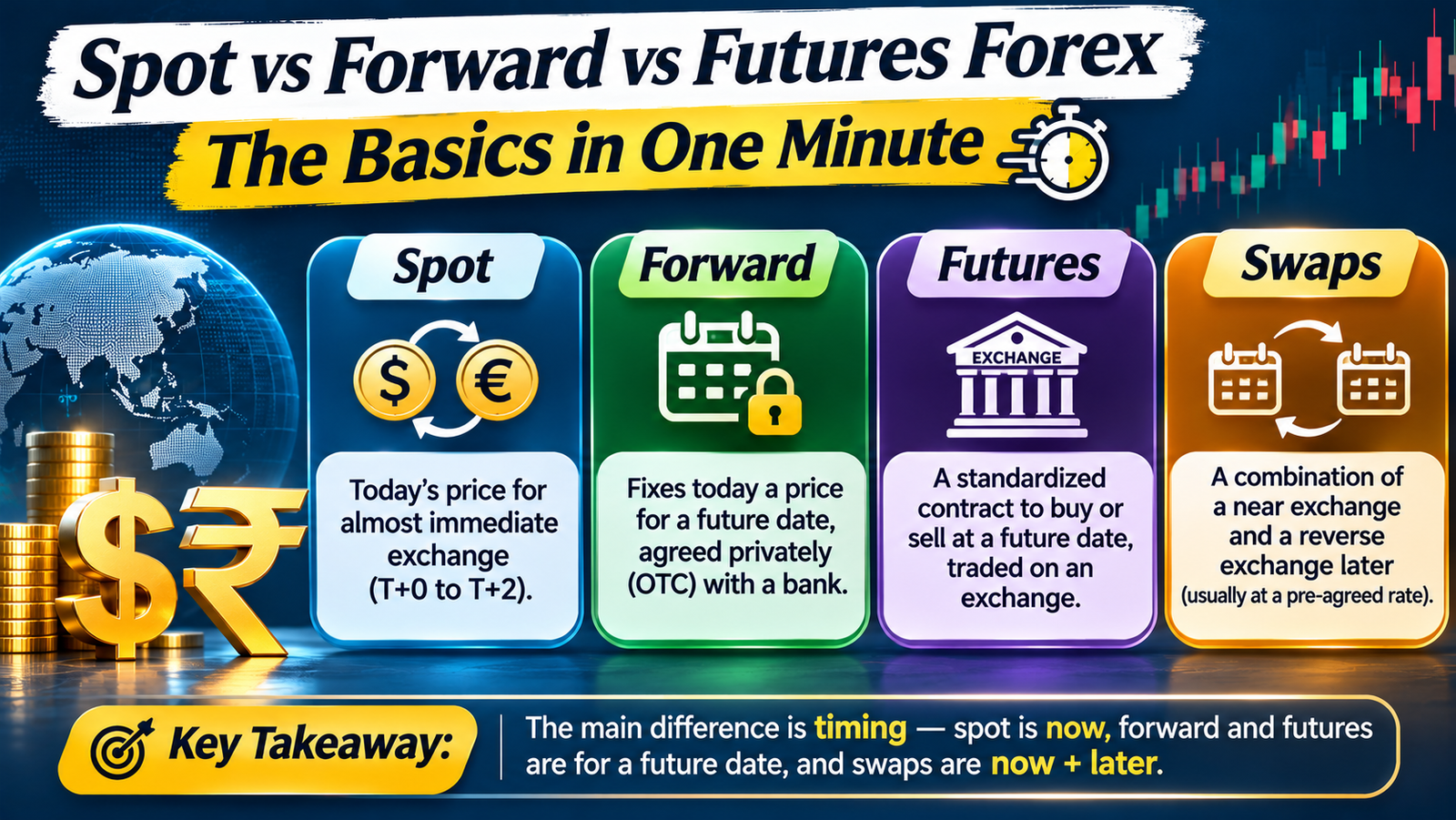
If you remember only one thing about spot vs forward vs futures forex, remember the timing. Spot is today’s price for almost immediate exchange. A forward fixes today a price for a future date, agreed privately with a bank. A futures contract does the same thing, but with standard sizes and dates on an exchange. Swaps combine a near exchange with a reverse exchange later. Everything else in the spot vs forward vs futures forex comparison, from margin to counterparty risk, follows from these basic differences.
How Big Is Each Part of the Market?
The BIS breaks down daily turnover by instrument. In April 2025:
| Instrument | Daily turnover | Share of total |
|---|---|---|
| FX swaps | About $4.0 trillion | 42% |
| Spot | About $3.0 trillion | 31% |
| Outright forwards | About $1.8 trillion | 19% |
| Options | About 7% of turnover | 7% |
| Currency swaps | About 2% of turnover | 2% |
Exchange-traded currency futures are counted separately by the BIS because they trade on exchanges rather than over the counter. Even so, the table shows that FX swaps, not spot trades, are the largest part of the market.
1. Spot Forex
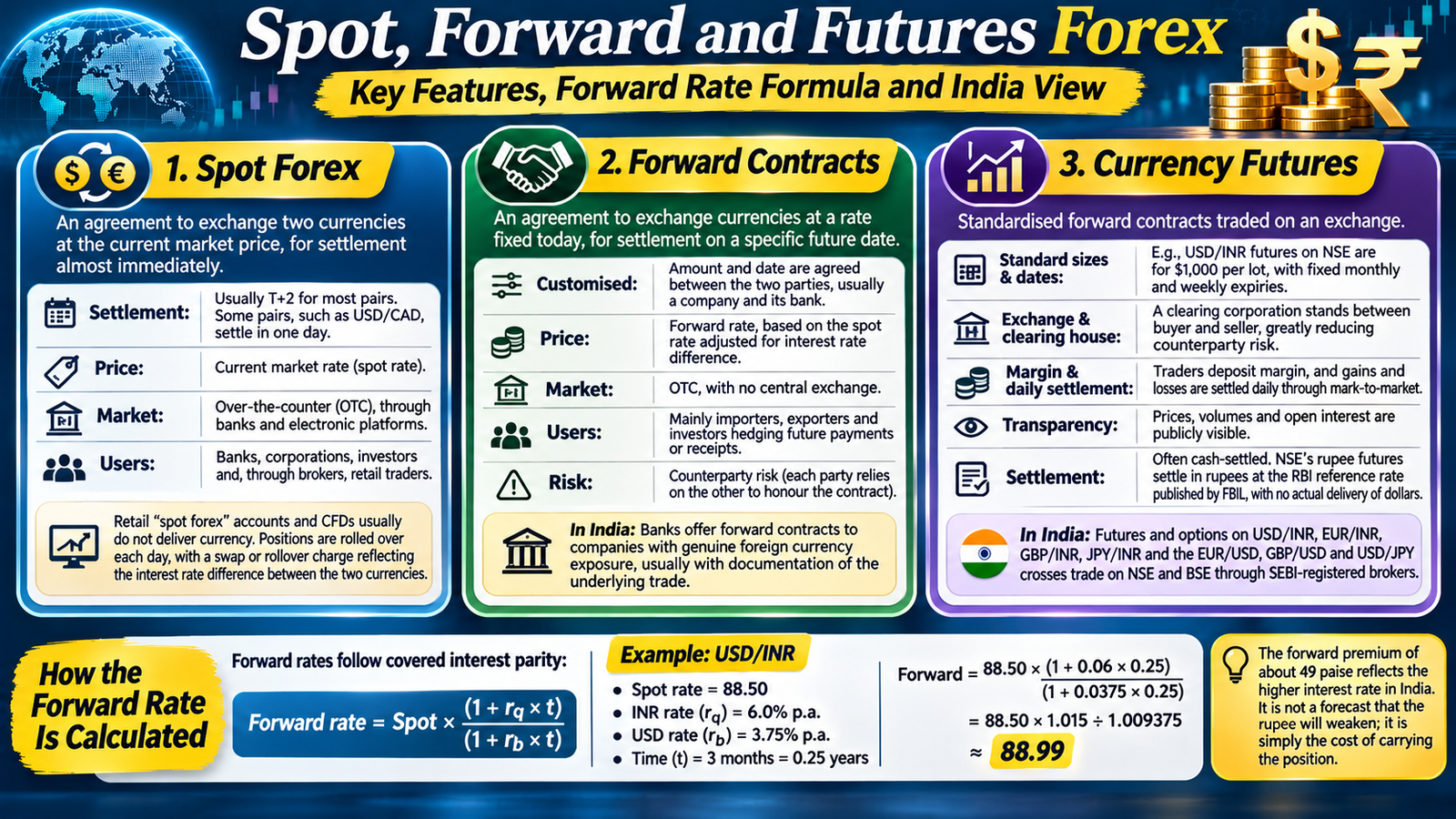
A spot transaction is an agreement to exchange two currencies at the current market price, for settlement almost immediately.
- Settlement: usually two business days after the trade (T+2) for most pairs. Some pairs, such as USD/CAD, settle in one day.
- Price: the current market rate, known as the spot rate.
- Market: over-the-counter (OTC), through banks and electronic platforms.
- Users: banks, corporations, investors and, through brokers, retail traders.
Retail “spot forex” accounts and CFDs usually do not deliver currency. Positions are rolled over each day, with a swap or rollover charge reflecting the interest rate difference between the two currencies.
2. Forward Contracts
A forward (or outright forward) is an agreement to exchange currencies at a rate fixed today, for settlement on a specific future date.
- Customised: the amount and date are agreed between the two parties, usually a company and its bank.
- Price: the forward rate, which equals the spot rate adjusted for the interest rate difference between the two currencies.
- Market: OTC, with no central exchange.
- Users: mainly importers, exporters and investors hedging future payments or receipts.
- Risk: each party relies on the other to honour the contract, known as counterparty risk.
In India, banks offer forward contracts to companies with genuine foreign currency exposure, usually with documentation of the underlying trade.
How the forward rate is calculated
Forward rates follow covered interest parity. The currency with the higher interest rate trades at a forward discount, and the one with the lower rate trades at a forward premium:
Forward rate = Spot × (1 + quote currency interest rate × time) ÷ (1 + base currency interest rate × time)
Illustrative example: USD/INR spot is 88.50, the rupee interest rate is 6.0% a year, the dollar rate is 3.75% a year, and the period is three months (0.25 years):
- Forward = 88.50 × (1 + 0.06 × 0.25) ÷ (1 + 0.0375 × 0.25)
- = 88.50 × 1.015 ÷ 1.009375 ≈ 88.99
The forward premium of about 49 paise reflects the higher interest rate in India. It is not a forecast that the rupee will weaken; it is simply the cost of carrying the position.
3. Currency Futures
Futures are standardised forward contracts traded on an exchange.
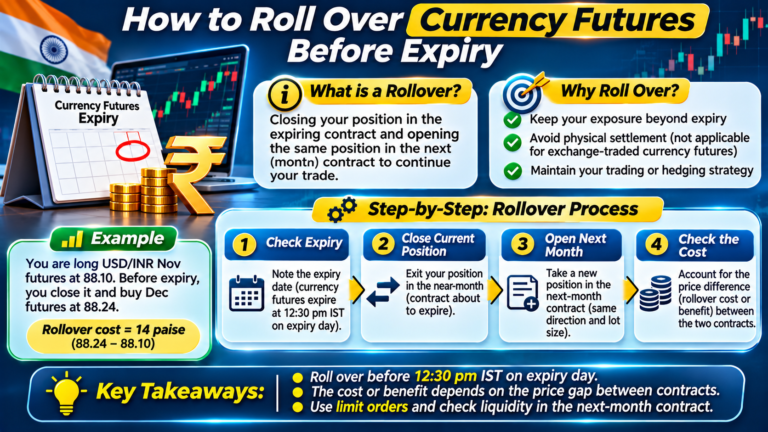
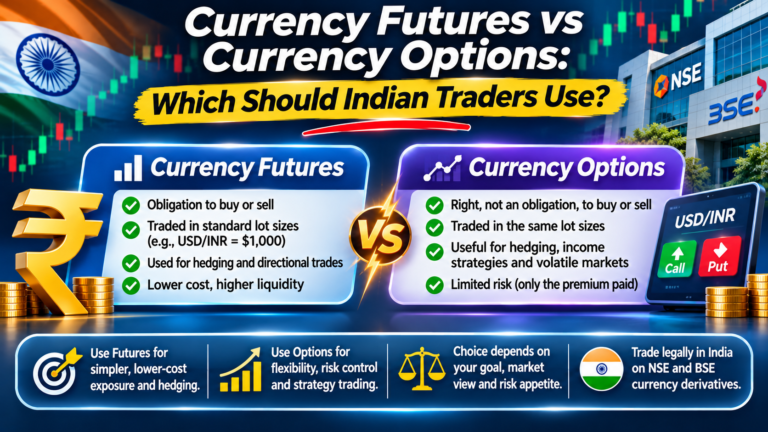
- Standard sizes and dates: for example, USD/INR futures on NSE are for $1,000 per lot, with fixed monthly and weekly expiry dates.
- Exchange and clearing house: a clearing corporation stands between buyer and seller, greatly reducing counterparty risk.
- Margin and daily settlement: traders deposit margin, and gains and losses are settled daily through mark-to-market.
- Transparency: prices, volumes and open interest are publicly visible.
- Settlement: often cash-settled. NSE’s rupee futures settle in rupees at the RBI reference rate published by FBIL, with no actual delivery of dollars.
This standardisation is the main spot vs forward vs futures forex distinction for most individual traders, because it makes futures accessible in small sizes with clear prices.
Major global currency futures trade on exchanges such as CME. In India, futures and options on USD/INR, EUR/INR, GBP/INR, JPY/INR and the EUR/USD, GBP/USD and USD/JPY crosses trade on NSE and BSE through SEBI-registered brokers.
4. FX Swaps and Currency Swaps
FX swaps
An FX swap combines two transactions: a spot (or near-date) exchange and a reverse forward exchange at a later date. For example, a bank buys dollars and sells rupees today, and agrees to sell the dollars back and buy rupees in three months at a fixed forward rate.
- Purpose: mainly short-term funding and liquidity management, not a bet on direction.
- Users: banks, corporations and central banks.
- Example: the RBI has used buy/sell USD/INR swaps to add rupee liquidity to the banking system while managing its dollar reserves.
FX swaps are the largest single segment of the market, accounting for about 42% of daily turnover in 2025.
Currency swaps
A cross-currency swap is a longer-term agreement in which two parties exchange principal and interest payments in different currencies, often for several years. Companies use them to convert foreign-currency borrowing into their home currency. Central banks also use currency swap lines with each other to provide emergency liquidity.
Spot vs Forward vs Futures Forex: Side-by-Side Comparison
| Feature | Spot | Forward | Futures | FX swap |
|---|---|---|---|---|
| Settlement | Usually T+2 | Agreed future date | Fixed expiry dates | Near date and far date |
| Where traded | OTC | OTC | Exchange | OTC |
| Contract terms | Flexible | Customised | Standardised | Customised |
| Counterparty risk | Low (short period) | Higher | Low (clearing house) | Moderate |
| Margin | Varies | Often credit lines | Required, daily settlement | Usually credit lines |
| Transparency | Moderate | Low | High | Low |
| Main users | Banks, traders, companies | Hedgers | Hedgers and traders | Banks and central banks |
| Share of 2025 turnover | 31% | 19% | Exchange-traded, separate | 42% |
The key spot vs forward vs futures forex difference is timing and standardisation: spot is for now, forwards are customised for a future date, and futures are standardised future contracts on an exchange.
Worked Example: Spot vs Forward vs Futures Forex for an Importer
This example is illustrative and uses hypothetical rates.
An Indian importer must pay $50,000 in three months. USD/INR spot is 88.50, and the three-month forward and futures prices are about 88.99.
- Spot (do nothing now): buy dollars at the spot rate in three months, whatever it is. If USD/INR rises to 90.50, the cost is ₹45,25,000. If it falls to 87.50, the cost is ₹43,75,000. The outcome is uncertain.
- Forward: book a bank forward at 88.99. The cost is fixed at about ₹44,49,500, whatever happens. The amount and date match the payment exactly.
- Futures: buy 50 lots of NSE USD/INR futures at 88.99. Gains or losses on the futures offset changes in the spot cost, giving an effective rate close to 88.99. The importer must manage margin and daily mark-to-market, and may face small differences between the futures settlement rate and the bank’s rate.
Each instrument solves the same problem in a different way. The spot vs forward vs futures forex choice depends on whether the importer values flexibility, exact matching or exchange transparency.
Spot vs Forward vs Futures Forex: Which Instrument Suits You?
| Your need | Best fit |
|---|---|
| Exchange currency now | Spot |
| Lock in a rate for a known business payment on an exact date | Forward |
| Hedge or trade with transparency, small sizes and low counterparty risk | Futures |
| Manage short-term funding or liquidity in another currency | FX swap |
| Convert long-term foreign borrowing | Currency swap |
Spot vs Forward vs Futures Forex in India
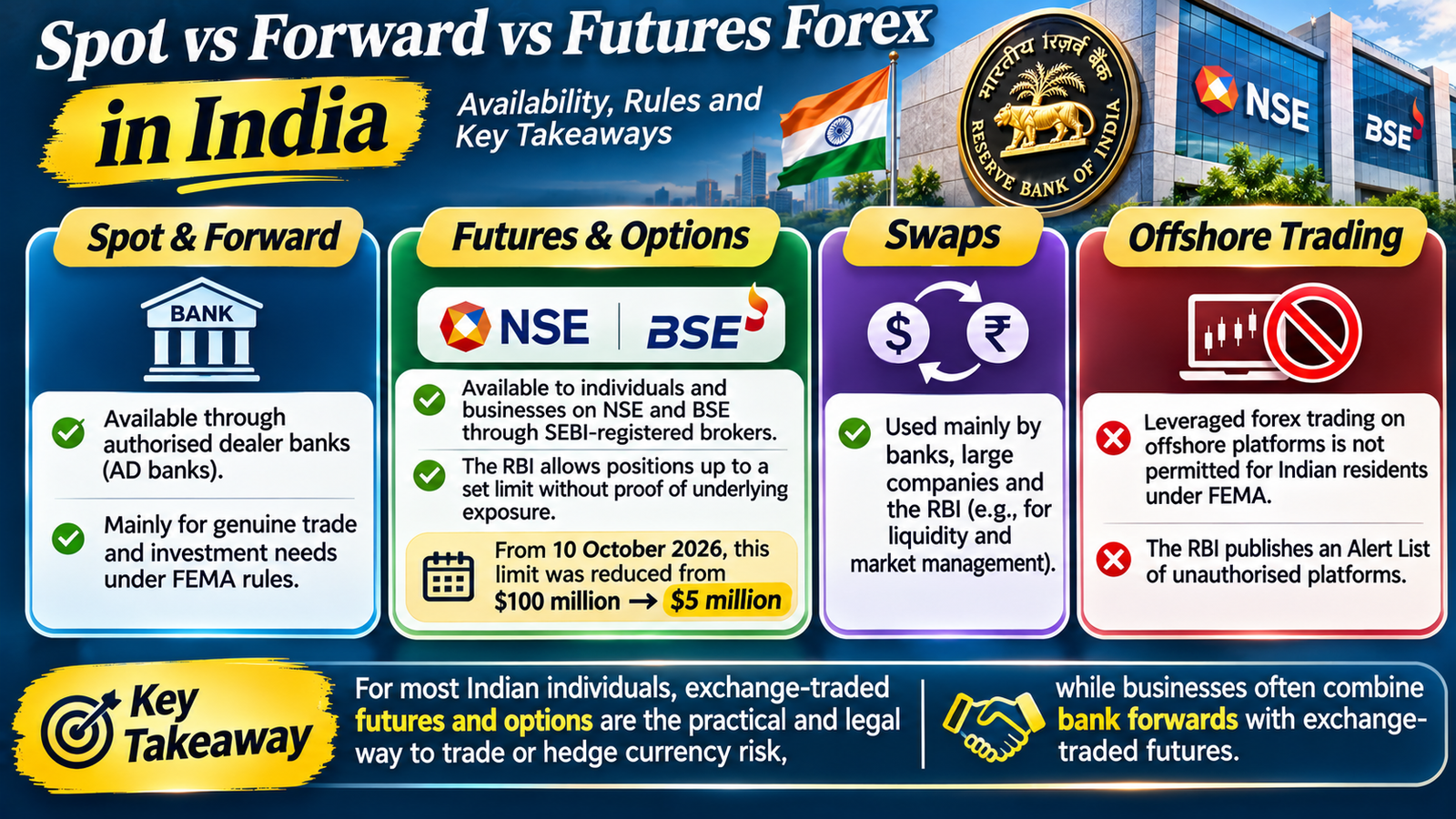
- Spot and forwards: available through authorised dealer banks, mainly for genuine trade and investment needs under FEMA rules.
- Futures and options: available to individuals and businesses on NSE and BSE through SEBI-registered brokers. The RBI allows positions up to a set limit without proof of underlying exposure; from 10 October 2026 that limit was reduced from $100 million to $5 million.
- Swaps: used mainly by banks, large companies and the RBI.
- Offshore trading: leveraged forex trading on offshore platforms is not permitted for Indian residents under FEMA, and the RBI publishes an Alert List of unauthorised platforms.
For most Indian individuals, exchange-traded futures and options are the practical and legal way to trade or hedge currency risk, while businesses often combine bank forwards with exchange-traded futures.
Costs in Spot vs Forward vs Futures Forex
Each instrument has a different cost structure. Spot trades cost the bid-ask spread, plus overnight rollover charges if a retail position is held. Forwards build the interest rate difference into the forward rate, and banks add a margin to the rate they quote, which is often not visible to the customer. Futures charge brokerage, exchange fees and taxes, and require margin, but their prices are transparent and can be compared easily. Comparing all-in costs is an important part of any spot vs forward vs futures forex decision, especially for businesses that hedge regularly.
Common Spot vs Forward vs Futures Forex Misunderstandings
- “The forward rate predicts the future spot rate.” It mainly reflects interest rate differences, not a forecast.
- “Spot trading is most of the market.” FX swaps are larger, according to the BIS.
- “Futures and forwards are the same.” They lock in similar rates but differ in standardisation, margin, transparency and counterparty risk.
- “Retail spot forex is the same as interbank spot.” Retail accounts usually roll positions daily rather than settling currency.
FAQs
What is the main difference in spot vs forward vs futures forex?
Spot settles almost immediately at today’s rate. Forwards lock in a rate for a customised future date with a bank. Futures lock in a rate for a standard future date on an exchange, with margin and daily settlement.
What is an FX swap?
A combination of a spot (or near-date) exchange and a reverse forward exchange, mainly used for funding and liquidity management.
Why is the forward rate different from the spot rate?
Because of the interest rate difference between the two currencies, as described by covered interest parity.
Is the spot vs forward vs futures forex choice relevant to small businesses?
Yes. Small importers and exporters can use bank forwards or exchange-traded futures to manage currency risk. Understanding spot vs forward vs futures forex options helps them choose the most cost-effective approach.
Which instrument is largest in the forex market?
FX swaps, at about 42% of daily turnover in April 2025, followed by spot at 31% and outright forwards at 19%.
Which is best for Indian retail traders?
Exchange-traded currency futures and options on NSE and BSE, through SEBI-registered brokers.
Conclusion
Currencies are traded in four main ways. Spot handles immediate exchange, forwards lock in rates for customised future dates, futures offer standardised, exchange-traded contracts with low counterparty risk, and swaps manage funding and long-term currency exposure. The over-the-counter part of the market alone handled about $9.6 trillion a day in April 2025.
Understanding spot vs forward vs futures forex instruments, and where swaps fit, helps you choose the right tool for your goal, whether that is trading, hedging a business payment or simply understanding the headlines. Match the instrument to your needs, understand its costs and risks, and use regulated channels.