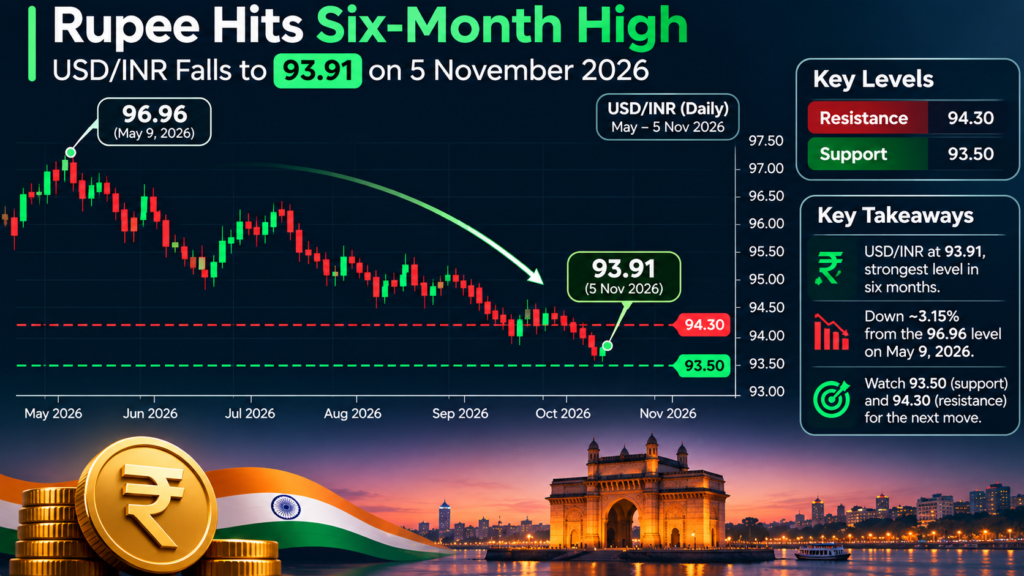
Key Takeaways
- The rupee closed at 93.91 per dollar on Friday, 6 November 2026, its strongest close since 22 April, up 56 paise on the day.
- It was the rupee’s biggest one-day gain since 12 October and its sixth straight session of gains, with a weekly rise of about 1.1–1.2%.
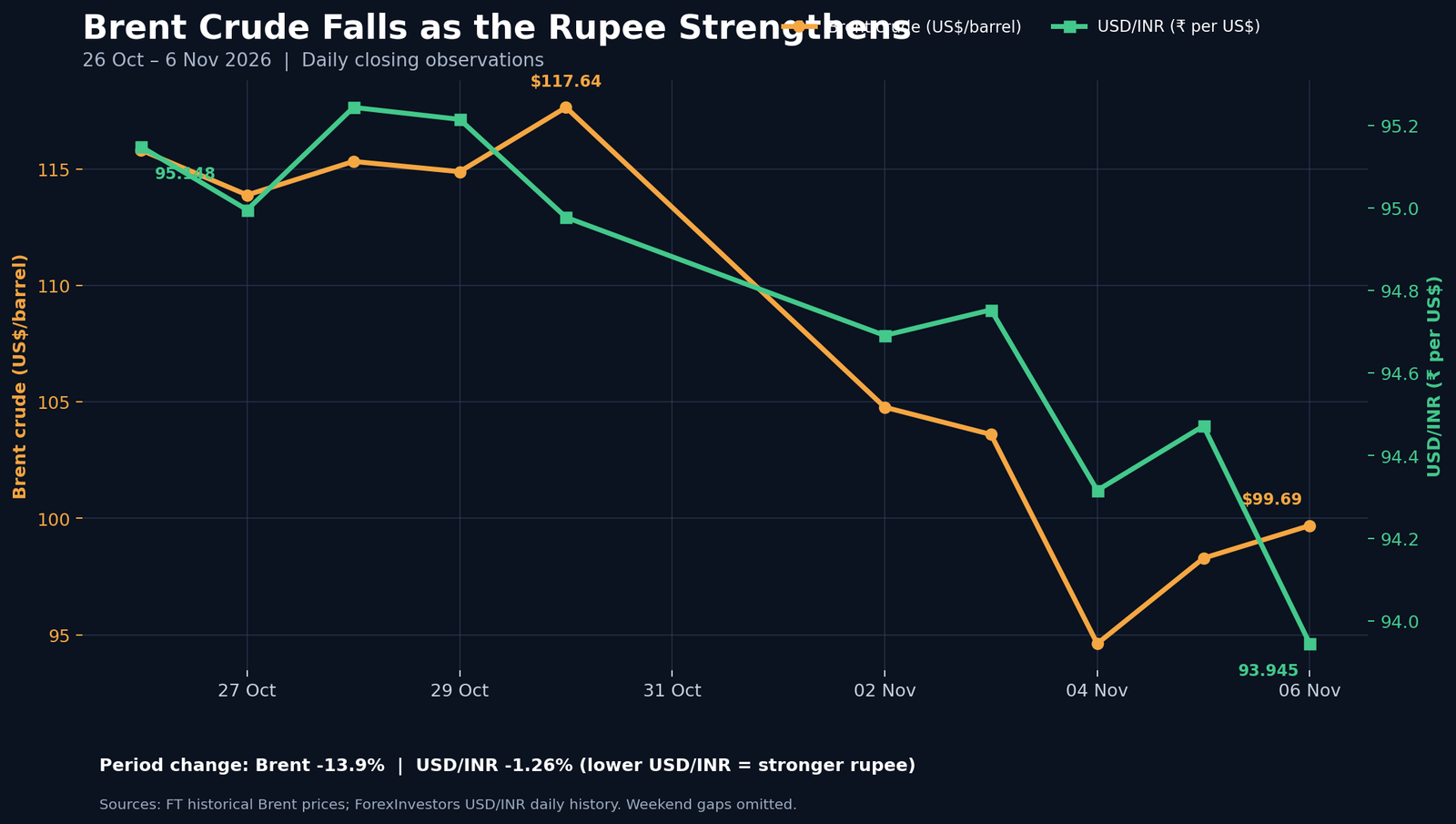
- Falling crude oil and record foreign portfolio buying of Indian shares drove the move; Brent fell from a 30 October peak of $117.64.
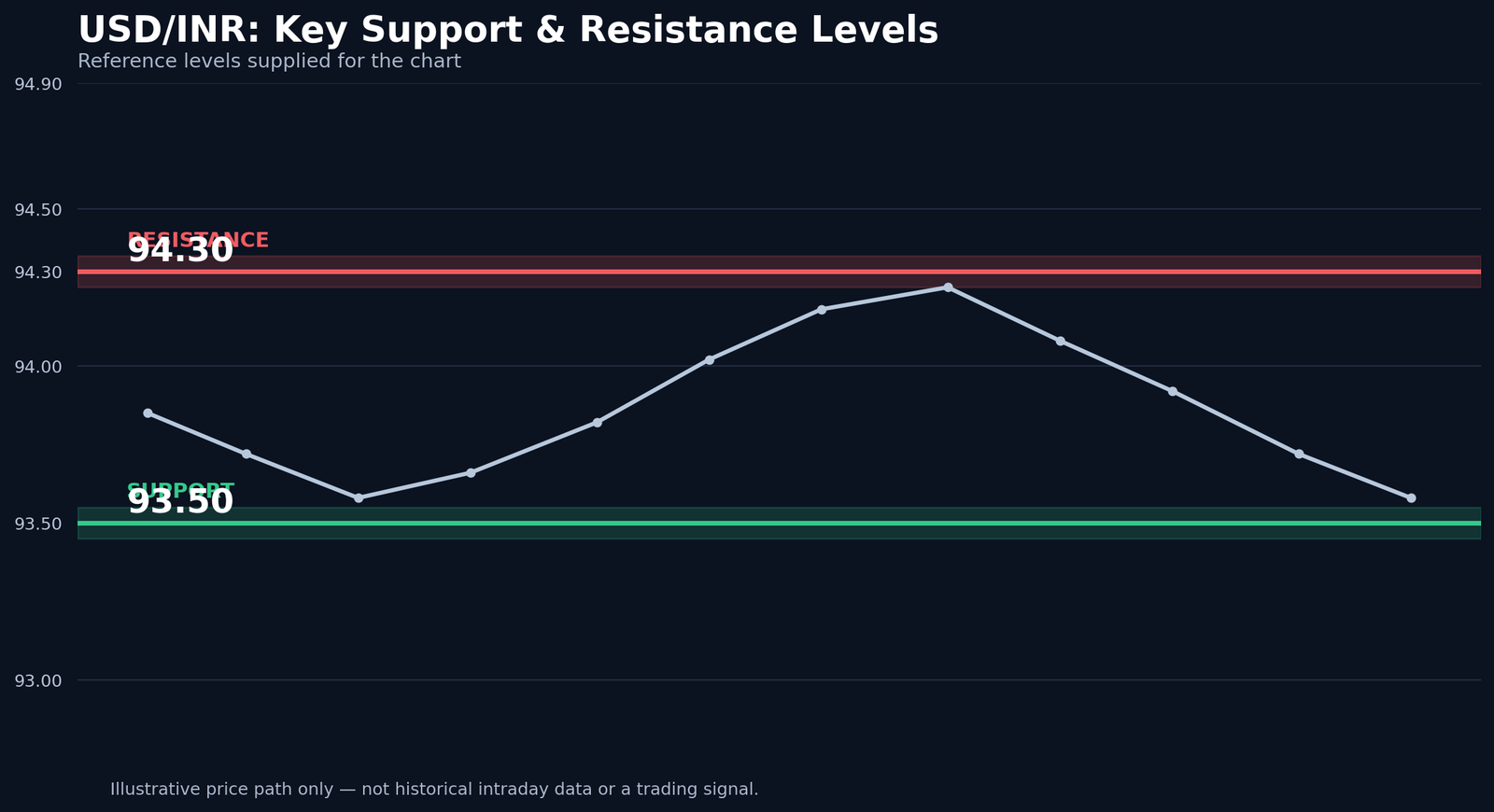
- Analysts see support near 93.50 and resistance near 94.30, while the RBI was reported buying dollars around 93.88.
- A strong US jobs report after India’s close lifted the dollar, so Monday’s open is the next test.
The rupee six-month high in November 2026 came fast. A week ago, Indian traders were watching oil above $110 and the RBI selling dollars. By Friday’s close, the rupee had gained for six sessions in a row and finished at 93.91, far from May’s all-time low of 96.96. This article explains what drove the rally, how big it was in rupee terms, where analysts see the next levels, and what it means for USD/INR futures traders, importers and exporters. It also covers the risk that arrived after India’s close, when strong US jobs data lifted the dollar. All times are in IST.
Why did the rupee hit a six-month high?
The rupee rose to a six-month high of 93.91 per dollar on 6 November 2026 because crude oil prices fell sharply and foreign investors poured record sums into Indian equities, Business Standard reported. The 56-paise gain was its biggest single-day rise since 12 October. Analysts also cited easing US-Iran tensions and the US midterm results.
USD/INR is the exchange rate showing how many rupees one US dollar buys. When USD/INR falls, the rupee is strengthening. On Friday the pair opened at 94.49, touched 93.83 intraday and closed at 93.91, against a previous close of 94.47, according to Business Standard.
| Measure | Figure | Source |
|---|---|---|
| Close, 6 Nov 2026 | 93.91 per $ | Business Standard |
| Previous close | 94.47 | Business Standard |
| Open / intraday best | 94.49 / 93.83 | Business Standard |
| Daily gain | 56 paise (0.60%) | Business Standard |
| Weekly gain | about 1.1–1.2% | Business Recorder; IANS |
| Calendar-2026 change | about −4.3% to −4.5% | IANS; Business Recorder |
| All-time low | 96.96 (May 2026) | Business Recorder |
The rupee was still weaker for the year, but the recovery from May’s low is now close to three rupees. For background on that slide, see our earlier coverage of the rupee at a record low.
The three drivers behind the rally
1. Crude oil fell from its peak
Oil is the single biggest swing factor in India’s import bill. Business Standard reported that the January Brent contract settled at $96.84 a barrel on Friday, down from $98.29 a day earlier, and well below the $117.64 peak of 30 October. Business Recorder reported that Brent was down nearly 20% for the week, its steepest weekly fall since April 2020. India imports nearly 90% of its oil, so cheaper crude reduces dollar demand from refiners. Our guide to crude oil’s impact on forex explains this link.
2. Record foreign buying of Indian shares
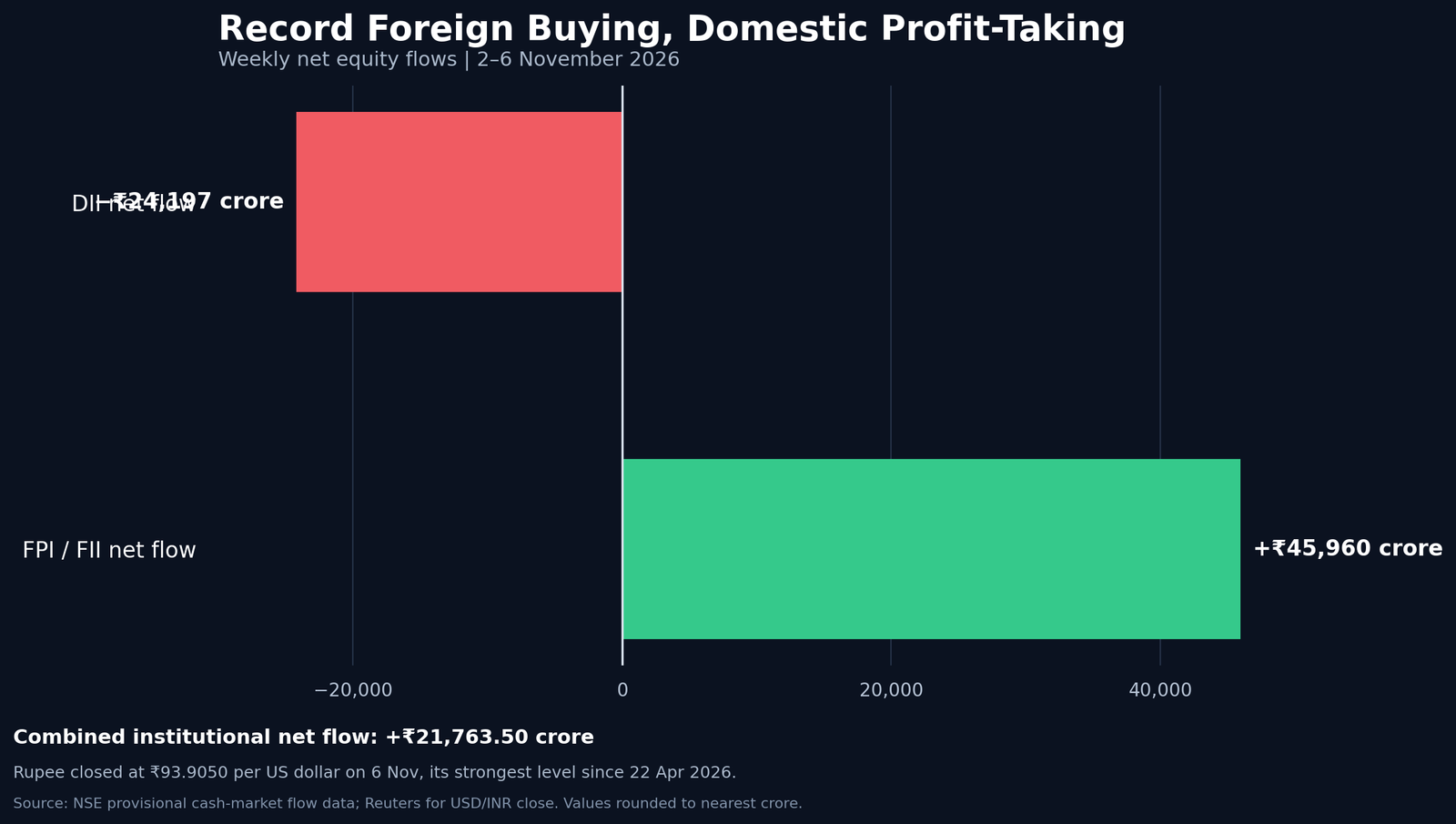
Business Standard reported that foreign portfolio investors (FPIs) bought a record ₹45,960 crore of Indian equities during the week, including ₹13,749.82 crore on Friday alone. Domestic institutions sold ₹24,197 crore, their largest weekly net outflow. The Nifty 50 gained 8.58% and the Sensex 8.82% in the week, their best since February 2021. Business Recorder separately put foreign equity inflows at nearly $3 billion for the week, so estimates differ by source and data cut-off.
When FPIs buy Indian shares, they convert dollars into rupees, which pushes USD/INR down. IANS reported foreign banks selling dollars on behalf of FPIs during Friday’s session.
3. Global risk mood and politics
Analysts quoted by Business Standard linked the rally to reports of US-Iran diplomatic engagement, the Democrats’ victory in the US midterms and an “anti-AI” rotation in which global money moved out of crowded AI stocks and into markets such as India. Kranthi Bathini of WealthMills Securities told Business Standard: “Oil prices cooled off to under $100 this week, which brought positivity.”
What is the RBI doing at these levels?
The RBI’s role flipped during the week. In late October, with oil spiking, it sold dollars to support the rupee, and India’s forex reserves fell for an eighth straight week to $717.06 billion in the week ended 30 October, Business Standard reported.
By Friday, the concern was the speed of the rupee’s rise. IANS reported the RBI was seen buying dollars near 93.88 to limit excessive appreciation. Governor Sanjay Malhotra had earlier said markets were overly pessimistic about the rupee, IANS added, citing his confidence in India’s medium- to long-term balance of payments.
For traders, this matters because RBI buying near 93.88 can slow the rupee’s gains, just as RBI selling slowed its fall earlier. USD/INR tends to move in measured steps rather than sharp trends when the central bank is active on both sides.
USD/INR levels to watch next week
| Level | Why it matters | Source |
|---|---|---|
| 94.30 | Resistance; a move back above would undo part of Friday’s gain | HDFC Securities (Dilip Parmar) |
| 94.00 | Round number the rupee broke through on Friday | Business Recorder |
| 93.88 | Area where the RBI was reported buying dollars | IANS |
| 93.70 | HDFC Securities’ immediate downside target for USD/INR | Business Recorder |
| 93.50 | Support; next target if rupee strength continues | HDFC Securities |
| 92.50 | Possible if USD/INR holds below 94 and the RBI does not buy, per Kotak Securities’ view | Business Recorder |
HDFC Securities’ Dilip Parmar told Business Recorder: “Rupee is expected to continue appreciating as this is a flow-driven strength.” Kotak Securities’ Anindya Banerjee was paraphrased as warning that a sustained break below 94 could open the way to 92.50 unless the RBI steps in.
These views were published before the US jobs report. Treat them as levels to watch, not predictions. Our guide to support and resistance trading explains how traders use such zones.
The risk after India’s close: a stronger dollar
At 19:00 IST on Friday, two hours after NSE’s currency futures closed, US data showed 165,000 jobs added in October against a forecast near 59,000. The dollar index rose about 0.7%, and US Treasury yields climbed. That is the main short-term threat to the rupee’s rally.
So Monday opens with a tug of war: global dollar strength on one side, and oil and FPI flows on the other. A gap at the 9:00 am IST open is possible in either direction.
Example: what 56 paise means in rupees (hypothetical)
One NSE USD/INR futures lot is US$1,000, and NSE’s contract specifications for INR pairs set the tick at 0.25 paise, so each paise is worth ₹10 per lot. Our explainer on pip and paise value in rupees covers the maths.
- A futures trader long USD/INR: A trader in Delhi bought 3 lots at 94.47 expecting rupee weakness. Friday’s 56-paise fall in USD/INR cost him 56 × ₹10 × 3 = ₹1,680 before charges.
- An exporter: A textile exporter in Tiruppur converting US$50,000 receives ₹46,95,500 at 93.91, against ₹47,23,500 at 94.47. That is ₹28,000 less for the same dollars.
- An importer: A Chennai electronics importer paying US$50,000 saves the same ₹28,000 at Friday’s rate.
- Sizing a range trade: A trader with ₹1,00,000 who risks 1% (₹1,000) and places a 20-paise stop risks ₹200 per lot, so 5 lots fit. Use our position size calculator for other stop sizes.
How USD/INR traders can approach the coming week
- Recheck open positions over the weekend. Note the ₹ value per paise of every USD/INR, EUR/INR or GBP/INR position.
- Plan for a gap. The US jobs data was not priced into Friday’s close; stops may fill away from your level.
- Mark the key zones. 93.50–93.88 below and 94.00–94.30 above are where analysts and the RBI have been active.
- Watch crude and FPI data daily. These were the main drivers this week and could reverse quickly.
- Avoid over-sizing. Narrow USD/INR ranges tempt traders into many lots; keep risk per trade fixed in rupees.
For a full primer on the contract, timings and margin, see our guide on how to trade USD/INR.
Common mistakes after a sharp rupee rally
- Assuming the trend runs in a straight line. The RBI was reported buying dollars near 93.88, which can stall gains.
- Ignoring after-hours news. Big US data often lands after NSE’s 5:00 pm close.
- Mixing up direction. A falling USD/INR chart means a stronger rupee; shorting USD/INR is a bet on further rupee gains.
- Trading offshore rupee products. Indian residents may trade currency derivatives only on recognised Indian exchanges through SEBI-registered brokers.
FAQs
Why did the rupee rise on 6 November 2026?
The rupee rose 56 paise to 93.91 per dollar mainly because crude oil fell sharply from its 30 October peak and foreign investors bought a record ₹45,960 crore of Indian equities during the week. Analysts also pointed to easing US-Iran tensions and the US midterm results, which improved risk appetite.
What is the rupee’s highest level in 2026?
The rupee’s 93.91 close on 6 November was its strongest since 22 April 2026, making it a six-month high, according to Business Standard. Over the year the rupee remains weaker, down about 4.3% to 4.5% in calendar 2026, and it hit an all-time low of 96.96 per dollar in May.
Is the RBI stopping the rupee from rising further?
IANS reported the RBI was seen buying dollars near 93.88 to limit excessive appreciation. The RBI has long said it intervenes to curb volatility rather than to defend a specific level. Its buying can slow the rupee’s gains, just as its dollar sales in October slowed the currency’s fall when oil prices spiked.
What are the USD/INR support and resistance levels for next week?
HDFC Securities’ Dilip Parmar placed support at 93.50 and resistance at 94.30. He also flagged 93.70 as an immediate target if appreciation continues. Kotak Securities said a sustained break below 94 could open 92.50 unless the RBI buys dollars. These views came before Friday night’s strong US jobs data.
How does a stronger rupee affect Indian importers and exporters?
A stronger rupee means fewer rupees per dollar. Importers pay less for dollar invoices, while exporters receive fewer rupees for the same dollar earnings. At Friday’s move, a US$50,000 payment changed by about ₹28,000 compared with the previous day’s rate.
Will the US jobs report reverse the rupee rally?
It could weigh on the rupee at Monday’s open. The October jobs report showed 165,000 jobs, far above forecasts, and the dollar index rose about 0.7%. Whether that outweighs cheaper oil and strong FPI inflows will only be clear once Indian markets reopen at 9:00 am IST on Monday.
Conclusion
The rupee six-month high in November 2026 was built on cheaper oil and record foreign buying of Indian shares, taking the currency to 93.91 per dollar, its best close since April. The RBI, which sold dollars when oil spiked, was reported buying near 93.88 to slow the climb. Analysts watch 93.50 as support and 94.30 as resistance, but Friday night’s strong US jobs data means Monday could open with a dollar bounce. Keep position sizes fixed in rupees and expect gaps. Before your next USD/INR trade, check your lot size with our position size calculator.