
Introduction
Gold moves fast. On a busy day, XAUUSD can swing $30–$40 — and if you don’t know what a pip is worth, that’s the difference between a controlled trade and a blown account. The problem is that gold doesn’t play by normal forex rules. The pip formula you learned on EUR/USD gives the wrong answer on gold, and worse, different brokers label the same price move in three different ways.
This guide fixes that. You’ll get the exact formula for calculating pips on XAUUSD, the pip value for every lot size, and clear worked examples using gold’s current price level (around $4,050 per ounce in late July 2026, down from a 52-week high near $5,595). And because this is written for Indian traders, we’ll be straight with you about what’s actually legal here — and how the regulated MCX gold route calculates the same thing in rupees.
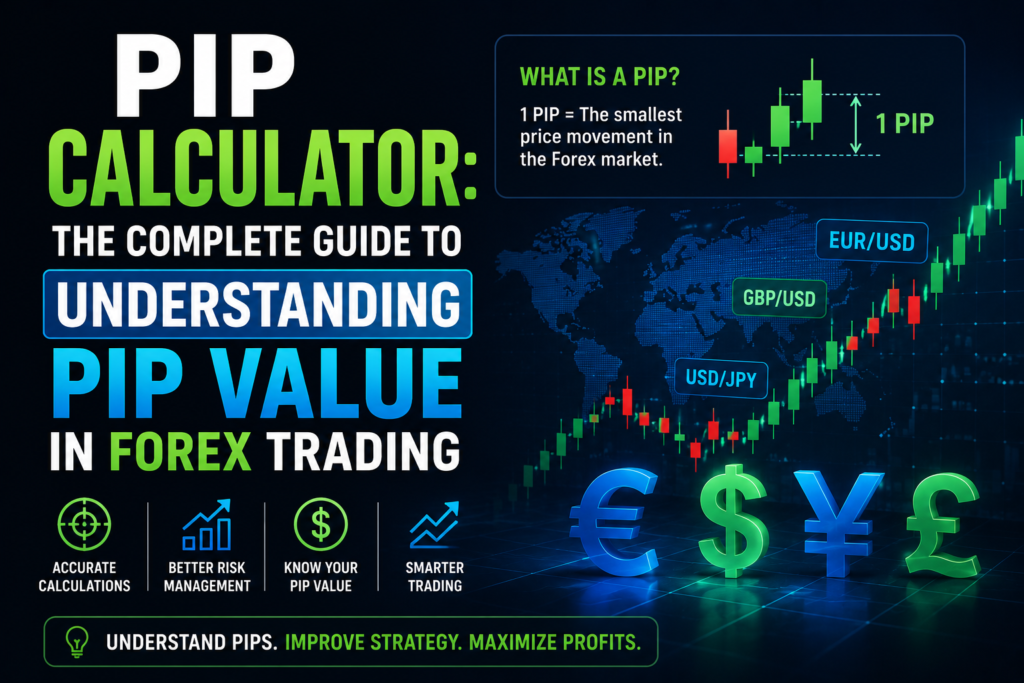
What Is a Pip in XAUUSD?
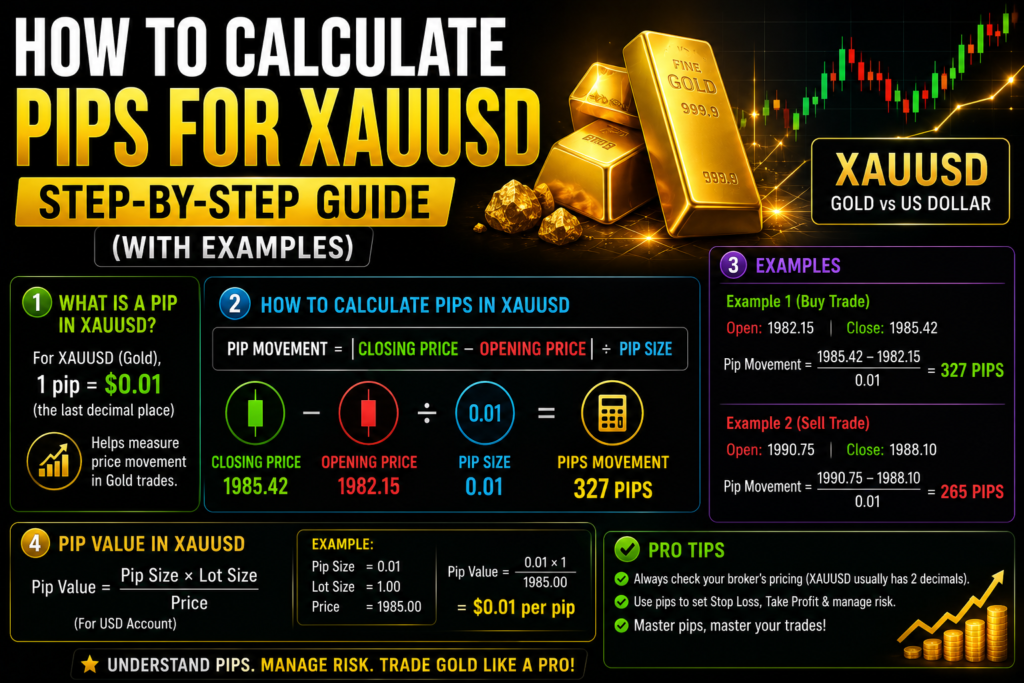
Quick answer: In XAUUSD, a pip is the smallest price increment your broker quotes. For most brokers quoting gold to two decimal places (e.g., 4,050.55), one pip = a $0.01 price move. On a standard lot (100 ounces), that pip is worth $1. But watch out — some brokers and traders define the pip as $0.10, and many use “points” where a full $1 move = 100 pips.
Here’s the core fact that everything else hangs on: XAUUSD is quoted in US dollars per troy ounce, to two decimal places. So a quote of 4,050.55 means one ounce of gold costs $4,050.55, and the last digit (the second decimal) is the smallest standard increment.
That’s completely different from EUR/USD, where a pip lives at the fourth decimal (0.0001). If you apply the 0.0001 currency formula to gold, your pip value will be off by a factor of 100. This single mistake is the most common reason new gold traders miscalculate risk.
The Three “Pip” Definitions for Gold (and Why They Confuse Everyone)
Gold has no globally enforced pip standard, so you’ll genuinely encounter all three of these. Knowing which one your broker uses is non-negotiable.
| Convention | “One pip” equals | Where you’ll see it | Value per standard lot (100 oz) |
|---|---|---|---|
| Pip = 0.01 (most common) | a $0.01 move | Most MT4/MT5 brokers, 2-decimal quotes | $1 per pip |
| Pip = 0.10 (pipette model) | a $0.10 move (0.01 is the “pipette”/point) | Some brokers, 3-decimal quotes | $10 per pip |
| “Points” instead of pips | often a full $1 move = 1 point | Many gold traders and platforms | $100 per point |
The dominant convention — and the one this guide uses unless stated otherwise — is pip = 0.01, worth $1 on a standard lot. But the safest habit is to stop arguing about the word and check your platform’s decimal precision. If XAUUSD shows two decimals (4,050.55), your minimum increment is $0.01. If it shows three (4,050.555), it’s $0.001, and the labels shift accordingly.
The XAUUSD Pip Value Formula
The formula is refreshingly simple because gold’s quote currency (USD) is fixed:
Pip value (USD) = Position size in ounces × Pip size
Since a standard gold lot is 100 ounces and the standard pip is 0.01:
- Standard lot (100 oz): 100 × 0.01 = $1.00 per pip
- Mini lot (10 oz / 0.10 lot): 10 × 0.01 = $0.10 per pip
- Micro lot (1 oz / 0.01 lot): 1 × 0.01 = $0.01 per pip
If your account currency is not USD, convert the result using the current exchange rate:
Pip value (account currency) = Pip value (USD) × USD-to-account-currency rate
For example, at a USD/INR rate of ~95.8, a $1 pip is worth about ₹95.80 — though, as the India section explains, a rupee account trading XAUUSD spot through an offshore broker is not a legal setup for Indian residents.
Pips-to-dollars reference table
| Price move | Pips (at 0.01) | Std lot (100 oz) | Mini lot (10 oz) | Micro lot (1 oz) |
|---|---|---|---|---|
| $0.01 | 1 | $1 | $0.10 | $0.01 |
| $0.10 | 10 | $10 | $1 | $0.10 |
| $1.00 | 100 | $100 | $10 | $1 |
| $10.00 | 1,000 | $1,000 | $100 | $10 |
| $50.00 | 5,000 | $5,000 | $500 | $50 |
Why Gold Pip Counts Look So Huge (The $1 = 100 Pips Trap)
This is the insight that saves accounts. Because one pip is just $0.01, every $1 move in gold is 100 pips, and a routine $20–$40 daily range is 2,000–4,000 pips. Compare that to EUR/USD, which typically moves 70–100 pips a day.
The raw pip number looks terrifying, but the dollar impact depends entirely on lot size. The danger is the reverse mistake: a trader thinks “gold only moved $2, that’s tiny” — not realising that’s 200 pips, and on an oversized position it’s a serious loss. Most gold blow-ups aren’t caused by exotic strategies; they’re caused by a lot size too large for the account, applied to gold’s naturally huge pip counts.
Worked Examples
Example 1 — Standard lot, long trade. You buy 1.00 lot (100 oz) of XAUUSD at 4,050.00 and close at 4,055.00.
- Move = $5.00 = 500 pips
- P/L = 500 pips × $1 = +$500 (or simply 100 oz × $5 = $500)
Example 2 — Mini lot, short trade. You sell 0.10 lot (10 oz) at 4,080.00 and close at 4,065.00.
- Move = $15.00 in your favour = 1,500 pips
- P/L = 1,500 pips × $0.10 = +$150 (or 10 oz × $15 = $150)
Example 3 — Micro lot for beginners. You buy 0.01 lot (1 oz) at 4,050.00; gold falls to 4,040.00.
- Move = −$10.00 = 1,000 pips against you
- P/L = 1,000 pips × $0.01 = −$10 (or 1 oz × $10 = $10)
Notice the shortcut in every case: P/L = ounces × dollar move. The pip count is useful for setting stops and comparing trades, but the money maths collapses to ounces times price change.
Position Sizing for Gold (Using Pip Value)
Gold’s volatility makes position sizing the most important skill, not an afterthought. Flip the formula to solve for lot size from your risk limit:
Max pip value = (Account risk in $) ÷ (Stop-loss distance in pips)
Example: You have a $2,000 account and risk 1% ($20) per trade. Your stop-loss is 200 pips ($2.00) away.
- Max pip value = $20 ÷ 200 = $0.10 per pip
- $0.10 per pip = a mini lot (0.10 / 10 oz)
So a $2 stop on gold, at 1% risk on a $2,000 account, means you should trade one mini lot — not a standard lot, which would risk $200 (10% of the account) on the same move. This is exactly how disciplined traders keep gold’s swings survivable.

Trading Gold in India: The Legal Reality (XAUUSD vs MCX)
Here’s the part most global “XAUUSD pip” guides ignore. For resident Indians, trading spot gold or gold CFDs through offshore forex brokers is not permitted. It falls under the same restrictions as offshore forex generally: the Foreign Exchange Management Act (FEMA), administered by the RBI, prohibits sending margin money abroad for speculative trading, and the RBI maintains an Alert List of unauthorised platforms. High leverage (100:1+), non-INR instruments, and requests to remit funds overseas are red flags.
The legal domestic route to trade gold price movements is the Multi Commodity Exchange (MCX), regulated by SEBI. Instead of XAUUSD pips in dollars, MCX gold uses rupee ticks — but the logic is identical.
MCX Gold contract mechanics
| Spec | MCX Gold (“Big Gold”) |
|---|---|
| Lot size | 1 kg (1,000 grams) |
| Quotation | ₹ per 10 grams |
| Tick size (the “pip”) | ₹1 per 10 grams |
| Value per tick | ₹100 per lot |
Why ₹100 per tick? Value per tick = (lot size ÷ quotation unit) × tick size = (1,000 ÷ 10) × ₹1 = ₹100. So every ₹1 move in the quoted price changes your P/L by ₹100 per lot.
Worked MCX example: You buy 1 lot of MCX Gold and the price rises ₹500 (per 10 grams).
- Ticks = ₹500 ÷ ₹1 = 500 ticks
- P/L = 500 × ₹100 = ₹50,000 per lot
Because the “Big Gold” contract value runs well above ₹1 crore at 2026 price levels (gold has traded above ₹1 lakh per 10 grams through 2026), MCX offers smaller variants — Gold Mini (100 g), Gold Guinea (8 g) and Gold Petal (1 g) — so retail traders can size positions sensibly. Each has its own, smaller tick value derived from the same formula.
Beyond derivatives, Indians can also gain gold exposure through gold ETFs and digital gold for investment (not pip trading). Always confirm current specifications on the MCX website and current rules on the RBI/SEBI sites before trading.
Pros and Cons of Using a Pip Calculator for Gold
| Advantages | Limitations |
|---|---|
| Prevents the 0.0001-vs-0.01 error that wrecks P/L maths | Only correct if you set the right pip size for your broker |
| Makes gold’s huge pip counts manageable | Ignores spread, swap, and commissions unless added |
| Turns risk into a precise lot-size decision | A fixed price input goes stale fast — gold moves quickly |
| Works for both XAUUSD and MCX (change the unit) | Won’t judge trade quality, only trade size |
Common Mistakes When Calculating Gold Pips
- Using the 0.0001 currency pip on gold. Gold’s pip is 0.01 (or per your broker’s precision) — a 100× error.
- Confusing pips, points, and pipettes. Confirm what your platform calls a “pip” before sizing anything.
- Underestimating $ moves. A “$2 move” is 200 pips; on a standard lot that’s $200.
- Oversizing the lot. Gold’s volatility punishes standard lots on small accounts.
- Forgetting costs and the India rules. Spread and swap eat profits; offshore XAUUSD isn’t a legal setup for resident Indians.
Myths vs Facts
| Myth | Fact |
|---|---|
| “A pip is always 0.0001.” | For gold it’s typically 0.01 — the second decimal of the quote. |
| “One gold pip is worth $10.” | Only under the 0.10-pip model; the common 0.01 model makes it $1 per standard lot. |
| “Gold pips work like EUR/USD.” | Gold quote precision and lot size (100 oz) make the maths different. |
| “I can freely trade XAUUSD via any app in India.” | Offshore spot XAUUSD is restricted; MCX gold is the regulated route. |
Expert Analysis
The deepest reason gold confuses traders isn’t the arithmetic — it’s the terminology gap between platforms. A trader who internalises “$1 per pip” on one broker can move to a three-decimal broker and silently start mis-sizing by 10×. The professional habit is to ignore the label and anchor to two hard facts: your broker’s decimal precision (which sets the true increment) and your contract’s ounce count (which sets the money value). From those two numbers, pip value is always recoverable from first principles.
For Indian traders specifically, the practical takeaway is a fork in the road. The XAUUSD pip maths in this guide is universally correct and worth understanding — but applying it through an offshore broker is not a compliant path for residents. The MCX gold framework delivers the same directional exposure to gold, with transparent rupee tick values, exchange oversight, and investor protection. Learn the XAUUSD mechanics for fluency; execute through regulated Indian channels.
A closing note on uncertainty: the price levels here (XAUUSD ~$4,050; USD/INR ~95.8; MCX gold above ₹1 lakh per 10 g) are late-July-2026 snapshots and will drift. Gold has been exceptionally volatile — a 52-week range roughly from $3,268 to $5,595 tells you how quickly the picture changes. Recompute pip values with live prices before every trade, and verify contract specs at the source.
Key Takeaways
- XAUUSD is priced in USD per troy ounce, usually to two decimals, so the standard pip is 0.01 — not 0.0001.
- Pip value = ounces × pip size. Standard lot (100 oz) = $1/pip, mini = $0.10, micro = $0.01.
- A $1 gold move = 100 pips; a normal $20–$40 day is 2,000–4,000 pips — huge counts, so watch lot size.
- Three “pip” definitions exist (0.01, 0.10, points) — confirm which your broker uses.
- Size positions from your risk limit: max pip value = risk ÷ stop-loss in pips.
- In India, offshore XAUUSD spot is restricted (FEMA); MCX gold futures are the regulated route, where ₹1 per 10 g tick = ₹100 per lot.
- All prices here are snapshots — recalculate with live data before trading.
FAQs
1. How do I calculate pips for XAUUSD? Multiply your position size in ounces by the pip size (usually 0.01). A standard lot is 100 ounces, so one pip is worth 100 × 0.01 = $1.
2. What is one pip in XAUUSD? For most brokers quoting gold to two decimals, one pip is a $0.01 price move — for example, 4,050.00 to 4,050.01.
3. How much is a pip worth in gold? On a standard lot (100 oz), $1 per pip; on a mini lot (10 oz), $0.10; on a micro lot (1 oz), $0.01 — assuming the 0.01 pip convention.
4. Is a gold pip 0.01 or 0.10? Both conventions exist. Most MT4/MT5 brokers use 0.01. Some use 0.10 and call 0.01 a “pipette” or point. Check your platform’s decimal precision.
5. How many pips is a $1 move in gold? 100 pips, when one pip equals $0.01. A $10 move is 1,000 pips.
6. Why does the standard forex pip formula give the wrong answer for gold? Because it assumes a pip of 0.0001 at the fourth decimal. Gold’s pip is at the second decimal (0.01), a 100× difference.
7. What is a “point” in gold trading? Many traders use “point” to mean a full $1 price move, which equals $100 per standard lot (100 pips). Terminology varies by platform.
8. How do I calculate profit or loss on an XAUUSD trade? The simplest way: P/L = ounces traded × dollar price change. For 100 oz and a $5 move, that’s $500.
9. How do I use pip value for position sizing on gold? Divide your dollar risk by your stop-loss distance in pips to get the maximum pip value, which tells you the lot size to trade.
10. What is the pip value if my account is in INR? Convert the USD pip value at the current USD/INR rate — e.g., a $1 pip ≈ ₹95.8 at a rate of 95.8. Note that trading XAUUSD spot via offshore brokers isn’t permitted for resident Indians.
11. Is XAUUSD trading legal in India? Trading spot XAUUSD or gold CFDs through offshore/unauthorised brokers is restricted under FEMA. Indians can legally trade gold via MCX futures and options, and invest through gold ETFs.
12. How is a “pip” calculated on MCX gold instead? MCX gold uses a tick of ₹1 per 10 grams. With a 1 kg lot, value per tick = (1,000 ÷ 10) × ₹1 = ₹100 per lot.
13. What is the lot size for gold? In XAUUSD forex, a standard lot is 100 troy ounces. On MCX, the main gold contract is 1 kg, with smaller Mini (100 g), Guinea (8 g) and Petal (1 g) variants.
14. Does gold pip value change with the price level? No. Because USD is the fixed quote currency, pip value stays constant for a given lot size regardless of whether gold is at $2,000 or $4,000.
15. Why is gold considered high-risk for pip miscalculation? Its large daily range means small-looking dollar moves are large pip moves, so an oversized lot can produce outsized losses quickly.
16. Should I include spread and swap in pip calculations? Yes. A pip calculator shows gross value; subtract spread, commission, and overnight swap to estimate real net P/L.
Author: Arihant Jain
Arihant Jain Financial Markets Analyst & Trading Educator
Arihant Jain has 5+ years of active trading experience across Forex, Gold (XAUUSD), Indices, and Crypto markets. He specializes in risk-managed trading systems and has educated thousands of retail traders through data-driven market analysis and transparent trading insights.
His content is built on real trade execution experience — not theory — and is regularly reviewed for factual accuracy in line with Google’s E-E-A-T (Experience, Expertise, Authoritativeness, Trustworthiness) standards.
Risk Disclaimer: Trading financial instruments including gold (XAUUSD) involves substantial risk of loss. All content on this page is for educational purposes only and does not constitute financial advice. Past performance is not indicative of future results. Always conduct your own research and consult a licensed financial advisor before making any trading decisions.
Last Updated: 26 February 2026