
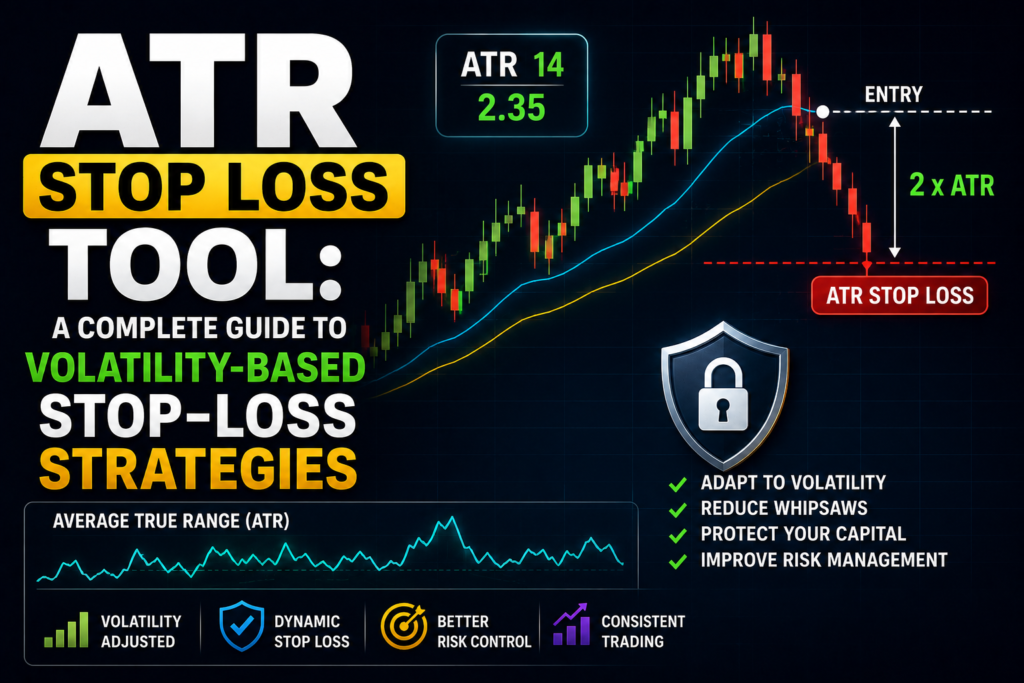

Managing risk is very important in trading; for that you need to use the correct stop-loss. It can be either a number within your risk capacity or a well calculated number. For that you need this ATR stop loss tool. Instead of picking a random price or a fixed percentage, it looks at the market’s sentiments and moves to decide the best stop-loss.
In this comprehensive guide, we’ll explore what an ATR stop loss tool is, how the ATR stop-loss method works, the volatility-based stop-loss formula, and practical ways to integrate this volatility-aware approach into your trading strategy.
What Is the ATR Stop Loss Tool?
The ATR stop loss is a safety net for times when the market’s mood is unpredictable. And instead of using a random number, it looks at the Average True Range (ATR) to see how much the price is actually moving right now.
By using this tool, you don’t need to guess anymore; you would have a more accurate and safer option to choose. And this would stop you from getting kicked out of a winning trade by a tiny price wiggle while still making sure you’re protected if a real crash happens. It’s a simple way to make sure that you’re protected in case the market goes against you.
Understanding ATR and Its Role in Stop-Loss Management
If you want to master the ATR stop-loss tool you first need to understand what is Average True Range (ATR). ATR is the “noise meter” for the market. It doesn’t care if the price is going up or down; it just measures how much the asset is actually jumping around at any given moment.
By smoothing out the price action over a specific time (usually the last 14 candles), it tells you the market’s current mood:
- High ATR: it means that the market is wild and making big, aggressive swings.
- Low ATR: this means that the market is calm, quiet, and steady.
This volatility awareness is exactly what makes the ATR stop loss tool a very important tool, it actually listens to the market instead of just picking a random number.
How the ATR Stop-Loss Method Works
Volatility-Based Stop-Loss Formula
At the heart of the ATR stop-loss strategy is a simple formula:
Stop-Loss = Entry Price ± (ATR × Multiplier)
- Long (buy) trades: Stop-Loss = Entry Price − (ATR × Multiplier)
- Short (sell) trades: Stop-Loss = Entry Price + (ATR × Multiplier)
The multiplier is a user-defined factor that determines how aggressive or conservative your stop-loss printing should be. For example, a multiplier between 1.5× and 3× ATR is commonly used, depending on market volatility and risk tolerance.
This approach is especially effective because:
- It adapts automatically with the market volatility.
- You can avoid getting kicked out by meaningless price movements.
- Your safety net is based on how the price is moving right now.
Why Use an ATR Stop Loss Tool?
Trading is very unpredictable; here you can’t depend on a “one-size-fits-all” stop loss. Most traders have experienced the sting of a trade hitting their stop by a single pip before immediately racing toward their target. Using an ATR stop loss tool can be a game changing move as it:
- It provides truly dynamic risk management. Unlike using a fixed stop (like “always 20 pips”), the ATR stop-loss method expands and contracts based on the current market conditions.
- It helps you stop getting kicked out by “market noise.” Many trades fail not because the market condition was bad, but because the stop was placed inside the normal daily “wiggle” of the price. The ATR stop loss tool helps you widen your stop-loss outside this meaningless noise, ensuring that a small, random price spike wouldn’t ruin a perfectly good trade.
- It forces you to use professional position sizing. Because your stop-loss changes on the basis of market volatility, it also helps in adjusting the position for your trade.
- The logic works across almost every market and timeframe. Whether you are trading Forex, stocks, or crypto, the principle of volatility remains the same. The tool doesn’t care about the asset’s name; it only cares about how much that asset is actually moving, making it a universal tool for any strategy.

How to Use an ATR Stop Loss Tool Effectively
To use the ATR stop-loss tool, you need to understand the basic logic behind volatility-based stop placement. Here’s how:
1. Select Your ATR Timeframe
Most traders prefer to use the standard 14-period ATR setting. If you are a day trader, you can use shorter timeframes or if you are swing trader, go for longer timeframes.
2. Set Your Multiplier
Your ATR multiplier determines how many times the ATR value you want your stop to be. Here’s how normal people pick:
- 1.5× ATR – best when the market is calm or if you prefer tighter stops
- 2× ATR – a perfectly balanced approach not too tight, not too loose.
- 3× ATR or more – use this when the market is highly volatile. It prevents you from being kicked out of a trade too early.
3. Apply the Stop Formula
To find the perfect stop-loss for your trades, just enter the ATR value and the multiplier into the volatility-based stop-loss formula. And it will automatically give you the exact price you’ll put on your chart or trade ticket.
4. Adjust With Price Movement (Optional)
You don’t need to leave your stop-loss at the same place. You can adjust it as the market moves, if the price is rising then you can trail your stop-loss behind the price using the same ATR distance.
Think of it like moving a safety net higher as you climb the ladder, it locks in your wins.
Practical Examples of ATR Stop-Loss Levels
Let’s see an example of how ATR stop-loss tool works:
- Asset: A volatile stock or forex pair
- ATR (14-period): 1.2 units
- Multiplier: 1.5
For a long trade with entry at 100:
Stop-Loss = 100 − (1.2 × 1.5) = 98.2
For a short trade with the same ATR and multiplier:
Stop-Loss = 100 + (1.2 × 1.5) = 101.8
Common Mistakes to Avoid
Even with a professional ATR stop-loss tool, it is easy to fall into common traps. To keep your account safe, you need to avoid these mistakes:
- Going back to the “one-size-fits-all” stop. It’s an old habit of setting your stop-loss at a fixed point. But doing this completely misses the point of using a volatility-based stop-loss.
- Forgetting to adjust your position size. A wider stop-loss during volatility means more at risk. That’s why it’s safer to trade with small positions to avoid big losses.
- Using settings that don’t match your trade. You need to make sure that the tool is looking at the same timeframe as your strategy.
Conclusion
Think of ATR stop loss as a smart safety net that follows the market. Instead of just picking any random price and hoping for the best, this tool analyzes the market’s movements and adjusts your stop-loss to match that energy.
It’s a game-changer tool because it helps you in managing your risk effectively when the market is volatile. No matter what your trading style is, using this method helps you stop guessing and start trading with a lot more confidence.
Insightful Trade is here to help you master these professional habits, providing the guidance you need to trade with total clarity and confidence.
FAQs
- What is an ATR stop loss tool?
It’s a trading calculator that helps traders set their stop-loss levels based on market volatility using the Average True Range indicator. - How does the ATR stop-loss method help traders?
This depends on how the market is actually behaving; it adjusts your safety net accordingly so that you don’t get kicked out of the trade due to minor, insignificant price fluctuations. - Can this method be used on any market?
Absolutely, you can use the tool with all types of financial instruments. Whether it’s stocks, forex, or cryptocurrencies, this method works with every market. - How often should I recalculate ATR stops?
It is recommended to check ATR once before you enter a new trade or whenever the market is volatile.
Author: Kumkum Chandak
Experience: 3+ Years in Trading Research & Market Content Strategy
Kumkum Chandak is a trading content strategist and market research writer who specializes in simplifying technical analysis, trading tools, and strategy-driven educational content. Her work is optimized for EEAT, accuracy, and user intent, ensuring every article delivers practical insights for traders of all levels.
Risk Disclaimer:
All content is strictly educational and not financial advice. Trading involves substantial risk. Always perform your own analysis or consult a professional advisor.
Last Updated: 27 December 2025