
Ever wondered what the trade frequency impact calculation is? The importance of understanding the calculation of the impact of frequency of trade is important to identify the hidden costs brought about by high frequency of execution and the unnecessary cost of overtrading. With the computation of the frequency of entering and exiting trades, you can see the impact on your portfolio and make better choices and hedge your returns without overtrading or death by fees.
Quick summary
| Topic | Simple meaning |
| Trade Frequency | How often do you trade in a set time? |
| Why it matters | More trades can mean more costs. |
| Formula | Trades ÷ Time Period |
| Main risks | Overtrading cost reduces profits. |
| Tool | The calculator shows real trading costs. |
| Goal | Trade smart, not too often. |
What Is Trade Frequency?
Let’s keep it simple. Trade frequency impact calculation informs you of your frequency of trade, or, in other words, your frequency of execution, and why it is important to the profits.
Trade Frequency Impact (%) =
(Cost per Trade × Total Trades) ÷ Total Capital × 100
Formula:
Trade Frequency = sum of Trades/time period.
Example: 20 trades per day = 20/day.
The trick? More trading has the potential to raise commissions and slippage costs of overtrading. Having a trade frequency, therefore, is the way to secure your profits and see the actual cost of trading.

Trade Frequency & Costs: Breaking Down Overtrading Costs
The point is as follows: trade frequency impact calculations are used to visualize the frequency of trade consuming profits. High frequency of execution may augment the overtrading product in:
- Commissions & fees
- Bid‑ask spreads
- Slippage
| Frequency | Cost impact |
| Low (10 trades/month) | ~1% drag |
| Medium (100 trades/month) | ~11% drag |
| High (10,000 trades/month) | ~65% drag |
The takeaway? More trades do not automatically mean more profits — especially when costs compound.
Execution Frequency vs. Performance: The Balancing Act
An increase in more trades does not necessarily translate to increased profits. Impact calculation is an evaluation of the influence of your frequency of execution on your net returns.
Excessive number of trades = increased cost of overtrading due to commissions, spreads, and slippage.
People who are smart in the business world emphasize quality rather than quantity; a few trades, which should be planned, usually result in more trading.
How Overtrading Erodes Profits Over Time
The truth is as follows: overtrading expense is not only charges; it is stress, decision fatigue, and money not allowed to be used in too many trades.
A simple way to see it:
Annualized Trading Cost = Avg Cost per Trade x Number of Trades x Percentage of Capital Utilized.
A cost of 0.5 percent of a trade can devour your profits by 2.4 percent without a murmur, even with 24 trades per annum.
Capital: $10,000
Cost per trade: 0.4%
Trades per year: 200
Total Annual Cost = 0.4% × 200 = 80% turnover impact
Even if a strategy wins 15% annually, excessive frequency may significantly reduce net performance.
Trade frequency impact calculation is important because it enables you to know how many times you should trade an asset to ensure that your frequency of execution does not eradicate your advantage.
Tools & Calculators for Trade Frequency Impact
You do not need to guess the impact of trade frequency on profits. The tools assist in monitoring execution frequency and preventing overtrading costs.
- Trade Growth Calculator—calculates profits and costs.
- Cost Breakdown Calculator—monitors fees, spreads, and slippage.
- Risk-Reward/Position Size Tools—Capital saved.
These applications allow viewing the actual cost of trading and planning better trades.
Practical Data: What Recent Studies Say
It is best to tell it straight; markets are dynamic, and so is trading. Recent studies indicate the following interesting patterns regarding the frequency of execution:
- High-frequency trading (HFT) is able to help narrow the spreads and increase liquidity, reducing the cost to the market.
- But HFT also increases the cost of capital on certain stocks, demonstrating that increased trading does not necessarily yield excellence.
The takeaway? Trade frequency impact calculation can assist even retail traders to identify the lurking costs without eating away the returns.
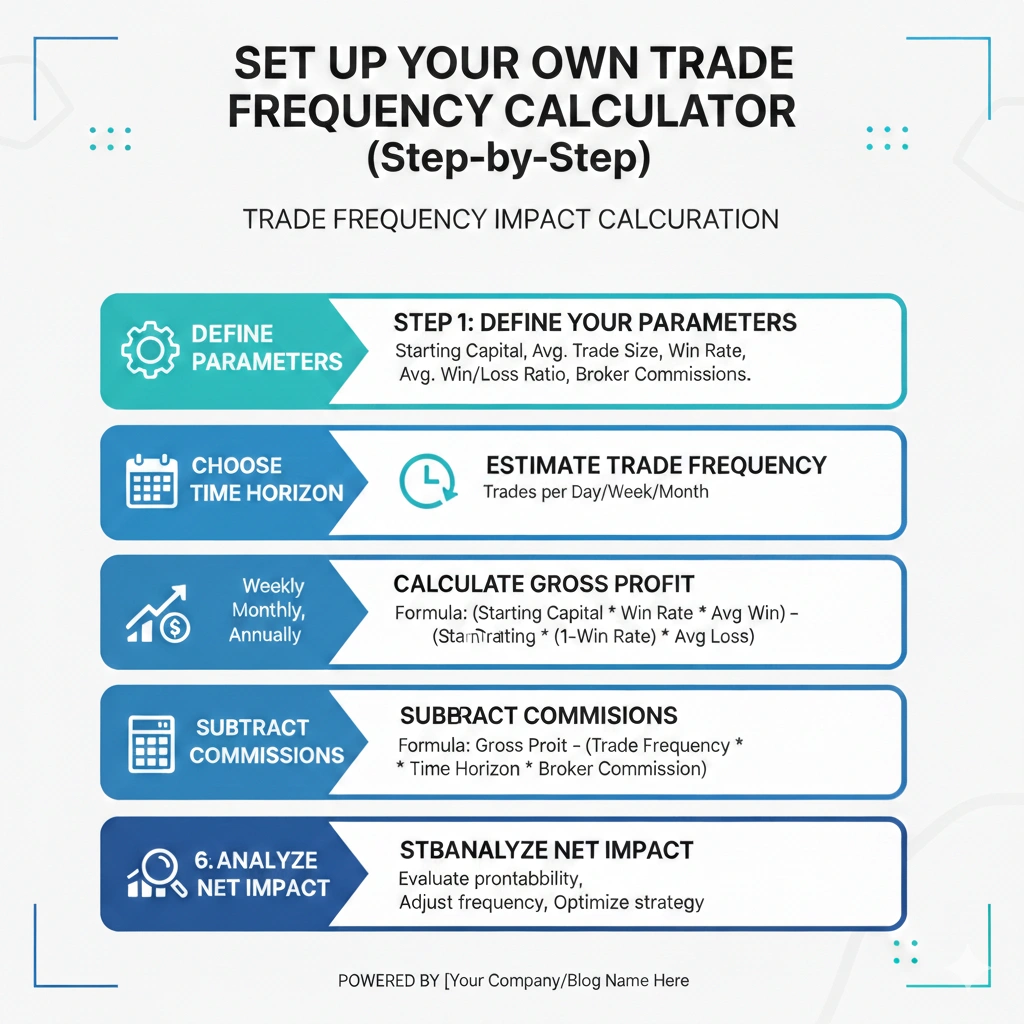
Set up Your Own Trade Frequency Calculator (Step‑by‑Step)
Want to see the influence of the trade frequency impact calculation on your profits? Every step to get your own calculator is not even complicated:
Step 1: List Fixed Costs
- Commission per trade
- Exchange fees
Step 2: Variable Costs Estimation.
- Spread per trade
- Average slippage
Step 3: Pick a Time Period
- Daily, weekly, or yearly
Step 4: Compute the frequency of execution.
- Total Trades ÷ Time Period
Step 5: Total Cost
- Cost of the Total = Fixed + Variable × Total Trades.
Compare this with what you are likely to make now. In case the expected edge exceeds these costs, then your trading frequency is rational. Otherwise, you are incurring a waste of overtrading expense.
Tips to Avoid Costly Overtrading
Profits can be in too many trades. The trade frequency impact calculation displays when your execution frequency is excessively costly.
Smart Tips
- Limit the number of trades you do in a day.
- Monitor your average trade costs.
- Bad setups can be skipped by the use of risk-reward limits.
- Get calculators to direct your trades, and then buy/sell.
- Check the frequency of your trade once a month.
Keep in mind: the increased number of trades does not guarantee increased profit. Calculated trading is always superior to overtrading.

Calculators Every Trader Should Use Now
Want to know how your profits are going to be affected by the trade frequency impact calculation? These tools allow easy monitoring of the frequency of execution and prevent the high cost of overtrading:
- Trade Growth Calculator—trade frequency returns.
- Spread Cost Calculator—indicates the spread impact on each trade.
- Risk-Reward Calculator—verifies trades in advance.
- Commission Comparison Tool—locates brokers with cheaper fees.
- Position Size Calculator—uses risk when trading frequently.
These calculators will provide a clear and data-oriented picture of the costs and profits, and hence, you will be trading better, not faster.
FAQs
1. What exactly is a trade frequency impact calculator?
The tool that measures the impact of your number of trades on cost and net profitability, including fees, spreads, slippage, and frequency.
2. How does execution frequency affect trading performance?
The faster the performance, the higher the execution costs (commission, slippage, and so on) are, and this cost can cut net returns, unless your strategy has an advantage compared to the cost, which should be greater.
3. Can trade frequency be a competitive advantage?
Yes—with massively optimized systems (e.g., HFT), it is possible to capture micro-moves in the execution frequency, but systems are required, and cost discipline is required.
4. Which tool best estimates the cost of frequent trading?
Such tools as spread cost calculators, growth/projection calculators, and commission comparison tools provide you with a quantitative impact of costs before implementation.
5. How do I avoid overtrading costs in my strategy?
Establish entry frequency limits, use risk-reward filters, examine cost breakdowns on a regular basis, and use trade timings to optimize with calculators.
Conclusion
Trade frequency impact calculation helps traders quantify whether their execution frequency supports or weakens long-term profitability. By modeling costs against trade volume, traders can control overtrading risk and improve capital efficiency. The goal is not to trade more — but to trade with a measurable edge after costs.
Realize the potential of your trades with Insightful Trade! Use trade frequency impact calculation tools to follow execution frequency, reduce overtrading costs, and increase your net profits today.
Author: Arihant Jain
Trading Experience: 5+ Years
Arihant Jain is a financial markets analyst and trading educator with expertise in Forex, indices, crypto, and risk-managed trading systems. His insights are based on real trading experience, data-driven analysis, and transparent market understanding. All content is reviewed for accuracy and aligns with Google’s EEAT guidelines.
Risk Disclaimer:
Trading involves substantial risk. All information is for educational purposes only and should not be taken as financial advice. Always do your own research.
Last Updated: 17 February 2026