Introduction
In simple words, supply & demand trading is an insightful approach. It is a price-action plan that focuses on spotting key price levels where selling and buying pressures create imbalances. It is based on the principle that prices move in response to changes in supply and demand.
As a trader, you also prefer supply & demand trading, like others, because it relies on market behavior and institutional activity rather than lagging technical indicators. If you are a beginner, demand zone trading rules can help you in increasing accuracy, preventing chasing, reducing emotional trading, etc. This guide breaks everything down so you understand what supply & demand are and how they help traders. Let’s break it down!

What is supply & demand trading?
So, what exactly is supply & demand trading?
As you all know, it is a price action-based strategy and focuses on identifying zones in the market. To put the demand zone simply, when demand exceeds supply, the price will rise, and in the supply zone, when supply exceeds demand, the price will fall. It may face resistance and drop again if the price revisits this zone. Basically, supply & demand trading aims to capture high-probability moves by aligning trades with natural market forces.
Why is supply and demand trading important?
Now, we’ll discuss the importance of supply & demand trading. Let’s dive in:
- Disclose Institutional Activity: It discloses the areas where institutions placed large orders. It often reacts strongly when prices return to these zones.
- Enhance Risk Management: These zones help you know instantly about where your stop-loss should go, which helps you grow your account more consistently.
- Ignore Indicator Overload: This strategy is built on price clarity; that is why it is extremely important. By ignoring indicator overload, you can easily align your strategy with how smart money actually trades.
- Increases Market Understanding: With supply-demand trading, you can better understand market cycles and clearly see market imbalances, making your overall market analysis stronger and more consistent.
- Works in all markets and time frames: The concept of supply-and-demand trading applies to indices, forex, crypto, stocks, and commodities.
- Trend Reversals and Continuations: It plays a big role in spotting trend continuations and reversals because it reveals where real buying and selling pressure exists.
How to Identify Supply and Demand Zones?
To identify supply zones and demand zones, here are some points for you:
- Look for the base: It usually contains small candles, wicks, or incense. This will help you by letting you know that the market is collecting orders, and you can mark the true origin or imbalance.
- Look for sharp price moves: They usually move before an impulsive move, which shows that institutions placed large orders.
- Use multiple timeframes: If you want to find stronger and suitable supply and demand zones, it can be helpful for you.
- Mark Zone Boundaries: By marking the zone as a rectangle, you can clearly visualize the imbalance originating in the buying or selling.
- Ignore Zones in Sideways: If the market is moving sideways, you should ignore market supply or demand zones and wait for a breakout before knowing valid zones.
How to Trade Supply and Demand Zones Effectively?
- Choose the correct entry point instead of entering immediately.
- For risk management, place stop-loss around zones.
- Profit targets based on opposing zones.
- Integrate trend analysis for higher accuracy.
- Aim for high risk-to-reward ratios.
What support tables should every supply-demand trader keep handy?
Here’s a simple table that you should save:
Pip value & lot size table (common forex pair EURUSD)
| Lot Size | Units | Approx. Pip Value (Per Pip) |
| Standard | 100,000 | $10.00 |
| Mini | 10,000 | $1.00 |
| Micro | 1,000 | $0.10 |
| Nano | 100 | $0.01 |
Tools and Indicators for Supply Demand Trading
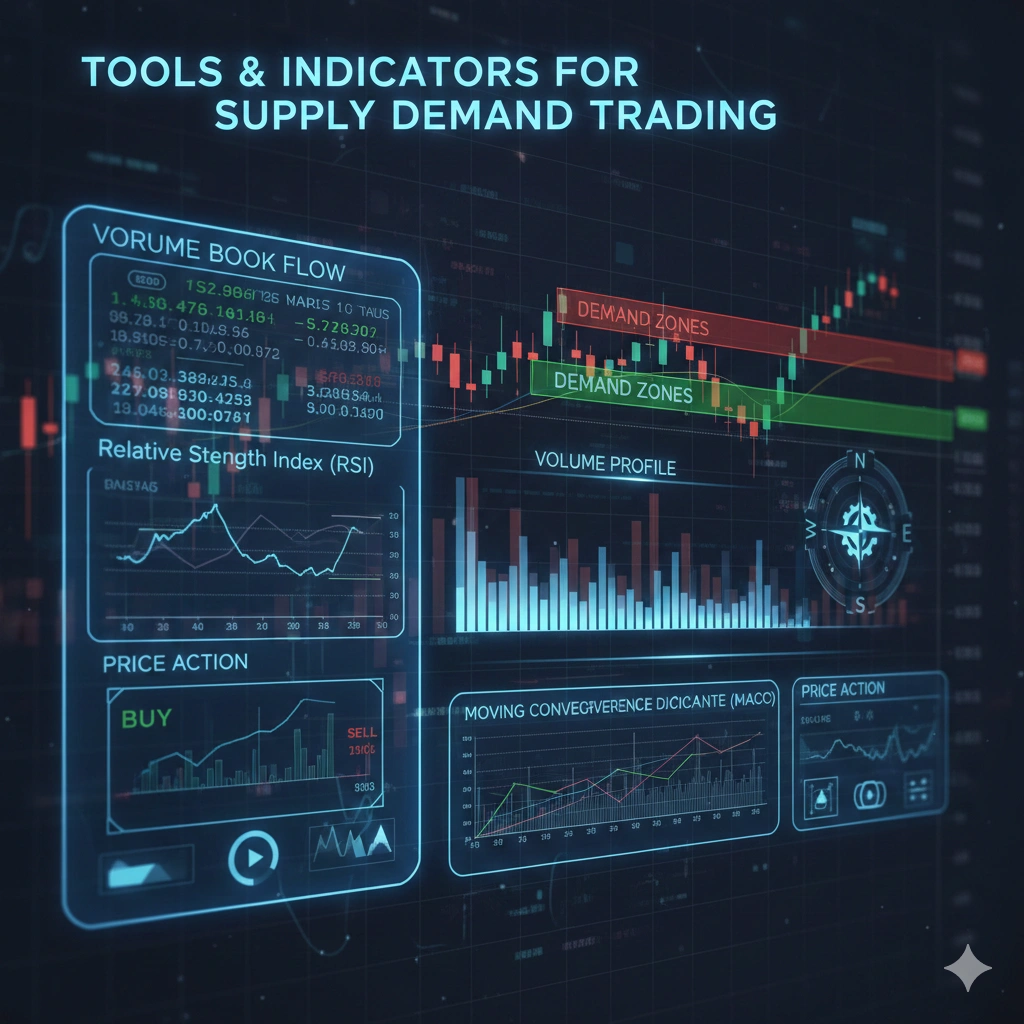
If you’re a trader, then these tools and indicators can make supply and demand trading easy and more accurate for you.
- Drawing Tool: Basically, this tool is used to draw supply-demand zones and works as bread and butter for you.
- Market Structure Indicators: This is the overall pattern of price changes, whether it is high or low, and helps you in aligning entries with the trend.
- Volume Indicators: If you trade in stocks, crypto, or indices, then this one is good for you. High volume indicates strong market participation, while low volume indicates invalidity or weakness.
- Candle Confirmation Indicators: These indicators give you clean and objective entry levels and help you with timing your entries. It highlights moments to make sure that you don’t enter early or miss any strong reversal candles.
What formula can help with position sizing and pip value?
While deciding how many lots to trade, you only need a formula. You can use this formula for position sizing and pip value
Position sizing (USD risk per trade):
Position size (lots): (Account balance * Risk % per trade) / (Stop loss * Pip value per lot)
Pip value example (EURUSD)
For a standard lot (100,000 units), it is $10 per pip (varies with quote currency). For a mini lot (10,000), it is $1/pip, and for a micro lot (1,000), it is $0.10/pip.
Look for a numeric example
- Account: $10,000
- Risk per trade: 1% → $100
- Stop loss: 30 pips
- Pip value (mini lot): $1/pip
Position size = $100 / (30 × $1) = 3.33 mini lots = 0.333 standard lots
In short, if you use this formula, you can get a clear and emotion-free number.

What Are Common Mistakes to Avoid in Supply & Demand Trading?
By avoiding these mistakes, you can improve your confidence and accuracy in your trading:
Mark Zones Wrong
- If you mark your zones incorrectly, your entries will be weak.
- To avoid this mistake, you should mark the origin of strong moves.
Rely on Zones
- You can lose if you only depend on zones without any context because supply & demand are not sufficient by themselves.
- So accurate and careful drawing of zones is necessary.
Misinterpreting Breakouts
- Also, you often misinterpret breakouts through thin liquidity areas, which can trap traders into false breakouts.
- So, wait for the volume confirmation and check the depth of liquidity that can help in preventing losses.
Letting Emotions Take Over
- If you let your emotions take over, it will influence your trading decisions, which can be the biggest mistake.
- You can avoid this mistake by following a clear plan and sticking to your risk rules.
Overleveraging
- Next is overleveraging, which can ruin the best trading setups. It can prove a dangerous mistake in supply & demand trading because trading with too much risk can amplify losses.
- To avoid this mistake, you should stick to one fixed risk percentage to protect your trading capital.
Overall, if you avoid these mistakes, it will lead to better decision-making, improve long-term profitability, and your confidence will grow naturally.
How can beginners practice and back test a supply & demand trading strategy?
- Learn Zone Identification
- Use Software and Indicators
- Use Demo Accounts
- Start Small with Live Trading
- Keep a Trading Journal
- Evaluate Zone Quality
- Avoid Curve Fitting
FAQs on Supply & Demand Trading
What timeframes work best?
It totally depends on the style and goals of your trading. If you are a full-time trader, use 15 minutes to 1 hour for precise entries or higher timeframes for 4-hour charts.
Can it be used for stocks, forex, and crypto?
Yes, of course, supply and demand trading can be used for stocks, forex, and crypto because price imbalances occur in these financial markets. So, it is a reliable and versatile strategy for these markets.
How to avoid false zones?
To avoid false zones, you should use multi-timeframe confirmation, avoid common traps, check zone quality, and wait for the price action confirmation.
How do I know if a supply or demand zone is still valid?
A zone is generally considered valid if the price rejects them on retest. Zones are valid if there are strong formation traits, retest reactions, and no significant breach.
Is supply & demand trading suitable for beginners?
If there is proper education and practice, it is suitable for beginners because it has a simple core concept, uses naked charts, and is versatile across markets.
Conclusion
After journeying through the whole supply-demand guide. Give it a try, where big traders create real price magic. Prices go up when demand crushes supply, or supply floods in to slam them down. In short, supply-demand trading is essential for you; it empowers informed, disciplined decisions rooted in economics, delivering reliability where others falter.
Are you also ready to zone in and trade like the pros?
Feel free to explore more with Insightful Trade to master supply & demand trading and trade with confidence in any market. Elevate your trading today!
Author: Arihant Jain
Trading Experience: 5+ Years
Arihant Jain is a financial markets analyst and trading educator with expertise in Forex, indices, crypto, and risk-managed trading systems. His insights are based on real trading experience, data-driven analysis, and transparent market understanding. All content is reviewed for accuracy and aligns with Google’s EEAT guidelines.
Risk Disclaimer:
Trading involves substantial risk. All information is for educational purposes only and should not be taken as financial advice. Always do your own research.
Last Updated: 2 December 2025