

Quick Summary
Order filling logic in trading are the hidden factors that turn your trade request into reality. Many traders spend most of the time on indicators, but they ignore how the execution process actually works. Frustration like slippage, partial fills and latency are usually built into the market’s logic, rather than being a mistake in your strategy. In this blog, you’ll get to learn what are these factors that affect your trade execution, how to handle them and how to improve your performance by finally understanding the structure behind your trades.
Order filling logic in trading refers to the structured process that determines how, when, and at what price your order gets executed in the market.
It includes order routing, matching engine rules, liquidity availability, and execution speed.
Understanding this helps traders reduce slippage and improve real trade performance.
Key Insights at a Glance
| Component | What It Does | Why It Matters |
| Order Type | Defines how trade is executed | Affects price certainty |
| Order Matching | Pairs buyers and sellers | Determines fill speed |
| Market Depth | Shows available liquidity | Impacts slippage |
| Execution Model | Broker routing structure | Influences trade outcome |
| Latency | Speed of order transmission | Affects fast markets |
| Documentation | Records trade details | Supports compliance |
What Is Order Filling Logic in Trading?
The order filling logic is a simple rulebook that decides how and when your trade actually happens. The moment you hit buy or sell your order starts a structured journey to find a matching buyer or seller.
This process includes:
- Sending the order
- Picking a trading hub
- Finding a similar trade
- Setting the price
- Closing the deal
If you want to get your desired trade, then you must follow each step. By the time you understand the logic behind this you’ll have more clarity about why the final results sometimes look a bit different from what you expected.
The Trade Execution Process: Step-by-Step
To understand order filling logic in trading, we must break down the trade execution process.
1. Order Placement
First your step is to select the type whether it’s a market, limit, stop, or a stop-limit order.
2. Transmission
Then your order is transferred from your trading app to your broker’s server.
3. Routing
The broker then sends your request to a specific marketplace, like an exchange or a big bank.
4. Order Matching
Then the process of order pairing begins, they match your request with someone who wants the opposite side of your trade.
5. Confirmation
Once a match is found, the trade is finalised and you get the official confirmation.
This structured trade execution process determines how efficiently your trade is filled.
How Order Matching Works
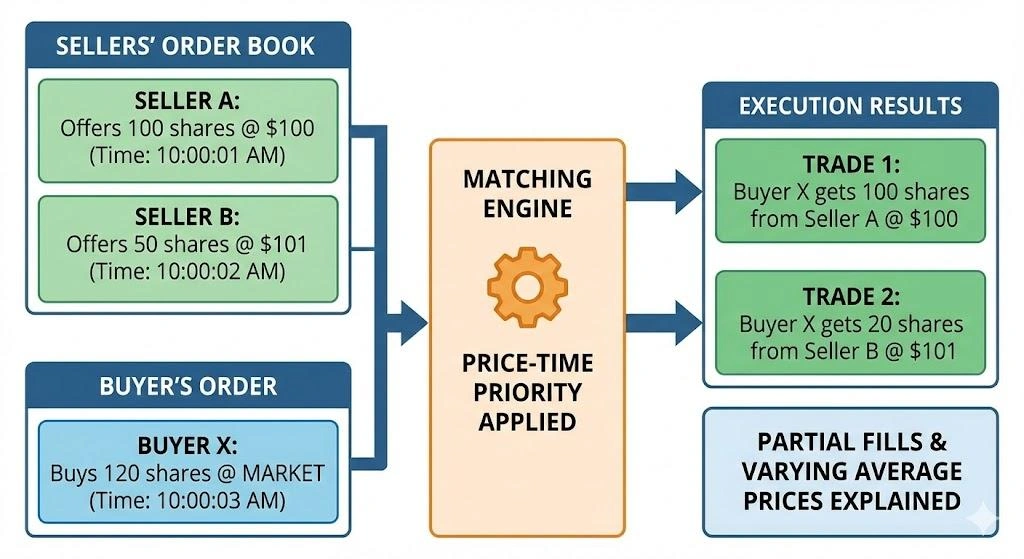
Matching is the process behind how every trade is filled. Most systems follow a simple price-time priority rule:
- The best price always gets picked first
- And if two are the same, the one that came first is picked.
- Most exchanges like NSE follow FIFO (First In, First Out) under price-time priority, meaning earlier orders at the same price get filled first.
For example:
- Seller A offers at $100
- Seller B offers at $101
- Your buy order at market will fill at $100 first
If Seller A has only partial quantity available, your order may:
- Fill partially at $100
- Fill remaining portion at $101
This explains why you occasionally see partial fills or end up with an average price that is different from the one you originally wanted.
Market Orders vs Limit Orders in Order Filling Logic
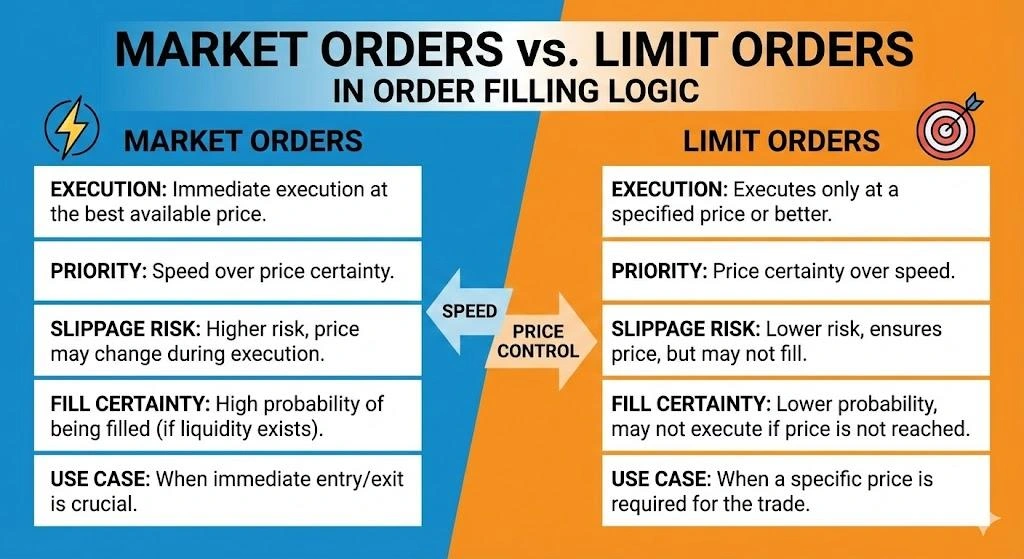
Each order type has their own way of processing during execution like:
Market Orders
- Execute immediately
- Accept best available price
- Higher risk of slippage
Here the priority is getting the order filed, not a certain price limit.
Limit Orders
- Execute only at specified price or better
- May not fill
- Lower slippage risk
Here the price of the equity or asset is prioritized over the certainty of getting a trade done.
Understanding this difference is the secret to mastering the real logic behind how your orders get filled.
Liquidity and Its Role in Order Matching
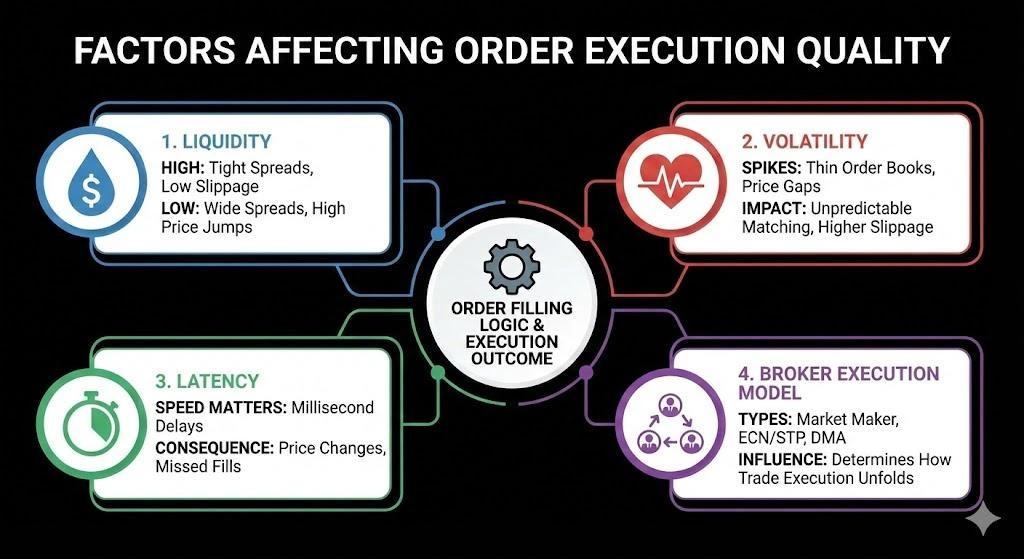
Liquidity means the number of active buyers or sellers present at various price levels.
High liquidity:
- Tighter spreads
- Lower slippage
- Faster trade complication
Low liquidity:
- Wider spreads
- Greater price jumps
- Increased execution variability
The logic behind order filing heavily depends on how deep the market is. When the market is low it is always hard to predict your final results.
Slippage and Order Filling Logic in Trading
Slippage means the price at which your order is filled is different from the one you originally requested. In the trade execution process, this gap often happens because:
- Price moves too fast during transmission
- Liquidity vanishes
- Large orders exceed available depth
It’s not necessarily negative, there are some positive sides also like you get a better pricing if the market moves in your favour. If you try to understand this through the lens of order filling logic makes it less mysterious and more manageable.
Latency: The Invisible Factor
The difference of time when you apply an order and your order actually get executed is called latency. Even a split second can make a huge difference.
High latency can cause:
- Price changes before matching
- Missed fills
- Execution at inferior prices
In high speed trading the logic of how orders are filled is tied directly to the quality of your technology and internet setup.
Order Filling Logic During Volatility
When the markets are volatile it becomes difficult for orders to get completed.
During volatility spikes:
- Order books thin out
- Price gaps appear
- Order matching becomes less predictable
Then the orders get hit by heavy slippage. You should adjust your position size and order type to stay safe.
Partial Fills: Why They Happen
Partial fills occur when:
- When there isn’t enough liquidity at the chosen price
- Your order is bigger than the available market depth
So, rather than cancelling the trade the system just fills it wherever it can. This is the standard part of order filling logic in trading especially when you are trading assets that aren’t very active.
Risk Management and Execution Awareness
How your trades are filled changes your whole risk math.
For example:
- A 1% stop-loss becomes 1.3% if slippage adds 0.3%
- Your trade size must be based on the real market conditions
Knowing how orders fill makes your risk management much more precise.
Regional Considerations: India
In India, traders operate across:
- NSE and BSE for equities
- International brokers for forex and global indices
Execution quality depends on:
- Exchange infrastructure
- Broker routing
- Internet reliability
Maintaining detailed execution logs supports both performance tracking and compliance requirements. During high-impact events like RBI policy announcements or Union Budget sessions, liquidity can thin rapidly on NSE, leading to wider spreads and partial fills.
Traders should be especially cautious with market orders during such periods.
Compliance and Documentation
Keeping solid records helps you maintain everything clearly and transparently.
Traders should record:
- Order type
- Timestamp
- Requested price
- Executed price
- Slippage amount
- Broker confirmation
These records help in:
- Reviewing your strategies
- Sorting out any dispute
- Following the official rules
Understanding the procedure of how orders are filled helps you build much better reporting habits.
Improving Order Execution Performance
To analyse your trades process:
- Use the right order types for each setup
- Avoid over sizing the position in low liquidity market
- Keep tracking how active buyers and sellers are
- Understand how many flows in different sessions
- Review your brokers execution reports regularly
Being aware of how your trades are being handled gives you a real edge over time.
Tools That Support Execution Transparency
Tools that can help you get the perfect entry in the trade:
- Slippage analytics
- Execution speed reports
- Market depth view
- Order history exports
- Volatility alerts
These tools help you track the execution process so that you can adjust your strategies based on real data.
Real Example of Order Filling Logic
Suppose you place a market buy order for 500 shares, but only 200 shares are available at the best price. The remaining 300 shares may be filled at higher levels. This results in an average price different from what you saw on screen.
This is not broker manipulation, it is simply how matching engines work in live markets.
Conclusion: Order Filling Logic in Trading
To end with, order filing is one of the major steps of trading that can affect the overall performance and traders often ignore it. The execution process and matching system dictates how your strategy turns into real results. In an order execution things like liquidity, order type and volatility all play a very important role. When you learn how orders are matched, why slippage happens and how models work, you can make much smarter choices. For better understanding and learning how to execute your order perfectly you can connect with Insightful Trade.
FAQs: Order Filling Logic in Trading
1. What is order filling logic in trading?
It’s a simple set of rules that decide how your buy or sell orders get matched and completed in the market.
2. Why does slippage happen in the trade execution?
There are two main reasons behind slippage: first when the liquidity is low or otherwise when the price jumps too fast for you to catch.
3. Can I control order matching?
You can’t control the system, but you can manage the results by selecting a smart order type and right size position.
4. How should Indian traders document execution details?
To maintain proper documentation you need a clear log of timestamps, prices and broker notes. It will help you to stay compliant and review your performance overtime.
Author: Kumkum Chandak
Experience: 3+ Years in Trading Research & Market Content Strategy
Kumkum Chandak is a trading content strategist and market research writer who specializes in simplifying technical analysis, trading tools, and strategy-driven educational content. Her work is optimized for EEAT, accuracy, and user intent, ensuring every article delivers practical insights for traders of all levels.
Risk Disclaimer:
All content is strictly educational and not financial advice. Trading involves substantial risk. Always perform your own analysis or consult a professional advisor.
Last Updated: 14 February 2026

