Introduction
Every financial market moves in trends, but no trend continues forever. After a strong upward or downward move, prices often return toward their average value before deciding their next direction. This natural behavior is the foundation of mean reversion trading, a widely used approach among forex traders who seek opportunities after prices become overextended. Instead of chasing aggressive market moves, this strategy focuses on recognizing when currency pairs have moved too far from their normal range and may be ready for a correction.
Understanding how prices behave over time allows traders to make better decisions without relying on emotions. Market participants often react strongly to economic news, central bank announcements, and geopolitical events, causing temporary price imbalances. These situations can create excellent trading opportunities for disciplined traders who understand price behavior. Rather than assuming every breakout will continue indefinitely, experienced traders evaluate whether a move has become excessive and whether the market is likely to return closer to its historical average.
Understanding the Concept Behind Mean Reversion
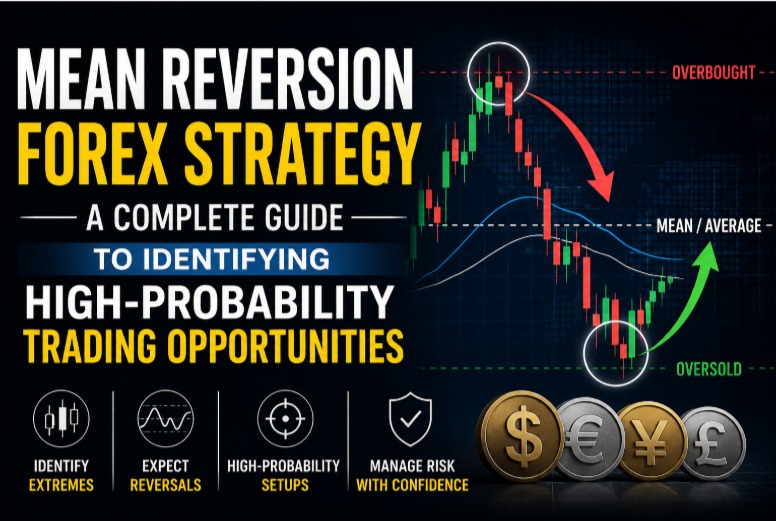
The core idea behind mean reversion trading is that prices naturally fluctuate around an average value over time. While markets can experience strong trends, they rarely move endlessly in one direction. After periods of unusually high buying or selling pressure, prices often stabilize and retrace before establishing a new trend.
This concept works because financial markets are influenced by both institutional investors and retail traders. Emotional reactions frequently push prices beyond their fair value, creating temporary inefficiencies. Once emotions settle and new information is absorbed, the market often returns toward a more balanced price level.
Successful traders understand that this approach is not about predicting exact tops or bottoms. Instead, it focuses on identifying situations where the probability of a price correction becomes significantly higher than continued movement in the same direction.
Why Price Corrections Happen in Forex Markets
The foreign exchange market is one of the most liquid financial markets in the world. Even with high liquidity, prices regularly experience temporary imbalances caused by economic releases, interest rate decisions, employment reports, or unexpected geopolitical developments.
These events often create sharp movements that eventually lose momentum. As buying or selling pressure decreases, profit-taking begins, and new market participants enter positions at more attractive prices. This process contributes to forex reversals, allowing the market to return closer to equilibrium.
Not every strong movement leads to an immediate correction, but recognizing the conditions that increase the likelihood of forex reversals helps traders avoid entering positions too late during extended trends.
The Importance of Technical Confirmation
Although price behavior provides valuable information, successful traders rarely depend on price action alone. They combine multiple technical indicators to improve the quality of their analysis and reduce unnecessary risk.
Moving averages help identify the average price over a selected period, while oscillators such as the Relative Strength Index and Stochastic Oscillator measure momentum and overbought or oversold conditions. Bollinger Bands are also commonly used to determine whether prices have moved unusually far from their average range.
Using several technical indicators together creates stronger confirmation than relying on a single signal. When different analytical tools suggest the same conclusion, traders gain greater confidence before entering a position.
Risk management remains equally important because no indicator guarantees accurate predictions in every market condition.
Identifying High-Probability Entry Zones
Finding quality entry points requires patience and discipline. Many beginners attempt to enter trades simply because prices have risen or fallen sharply. However, experienced traders wait for confirmation before taking action.
A strong trading opportunity often develops after a prolonged directional move begins losing momentum. Candlestick patterns, declining volume, or weakening momentum indicators may suggest that buyers or sellers are becoming exhausted.
These situations frequently develop into reliable forex setups when several technical conditions align simultaneously. Instead of reacting emotionally, traders evaluate whether the probability of a correction justifies the potential risk.
Waiting for confirmation helps reduce unnecessary losses while improving overall consistency.
The Role of Market Cycles in Price Behavior
Financial markets move through repeating phases of expansion, contraction, accumulation, and distribution. Understanding these market cycles allows traders to recognize whether current price movement reflects normal volatility or an unusually extended trend.
During strong trending environments, corrections may remain relatively small before the primary trend resumes. In ranging markets, however, prices often move repeatedly between support and resistance, creating favorable conditions for reversal-based strategies.
Recognizing market cycles helps traders adjust their expectations instead of applying identical strategies under every market condition. Flexibility often separates consistently profitable traders from those who rely on fixed rules regardless of changing market behavior.
Managing Risk During Reversal Trades
Risk management is the foundation of every successful trading strategy. Even when market analysis appears convincing, unexpected economic events can quickly invalidate a trading idea.
Professional traders determine their stop-loss levels before entering positions and calculate appropriate position sizes according to their account balance. They avoid risking excessive capital on a single trade because no strategy produces perfect results.
Maintaining favorable risk-to-reward ratios allows traders to remain profitable even if only a portion of their trades succeed. Consistency over hundreds of trades matters far more than attempting to maximize profits from individual positions.
Developing this disciplined approach helps reduce emotional decision-making while improving long-term performance.
Combining Analysis for Better Decision Making
The most reliable trading decisions come from combining several forms of market analysis instead of depending on one signal alone. Price action, support and resistance, momentum analysis, and economic awareness work together to create a complete picture of market conditions.
Many traders also monitor higher timeframes before entering positions on shorter charts. This approach helps identify whether a short-term correction aligns with the broader market direction or moves against a dominant trend.
When multiple forms of analysis support the same conclusion, confidence naturally increases while unnecessary trades become easier to avoid.
Common Mistakes Traders Should Avoid

Many beginners assume every sharp price movement will immediately reverse. In reality, markets can remain overbought or oversold for much longer than expected. Entering trades too early often results in avoidable losses.
Another common mistake involves ignoring economic calendars. High-impact news releases frequently create significant volatility that temporarily overrides technical analysis. Traders who remain aware of upcoming events can better prepare for sudden market movements.
Overtrading also reduces long-term performance. Waiting patiently for higher-quality opportunities generally produces better results than attempting to participate in every price fluctuation.
Developing discipline and following a structured trading plan ultimately contributes more to success than constantly searching for new strategies.
Building Long-Term Consistency
Successful forex trading is not about predicting every market movement correctly. Instead, it focuses on following a repeatable process supported by sound analysis, disciplined execution, and responsible risk management.
Keeping detailed trading journals helps identify strengths and weaknesses over time. Reviewing completed trades allows traders to recognize recurring mistakes while reinforcing successful habits. Continuous learning and gradual improvement contribute significantly to long-term consistency.
As market conditions evolve, traders who remain adaptable while maintaining disciplined execution often achieve better results than those who rely solely on intuition or emotions.
Conclusion
Understanding price behavior is essential for anyone seeking long-term success in the foreign exchange market. By learning how prices return toward their historical averages, traders can identify opportunities that many market participants overlook. A disciplined approach to mean reversion trading combines patience, analytical confirmation, and effective risk management to improve decision-making under changing market conditions.
Recognizing potential forex reversals, evaluating multiple technical indicators, understanding evolving market cycles, and waiting for reliable forex setups all contribute to higher-quality trading decisions. While no strategy guarantees success, combining education, discipline, and continuous practice provides a strong foundation for navigating the forex market with greater confidence and consistency.