Quick Summary
Are you trading forex? As a trader, it is very important to know how you can use your money safely and legally while trading. In India, forex payment methods are strictly regulated. Therefore, you can withdraw or deposit your funds only through INR-based payment methods with brokers who are registered with SEBI.
The payment options include net banking, UPI, IMPS, RTGS, NEFT, and transfers directly from your bank account. Let’s move on to the available forex payment methods India.

What Are the Forex Payment Methods India?
Coming to the next step, the forex payment methods India are commonly used legal methods by traders to deposit and withdraw funds from Forex trading. Forex payment methods India ensure transparency and regulatory safety and act as a bridge between your bank account and trading account. India has restrictions on:
- Non-INR Currency pairs
- Foreign remittances
- Margin trading with overseas brokers
Which Forex Payment Methods India are Legal?
Here are some Forex payment methods India that are legal with low risk. Let’s quickly see:
| Payment Method | Legal Status | Speed | Risk Level |
|---|---|---|---|
| Indian Bank Transfer | Allowed | 1-2 days | Low |
| UPI | Allowed | Instant | Low |
| Net Banking | Allowed | Instant-24 hrs | Low |
| Debit Cards | Partially Allowed | Instant | Medium |
Some of the forex payment methods India that are not allowed or restricted are
- Credit cards
- Crypto payments
- Paypal for trading
- Skrill / Neteller
How Do Forex Deposits Work for Indian Traders?
Let’s simplify how it works for Indian traders step by step:
- Choose a broker who is registered under SEBI and offers INR accounts.
- Complete your KYC & bank account verification, because deposits are accepted only from your own bank account.
- Deposit funds in INR; forex trading in India only allows INR-based pairs.
- Use methods such as UPI, net banking, bank transfer, NEFT, RTGS, or IMPS, which is one of the best deposit methods forex India.
- Money will be deposited into a segregated client account as per SEBI rules and converted into trading margin.
How Do Forex Withdrawals Work in India?
Being a trader and not wanting to face issues like others and wanting a safe withdrawal process, then follow the things given below:
- Withdraw funds only to the same account used for deposits.
- Withdrawals are processed in INR.
- The broker verifies your KYC and bank details.
- Payment will be made through NEFT/RTGS/IMPS and sent to your linked bank account.
- It usually takes 2-5 working days or the same day.
What Is the Best Forex Payment Method in India?
If we talk about the best forex method in India, bank transfer and UPI are considered as best methods. Want to know the reason? The reasons are given below:
Why UPI
- Compliant with RBI, which makes it legal and safe for Indian traders.
- Reduce trading costs because most transactions done through UPI are free.
- The success rate is high compared to cards and wallets.
- Provides two-factor authentication security to protect your funds.
- Directly linked to your Indian bank account.
Why Bank Transfer
- It offers the most transparent and safest way to fund forex trading.
- It costs less than cards or e-wallets.
- Reduces the chance of fraud and chargeback risks.
- Easy to track, which helps to resolve any dispute or tax reporting.

How Do Forex Payment Methods India Affect Trading Costs?
Table to compare costs
| Method | Deposit Fee | Conversion Fee | Withdrawal Fee |
| Bank Transfer | ₹0–₹500 | Low | Low |
| UPI | Usually Free | Low | Free |
| Crypto | Volatile | Very High | Risky |
| Wallets | High | High | High |
Real Market Example: EURUSD Trade Using Indian Payment Method
Let’s understand it simply with a practical EURUSD example. If you are an Indian trader and deposit ₹10,000 via an INR bank transfer into a broker that supports Indian accounts. The broker can convert the amount into $120, and the transaction is fully compliant with RBI guidelines.
- Lot size: 0.10
- Move: 50 pips
- Pip Value: $1 per pip (0.10 lot)
To calculate profit:
50 pips * $1 = $50
Forex Lot Size, Pip Value & Payment Impact Table
| Instrument | Lot Size | Pip Value | Recommended Payment |
| EURUSD | 0.01 | $0.10 | Bank/UPI |
| US30 | 0.01 | $0.50 | Bank Transfer |
| XAUUSD | 0.10 | $1 | INR Account |
| GBPUSD | 0.10 | $1 | Bank Transfer |
Formula: How Deposit Size Impacts Risk
Your deposit or account balance directly impacts risk. Here’s a quick formula for risk management:
Risk amount = Account Balance * Risk Percentage per Trade
Suppose that your deposit is ₹200,000 and your risk is 1% per trade; then the risk amount is
200,000 * 0.01 = ₹2,000.
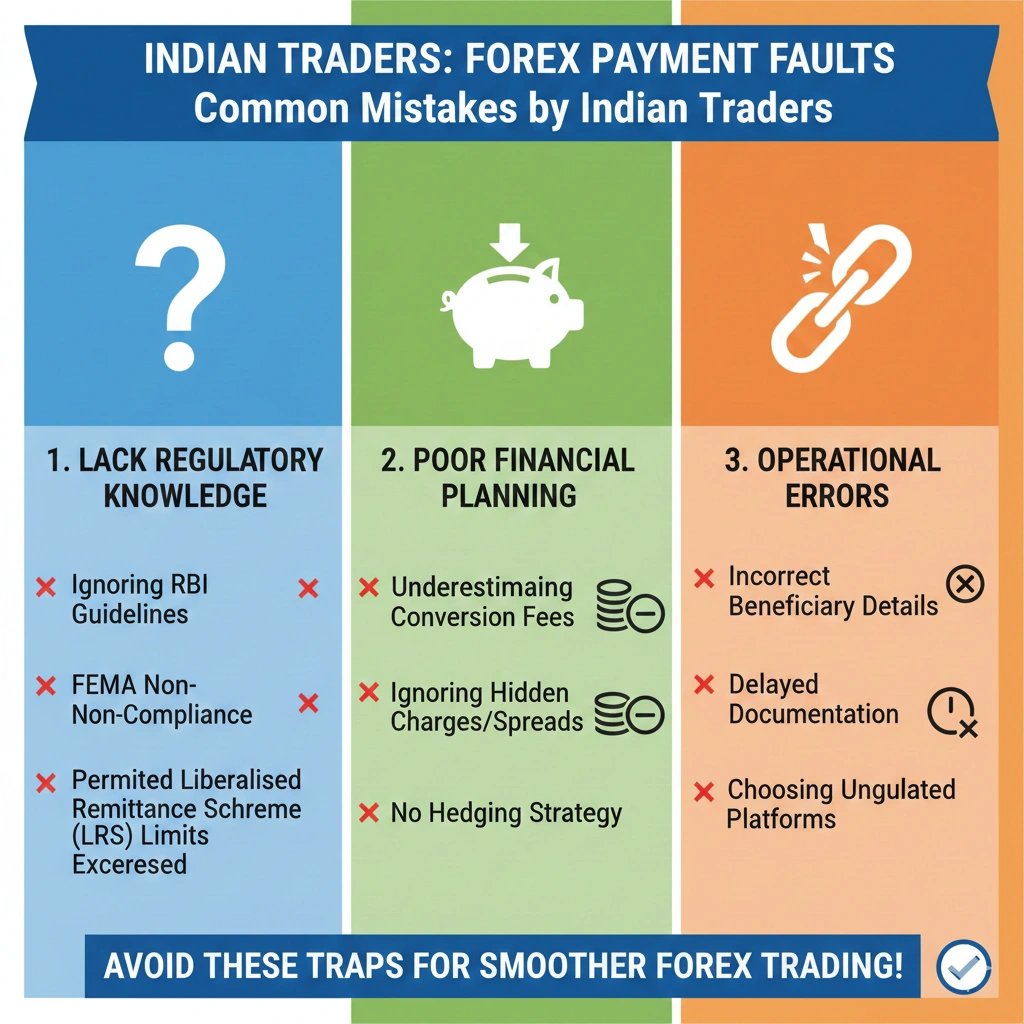
What Are Common Mistakes Indian Traders Make with Forex Payments?
- If you’re using unregulated offshore brokers, then it leads to stuck withdrawals or blocked deposits.
- Another mistake is using crypto or international wallets that can lead to frozen accounts.
- If you ignore INR-based account options and trade with USD-only brokers.
- Not verifying KYC properly can cause rejections or delays.
- If you use credit cards for deposits, that can lead to transaction failure, and the charges are also high.
Pro tip: To avoid payment issues and stay compliant, always use bank transfer or UPI with SEBI-registered brokers.
FAQs: Forex Payment Methods India
1. Are forex payment methods legal in India?
Yes, if the payment methods are regulated through RBI and SEBI. If you send money using restricted methods, such as credit cards or unregulated brokers, it may result in penalties.
2. Can Indian traders use UPI for forex trading?
Only with SEBI-registered Indian brokers who offer INR-based currency derivatives. But UPI is only allowed for deposits, not for withdrawals.
3. Are Skrill or Neteller allowed for forex in India?
No, under RBI and SEBI rules, it is not officially allowed. If you try to send money abroad via Skrill or Neteller to unregulated brokers, it will be considered non-compliant.
4. Can I use crypto to fund forex trading?
No, you cannot use cryptocurrency to fund forex trading in India because it is not permitted by the RBI and SEBI. Using bank transfers or SEBI-approved payment methods will be a great choice for compliant forex trading.
5. What is the safest forex payment method in India?
The safest forex payment method in India is a direct bank transfer through RTGS, NEFT, or IMPS, which is fully compliant with RBI, SEBI, and FEMA regulations and reduces the risk of fraud.
Final Thoughts: Choosing the Right Forex Payment Method in India
Choosing one of the right forex payment methods India ensures smoother transactions and legal compliance and also protects you from forex-related scams in India. It is not just about your convenience, but it also gives you peace of mind by providing you with safety and legality. Always choose safe forex payment gateways that support transparent conversion, INR deposits, and direct bank withdrawals.
Forex trading already carries market risk, or it will be better to ask yourself a question before choosing any payment method: Is the payment method legal and transparent in India? After getting a clear answer, trade smarter and improve your trading strategy with Insightful Trade’s expert guidance, which helps you to trade in the right way. Learn to be safe and avoid scams by choosing trusted deposit options.
Author: Arihant Jain
Trading Experience: 5+ Years
Arihant Jain is a financial markets analyst and trading educator with expertise in Forex, indices, crypto, and risk-managed trading systems. His insights are based on real trading experience, data-driven analysis, and transparent market understanding. All content is reviewed for accuracy and aligns with Google’s EEAT guidelines.
Risk Disclaimer:
Trading involves substantial risk. All information is for educational purposes only and should not be taken as financial advice. Always do your own research.
Last Updated: 23 December 2025