Quick Summary
The difference between demo and live feed is a great reason for confusion among many traders. It’s common for a strategy to succeed in a demo account but fail when used in real trading. While we often blame our mindset for any mistake, the real culprit in this is technical execution. Demo accounts offer a perfect world, whereas live feeds handle the messy reality of liquidity and broker constraints. Understanding this difference between the two is important to select the right broker and strategies and manage risk efficiently.
Demo vs Live Feed Comparison Table
| Aspect | Demo Feed | Live Feed |
| Pricing Source | Simulated / averaged | Real-time liquidity |
| Order Execution | Idealized | Market-dependent |
| Slippage | None or minimal | Variable |
| Liquidity Constraints | Ignored | Enforced |
| Broker Risk Management | Disabled | Active |
| Demo vs Live Feed Difference Impact | Hidden | Visible |
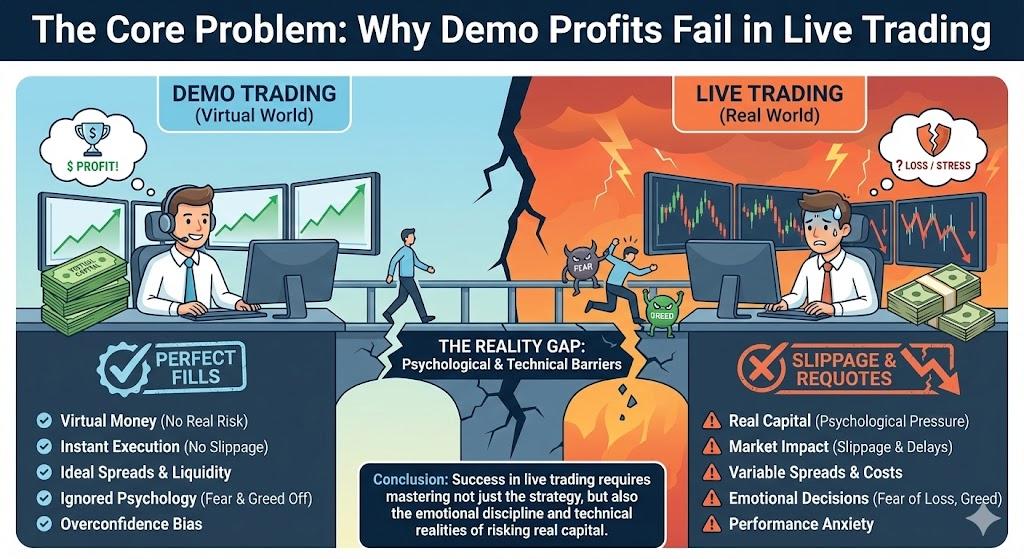
The Core Problem: Why Demo Profits Fail in Live Trading
It’s a pattern that every trader knows:
- Your strategy work well in the demo
- Risk levels look solid
- Execution feels effortless
But the moment you switch to real money:
- Slippage starts biting
- You’re always a step behind
- Stops get hit
You might think it’s just your nerves, but it’s not just psychology. The technical difference between demo and live data feeds is often the real reason for the shift.
What Is the Demo vs Live Feed Difference?
The difference between a demo and the real market is the gap between how prices look on a demo account and how they actually act when you are trading for real.
They’re different because:
- Demo feeds don’t use real orders from the market
- Your trades aren’t being matched with real people or firms
- The broker’s safety rules aren’t being used
- Your trade is just being pretended, not actually negotiated
Because of this, you will see better results on the demo than you will when you start with real cash.
Why Demo Pricing vs Live Feeds Exist
Purpose of Demo Accounts
Demo accounts are built to help you:
- Learn how to use trading platforms
- Practice your own strategies
- Understanding the cost of trading
They aren’t this perfect copy of the real market, but they are still helpful in learning.
Live Feeds Reflect Market Reality
Live feeds must account for:
- Actual demand and supply
- Your place in the order line
- Price jumps during wild markets
The gap between demo vs live feed is created by intention, not by error.
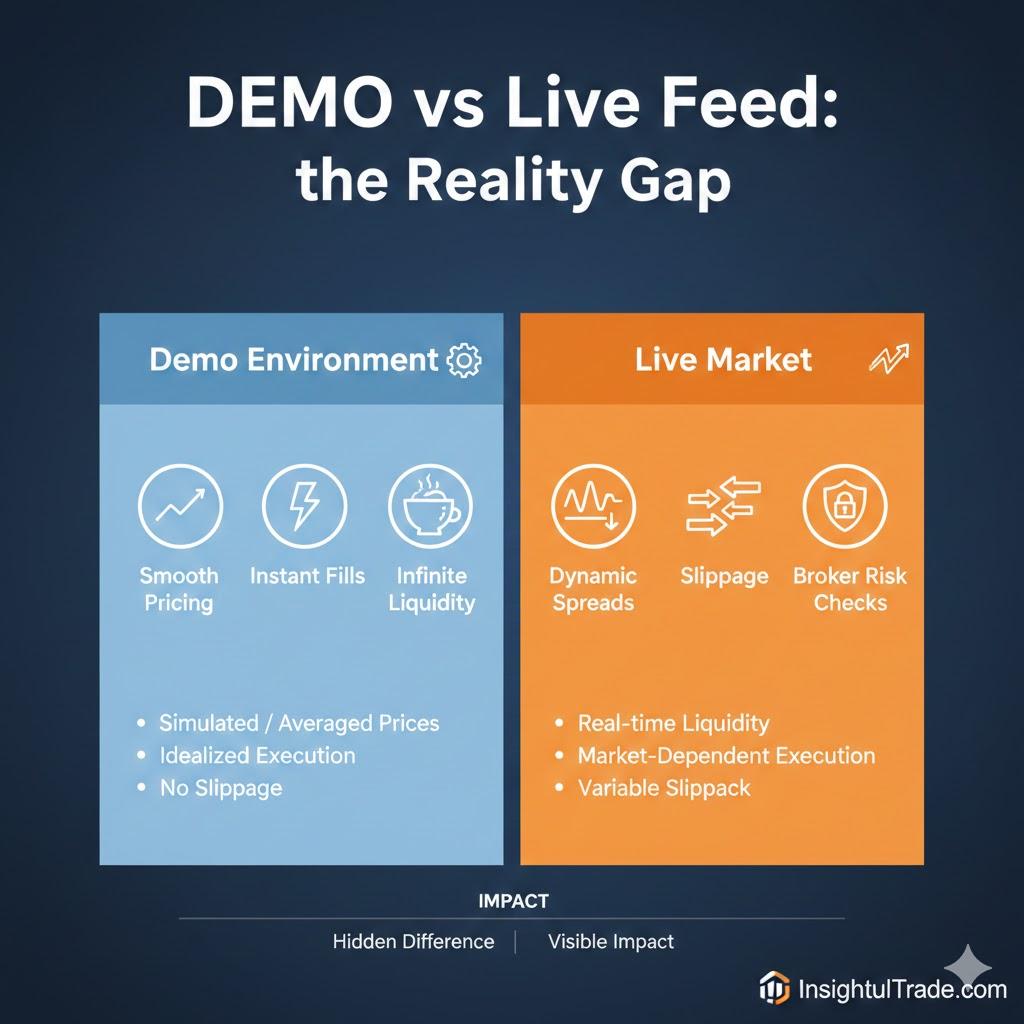
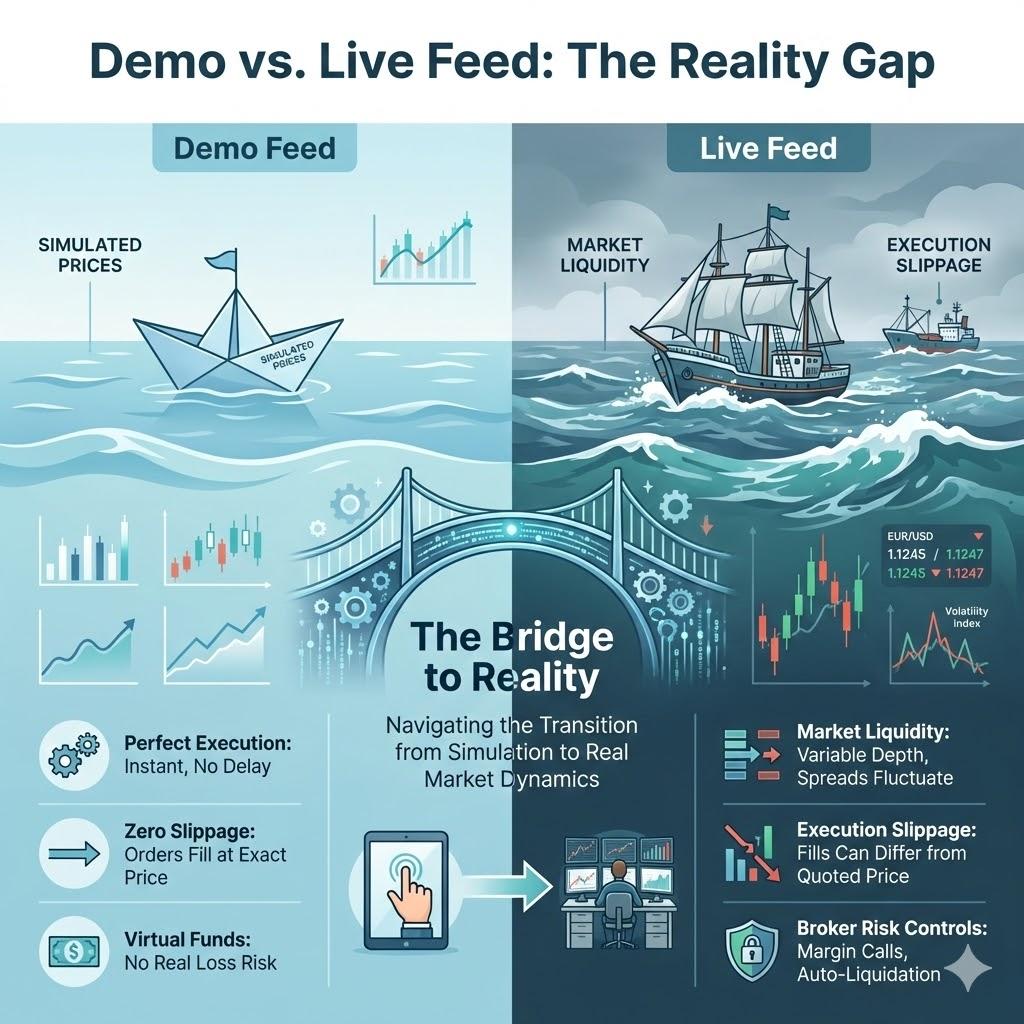
Demo Pricing vs Live: A Structural Breakdown
Demo Environment
- Price moves look smooth and steady.
- The order gets accepted the second you click.
- The gap between the buy and sell price remains the same.
- You aren’t competing with anyone else in the trade.
Live Environment
- Prices jump and skip around.
- Orders have to fight to get filled.
- The gap between buy and sell can widen in an instant
- The broker’s system are constantly watching their own risk
Knowing this difference is important when you are comparing paper money to real thing.
Why Slippage Appears Only in Live Trading
You will never find those bad price jumps in a paper money account because:
- You aren’t actually using any real orders in the market
- Your trades aren’t competing with anyone else
- The price moves are just being copied
In live trading:
- Your trades have to find a real person or firm to trade
- Big trades can actually push the price around
- Your success depend on exactly how many orders are available at the second
This makes price jumps a huge part of the difference between a demo and a real life.
Broker Risk Management and Demo Feeds
Paper money feeds usually turn off brokers’ safety features, like:
- Slowing down your trades
- Limits on how much you can buy or sell
- Automatic margin checks
On a real account, these controls are always on. This explains why some strategies seem like they have no limits on a demo, but hit a wall the second you go live.
Platform Architecture and Feed Behavior
Some app use:
- Totally separate servers for demo accounts
- Older or buffered price data
- A very simplified way of handling trade
Live platforms require:
- Perfect, real-time syncing
- Connection with all big banks and firms
- Constant safety and legal checks
This huge difference is how they are built is exactly why your results on demo aren’t the same as in the live market.
Demo vs Live Feed Difference in Broker Evaluation
Judging a broker based on paper money experience is a big mistake.
Here’s what you miss in demos:
- How much the price actually jump
- The logic behind why a trade gets rejected
- How a platform handle pressure during busy market
You have to judge a broker by how they handle real trades, not by how easy it feels on a demo account.
Indian Context: Demo vs Live Feed Difference
Indian Market Structure
- Indian Exchange have very strict rules for checking risk and margin
- They keep constant eye on every single order
Demo accounts show you the price, but they can’t perfectly mimic these high level controls. That’s why you’ll notice a big difference between your demo and your real account once you start trading.
Compliance Perspective (India)
- Being honest about the trades
- Making sure every trade is handled fairly
- Stopping any fake or get-rich-quick promises
Thinking your demo account is similar to the real one can lead to some dangerous expectations, something SEBI will really want to avoid. Knowing the difference between a demo account and real life helps you trade responsibility.
Tools to Analyze Demo vs Live Feed Difference
You can see the real difference for yourself by checking:
- The exact time each trade was filled
- The data on how much price jumped after you clicked
- How much the gap between buy and sell prices actually change
- Your actual record of how orders were filled
When you compare your paper money results with your real money records, you will see exactly where your plan starts to fall.
Common Trader Mistakes
- Thinking your paper money profit means your strategy will work in real life
- Totally ignoring the bad price jumps during your live trading sessions
- Jumping straight into big trades as soon as you do well in demos
- Assuming the price data on demo account is same as live market
- Blaming your mindset when the real problem was slow tech or bad broker
Pro traders see demo accounts as a tool for learning, not as a tool that proves that you are successful in trading.
Institutional View on Demo vs Live Feeds
The professional:
- They never rely on demo accounts
- Test their new idea using small amounts of actual cash
- Check their execution quality in the real, live market
Regular traders should also start doing the same for better understanding.
Conclusion
To wrap it up, you must know why demo accounts are different from real market trading. The demo versions are there for you to practice strategies and understand charges and cost systems for when you start trading on a real platform, but they aren’t any signal for real money trading.
And traders who understand this difference can trade smoothly on live markets and easily save their hard-earned money from losing it to careless trades. For further guidance, connect with InsightfulTrades. They have some expert traders who can help you in selecting the right platform for trading.
FAQs
1. Why does demo pricing vs live execution differ so much?
Because demo feeds are for learning purposes they don’t have real liquidity, brokers safety check or competing orders.
2. Is demo vs live feed difference relevant for Indian traders?
Definitely, India’s specific margin rules and regulations mean live trading feels very different from demos.
3. Does SEBI allow brokers to use simulated demo feeds?
Yes, they are allowed in India for educational purposes, as long as traders don’t claim that they’ve mastered the real market through it.
4. Should traders skip demo accounts entirely?
No, use a demo account to learn the platform’s layout, but use a small live test to check the efficiency of your strategy.
Author: Kumkum Chandak
Experience: 3+ Years in Trading Research & Market Content Strategy
Kumkum Chandak is a trading content strategist and market research writer who specializes in simplifying technical analysis, trading tools, and strategy-driven educational content. Her work is optimized for EEAT, accuracy, and user intent, ensuring every article delivers practical insights for traders of all levels.
Risk Disclaimer:
All content is strictly educational and not financial advice. Trading involves substantial risk. Always perform your own analysis or consult a professional advisor.
Last Updated: 23 January 2026