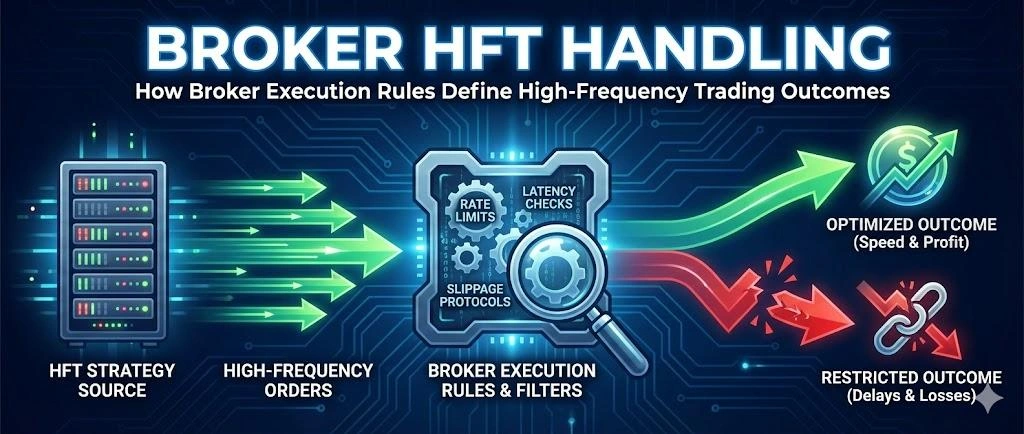
Quick Summary
How a broker manages their risk is a huge factor in your result, but it is something that people often ignore. Most traders spend all their time on creating strategies and finding the setups while completely forgetting about the brokers’ risk management, too. In the real world, a broker’s safety rules directly affect your trading results, whether your orders are accepted, how much the price jumps, or even your margin rules. Understanding how this works will help you judge a platform much more fairly, avoid surprises, and make your trading style actually work with how a broker operates.
Broker Risk Management Overview Table
| Aspect | Weak Broker Risk Management | Structured Broker Risk Management |
| Order Handling | Reactive | Rule-based |
| Execution Consistency | Variable | Predictable |
| Slippage Control | Poor | Managed |
| Margin Adjustments | Sudden | Transparent |
| Platform Stability | Degrades under stress | Maintained |
| Broker-Side Risk Impact | High and erratic | Controlled |
The Core Problem: Why Traders Misdiagnose Execution Issues
When trades behave unexpectedly, traders often assume:
- The strategy was wrong
- The market was just acting crazy
- Price swings were out of control
While these can be true, most traders totally miss the factor of broker-side risk.
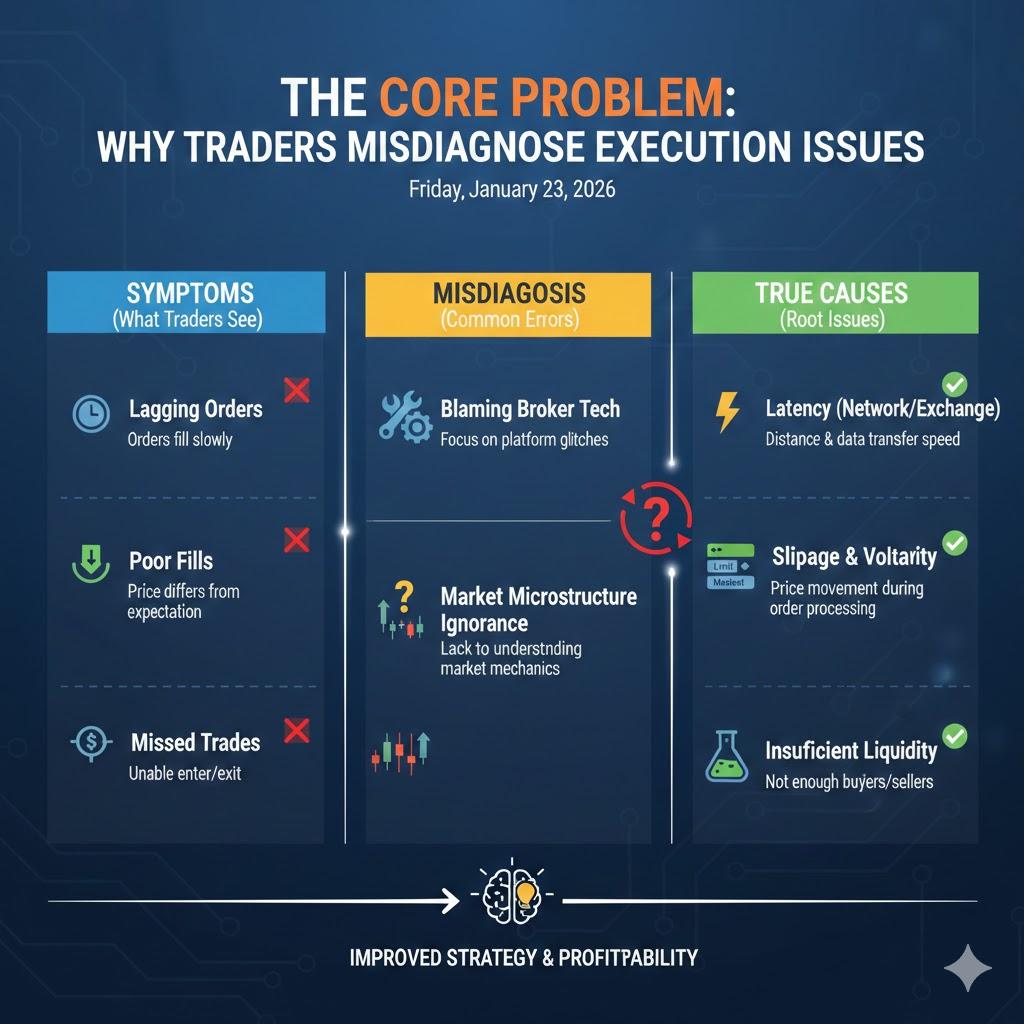
Why This Misdiagnosis Happens
A broker’s risk management happens behind the scenes. Traders rarely see:
- Their internal limits on how much they can trade
- How they scramble when order pool dries up
- The automatic filter they used to block certain moves
- The system they used to protect themselves from bad margin
Because of this, people often mistake the broker’s own safety moves for the market’s actual behavior.
What Is Broker Risk Management?
Risk management is all about how a broker protects himself. It’s the systems and rules they use to:
- Keep an eye on how much they could lose if there client’s trade go wrong
- Manage cash flow and margin risks
- Make sure they are following all the legal rules
- Keep the platform running smoothly even when the market is wild
Ultimately, these rules are there to save brokers, not you, but they definitely affect your trading every single day.
Why Broker-Side Risk Exists at All
Brokers have to worry about a few things like
- Too many people doing the same thing, like if every client tries to buy gold at once.
- Getting stuck: They need to be able to cover all the trades people are making.
- Market gaps: Sudden price changes that happened too fast to react to.
- Technical meltdowns: Their platform crashing or slowing down when everyone is trying to use it.
The broker’s risk management system is built specifically to stop these things from happening.
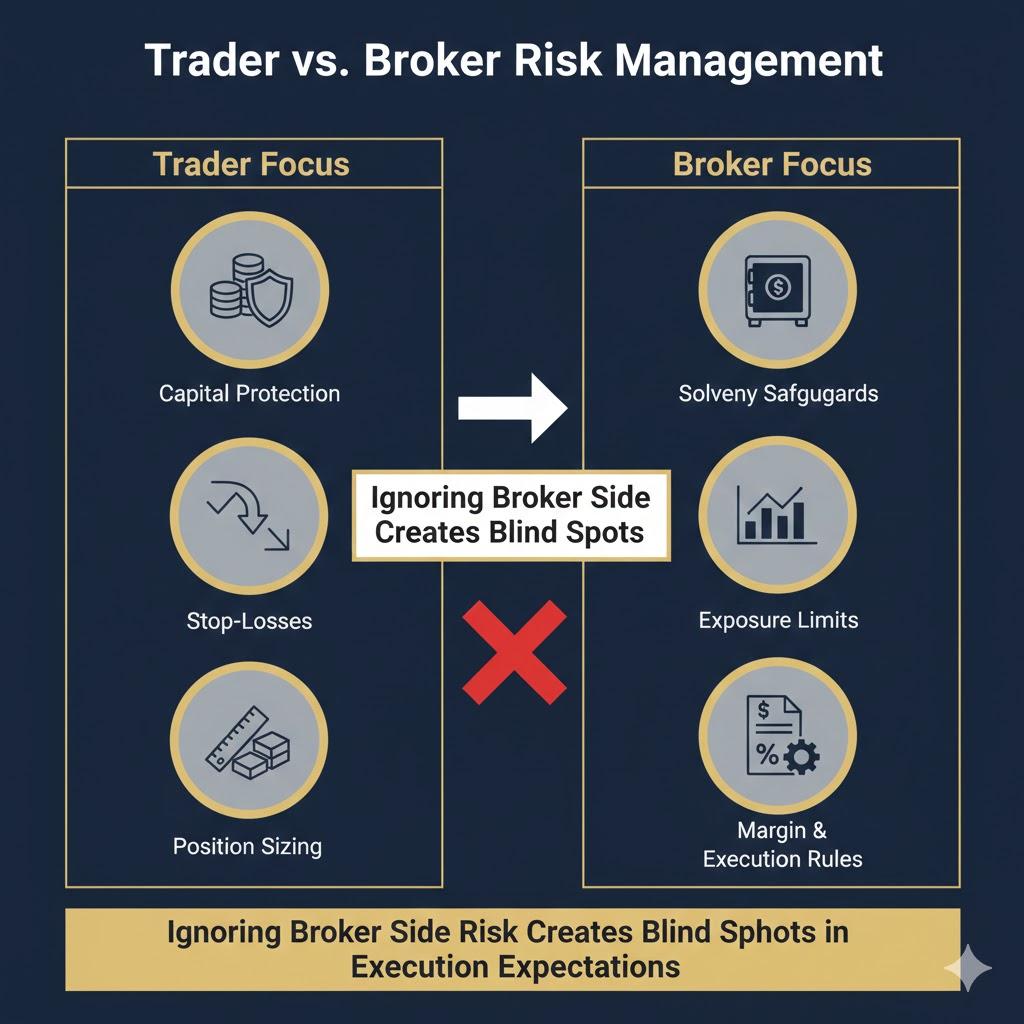
Broker Risk Management vs Trader Risk Management
These two are often confused but serve different purposes.
| Trader Risk Management | Broker Risk Management |
| Protects trading capital | Protects broker solvency |
| Position sizing | Exposure limits |
| Stop-loss placement | Margin and execution rules |
| Strategy-level | Platform-level |
Ignoring broker-side risk creates blind spots in execution expectations.
How Broker Risk Management Affects Execution
The way a broker manages their risk directly affects:
- Whether your trade is accepted or rejected
- Getting half-filled on an order
- Price jumps they allow before stopping a trade
- Annoying pop-ups of “price has changed” during volatile market
- Temporary trading restrictions
These safety controls are usually automated and happen without any warning.
Broker-Side Risk and Slippage
Getting a price different than your preferred one isn’t always due to low liquidity; it can be just your broker’s risk management system, like:
- That might slow down how fast they send your order to the market
- Changes in the price at the last second when things get crazy
- They might add a buffer to the price to protect their interest
All of this makes those bad price jumps more likely during busy times, even if there’s plenty of money in the market. Knowing how your broker manages risk explains why these sudden price jumps happen during a big event.
Hypothetical Example: High-Impact News Event
Market Conditions
- Major economic report drops
- The price spikes
- Everyone trying to buy or sell at once
Broker Risk Management Response
- They make the trade-filling rules much stricter
- The focus entirely on lowering their own risk
- They might quietly slow down the speed of orders
Trader Outcome
- Your trades get filled at much worse price then you wanted
- Stops trigger earlier than you expected
This isn’t a glitch or the platform breaking; it’s just the brokers’ way to manage risk.
Broker Risk Management and Execution Rules
A broker’s trading rules are usually just an extension of the safety policies. These rules might include:
- Maximum order size
- Order frequency limits
- Minimum distance for stops
- Restrictions on certain strategies
Every one of these rules is there to help the broker manage his risk when things get wild.
Why Broker Risk Management Differs Across Brokers
Every broker is different when it comes to the limits they face. These differences come from:
- How much capital they have in account
- Type of clients (retail vs institutional)
- Big banks and firms they are connected to
- Which country’s rules they follow
- How good their technology is
Because of all this, each broker’s risk handling varies a lot.
Broker Risk Management in the Indian Context
Indian Market Structure
- Everything is done through official exchanges.
- The SEBI keeps close watch on everything
- Systemic risk is a top priority
A broker can’t avoid risk management; it’s very essential in trading.
SEBI and Broker-Side Risk
SEBI is very clear about
- Having strong self-control
- Constant monitoring of margin
- Limit on how much exposure a broker can have
- System that protect the client
Offshore Brokers and Broker-Side Risk
For Indian traders accessing offshore platforms:
- Broker risk management may be less transparent
- Dispute resolution is limited
- Execution rules vary widely
Understanding broker-side risk becomes even more important in such environments.
Tools to Understand Broker Risk Management
Even though brokers don’t expose their internal systems, you can still figure out their risk handling style through:
- How often they change their margin requirements
- How the platform acts when market get wild
- The pattern in those bad price jumps
- Your logs of rejected orders
- Any sudden announcement they make about the platform
Watching these patterns will tell you much more than their ads.
Common Trader Mistakes
- Assuming that brokers don’t care of what you do
- Totally ignoring the actual rules for how they handle trades
- Using too much leverage due because the market is quiet
- Blaming your strategy when it was actually the broker’s safety rule that changed your result
Professional traders always take the broker’s own risk management into account when they are making plans.
Institutional Perspective on Broker Risk Management
Big firms expect their brokers to:
- Keep their system stable and running
- Follow the execution rules consistently
- Adjust their risk settings according to the market
Instead of fighting against the broker’s safety rules, they build their strategy to work with them. Regular traders would be much better off if they start doing the same thing.
Conclusion
A broker’s risk management isn’t an obstacle in your trading; it’s just the reality of how today’s market works. Their safety rule affects how your trades are filled, how your margin works, and how steady the platform is, but we only notice them when things get wild. A lot of what looks like failed trade is actually just a misunderstanding of how the broker is protecting themselves.
By analyzing how a broker manages their risk, you’ll start trading like a professional. Want to stay one step ahead of the rules? Connect with InsightfulTrade for expert guidance on broker risk and platform selection.
FAQs
1. What is broker-side risk?
It’s basically the risk the broker takes on their own back whenever they help you place a trade.
2. Is broker risk management relevant for Indian traders?
Definitely, in markets overseen by SEBI, there is a huge focus on the broker having tight risk control and keeping a close eye on margin.
3. Can broker risk management affect profitable strategies?
Yes, if your strategy doesn’t account for how brokers protect themselves, it will easily fail during volatile markets or when new rules come out.
4. Does SEBI require brokers to manage risk actively?
Yes, SEBI demands that all brokers have a strong risk system in place to keep the market honest and protect everyone involved.
Author: Kumkum Chandak
Experience: 3+ Years in Trading Research & Market Content Strategy
Kumkum Chandak is a trading content strategist and market research writer who specializes in simplifying technical analysis, trading tools, and strategy-driven educational content. Her work is optimized for EEAT, accuracy, and user intent, ensuring every article delivers practical insights for traders of all levels.
Risk Disclaimer:
All content is strictly educational and not financial advice. Trading involves substantial risk. Always perform your own analysis or consult a professional advisor.
Last Updated: 22 January 2026