

Quick Summary: Why Are Breakouts Failing in Asian Markets?
In India and Vietnam, one of the most common frustrations for you is breakouts failing in Asian markets. You cannot say it is a random problem because it is a structural reality, and markets often lack the volume and institutional participation needed to sustain strong directional moves during Asian hours.
Vietnamese markets often see low intraday follow-through due to limited institutional participation and lower foreign capital activity. Breakouts that appear strong initially tend to stall as volume fades, turning momentum trades into liquidity traps. Today, through this guide, we’ll break down why false breakouts in India occur and how you can identify them, and we’ll also talk about strategies that professionals adopt to survive.
What Does “Breakouts Failing in Asian Markets” Really Mean?
If you want to know about breakouts failing in Asian markets, it simply means the situations where:
- Immediate spike of retail participation
- Price reverses back into the prior range
- Price breaks a widely visible technical level
Many Asian markets still have:
- Lower depth beyond top price levels
- Asymmetric information flow
- High retail dominance
According to the BIS Triennial Survey, Asian trading sessions have thinner FX liquidity than London–New York hours, which explains why breakouts fail in Asian markets and false breakouts in Asia occur frequently.
Why Are Breakouts Failing in Asian Markets So often?
Across Asian markets, breakout trading is one of the most popular strategies. Traders like you are trained to believe that momentum will follow once the price breaks a key resistance or support level. To understand why breakouts fail is more important than finding breakouts themselves. These false breakouts are the result of:
- Changing market microstructure
- Evolving liquidity dynamics
- Institutional behavior
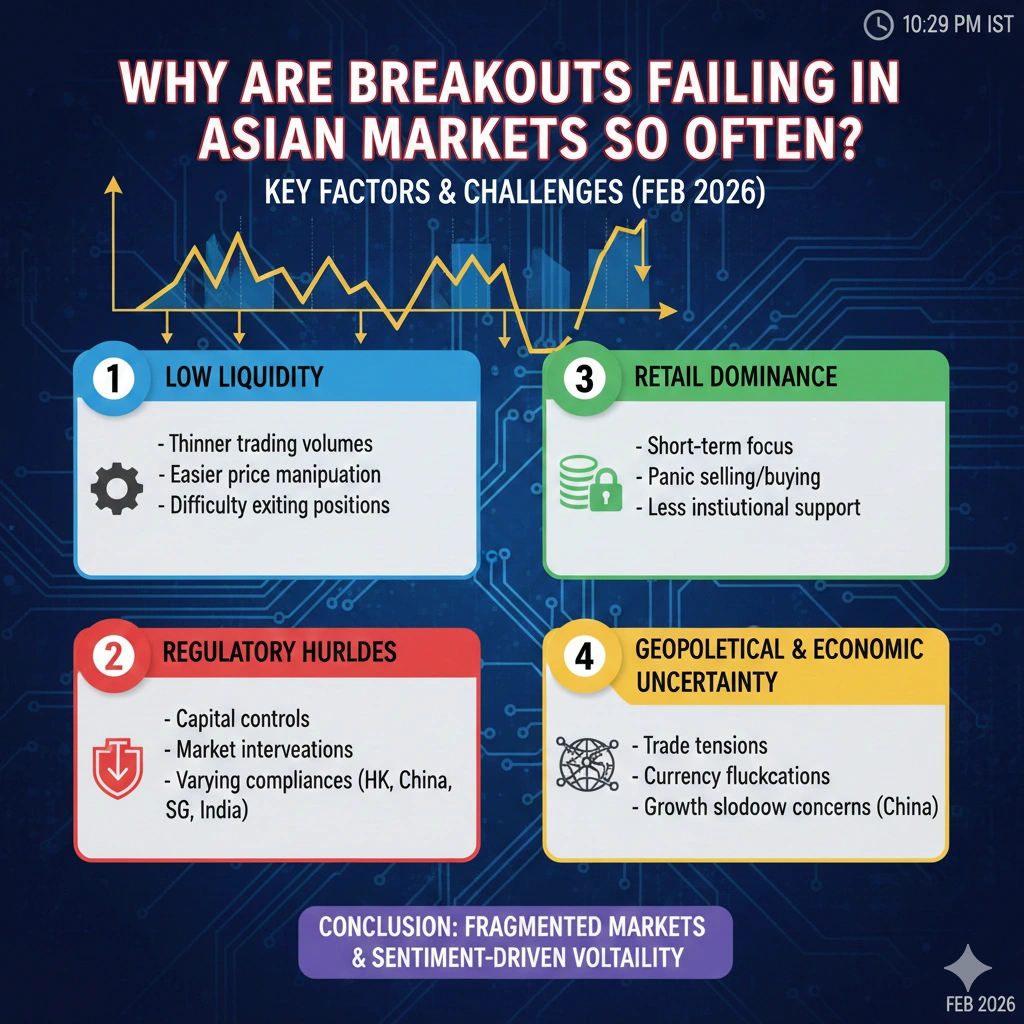
The Structural Reason Breakouts Are Failing in Asian Markets
1. Retail Crowding at Obvious Levels
When a breakout happens, most traders in Asian markets watch the same price levels and enter into a trade at the same time.
2. Liquidity Harvesting by Institutions
It is often caused by institutions pushing prices slightly beyond a key level to absorb liquidity, activate breakout buy orders, and trigger stop losses.
3. Algorithmic Trading Expansion in India
When we talk about algorithms, Indian markets are influenced heavily by them because they help in detecting thin post-breakout liquidity and clustered stop zones.
Why False Breakouts Are Common in India
India’s markets are among the most liquid in Asia, but that liquidity is unevenly distributed. This behavior is amplified in markets with high retail participation, as seen in NSE derivatives data and regional liquidity studies.
India-Specific Factors
- Heavy retail participation in intraday breakouts
- High use of leverage in futures and options
- Index-heavy algorithmic influence
In India, false breakouts in Asia frequently occur:
- During the first 30 minutes of the session
- Near option expiry days
- Around psychological round numbers
Volume: The Missing Link in Most Failed Breakouts
One of the main reasons behind why breakouts fail in Asian markets is volume. Many traders, including you, ignore it because it rises only for a short time and then quickly drops in many false breakouts in Asia, which means:
- Big players are not supporting the move
- If you observe it, it will help you to avoid false breakouts in Asia
- Price will reverse into the old range
- Weak volume leads to loss of momentum
How Traders Can Adapt to Breakouts Failing in Asian Markets
- If you wait for a rest, it filters out false moves and also improves the risk management.
- Breakouts aligned with sector or index strength perform better, so use relative strength confirmation.
- Avoid low-volume sessions such as lunch hours, pre-holiday sessions, and thin global market days.
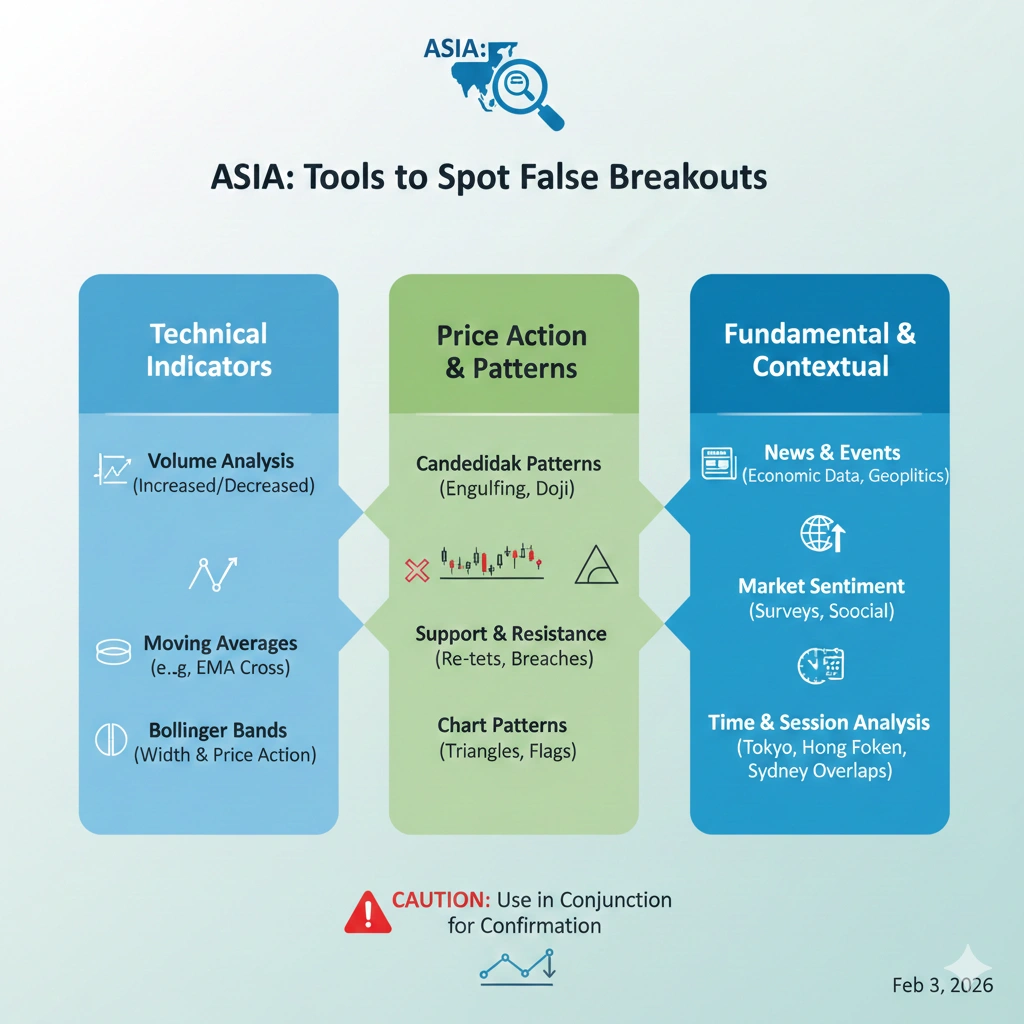
Tools That Help Identify False Breakouts in Asia
To reduce subjectivity, modern traders rely on analytics platforms.
- Volume analysis tools are a tool that confirms if real buyers or sellers support the breakout.
- A market structure tool that shows you whether the price is breaking a strong or weak level.
- To reduce noise in Asian markets, the timeframe alignment tool is perfect.
- Tools that highlight trap zones are liquidity and volatility.
You should join a platform like InsightfulTrade that can help you to visualize where the liquidity is likely to trap breakout participants.

Why Breakouts Will Keep Failing in Asian Markets
The reason is the structure of these markets has changed, and many traders like you are using the same chart patterns and the same indicators, which creates overcrowding. This makes it easy for big players to trap retail and small traders. The things that reduce the chances of sustained breakouts are:
- Changing interest rate expectations
- Global uncertainty
- Short-term trading behavior
India vs Vietnam: Why Breakouts Fail Differently
| Market | Core Reason for Breakout Failure | Typical Trap Zone |
| India | Algorithmic trading combined with heavy retail crowding | Opening range, key option strike prices |
| Vietnam | Low liquidity and weak follow-through volume | Mis-session breakouts |
Real Market Examples: How Breakouts Fail in India and Vietnam
In Asian markets, breakouts often fail because liquidity is uneven across the trading session.
- In India, many false breakouts occur during the first 30–45 minutes, when retail participation is high but institutional follow-through is limited. Around weekly and monthly option expiry, prices frequently break key levels only to reverse as option writers defend strikes.
- In Vietnam, low intraday liquidity and limited foreign institutional activity mean breakouts struggle to sustain momentum beyond initial moves. Without consistent post-break volume, these moves turn into liquidity traps rather than trends, making false breakouts a structural feature of Asian trading conditions.
“In Asian markets, breakouts without sustained volume expansion are more likely to be liquidity events than trend beginnings.”
FAQs: Breakouts Failing in Asian Markets
1. Why are breakouts failing more often in Asian markets?
The reason behind breakouts failing more often in Asian markets is algorithmic liquidity hunting, retail crowding, and weak post-breakout participation.
2. Are false breakouts in Asia more common in India or Vietnam?
Algorithmic trading and heavy retail participation create frequent breakout traps in India, while in Vietnam, it occurs due to weak follow-through and low liquidity.
3. Which tools help identify false breakouts in Asia?
Platforms such as Insightful Trade can help you to avoid these false breakouts and focus on market structure and volume.
4. Is breakout trading still profitable in Asian markets?
Yes, it can still be profitable, but only if you adapt by using volume confirmation, waiting for retests, and following higher timeframes.
5. What timeframe works best to avoid breakout failure?
Higher timeframes reduce noise and traps and work better to avoid breakout failure.
Conclusion: Trading Smarter in an Era of Failed Breakouts
The number of breakouts failing in Asian markets is increasing, which shows that if your strategies are simple and alone, then they will no longer work. You need to understand that breakouts can be false, crowded retail trades, and short-term liquidity issues.
Now, success requires
- Understanding of market structure
- Reading volume behavior
- Adapting to region-specific conditions
To achieve this success, use InsightfulTrade to avoid false breakouts in Asia, which can help you to identify the breakouts that are genuine and also help you to make more informed decisions.
Author: Arihant Jain
Trading Experience: 5+ Years
Arihant Jain is a financial markets analyst and trading educator with expertise in Forex, indices, crypto, and risk-managed trading systems. His insights are based on real trading experience, data-driven analysis, and transparent market understanding. All content is reviewed for accuracy and aligns with Google’s EEAT guidelines.
Risk Disclaimer:
Trading involves substantial risk. All information is for educational purposes only and should not be taken as financial advice. Always do your own research.
Last Updated: 03 February 2026