
Introduction
Algorithmic trading basics may be intriguing initially, but it can be one of the valid means of trading nowadays once one gets acquainted with the principles of algorithmic trading. Rather than entering trades by hand, you allow a system to follow some transparent rules and make trades automatically. It is a beginner’s guide to algorithmic trading basics that aims to offer consistency, speed, and fewer emotional errors to traders. Algo trading will make you remain disciplined in the fast-moving markets, whether you are trading Forex pairs such as EURUSD or you just want to automate a US30 strategy.
The best part? You do not require being a programmer to begin with. Even a novice can easily create, test, and operate automated trading systems using the correct tools and a simple strategy.
What is algorithmic trading?
Algorithmic trading refers to the automatic trading whereby a system or a computer program is used to trade according to predetermined rules. The strategy does not rely on manual trading but rather on logic, which is the essence of algorithmic trading fundamentals and all beginner algorithmic trading textbooks.
How it works:
- You establish exit and entry regulations.
- The system keeps track of the market.
- Trades are automatically executed.
Simple Examples:
- Purchasing EUR USD when the price crosses the moving average.
- Sale of US30 through RSI in an automated US30 strategy.
Why traders use it:
- Faster trade execution
- No emotional trading
- Consistent results
How Does Algo Trading Work?
Step-by-Step Process:
- Define Trading Rules
Establish explicit buy and sell setups, such as a moving average crossover, or computerize a US30 strategy.
- Choose a Trading Platform
Such platforms as MT4 or MT5 are easy to use and can be easily automated.
- Program the Algorithm
Your trading rules are translated to code in such a way that trades have a way to execute automatically.
- Backtest the Strategy
Test the rules on the past data to check the performance of the rules.
- Go Live with Risk Control
Test the strategy using the appropriate lot, stop-loss, and risk constraints.

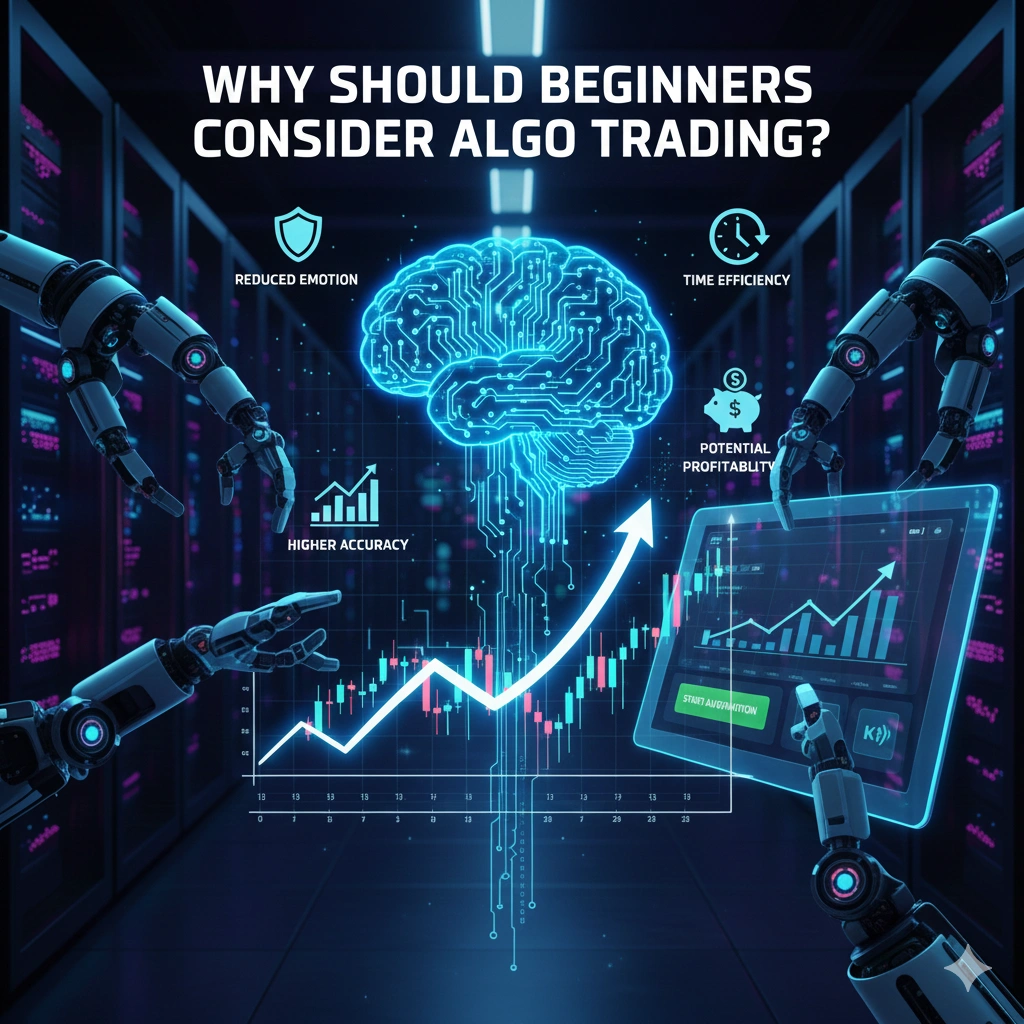
Why Should Beginners Consider Algo Trading?
The beginners will learn the algorithmic trading basics, which makes the process of trading less stressful and more disciplined. An easy-to-follow beginner’s guide to algorithmic trading basics explains why automation is reasonable.
Novices ought to have a look at algorithmic trading since it:
- Eliminates emotional decisions.
Trades are not guided by fear or greed.
- Automation of basic strategies.
Simple systems could be automated.
- Monitors multiple markets
You are even able to automate a US30 strategy with Forex pairs.
What Are the Core Types of Algorithmic Trading Strategies?
These are some of the aspects of algorithmic trading basics to understand. The first step to automate a US30 strategy would normally be a beginner’s guide to algorithmic trading.
| Strategy | What it does | Good for |
| Trend-Following | Trades with the trend | Beginners |
| Mean-Reversion | Buys low, sells high | Ranges |
| Arbitrage | Uses price gaps | Low risk |
| Market-Making | Earns from spread | Fast markets |
| AI-Based | Uses data models | Advanced |
How Can You Build Your First Algo Trading Strategy?
A major component of algorithmic trading fundamentals is the construction of a strategy. A beginner’s guide to algorithm trading basics will help you get started without any misunderstanding.
Beginner Algo Trading Guide:
- Pick One Market
Begin with EURUSD, or then automate a US30 strategy.
- Set Simple Rules
Simple indicators, such as moving averages or RSI, should be used.
- Choose a Platform
MT4 or MT5 is the easiest to use.
- Backtest the Strategy
Evaluate its performance on historic data.
- Test on Demo
Test it in real-time, and no money is lost.

What Are the Key Tools and Platforms for Algo Trading?
The second issue is selecting the appropriate tool to learn the basics of algorithmic trading. An introductory guide to algo trading would always begin on basic platforms.
- MetaTrader 4/5 – easier to automate and beginner-friendly US30 strategy.
- TradingView—Idea and visual testing: Good.
- NinjaTrader—Automated futures trading.
- Python/R—Custom and advanced algorithm systems.
How to Backtest a Trading Strategy Like EURUSD or US30?
- Download Historical Data
Break through the price data of EURUSD or US30.
- Apply Your Strategy
Simulation: Test your rules.
- Check Performance Metrics
Check on win rate, profit factor, and drawdown.
- Adjust Parameters if Needed
Maximize settings, not overfitting.
Numerical Example:
- EURUSD 1-hour chart, 50/200 crossover of SMA.
- Backtested on 2023 data
- Outcome: 120 trades, 65% win rate, largest drawdown was 5%.
What Are Pip Values and Lot Sizes in Algorithmic Trading?
In the algorithmic trading basics, it is necessary to know how to calculate pip values and the size of lots. This is always the first point in a beginner’s guide to algo trading: to manage the risk correctly, even when you are willing to automate a US30 strategy.
| Pair/Index | Standard lot | Pip value | Mini lot | Micro lot |
| EURUSD | 100,000 | $10 | 10,000 | 1,000 |
| US$30 | 1 contract | $1 | 0.1 | 0.01 |
How Do You Automate US30 Strategy?
One of the important steps in algorithmic trading basics is the automation of a strategy. An introductory guide to algorithmic trading maintains simplicity.
Step-by-Step Process:
- Established Trading Rules, e.g., RSI less than 30, then buy; RSI more than 70, then sell.
- Select a Platform: MT5 or NinjaTrader.
- Test on past historical data of the US30
- Go live with risk control—take profit and stop loss.
- Monitor—Adjust as needed.
What Are Common Mistakes Beginner Traders Make?
- The Over-Optimization—Excessive tweaking fails in the real markets.
- Loss of Attention to Costs—Costs and spreads eat up profits.
- Trading Too Many Assets—Attention is lost.
- The bad Risk Management – There was no stop-loss or correct lot size.
Hint: Begin with simple configurations, then progress to complicated configurations such as automating a US30 strategy.
How to Manage Risk in Algo Trading?
Risk management is one of the aspects of algorithmic trading. The best guide to beginning algorithmic trading basics would always highlight correct position sizing, stop-loss and take-profit, and risk of one to two percent of your capital in a trade.
The act of diversifying your instruments, such as EURUSD or when you automate your strategy of US30, is used to cushion your account against large-scale losses and yet maintain your trading the same way: disciplined.
What Are Real-World Examples of Successful Algorithmic Trading?
It is best to have real-life examples to understand the algorithmic trading basics. Rudimentary guidelines to algorithmic trading tend to point out:
Mean-Reversion Strategy of EURUSD.
- Uses SMA crossovers
- Take-profit of 30 pips
- Easy and not challenging.
US30 Momentum Strategy
- RSI-based breakout rules
- Automated on MT5
- Manages high-volume market time.
High-Frequency Arbitrage
- Takes advantage of differences in the prices between futures and ETFs.
- Needs high-tech infrastructure.
- Consistent small profits
FAQs
- Is algorithmic trading suitable for beginners?
But yes, when you begin with simple rules and demo testing. - Do I need programming skills for algo trading?
Simple knowledge of code is helpful, but it is easier on platforms such as MetaTrader 5. - Can I trade with small capital using algorithms?
Yes, particularly when it comes to Forex, or mini/micro lots such as US30. - How much does it cost to automate the US30 strategy?
It may be based on platform and data feed; MT5 is free, whereas other brokers may levy small fees. - Are algorithmic trading strategies profitable?
The quality of strategies, market conditions, and risk management is dependent on profitability.
Conclusion
The initial step to disciplined and consistent trading is mastering the basics of algorithmic trading. A good beginner guide to algo trading can help you know how to set rules, backtest strategies, and manage risk. Trading EURUSD or mastering the automate US30 strategy, automation eliminates emotional errors and increases the speed of execution.
Keep it easy and work with one strategy at a time, and you can develop over time. Through patience, the proper tools, and practice, you can become a smarter, more disciplined, and more confident modern trader through algorithmic trading. Join InsightfulTrade today to get expert guidance and learn step-by-step how to automate your strategies. Trade safer and smarter!
Author: Arihant Jain
Trading Experience: 5+ Years
Arihant Jain is a financial markets analyst and trading educator with expertise in Forex, indices, crypto, and risk-managed trading systems. His insights are based on real trading experience, data-driven analysis, and transparent market understanding. All content is reviewed for accuracy and aligns with Google’s EEAT guidelines.
Risk Disclaimer:
Trading involves substantial risk. All information is for educational purposes only and should not be taken as financial advice. Always do your own research.
Last Updated: 19 December 2025