Introduction
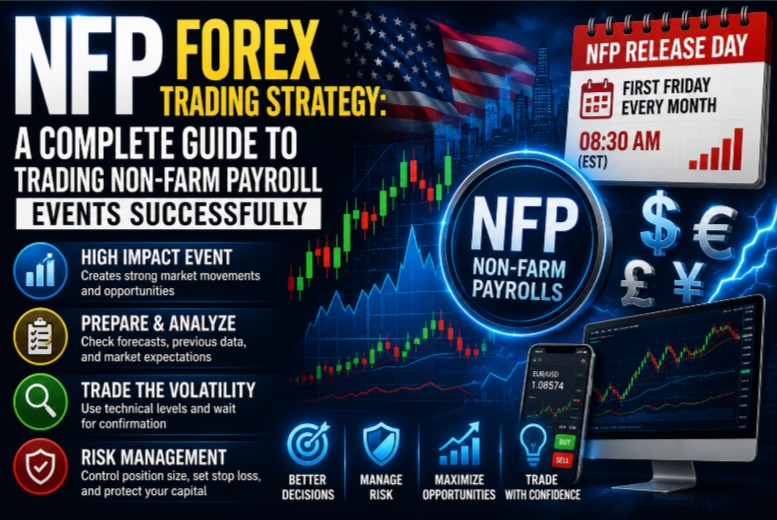
The Non-Farm Payroll report is one of the most anticipated economic releases in the financial markets. Published on the first Friday of every month by the United States Bureau of Labor Statistics, this report measures the number of jobs added or lost in the U.S. economy, excluding farm workers, private household employees, and a few other categories. Because employment growth directly reflects economic strength, the report has a significant influence on the value of the US Dollar and major currency pairs.
A well-planned NFP trading strategy helps traders prepare for these high-impact announcements instead of reacting emotionally to sudden market movements. While the opportunities surrounding employment data can be substantial, the risks are equally significant due to rapid price fluctuations, wider spreads, and increased volatility. Traders who understand how employment data affects market sentiment are often better equipped to identify quality opportunities while protecting their capital.
This guide explains how Non-Farm Payroll announcements influence forex markets, how traders prepare before the release, and how proper risk management contributes to consistent trading performance.
Understanding the Non-Farm Payroll Report
The non-farm payrolls report is considered one of the most influential indicators of the overall health of the United States economy. It provides investors with valuable information about employment growth, unemployment trends, wage increases, and labor market conditions.
When employment numbers exceed market expectations, investors often interpret the data as a sign of economic strength. Strong job creation can increase expectations of higher interest rates, encouraging demand for the US Dollar. Conversely, weaker employment figures may reduce confidence in the economy and place downward pressure on the currency.
Financial institutions, hedge funds, banks, and retail traders closely monitor these announcements because they frequently trigger significant market reactions within seconds of publication.
Why NFP Creates Significant Market Movement
Employment data affects nearly every aspect of the economy, including consumer spending, business confidence, inflation expectations, and monetary policy. Since central banks closely monitor employment conditions when making interest rate decisions, the release often influences future policy expectations.
This relationship contributes directly to USD volatility immediately after the announcement. Currency pairs involving the US Dollar frequently experience rapid price swings as institutional traders adjust their positions according to the released data.
The first few minutes following the announcement are often characterized by sharp movements, temporary reversals, and increased uncertainty. Traders who understand these conditions recognize that patience frequently produces better outcomes than rushing into positions immediately after the numbers become public.
Preparing Before the Announcement
Preparation is one of the most important elements of a successful NFP trading strategy. Rather than focusing only on the employment figures themselves, experienced traders study market expectations, previous employment reports, wage growth forecasts, and recent Federal Reserve commentary.
Reviewing the broader economic environment provides valuable context before entering the market. If investors already expect strong employment growth, the actual report may need to exceed expectations significantly to generate additional buying pressure.
Many traders also identify important technical support and resistance levels before the announcement. These levels often become key decision points once increased market activity begins following the report.
Understanding Market Expectations
Financial markets constantly price in expectations before major announcements. This means the actual employment number is only one part of the overall picture. Market reactions depend largely on whether the released figures differ from consensus forecasts.
Sometimes employment data exceeds expectations but the currency still declines because investors anticipated even stronger results. Conversely, slightly weaker numbers may still support the currency if traders had prepared for a much worse outcome.
Understanding expectations helps traders interpret price action more effectively instead of reacting solely to headline numbers.
Combining Technical Analysis with Fundamental Data
Successful news trading rarely depends exclusively on economic reports. Professional traders frequently combine technical analysis with fundamental information to improve decision-making.
Support and resistance zones, trend lines, moving averages, and momentum indicators provide additional confirmation before entering positions. These tools help traders determine whether price movements represent genuine market conviction or temporary emotional reactions.
Technical confirmation often reduces unnecessary trades while improving overall consistency during volatile market conditions.
Managing USD Volatility Effectively
One of the greatest challenges surrounding employment announcements is managing increased USD volatility. Rapid price fluctuations can produce substantial profits but also expose traders to larger losses if positions are not managed carefully.
Reducing position size before major announcements is a common practice among experienced traders. Smaller positions help control overall account risk while allowing participation in potential market opportunities.
Waiting for the initial volatility to settle before entering a trade also reduces the likelihood of becoming caught in false breakouts or temporary price spikes that frequently occur immediately after major announcements.
Risk Management During High-Impact Releases
Risk management becomes especially important during employment announcements because market conditions change rapidly. Spreads may widen, liquidity may temporarily decline, and price execution can differ from expected levels.
Professional traders determine stop-loss levels before entering positions and avoid increasing risk simply because potential profits appear attractive. Consistent capital preservation remains the primary objective regardless of market conditions.
Successful trading is built on disciplined execution rather than attempting to capture every market movement.
Common Mistakes Traders Should Avoid
Many beginners make the mistake of entering trades seconds before employment data is released. This approach exposes them to unpredictable price swings and increased execution risk.
Another common error involves assuming every strong employment report will automatically strengthen the US Dollar. In reality, market expectations often influence price movement more than the headline figures themselves.
Overtrading after large price swings also creates unnecessary losses. Emotional decisions frequently replace disciplined analysis when traders attempt to recover missed opportunities or chase fast-moving markets.
Developing patience allows traders to focus on quality opportunities rather than reacting impulsively during periods of heightened volatility.
Understanding Forex Fundamentals

Long-term success depends on understanding forex fundamentals rather than relying exclusively on short-term price movements. Employment data should always be viewed alongside inflation, interest rates, GDP growth, consumer confidence, and central bank policy.
The relationship between these economic indicators creates a more complete picture of overall market conditions. Strong employment growth accompanied by rising inflation may have a different market impact than employment growth occurring during periods of slowing inflation.
Building knowledge of forex fundamentals enables traders to evaluate economic reports within the broader context of global financial markets.
Developing a Consistent Trading Routine
Consistency comes from preparation, discipline, and continuous learning. Maintaining a trading journal helps traders review previous employment releases, evaluate successful decisions, and identify recurring mistakes.
Studying historical price reactions also improves confidence before future announcements. Every employment report contributes valuable experience that strengthens analytical skills over time.
Rather than focusing on maximizing profits from individual announcements, successful traders prioritize consistent execution across many trading opportunities.
Conclusion
Employment announcements remain among the most important economic events for currency traders worldwide. A disciplined NFP trading strategy focuses on preparation, market expectations, technical confirmation, and responsible risk management instead of emotional decision-making.
Understanding the influence of non-farm payrolls, preparing for periods of USD volatility, combining analysis with effective news trading, and strengthening knowledge of forex fundamentals all contribute to better trading decisions. While no strategy guarantees success, maintaining patience, following a structured trading plan, and protecting trading capital provide a strong foundation for navigating one of the forex market’s most influential monthly events.